


TL;DR: Basel IV reframes capital adequacy as a continuous data problem. The March 2026 US rule pulled every bank with more than $100 billion in assets into scope. The 72.5% output floor forces real-time parallel calculation of two risk models on the same exposures. Banks that treat this as a compliance project will stall at the integration layer. That layer sits between legacy trade systems and modern streaming infrastructure. Banks that treat it as a data engineering project will own a capital intelligence platform. That platform compounds value across every other regulatory regime they face.
Key Takeaways: - The March 2026 US rule brought all banks with more than $100 billion in assets under the same framework. It caught regional institutions alongside the Wall Street giants. - The 72.5% output floor means internal-model RWAs cannot fall below 72.5% of the standardized calculation. This turns capital reporting into a continuous dual-engine problem. - The integration layer sits between legacy trade capture systems and the modern risk engine. This is where every Basel IV project actually stalls. Timelines consistently blow past the initial scope. - A streaming-first four-layer architecture (capture, transform, store, report) compresses regulatory reporting cycles from weeks to hours. It feeds every other capital regime at near-zero marginal cost. - Getting this right turns the CTO from owning a compliance cost center. Instead, the CTO owns a competitive capital intelligence platform.
The $100 Billion Threshold Reshapes Who Counts as a Data Shop
Most banks are treating Basel IV as a regulatory compliance project. By 2027, the ones still in business will realize it was a data infrastructure crisis. It was wearing a compliance label.
In March 2026, US regulators released a landmark proposal. It pulled every bank with more than $100 billion in assets into the same framework.
That number pulled regional banks into scope for the first time. They now sit alongside JPMorgan and Goldman Sachs. Those institutions have spent years building risk infrastructure for this moment.
The Silicon Valley Bank collapse added political urgency. Timelines are no longer negotiable around legacy system constraints. A regional bank CIO in 2025 had a Basel IV problem, but it was theoretical.
That same CIO in 2026 has a Basel IV problem with a hard deadline. They have a board that has read about SVB. They also have a budget set in 2024 when "Basel IV" still felt optional.
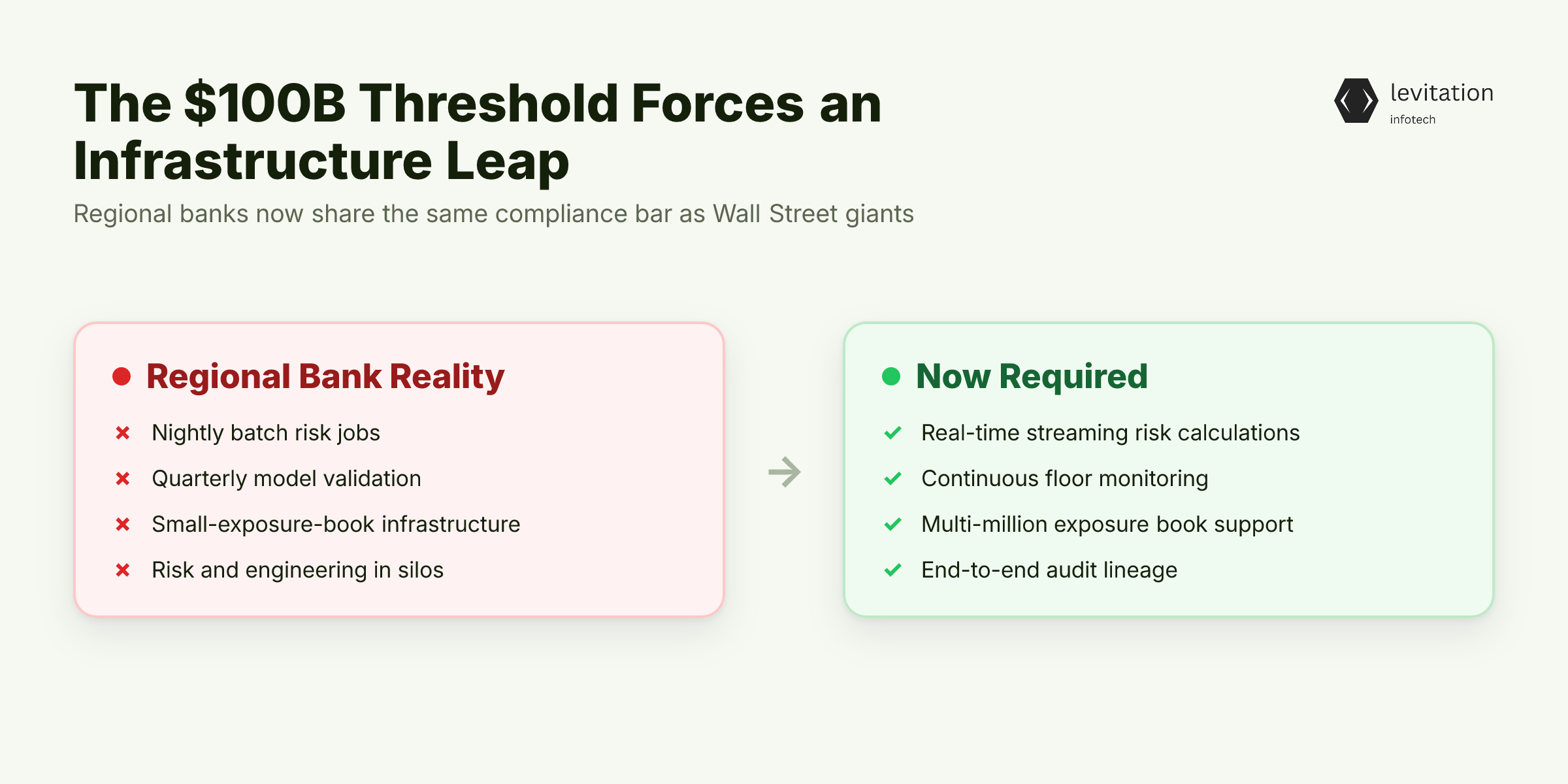
The new entrants face a specific architectural mismatch. They need to produce the same RWA standardization as the Wall Street giants. But their data infrastructure was built for a fraction of that complexity.
A regional bank running a smaller exposure book has historically operated with nightly batch jobs. They also use quarterly model validation. A global bank managing vastly larger exposure populations has been running streaming risk calculations for years.
The threshold just made those two groups neighbors. They share the same compliance expectations. However, they have very different foundations.
Consider what this means for the CTO. They now own a Basel IV problem without owning a Basel IV budget or team. The risk function has always spoken a different language than engineering.
Now the risk function needs engineering to deliver real-time risk numbers. They also need continuous floor monitoring and end-to-end audit lineage. The technology stack that supports a small exposure book is one thing. A multi-million-exposure book needs a different stack. The latter must run under continuous dual-model comparison.
The institutions that recognize this early are already investing in real-time data pipeline infrastructure. They do it not because regulators asked. They do it because the math no longer works on yesterday's data. The rest are about to learn that lesson the expensive way.
But the threshold is just the entry fee. The real shock comes from what the rule does. It changes the numbers your internal models have been producing for a decade.
The 72.5% Output Floor Makes Your Internal Model a Liability
Basel IV does not eliminate internal models. It reins them in.
The output floor sets a hard minimum. A bank's total risk-weighted assets under internal models cannot fall below 72.5% of the standardized amount.
This is a fixed formula defined by regulators, not a model. It does not care about your data quality, your model sophistication, or your risk committee's best arguments.
In practice, every bank must now run two parallel risk calculations on the same exposure. They must compare them in real time. They must also prove the modeled number meets the floor.
Every trade, every credit migration, and every market move potentially affects which approach produces the higher number.
The binding constraint can flip intra-day. Banks whose internal models have produced capital numbers below the standardized approach will see this. Required capital will jump overnight. They will have no model change to explain it.
The floor is not a punishment for bad modeling. It is a cap on the benefit of good modeling. That distinction matters. It changes the conversation with the CFO. The talk moves from "we need a better model" to "we need a different architecture."
The fix is to build event-driven data infrastructure that handles both calculations as a single pipeline. It should not run as two parallel pipelines on different schedules. The build often looks like streaming ETL feeding a single canonical risk store. Both calculations happen against the same exposure record at the same timestamp.
One concession from regulators shows how seriously they take data quality concerns. In specific contexts, regulators have eased penalties. They eased penalties when institutions made concrete, documented cases. Those cases showed the original calibration rested on assumed data quality. That assumed quality did not match reality. The lesson: regulators adjust when the data argument is real, not when it is rhetorical.
Running one risk calculation is a finance problem. Running two, comparing them continuously, and feeding the result into capital adequacy reporting is a data engineering problem. Most banks have not built for it. The real damage shows up in reporting cadence. Quarterly processes are now asked to answer questions. Regulators expect those questions answered in real time.
Why Quarterly Risk Reporting Is Now Architecturally Obsolete
The output floor requires continuous comparison between modeled RWAs and standardized RWAs. This means every position change, every credit migration, and every market move potentially affects the binding constraint.
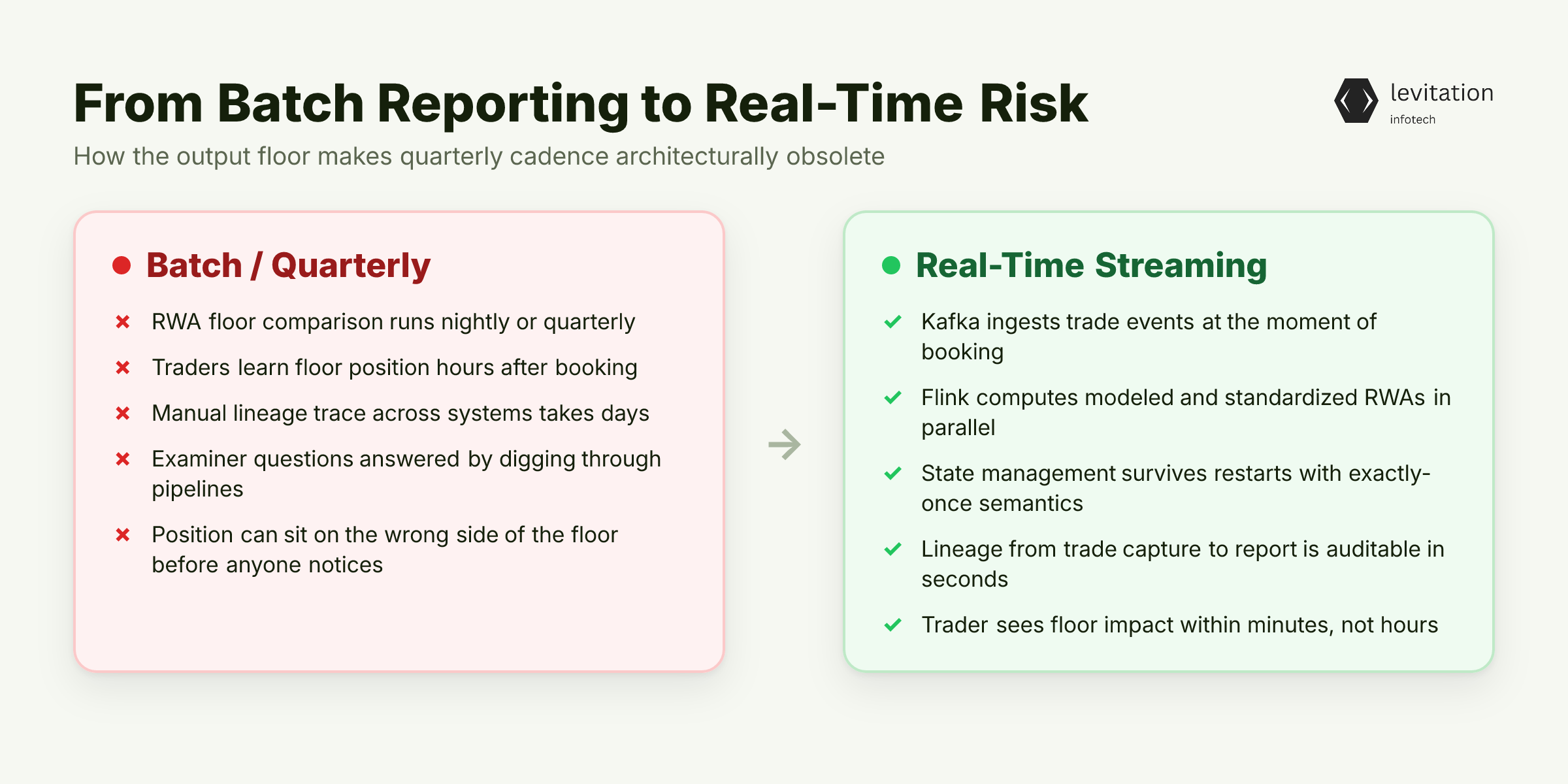
A bank that runs its floor comparison once a quarter is running an unreliable comparison. It is unreliable in the regulator's eyes. Banks still running nightly batch jobs to feed their risk engines cannot answer a basic question. They cannot answer: "Are we above the floor right now, on this trade?"
The trader who books a position mid-morning should know within minutes. They should know whether that trade pushes the modeled number toward the floor. Under batch architecture, they find out many hours later. By then the position is on the book and possibly the wrong side of the constraint.
That delay is the structural problem.
Counterparty credit risk calculations need recomputation against both approaches. The data lineage between systems must be auditable end-to-end. Those systems are the trade capture system, the risk engine, and the regulatory reporting layer. An examiner asking "where did this exposure number come from" expects an answer in seconds. They do not expect a manual trace through a batch pipeline that takes days.
The architecture that actually solves this uses Apache Flink stream processing. It uses Flink to compute both RWA numbers in parallel, keyed by exposure ID. It includes state management that survives restarts. It also includes exactly-once semantics. Those semantics prevent double-counting during reconciliation.
The source of truth is a Kafka-based real-time pipeline. That pipeline ingests trade events the moment they are booked, not the night after. This is not a technology preference. It is a regulatory requirement that happens to be technically specific.
Many institutions learned this the hard way. They watched event-driven banking initiatives win the demo and lose the production battle without the right foundation underneath.
Quarterly reporting is no longer a cadence regulators accept. Neither is nightly. The architecture that supports it must be streaming-first, not streaming-as-an-afterthought.
Knowing what you need is one thing. Building the pipeline that delivers it without a multi-year integration project is another. The architecture that actually works looks different from what most banks have sketched on whiteboards.
The Four-Layer Data Architecture Basel IV Actually Demands
The clean way to think about Basel IV data architecture is four layers. Each has a specific job and a specific technology category that does that job well.
Layer 1: Capture. Trade events, credit events, and market data flow through a streaming substrate. The floor calculation needs fresh inputs within seconds, not hours. Kafka is the dominant choice. It gives you replay, partitioning by exposure, and durability without a database in the hot path.
Layer 2: Transform. A stream processing engine like Flink or Spark Structured Streaming computes standardized and modeled RWA. It runs both calculations in parallel, keyed by exposure ID. The two calculations must be deterministic against the same input snapshot. Exactly-once semantics prevent the double-counting errors examiners will flag. The output is a single canonical risk record per exposure per timestamp.
Layer 3: Store. A dual-purpose data lake and warehouse holds both raw position data and pre-computed floor comparisons. The lake handles raw history for lineage and model retraining. The warehouse handles the queryable, current state for regulatory reporting and ad-hoc capital optimization queries. The hidden TCO of real-time pipelines lives mostly in this layer. It lives there when partitioning and retention are scoped wrong.
Layer 4: Report. An orchestration layer runs the full Pillar 3 disclosure generation. It also runs capital adequacy reporting and internal model validation on the same canonical dataset. This eliminates the spreadsheet handoffs that auditors flag every cycle. Airflow is the common choice. It handles dependencies, retries, and scheduling for the kind of multi-stage reports Basel IV demands.
The specifics of data lake and warehouse design for this workload matter more than vendor selection. The wrong partitioning strategy turns a fast report into a slow one.
The right Airflow orchestration for regulated pipelines turns a multi-week reporting cycle into a multi-hour one. The architecture diagram is clean.
The reality is the integration between your trade booking systems and the risk engine.
About the author
Mayank Singh is a software developer at Levitation Infotech, where he builds web and AI-powered applications across the company’s fintech, healthcare, and enterprise projects.