


TL;DR: A genuine SaaS MVP in India costs ₹3L-₹8L, and a mid-scale product runs ₹8L-₹25L. But most quotes hide a 1.4-1.6x TCO multiplier through GST, hosting, and maintenance that founders never budget for. The ₹18L quote isn't "comprehensive." It's padded with phases you don't need, and the ₹3L quote is incomplete because it omits what you'll actually pay. Here's how to audit any quote in 10 minutes and force vendors to show their work.
Key Takeaways: - SaaS quotes in India vary 6x for identical specs because vendors hide costs in different places, not because the work itself differs - Total cost of ownership lands at 1.4-1.6x the quoted build number once GST, hosting, and 12 months of maintenance are added - A 10-minute audit (phase breakdown, role rates, project management percentage, pass-through licenses) surfaces padding - An outsourced SaaS team can deploy faster than an in-house build, and speed is where the real savings live
The Same Product, Six Different Prices: Why Noida Quotes Vary So Wildly
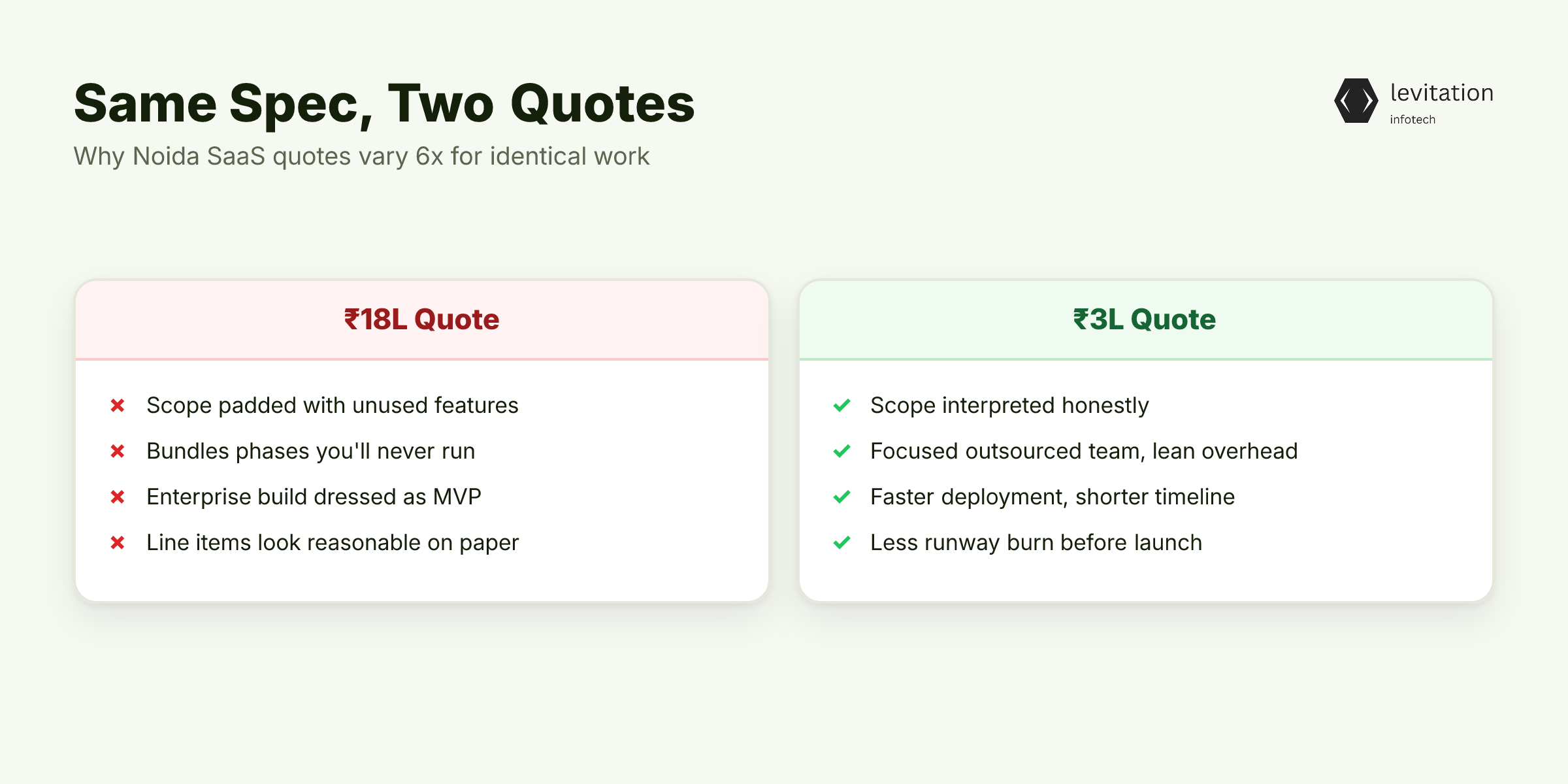
Two vendors. Same SaaS spec. One quotes ₹3 lakh, the other ₹18 lakh. Both insist the higher one is "comprehensive." Both can't be right, and in most cases, neither is.
SaaS development cost in India ranges from ₹3,00,000 to ₹3,00,00,000+ for functionally identical MVPs. The spread is real, not a typo. The variance comes from three places: scope interpretation, vendor overhead model, and what's deliberately left out of the quote.
A vendor quoting ₹18L for a spec another quotes at ₹3L isn't offering more value. They're padding line items, bundling phases you'll never need, or quoting a custom enterprise build disguised as an MVP. The dangerous part isn't the inflated number itself. It's the line items hiding inside it that look reasonable on paper.
Speed is where the real advantage sits. A focused outsourced team can deploy faster than a typical in-house build. Same product. Same spec. But the timeline compression reduces runway burn before launch.
When three vendors quote wildly different numbers for SaaS product development, the answer isn't to pick the cheapest. You need to find out what each quote contains, and what it leaves out.
The padding lives in the line items, not the headline number.
The Line Items Your Quote Is Hiding From You
GST at 18% is applied to every invoice. A ₹10L project quietly becomes ₹11.8L before any work starts, and most first-time founders forget to budget for it. Payment gateway fees of 2% plus GST per transaction bleed ₹23,600/month on ₹10L of monthly revenue. Vendors rarely flag this in a build quote.
Cloud hosting scales from ₹3,000/month at MVP stage to ₹5,00,000+/month at scale. Your quote probably shows only the launch number. Compliance (SOC 2, GDPR, HIPAA) adds ₹50,000 to ₹8,00,000 depending on requirements, and is almost never called out separately in initial proposals.
Custom software development cost in India varies so widely because vendors treat these "incidentals" as either padding material or omissions, depending on which makes their number look better. The real cost to build software doesn't live in a single line item. It lives in the sum of every line item the vendor chose to show you, and every line item they didn't.
Maintenance runs as a recurring annual cost that few quotes call out separately. Even fewer founders budget for it, and the gap between quoted and actual spend is where most SaaS projects quietly double in scope.
Once you map the hidden line items, the bigger question becomes: what should a legitimate quote actually contain at each price tier?
What a Genuine ₹3 Lakh, ₹10 Lakh, and ₹25 Lakh SaaS Quote Actually Includes
A genuine ₹3L-₹8L quote buys you a single-tenant MVP with auth, one core workflow, and a basic dashboard. Anything beyond that means you're not in MVP territory. The custom software cost at this tier reflects narrow scope, not corner-cutting.
A ₹8L-₹25L quote should include multi-tenant architecture, role-based access, third-party integrations, and a design system. This is the mid-scale tier where most B2B SaaS products live. If your software development cost India quote at this level doesn't mention these four elements, you're looking at trouble. Either you're talking to the wrong vendor, or this is a padded MVP quote.
Anything quoted above ₹25L needs to explicitly name advanced security, compliance certifications, AI/ML features, or complex data pipelines. Otherwise you're paying enterprise rates for mid-scale work. The engineering quality that keeps systems still running in production years after deployment doesn't come from inflated rates. It comes from disciplined architecture and realistic scoping.
If a vendor refuses to map line items to these tiers, you're negotiating blind. Ask them: which tier is this build, and which features pushed it up?
The tier itself isn't the trap. The trap is what happens to your quoted number the moment the project goes live.
The 1.4-1.6x Multiplier That Quietly Doubles Your SaaS Budget
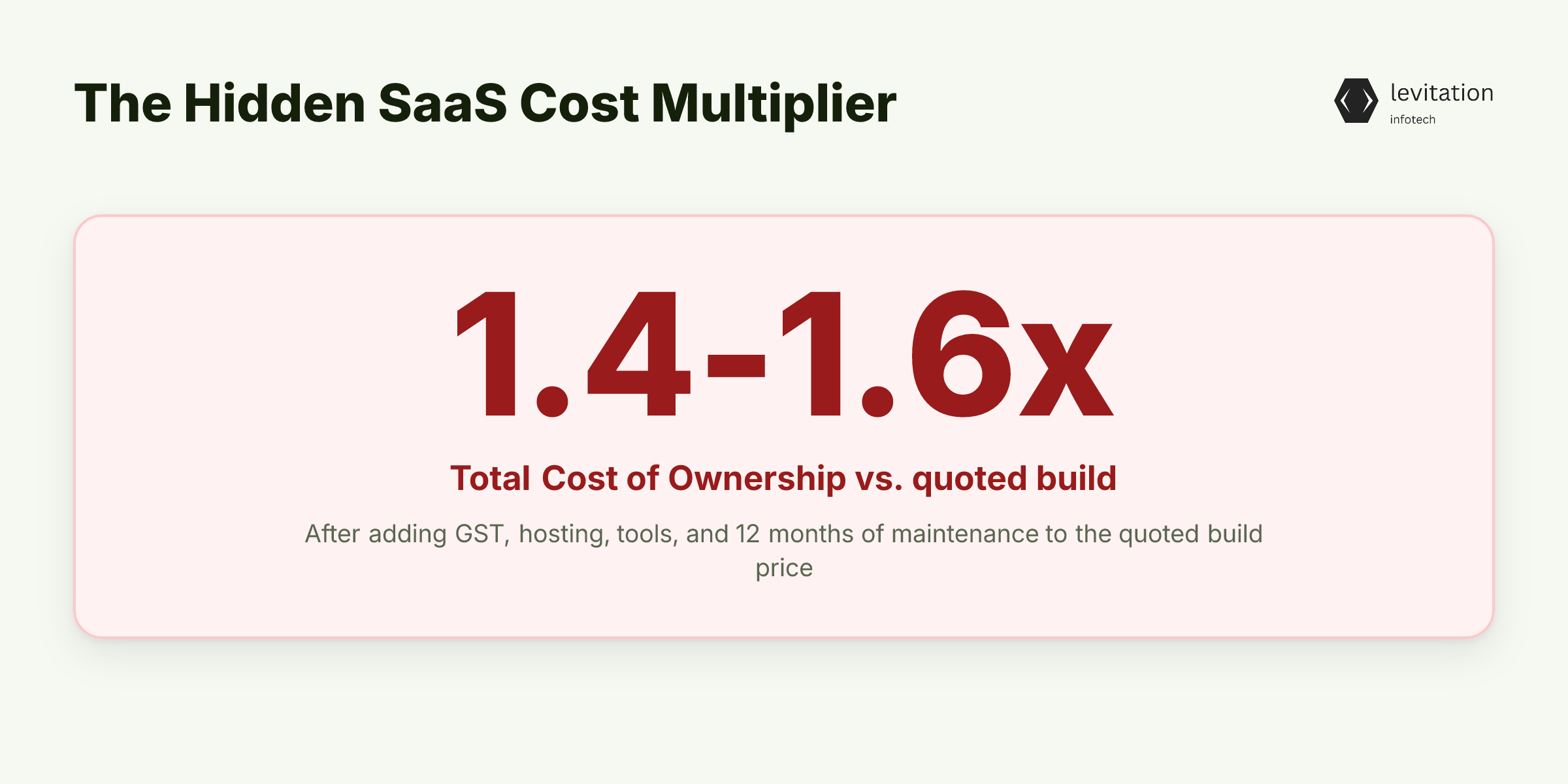
Total cost of ownership for any SaaS build in India lands at 1.4-1.6x the quoted number. That's after you add GST, hosting, tools, and 12 months of maintenance. This isn't vendor padding. It's the math of running real software.
Maintenance is a recurring cost baked into the TCO multiplier. Founders who budget only the quoted number underestimate their runway needs, right when they need money for paid acquisition.
The custom software development shop that quotes you ₹10L isn't necessarily wrong. They're quoting the build. You're paying for the build, the compliance, the hosting, the monitoring, and the first year of patching. That's the bespoke software reality most founders learn about six months in.
The same pattern plays out across adjacent build types. We've tracked how CRM projects hit 2x budget for almost identical reasons.
The fix: ask every vendor to quote a 12-month TCO line-by-line, not just the build figure. If they can't, they don't know what they're selling you.
Knowing the real number is half the battle. The other half is forcing the vendor to show their work in the quote itself.
A 10-Minute Quote Audit That Surfaces the Padding
Ask for a phase-wise breakdown: Discovery, Design, Backend, Frontend, QA, Deployment. If any single phase consumes a disproportionate share of the total without explanation, it's likely padded. A SaaS development company that won't show you this breakdown is hiding the markup.
Request the hourly rate per role and the estimated hours per phase. A ₹18L quote with no role-level breakdown is a red flag.
Legitimate shops will provide it on request. We've reviewed enough Noida quotes to know that the padding only survives in summaries the moment you push for line items.
Check if "project management" or "communication overhead" is inflated relative to the build cost. An inflated PM line is often a tax on your own indecision, not genuine value.
Verify whether third-party licenses (payment gateway, email service, monitoring tools) are pass-through costs or marked up. Vendors commonly mark up these pass-through costs. Ask for the actual subscription cost, not the vendor's line item.
A build a SaaS engagement that survives this audit in 10 minutes is probably honest. One that doesn't is probably not.
If the vendor's timeline contradicts their team size, the quote is fiction.
A clean quote tells you what you'll build and when. The timeline attached to that quote tells you who you're really hiring.
What an Honest Timeline Looks Like, and What Yours Is Telling You
A genuine SaaS MVP lands in months with a focused team. That's the baseline, not a stretch goal. Any application development engagement that drags on is either overstaffed or scope-padded.
A long timeline is typical of an in-house team still ramping up. Any outsourced vendor matching an in-house timeline is either overstaffing or padding scope to justify headcount. The same product SaaS MVP can deploy in months if the team is right, and a stretched schedule usually signals something the quote isn't telling you.
If the vendor's timeline doesn't map to the phase-wise breakdown from your audit, one of the two numbers is fiction. Ask for a milestone-based payment schedule tied to phase delivery. This single clause eliminates most timeline padding and forces the vendor to commit to delivery, not just promises.
Audit the quote, stress-test the timeline, map the TCO, and the gap between vendors stops looking like price difference and starts looking like transparency.
What Changes When You Stop Accepting the First Number
Founders who run a quote audit usually reduce their build cost without changing scope. Not by negotiating harder, but by removing fabricated line items and forcing transparency on the rest.
A TCO-aware budget means you fund post-launch operations instead of scrambling for a bridge round early. The right vendor signals themselves: transparent breakdowns, milestone payments, realistic timelines.
Those vendors tend to ship multi-tenant SaaS systems and microservices architectures that hold up long after launch. The software development price you pay should match the engineering quality you receive. The audit is the only way to know if it does.
This is the standard production-grade teams ship to, where engineering longevity matters more than the headline quote. It's what separates a real partnership from a padded invoice.
Stop accepting the first number. The quote is a conversation, not a verdict.
Frequently Asked Questions
Q: How much does it actually cost to build a SaaS product in India in 2026?
A: A genuine SaaS MVP in India costs ₹3L-₹8L, a mid-scale product with multi-tenancy and integrations runs ₹8L-₹25L, and enterprise-grade SaaS with compliance and AI features starts at ₹25L and can cross ₹1Cr. Total cost of ownership lands at 1.4-1.6x the quoted build cost once GST, hosting, and 12 months of maintenance are added.
Q: Why do SaaS development quotes in Noida vary so much for the same product?
A: The spread comes from three places: different scope interpretation, vendor overhead structure, and line items deliberately left out. A vendor quoting ₹18L for a spec another quotes at ₹3L is padding phases, bundling features you didn't ask for, or quoting an enterprise build disguised as an MVP.
Q: Is outsourcing SaaS development to India actually cheaper than hiring in-house?
A: Yes, but the bigger savings show up in time-to-market, not just line-item cost. You avoid the recruiter and HR overhead of building an internal team, and you stop burning runway before you ship. Hourly rates run lower, and a focused outsourced team typically deploys faster than an in-house build still ramping up.
Q: What hidden costs do SaaS development quotes in India usually miss?
A: The most commonly overlooked items are GST at 18% on every invoice, payment gateway fees of 2% + GST per transaction, cloud hosting that scales from ₹3,000 to ₹5,00,000+ per month, compliance costs between ₹50K and ₹8L, and recurring annual maintenance. Together these inflate the quoted number by 1.4-1.6x.
Q: How do I verify if a SaaS development quote is fair?
A: Ask for a phase-wise breakdown, the hourly rate per role, and estimated hours per phase. If "project management" is inflated relative to the build cost, or any single phase consumes a disproportionate share of the total without justification, the quote is padded. Also request a 12-month TCO line-by-line, not just the build figure.
About the author
Mayank Singh is a software developer at Levitation Infotech, where he builds web and AI-powered applications across the company’s fintech, healthcare, and enterprise projects.