


TL;DR: A fixed-bid quote from a Noida vendor feels safe because it shows one number, but that safety is the trap. Without an hourly rate, you have no baseline to challenge scope changes. So invoices quietly double by month six. Rate transparency, written into the contract before work starts, is the only mechanism that keeps the number honest.
Key Takeaways: - A fixed bid without a rate card removes the floor you need to push back on change orders - The same Noida vendor will quote meaningfully lower on time-and-materials for the identical scope - Four contract clauses: rate card, change-order SLA, weekly burn dashboard, capped PM margin, stop the drift before it begins
A fixed-bid quote from a Noida software vendor looks safe because it shows one number. But that number isn't the rate. It's the total.
Without an hourly rate in the contract, you have no floor to push back against when scope changes. The vendor doesn't raise the rate. They raise the scope. And because the contract never named an hourly number, the founder has no baseline to challenge the new line items against.
Why Fixed-Bid Quotes Quietly Double
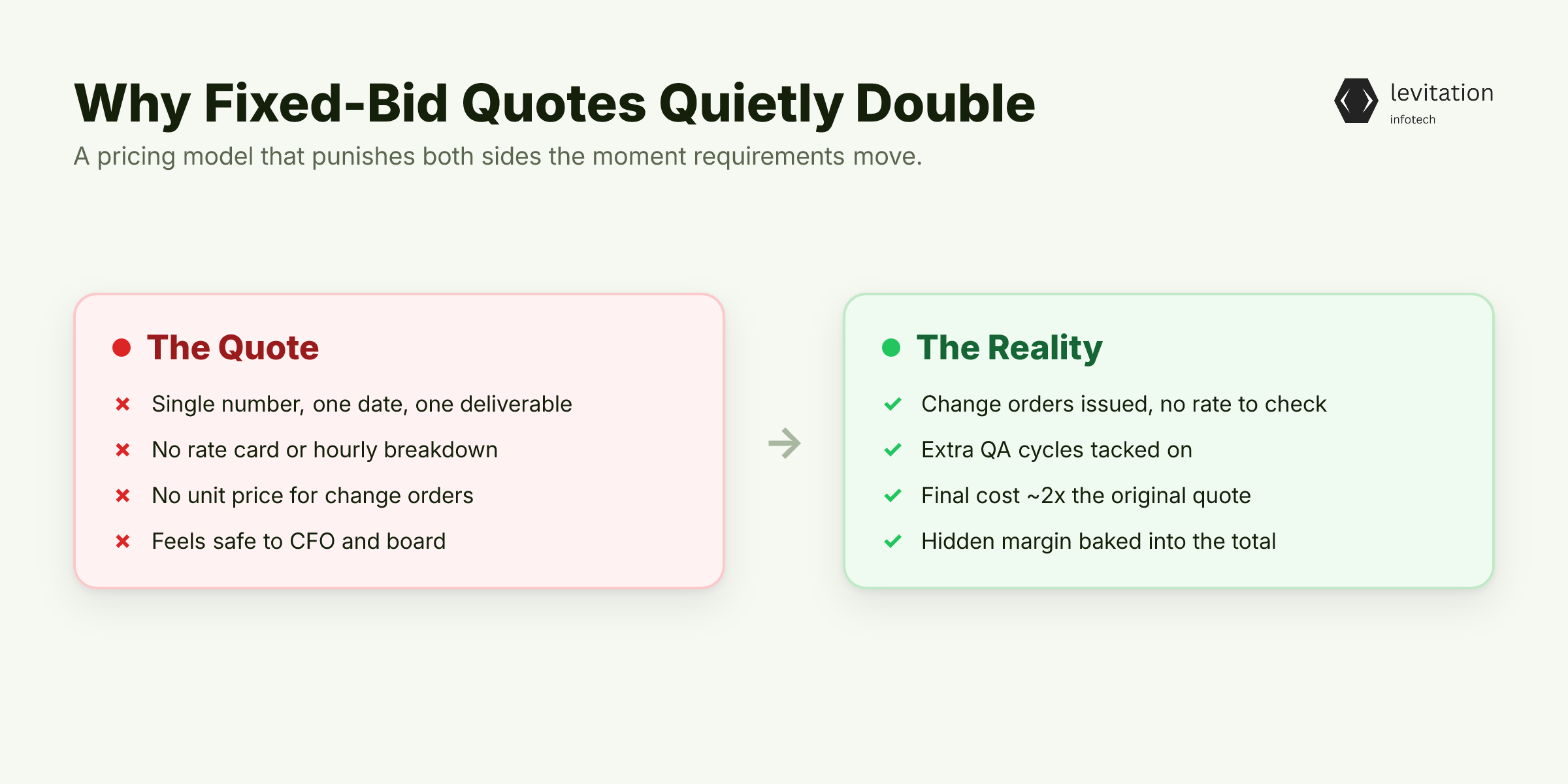
The pattern is familiar enough that any founder who has worked with a Noida vendor has seen some version of it. Three vendors pitch. Two are tossed out for being vague. The third wins on clarity: one number, one date, one deliverable.
The CFO signs off quickly. The board likes the certainty. That certainty is the problem.
The winning quote has no rate card. No role-wise hourly breakdown. No unit price for change orders. It has a single line covering the full scope. The founder thinks clarity means a single number.
The vendor knows clarity means the absence of one. The actual rate that produced that total, the developer cost, the vendor margin, the PM overhead, the QA buffer, never shows up in the document.
When later sprints surface missing requirements the founder forgot to mention, the vendor doesn't negotiate. They issue a change order. The founder has no rate to multiply hours against, so the number is just... accepted. After a couple of change orders and an "extended QA cycle," the project has roughly doubled from the original quote.
None of that is greed. It is the pricing model doing exactly what it was designed to do. This is the software development cost in India gap nobody warns founders about. The headline quote is below market, the per-hour reality is above market, and the contract sits silent on the difference.
If the quote felt safe, why did it double? The answer isn't greed. It's a pricing model that punishes both sides the moment requirements move.
Why Fixed-Bid Pricing From Noida Inverts by Month 3
The vendor isn't evil. They're doing math.
A fixed bid has to absorb unknowns the client refuses to specify. So the vendor adds a margin buffer on top of estimated cost, then layers a change-order fee schedule on top of that.
Management overhead, knowledge transfer, and quality rework all inflate agile budgets well beyond base estimates. The fixed bid has to assume the worst-case combination of those will hit.
Wage pressure makes it worse. Factory workers across Noida have staged repeated protests over monthly salaries of ₹11,000-13,500, with demands for overtime pay and weekly rest days. Engineering talent in the same city faces its own version of that squeeze.
Vendors hedge harder because their own cost base is moving. The only way to hedge in a fixed-bid contract is to bake in more buffer.
Here's the part founders miss. The same vendors on the top software development companies in Noida shortlists will often quote meaningfully lower on time-and-materials for the same scope. The fixed bid isn't expensive because the work is expensive. It's expensive because the vendor is pricing in your future changes at penalty rates.
The buffer isn't evil. It's rational. But the founder can't see it, can't negotiate it, and can't shrink it. That opacity is the real problem.
The Noida Iceberg: Seven Cost Layers Your Quote Hides
The headline number is the tip. Below the waterline sits the mass.
Every custom software development engagement carries seven hidden cost layers that almost never appear in a fixed-bid quote: - Onboarding: environment setup, repo access, credential rotation, baseline integration - PM overhead: standups, status reports, sprint planning, the project manager the quote never names - QA rework: bugs caught late, retest cycles, environment drift between dev and staging - Environment setup: CI pipelines, staging mirrors, secrets management, observability wiring - Communication tax: timezone overlap, async thread cleanup, escalation chains - Knowledge transfer: the first month where the team learns your domain - Post-launch stabilisation: hotfixes, incident response, the "first 30 days in production" tax
The gap between the direct developer cost and the loaded bill rate, once vendor margin, PM overhead, and QA buffers are added, is the iceberg. That delta is where the fixed bid hides its true cost, and it explains why the headline number never matches the final invoice.
AI tooling can trim labour costs, but in a fixed-bid contract the credit flows to vendor margin, not the client's invoice. Once you can see the iceberg, you can name it in a contract. That's where the pricing model matters more than the price itself.
Three Pricing Models, One Transparent Answer
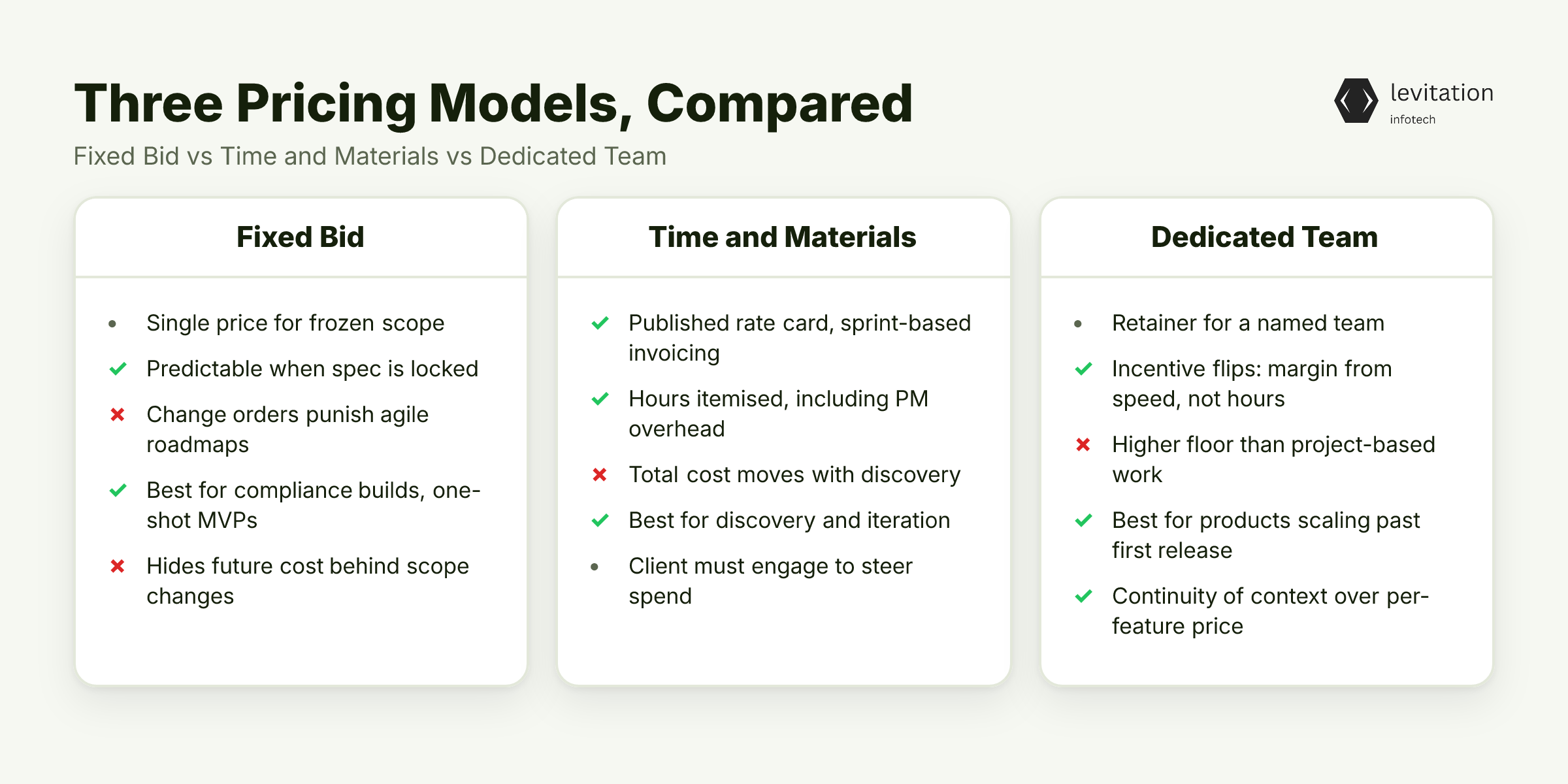
The model you pick decides whether the iceberg stays hidden or comes into the light.
Fixed Bid
A single price for a single, frozen scope. It works for compliance-heavy builds with documented regulatory requirements, or one-shot MVPs where the spec is unlikely to evolve. It punishes any product whose roadmap moves, because every move is a change order.
Fixed bid is a tax on agility.
Time and Materials
A published rate card, sprint-based invoicing, and hours logged against named roles. The iceberg stops being an iceberg. It shows up as line items the client can see, question, and steer.
Vendors that run on T&M can't hide PM overhead, because PM hours are itemised. This is the model where rate transparency does the most work for the least friction.
Dedicated Development Team
A retainer for a named team. The vendor's incentive flips from billing more hours to delivering faster, because margin comes from efficiency, not from change orders.
A dedicated development team in India is usually the right answer for products that will scale past their first release. For those products, continuity of context matters more than per-feature price.
The recommendation, almost always, is a blended model. Use fixed milestones for the known scope and T&M for discovery and iteration, with a stated rate band in writing. This is how teams trusted by Fortune 500 brands for enterprise AI systems in India structure their commercial side. The alternative is exactly the quote that doubled.
Picking the model is half the battle. The other half is writing it so the vendor can't drift.
Contract Clauses That Lock Your Number in Place
Four clauses. They do most of the work. - Rate card appendix. Role-wise hourly rates attached to the SOW, with currency and an annual escalation cap tied to a published index. A unit price applies to any custom software feature added mid-sprint. - Change-order protocol. 48-hour quote turnaround on any scope change, with a stated unit price per role. No verbal approvals count. Email or workflow tool only. - Weekly burn-rate dashboard. The client sees the same hours the vendor bills. No invoiced hour that wasn't visible mid-week. This single clause kills most "we worked on it" padding. - Capped management fee. A low single-digit percentage is a fair benchmark for vendor overhead, with PM hours itemised separately rather than bundled into the rate. The cap matters less than the visibility it forces. Once PM hours sit on the invoice, padding becomes impossible to hide.
Without these four, the vendor has no incentive to control internal cost, because the contract transfers every unknown back to you.
A transparent contract is the contract that doesn't need renegotiating in month five.
What Changes When Your Quote Holds Steady
Predictability changes everything.
The founder who negotiated a rate card before kickoff still pays monthly invoices, but the number no longer surprises. The runway calculation holds. The board deck's burn line is honest.
The cap table math doesn't shift mid-round. The deeper shift is vendor behaviour. A team confident in its rate defends that rate, because it plans to keep the client for year two and year three.
The same software development price in India that stays flat is the team that stays accountable. When the cost stops moving, the conversation moves to quality, to roadmap, to outcomes. That's where founders want to be spending their time.
This is the pattern we have seen across systems still running in production five-plus years after deployment. Those systems were not built on the cheapest quote. They were built on the most legible one, by teams that keep every rate open to scrutiny through renewal. Those teams knew the number would be examined again at renewal.
Rate transparency is a procurement filter. It selects for vendors who plan to be around in year three. The Noida vendor who won't show you their rate is the Noida vendor who won't show you in year two either.
If you want a quote that holds, you negotiate the rate before you negotiate the scope. The contract language is straightforward. The team that pushes back on it is telling you something useful about how the next eighteen months will go.
Frequently Asked Questions
How much does software development cost in India per hour in 2026?
Direct mid-level developer rates in India vary by city and stack. The spread between direct cost and the loaded bill rate is where vendors make their margin. Once vendor margin, PM overhead, and QA buffers are added, the loaded bill rate climbs well above direct cost.
Senior architects and AI/ML specialists sit at the top of the range. The Noida fixed-bid quote that hides these numbers is almost certainly baking in the higher end of that band.
Why do Noida software vendor quotes keep increasing mid-project?
Fixed-bid contracts from Noida vendors include a margin buffer for unknowns and a scope-change fee schedule. When your product inevitably evolves, those buffers get billed back as change orders. Because the original quote had no hourly rate, you have no baseline to challenge the new line items against.
Is fixed-price or time-and-materials better for a startup MVP?
For an evolving MVP, T&M or a dedicated team model almost always beats fixed-bid. Fixed-price only wins when the scope is frozen, documented, and unlikely to change. That describes almost no startup product after the first three months.
What should a Noida software development contract include to prevent cost overruns?
Four items: a role-wise rate card with an annual escalation cap, a change-order protocol with turnaround SLAs, a weekly burn-rate dashboard, and a capped management fee with PM hours itemised separately. Without these, the vendor has no incentive to control internal cost.
How do I verify a Noida vendor's actual hourly rate?
Ask for the bill-rate-to-salary ratio. A reasonable multiplier between engineer salary and bill rate keeps the vendor lean; an excessive ratio means you're funding overhead, not engineers. Cross-check by asking for the LinkedIn profiles of the team assigned to you and confirming their seniority matches what was sold.
Send the contract draft before you sign and we'll mark the missing clauses in a day.
About the author
Mayank Singh is a software developer at Levitation Infotech, where he builds web and AI-powered applications across the company’s fintech, healthcare, and enterprise projects.