


A chatbot can answer a return question in seconds, then fail when the order lookup breaks. A small quote can hide the cost of exception handling and operational recovery, not just conversational polish.
For Indian retailers, that gap turns a promising demo into a production problem. The costly work starts when the bot identifies a return, applies policy, triggers a refund, and recovers from failed systems.
Price this exception path as a production workflow. Model returns as workflows with clear states, fixed rules, APIs, audit records, and safe retries. Buy the workflow in bounded slices, starting with read-only lookup and adding refund execution only after exception tests pass.
The Quote Covers the Chat, Not the Return Journey
Indian consumers spent 15 billion hours waiting on hold in the past year, according to the ServiceNow Customer Experience Report. It also found that 89% of Indian consumers are willing to switch brands after slow or inefficient service. A retail chatbot makes returns look easy, then strands the customer when a low-cost demo becomes a service failure.
The visible quote understates the operating exposure
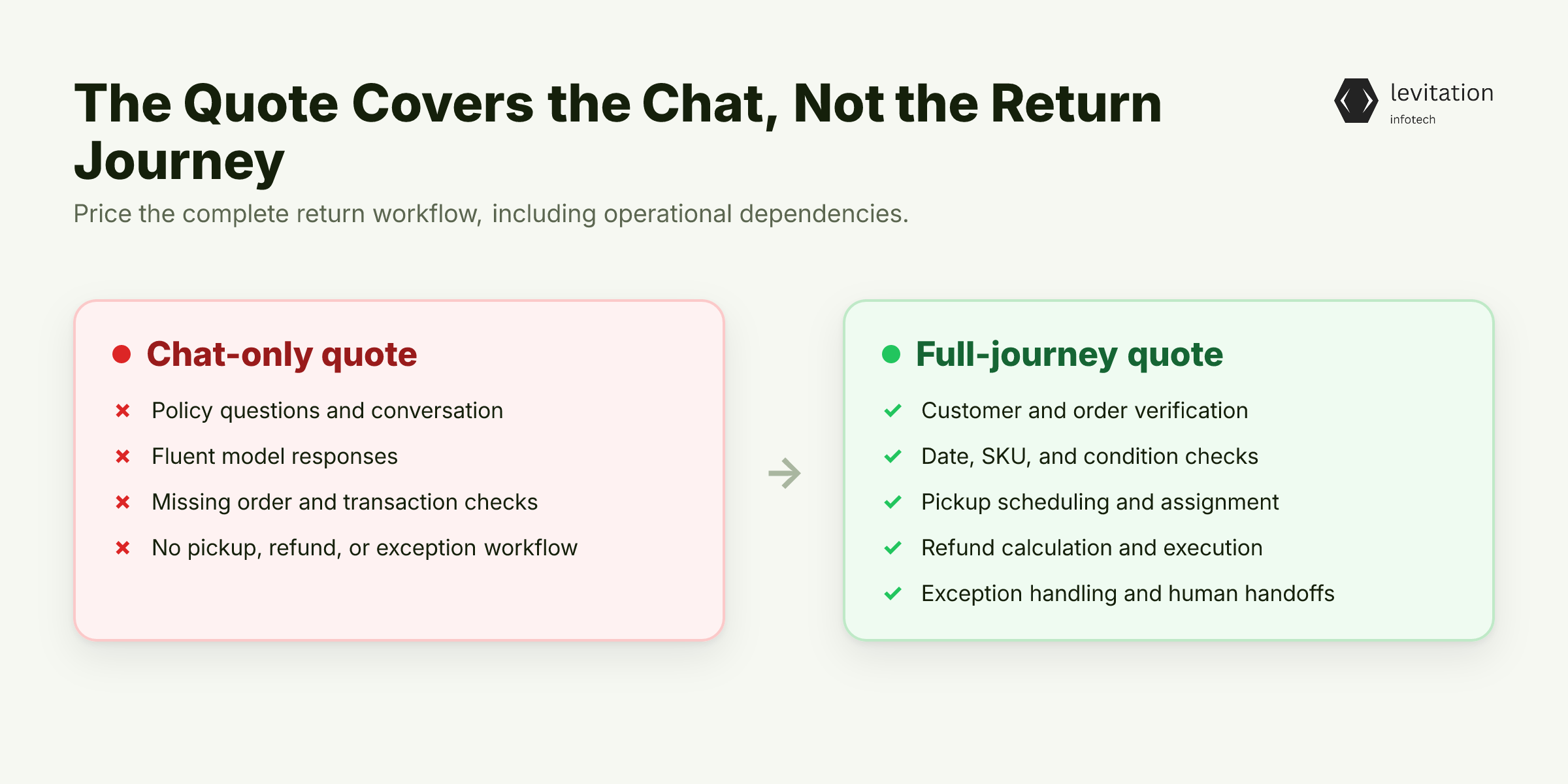
A build quote that covers only the chat understates operating exposure. Returns also require order lookup, policy evaluation, transaction execution, exception handling, and human handoffs. Treat scope differences, not a generic price band, as the relevant comparison.
The AI chatbot development cost in India benchmark becomes useful only when its scope matches the journey you are buying.
The mismatch appears during returns
Consider a customer asking, “Can I return this jacket?” The bot can quote policy. A real return can require order identification, date-window checks, item condition, pickup logistics, refund execution, and exception handling.
The workflow must verify the customer, order, purchase date, SKU, and item condition. It must also manage pickup availability and assignment, then calculate and execute the refund. Every step depends on a system of record, and a fluent model cannot supply missing authority.
Service speed affects retention
ServiceNow also reports that 80% of consumers rely on chatbots for key services. That level of reliance turns a stalled return into a commercial risk. The research links that risk to slow service, not merely chatbot dissatisfaction.
Reframe the buying question
For an operations head, chatbot development cost must include what happens after the bot explains a policy. The workflow must identify the order, decide eligibility, execute the transaction, and hand off exceptions safely.
Buying only the conversation is like pricing a courier for pickup while ignoring delivery. The failure is not model quality alone.
The demo never crossed the operational boundaries a return requires. What breaks when it enters production?
Why Returns Break the Demo-to-Production Path
A return is a stateful transaction, not a FAQ
A return can move through request, order verification, eligibility, pickup, refund initiation, settlement, and escalation. Each transition depends on the authoritative system of record, not a clever response.
That is the central difference between enterprise AI solutions and a website FAQ. The same gap appears in Your AI Reads the X-Ray. Your Workflow Still Faxes. Understanding the request never replaces the surrounding transaction.
The obvious fix fails
Longer prompts can improve phrasing. They cannot supply missing order data, apply a policy version, authorize a refund, or reconcile a failed transaction. Fluency is not authority.
This is the lesson in Indian AI Vendors Can Demo. Ask What Actually Failed: a demo can look successful while leaving production failures unexposed.
Authority crosses three boundaries
The bot crosses three authority boundaries. Each boundary needs a system interface, access rule, failure path, and accountable owner.
It needs customer and order authority to access personal and purchase details. It needs merchandising and returns-policy authority to evaluate eligibility rules. It needs money-movement authority to execute financial transactions.
Human escalation does not close those gaps unless the case context survives the handoff.
Design the handoff as a supported state
Create an explicit human-handoff state when confidence is low. Preserve the collected order and policy facts, and name the next owner.
Provide a durable reference number and state the next step. The bot should stop rather than invent a refund amount, approval, or status.
An unsupported promise creates a second failure after the first one.
Channel parity matters
Customers do not respect internal ownership boundaries. A return started on the website must continue in the app or messaging channel without duplicate requests.
Carry one case reference and one authoritative status across every channel. The budget and architecture become clearer once returns become a workflow rather than a prompt. Which costs deserve their own line item?
Price the Exception Engine, Not the Conversation
Price workflow discovery separately
Generic development quotes hide discovery inside a convenient line called build. Price workflow discovery separately. The baseline must cover policy categories and change ownership.
Include customer-journey mapping, conversation and escalation flows, UX design, and acceptance criteria. Discovery is expensive because unresolved policy branches become production defects later.
Define retail chatbot integration cost explicitly
Retail chatbot integration cost starts where connector work ends. Count the costs of authentication, data mapping, API contracts, reconciliation, recovery, audit trails, monitoring, and ownership.
Map orders, returns, inventory, pickup, refunds, CRM, and ticketing systems. Connector code alone is not an integration.
Budget the AI quality layer
Budget prompt and tool design, tests for normal and edge cases, regression tests, model selection, fallbacks, and agent tools. The evaluation set must include successful returns and deliberately difficult ones.
Fluency tests alone miss transactional failures.
Budget ongoing operating costs
Model and API usage are only part of the monthly bill. These costs depend on conversation volume, model tier, and the calls needed to complete a return. Price infrastructure, monitoring, incidents, policy updates, retesting, vendor changes, and the human queue for unresolved cases.
Cost drivers include team composition, integrations, conversation complexity, customization, requirements, and ongoing usage.
Separate prototype, pilot, and production
A conversational demo is not a production return agent. Require every proposal to show prototype, pilot, and production scope, exclusions, acceptance gates, and post-launch ownership.
Any quote that treats them as one product hides the expensive boundary.
Compare partners by production capability
When assessing AI development services or top generative AI companies in India, test failure behavior. Ask how failed APIs, conflicting policies, incomplete cases, and human handoffs are handled.
Speech quality is visible, but operational recovery is where the real cost appears. A cost model only helps if operations can turn each line item into a testable procurement decision. Can your team write that test?
Turn Returns Into a Verifiable State Machine
Draw the state machine first
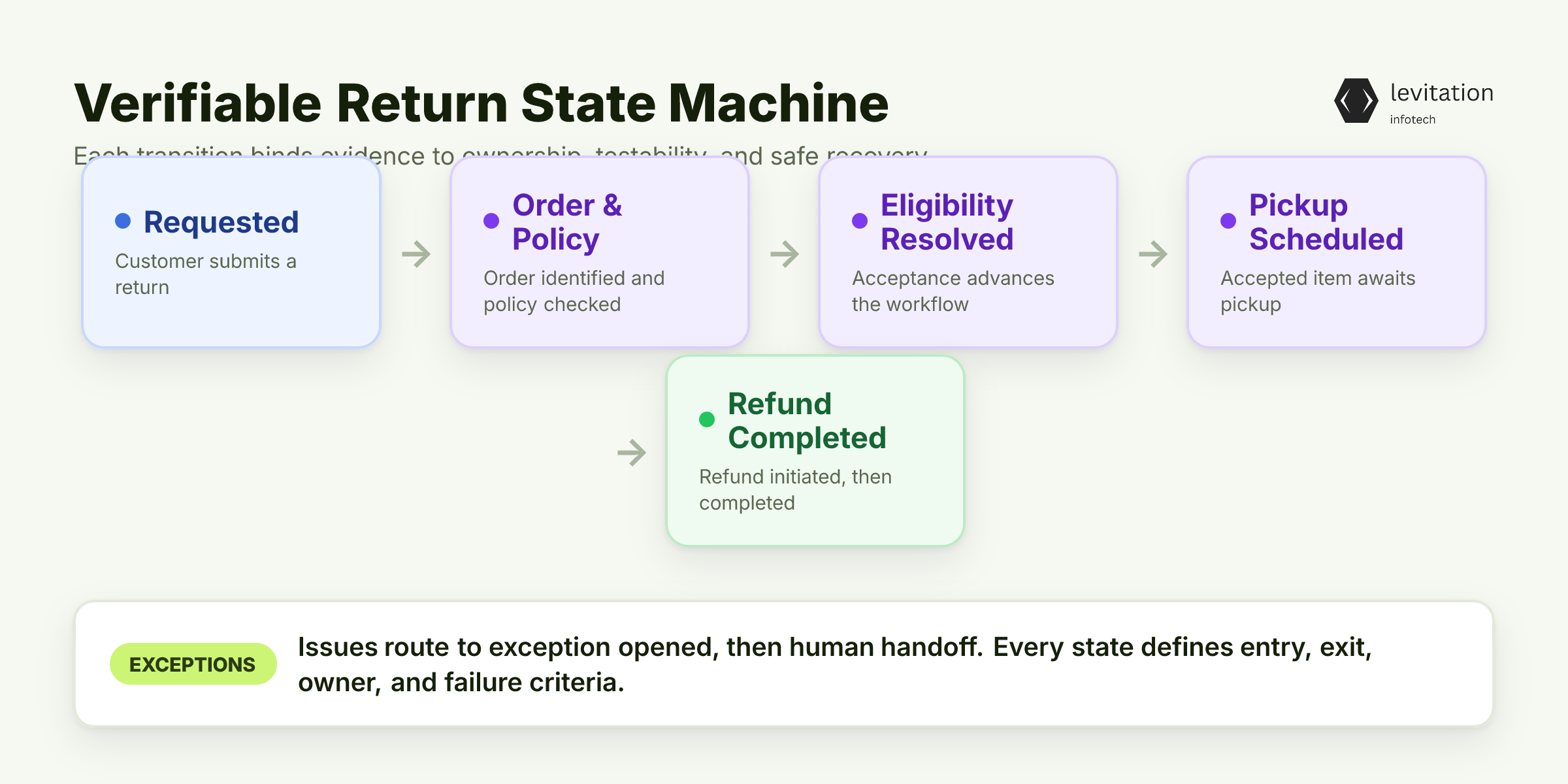
Start with states, not screens. The workflow begins when a customer submits a requested return. It then advances to order identified and policy checked before reaching eligibility resolved.
Once the item is accepted, the process moves to pickup scheduled. The financial path ends with refund initiated and refund completed.
When an issue arises, route the request to exception opened and human handoff. Define entry criteria, exit criteria, owner, and failure route for every state. This is what separates enterprise AI solutions from a polished chat interface.
Give each component one job
Give each component one job to keep architecture boundaries clear. The language model interprets intent, collects missing details, and explains status. The rules engine evaluates policy and authorization.
APIs retrieve authoritative data and execute transactions. People approve exceptions when needed. Mixing these jobs makes failures hard to locate and impossible to test independently.
Bind each decision to evidence
Bind every decision to evidence. Record the applicable policy version, order facts, and timestamp for each transition.
Also store the rule result, API response, actor, and reference number. This record lets operations explain a refund and reconstruct a dispute. Chat transcripts alone cannot.
Engineer duplicate and retry behavior
A repeated message must not create a second refund request or refund. Use idempotent transaction requests that can be repeated safely, and assign explicit reference numbers.
Run reconciliation checks against payment and order records. Safe retries depend on those checks. Without them, convenience multiplies financial exposure.
Build an exception test set
Assemble an exception set before live traffic. Test a normal return, an ineligible item, and a damaged-item claim.
Also test a missing order ID, a partially refundable basket, a changed policy, and an unavailable pickup slot. Also verify behavior for a refund-status request.
These cases expose different authority and recovery failures.
Define observable success
Success is not a helpful sentence. The correct order must match, the correct policy branch must apply, and the transaction must complete or escalate. Every outcome needs a durable record.
With the workflow specified, how do you buy it without confusing a prototype with production?
Scope the Build in Return-Sized Procurement Slices
The safest first purchase is one bounded return journey, not a company-wide chatbot.
Map the journey and its decisions
Map one return journey, every policy branch, and the owner of each authoritative field. Baseline current ticket volume, cycle time, handoff rate, and unresolved queue.
Produce a journey and policy map, plus a data-owner register. Include a current-state baseline and clear, testable acceptance criteria.
Do not accept a production promise before these outputs exist.
Connect safely before moving money
Connect order lookup and ticket creation first. Start with read-only retrieval, then add refund execution after duplicate prevention, reconciliation, approval rules, and failure recovery pass tests.
Read-only failures expose data and access problems without moving money. Use those failures to uncover bad assumptions before writes.
Run a controlled pilot
Run a controlled pilot, replay the exception set, and inspect every false completion. Monitor unresolved cases and compare cost per resolved return with the current process.
Expand only when the pilot shows completed outcomes, not merely fewer messages. A failure before broader rollout provides useful evidence.
Request an itemized proposal
Require separate lines for major project components. Cover discovery and journey mapping, UX, and generative AI development. Detail workflow rules and integrations, testing, security, and access controls.
Specify deployment, monitoring, support, service levels, and usage charges. Request an INR quote even when benchmarks arrive in USD. A single total cannot reveal what the buyer is purchasing.
Make the vendor demo operational
Give every bidder the same standard, ineligible, damaged, missing-order, duplicate, and refund-status scenarios. Require evidence of API calls, policy decisions, audit records, and graceful human handoff.
A scripted answer is not an operational walkthrough.
Match the pricing model to uncertainty
Use fixed pricing after workflows and integrations are defined. Use time and materials or a dedicated team when policy exceptions and legacy systems remain uncertain.
State every exclusion, rate, and change process. An early fixed bid often hides discovery when policy exceptions and legacy-system dependencies make scope uncertain.
Write measurable acceptance criteria
Use measurable acceptance criteria to define project success. Require verified order and policy data. Prohibit invented refund amounts or statuses.
Also require durable transaction references, explicit escalation, and named ownership. Enforce reconciliation and duplicate checks, plus regression tests after model or policy changes.
A vague accuracy promise cannot become a contract test.
Use longevity as a vendor signal
Operational longevity is a useful vendor signal. When comparing top generative AI companies in India, ask who owns production operations. Use AI chatbot development cost in India as a scope benchmark, not a proposal.
Treat Levitation like any other bidder. Require evidence about production ownership, operational recovery, and longevity.
A pilot proves one journey. Scaling asks whether the system stays dependable after policy changes, traffic shifts, and vendor upgrades?
Measure Cost per Resolved Return, Not Messages
A cheap conversation can be an expensive return.
Calculate cost per resolved return
Cost per resolved return equals total monthly chatbot cost divided by valid completed resolutions. Include build-cost amortization, model and API usage, infrastructure, human handoff, rework, and reconciliation failures. Report it as a blended operating metric, not a model benchmark.
Track service outcomes together
Pair cost with median return cycle time, policy accuracy, exception rate, handoff rate, and unresolved-case age. Also track duplicate-refund incidents and reconciliation breaks.
A fast wrong answer is still an operating failure.
Guard against misleading deflection
Message deflection hides work moved to another channel when teams count only chat messages. Start with one journey, measure every resolved return, and expand only when the numbers hold. Can those savings survive once exceptions, rework, and handoffs are counted?
About the author
Mayank Singh is a software developer at Levitation Infotech, where he builds web and AI-powered applications across the company’s fintech, healthcare, and enterprise projects.