


TL;DR: Radiology AI fails clinically when its output stops at detection instead of becoming an accountable task. Build a recoverable DICOM-to-FHIR workflow around a canonical event and action contract, then prove every handoff before reducing fax traffic.
Key Takeaways: - DICOM and PACS move imaging evidence; FHIR must turn findings into owned, acknowledged tasks. - A canonical event and action contract prevent silent, duplicate, or misrouted clinical work. - Start in shadow mode, measure the closed loop, then retire fax only after the replacement is proven.
The Model Is Live. The Routing Is Not.
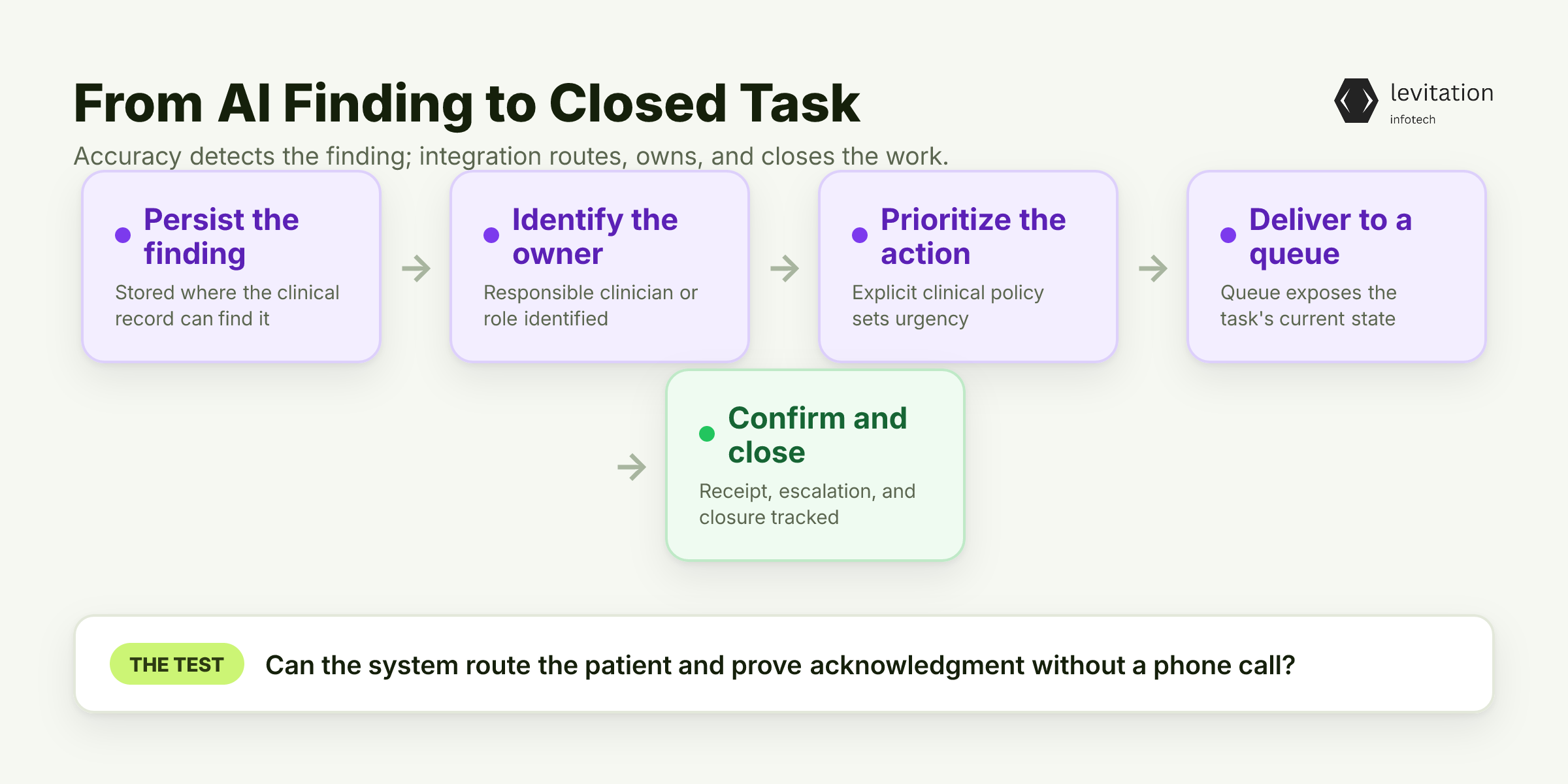
A radiology model can flag a critical finding while the clinician who must act still receives a fax. The output never became a routed, acknowledged clinical task.
Meanwhile, the finding can sit in a separate console, portal, or PACS viewer. The ordering team may still handle referrals by hand.
Model accuracy and clinical AI integration answer different questions. Accuracy asks whether the system detects a finding. Integration asks whether that finding becomes owned, timely, acknowledged work.
A complete integration must: - Persist the finding where the clinical record can find it. - Identify the clinician or role responsible for acting. - Prioritize the action through an explicit clinical policy. - Deliver the result to a queue that exposes its state. - Confirm receipt, escalation, and final closure.
Four disconnected surfaces create the paradox: - Modality and PACS: Imaging objects, study metadata, and reports. - AI result store: Findings detached from the live clinical workflow. - EHR and FHIR services: The durable record, order, task, and provenance. - Human work queues: Where staff sort, escalate, and chase results.
Any gap breaks the chain. Test this before each proposed deployment.
If an AI result appeared after hours, could the system identify the patient and route it? Could it prove that someone acknowledged it without a phone call?
A shortlist of top AI companies for healthcare in India can guide a market scan. Require every shortlisted provider to show operational handoffs, not only diagnostic performance.
This follows the central warning in Enterprise AI Is Judged on Integration, Not the Model. Clinical value appears after the model meets the workflow.
Yet if the image path is already digital, why does the clinical action still end on paper?
DICOM PACS Integration Stops Before the Workflow
A CT scanner can send images to a PACS. The radiologist can sign a digital report. Neither fact guarantees that a critical AI finding reaches the right work queue.
DICOM and PACS integration moves imaging objects, study metadata, and reports between systems. It does not decide who must act, how urgent the action is, or whether anyone accepted it.
The obvious fixes fail for the same reason: - Email adds a destination, not clinical ownership. - Shared folders add storage, not a deadline. - Portals add another place to look. - Extra viewers add context, not a closed task.
None of them records who accepted responsibility, when escalation began, or how the result reached closure.
Manual handling of faxes often remains. Staff still sort, flag, upload, index, and route them, especially for referrals. A machine-readable source does not remove those handoffs.
Break the process into five handoffs: - Capture: Receive the document or event without losing source metadata. - Understand: Extract the patient, order, finding, and urgency. - Decide: Select the required action and accountable role. - Act: Deliver the work into a trackable queue. - Confirm: Record acknowledgement, escalation, and closure.
Ownership can disappear between these steps. An AI workflow automation agent can classify a document, extract clinical data, match a patient, and initiate the next action. It should not stop at extraction.
Zero-keystroke fax-to-EHR automation is a goal, not proof that fax has vanished.
The missing layer is not another inbox. It is an explicit contract for what must happen after inference, including when each handoff fails. Can that contract make every failure visible before it becomes a missed clinical action?
FHIR Workflow Automation Needs an Action Contract
Canonical Event
Create one traceable event with patient and order identifiers. Add source DICOM references, finding details, urgency, confidence, provenance, policy version, and destination.
Preserve the imaging evidence through DICOM Structured Reports or equivalent references. Project actionable content into the FHIR workflow. The task and diagnostic evidence must remain linked.
Without this envelope, each integration can invent its own identifiers and lose context. Treat model confidence as a routing input, never as proof of clinical truth.
Until those elements share one envelope, downstream systems cannot trace the finding to its task. The next question is who must act.
Action Contract
Declare the required actor, action, deadline, acknowledgement, escalation path, and terminal state.
Represent that work with FHIR resources: - DiagnosticReport for the report and imaging conclusion. - Observation for a structured finding or measurement. - ServiceRequest for requested care or review. - Task for assignment, status, and the responsible role. - Provenance for origin and policy decisions.
A free-text alert is not a task. It has no owner, deadline, state machine, or proof of completion. Who should control those transitions?
Guardrails
Require deterministic patient matching. Send uncertain matches to a visible identity-resolution queue instead of guessing. Version routing policies because urgency rules change as clinical operations evolve.
Governance must decide which actions can proceed automatically and which require human review. A workflow automation agent can read a document, judge urgency, and route it to the right queue before a human opens it.
Automation can prepare and route. Policy, not the agent, controls clinical authority.
An explicit contract makes the integration enforceable, but it does not prevent the pipeline from failing at its weakest handoff. Can the contract specify recovery as clearly as the successful path?
Build Radiology AI Routing as a Recoverable Pipeline
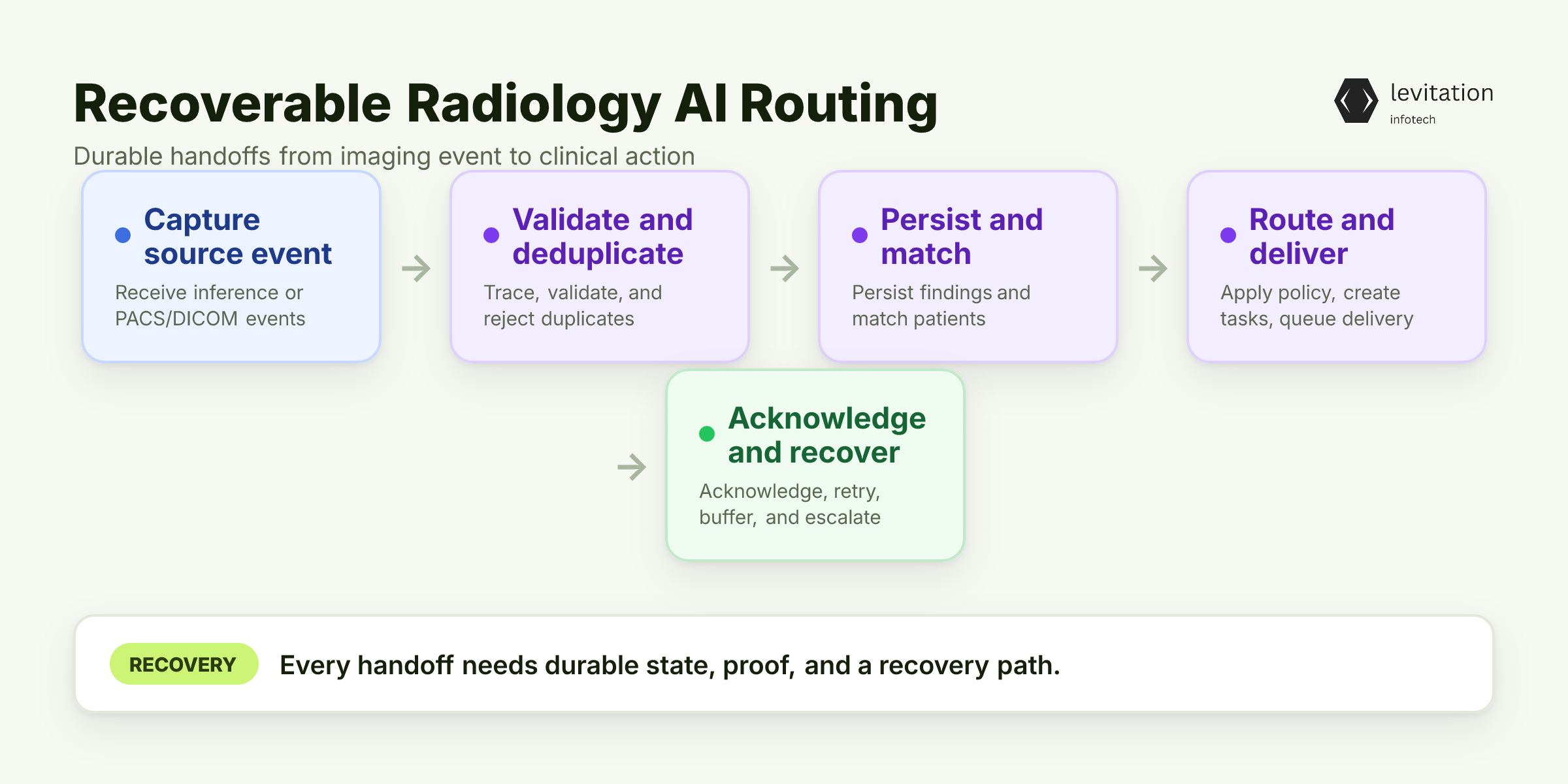
Modality or AI inference → PACS or DICOM event → canonical result → patient matching → clinical persistence → policy-based routing → work-queue delivery → acknowledgement → escalation
Every arrow needs durable state and a recovery path. A line in an architecture diagram is not a handoff until the system can prove it.
Normalize and Deduplicate
Assign a trace identifier and idempotency key at ingestion. Validate required DICOM and FHIR fields before creating work. Reject duplicate or conflicting events before they create duplicate tasks.
This is the same feature-contract failure described in Your Model Didn't Break. The Feature Contract Did. An idempotency key lets a replayed DICOM event return the existing task instead of opening another clinical action. The clean event still needs a destination.
Route and Deliver
Persist the report before notifying anyone. Evaluate the versioned routing policy, then create the appropriate FHIR Task.
Deliver to a role-based queue, not a named person's inbox. A queue can survive leave, shift changes, and staff turnover.
Document workflows can route files to folders, messages, and checklists after automated reading and classification. A clinical queue also needs ownership, deadlines, and closure.
A compact policy might work like this: - For a matched critical finding, write the DiagnosticReport and create a Task for the ordering clinician. - If the acknowledgement deadline expires, escalate to the configured backup. - For an unmatched record, send it to identity resolution. Never guess.
Each rule is explicit, testable, and linked to the canonical event. Delivery can still fail after the task exists.
Recover and Observe
Use a transactional outbox for delivery, bounded retries for transient failures, and a dead-letter queue for work needing intervention. Carry correlation IDs across DICOM, FHIR, messaging, notification, and audit events.
Failure behavior must be explicit: - If inference is unavailable, preserve source work for replay and create no phantom finding. - If the PACS is unavailable, buffer the event and expose the delay. - If the FHIR write fails, retain the canonical event for retry and recovery. - If identity or notification is unavailable, leave the task pending and visible. - If an event is replayed, return the existing task instead of duplicating it.
A recoverable pipeline matters only if the team can prove every handoff before patients are affected. Tests must probe failures, not just the happy path. Which failure mode will expose the weakest control during live testing?
Test the Handoffs Before Clinical Go-Live
Contract and Failure Tests
Test the handoffs with deliberately broken inputs and dependencies. - Missing DICOM metadata and malformed source references. - Duplicate studies, conflicting reports, and replayed events. - Incorrect patient matches and uncertain identity outcomes. - FHIR write rejections, unavailable destinations, and notification failures. - Acknowledgement timeouts, escalation failures, and terminal-state errors.
Each test must assert the visible recovery state, not merely that a message was sent. Happy-path tests prove very little. How should the team roll out safely after those tests?
Progressive Rollout
Move through three controlled stages: - Shadow mode: Observe proposed routing without changing clinical work. - Staff-assisted routing: Let automation prepare tasks while staff perform the action. - Bounded automation: Automate validated result classes with monitoring and rollback.
Expand only while monitoring remains reliable, identity exceptions remain bounded, and rollback controls remain tested. Shadow mode exposes policy errors before patient care depends on them. Which partners can support that operating model?
Partner Due Diligence
Evaluate vendors as operating-system partners, not model suppliers. When reviewing healthcare AI vendors, ask for evidence of regulated-industry delivery. Check healthcare deployments, production longevity, client retention, and realistic rollout timelines.
Claims about HIPAA-compliant hospital deployments, deployment scale, retention rates, and rollout speed need evidence. Model validation remains essential, but it cannot show ownership, acknowledgement, or recovery. Ask which components the vendor owns during outages and who operates the recovery controls.
Every routed result must trace to its source, reach an accountable queue, meet its acknowledgement policy, and remain recoverable after downstream failure.
Use a trace viewer to reconstruct the DICOM object, FHIR resource, human action, policy decision, retry, override, and final status. A complete inference log can still miss workflow evidence, as clinical AI inference logs explains.
Passing integration tests does not remove the fax while it remains the source of truth and default fallback. Retirement must follow measured replacement, not a successful test run. How can you know the new path carries the same volume safely?
Measure the Closed Loop, Then Retire the Fax
Measure the closed loop, not inference alone.
The operational dashboard should expose: - Time from result creation to the right queue. - Manual touches and the auto-routed share. - Unmatched-record and duplicate-task rates. - Misroute rate and acknowledgement latency. - Escalation rate and unresolved escalations. - Fax volume by source.
Track each measure by result class, source, and clinical site. Diagnostic accuracy remains a separate quality measure. A perfect finding can still miss its deadline.
The same event model can route a DICOM-derived critical result, a faxed referral, and a FHIR-originated request. Provenance and ownership rules then stay consistent across channels.
Set zero-keystroke handling as the target for matched, machine-readable documents. Retain a controlled fallback for unmatched identities, degraded systems, and workflows requiring human review.
AI fax automation can reduce manual routing work. It does not prove that fax communication has disappeared. Retire each fax source only after the replacement carries its volume safely.
That requires clinical AI workflow automation as a system discipline, not a feature. It also changes how buyers compare healthcare AI integration providers.
The design principle remains provider-neutral: a useful clinical AI system does more than see the X-ray. It turns every finding into an accountable, observable clinical action. Can your current architecture prove that chain?
Frequently Asked Questions
What is clinical AI integration in radiology?
Clinical AI integration connects a model's output to the workflow that follows it. That includes patient matching, result persistence, prioritization, routing, acknowledgement, escalation, and audit.
A model can be clinically accurate yet operationally disconnected if staff must retrieve, re-enter, or manually distribute its output.
How should DICOM PACS integration and FHIR workflow automation work together?
DICOM and PACS integration should preserve the imaging study, metadata, and diagnostic evidence. FHIR workflow automation should represent the order, report, observation, task, and acknowledgement.
A canonical event with shared identifiers should bridge both. You should be able to trace the workflow to the exact clinical evidence that triggered it.
Can clinical AI eliminate fax-based referrals?
AI fax automation can reduce the manual work needed to classify, extract, match, and route machine-readable faxes into the EHR. It does not show that every organization has eliminated fax communication.
Identity exceptions, degraded systems, and non-machine-readable documents still require a controlled fallback.
What should technical architects measure after deploying radiology AI routing?
Track time to routing, manual touches, unmatched records, duplicate records, and misroutes. Also track acknowledgement latency, escalation completion, and remaining fax volume by source.
Diagnostic accuracy remains important, but it does not prove that the result reached the right person or changed the workflow.
Which handoff would be hardest for your team to prove today?
About the author
Mayank Singh is a software developer at Levitation Infotech, where he builds web and AI-powered applications across the company’s fintech, healthcare, and enterprise projects.