


TL;DR: Enterprise AI selection should rest on failure evidence, not demo polish. Ask vendors to expose failures, prove fixes, test the full workflow, and contract for model control, data ownership, and a tested exit.
Key Takeaways: - A credible vendor can name a failure, explain its cause, show the fix, and assign an owner. - Production readiness depends on workflow fit, recovery, traceability, integrations, support, and portability. - Model changes, data access, ownership, and exit must become contract gates before signature.
A Great Demo Can Hide a Brittle Production System
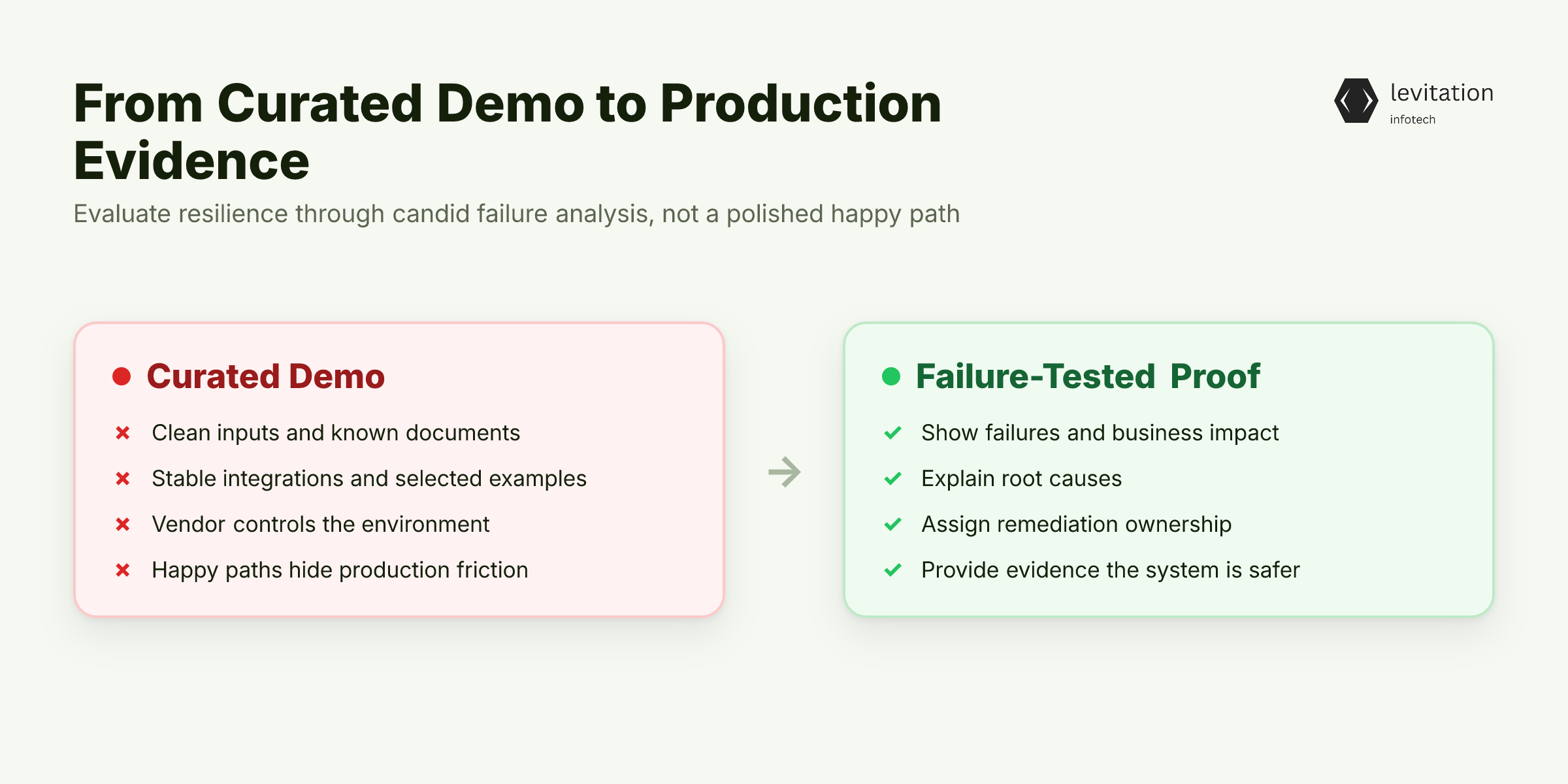
A polished demo can turn a brittle system into a procurement winner. The gap matters because a staged answer rarely reveals what breaks after launch.
The real test is not whether a vendor can stage success, but whether it can show failures, explain their causes, and prove what changed afterward.
The demo is a curated environment
A vendor controls the demo environment. Inputs are clean, documents are known, integrations are stable, and examples are selected. The setup makes the happy path look smooth.
That control hides friction that shapes production. A support assistant may ace a polished invoice, then meet a scan with missing fields, conflicting customer records, or restricted access.
Ask whether it refuses, recovers, escalates, or quietly guesses. Those behaviors matter more than another perfect sample answer.
Treat AI development services as an operating capability, not a showcase. Ask each shortlisted vendor for a candid failure debrief.
Nationality is not evidence
Indian vendors are not uniquely prone to weak systems. Vendors elsewhere can produce equally convincing demos.
The useful distinction is the quality of failure evidence, not the vendor's address. Replace "Can it demo?" with four sharper questions: - What failed, and what business impact did it cause? - What was the root cause? - Who owned the remediation? - What evidence shows the system is safer now?
This structure keeps criticism specific. It tests evidence without inviting anecdotal attacks on a competitor.
If the demo is designed to succeed, which failures must your team force into the open?
The Five Failures an AI Vendor Evaluation Must Surface
A failure can sit between components rather than inside the model. The answer may sound useful, but the source was stale, access permissions had expired, or a downstream record changed.
That is why a vendor evaluation must test failures across the whole system.
Data quality and structure
Ask which data assumptions the system depends on. Then test how missing, conflicting, poorly structured, or inaccessible data changes the answer. - Which sources are authoritative? - How are conflicting records surfaced? - What happens when required fields are absent? - Does inaccessible data trigger refusal, fallback, or inference?
These questions turn enterprise AI solutions from a capability claim into a testable contract.
High-impact model failures
Request recent high-impact errors. Insist on root-cause analysis, remediation records, and proof that the same failure mode is now resolved or contained.
"The model was wrong" is not a root cause. Ask which input, retrieval path, prompt, validation rule, or human handoff broke.
Integration chaos
Examine behavior when APIs, permissions, schemas, or source systems fail or change. A standalone response is not an integrated production capability.
A bot can retrieve a policy correctly and still fail to update a ticket because its CRM token expired. That failure belongs in the evaluation.
Traceability and proprietary model decisions
Require visibility into sources, model decisions, tool calls, and human-review triggers. Know which proprietary dependencies limit output choices or make substitution harder.
Ask whether reviewers can reconstruct what happened without trusting the vendor's summary.
Continuity, lock-in, and ownership
Ask about access to source code and operational artifacts, generated intellectual property, proprietary APIs, storage formats, and the vendor's obligations when failures occur.
Convert answers into a shared failure register. Each entry should contain: - Severity and affected workflow - Root cause - Remediation owner - Verification status - Residual risk and the decision date
Once those failures are visible, the next move is to stop grading presentations and start grading evidence. Which evidence should carry that weight?
Build a Production Readiness Scorecard, Not a Demo Scorecard
A vendor can meet every demo metric and still break under real operating conditions. Demo scores reward visible success, while production testing exposes hidden dependencies.
Score six operational dimensions - Workflow fit and data readiness: Does the design match real work, inputs, and access patterns? - Task reliability and failure containment: Does it detect uncertainty and limit harmful output? - Traceability: Can reviewers reconstruct sources, decisions, and interventions? - Integration behavior: Does it handle timeouts, schema changes, and permission failures? - Supportability: Can your team diagnose, patch, and operate the system? - Portability and exit readiness: Can data, configuration, and integrations leave the vendor?
Use the same scorecard to evaluate AI development services and enterprise AI solutions.
Use an evidence ladder
Grade evidence in four levels:
- Vendor claim: A statement without supporting proof.
- Supporting artifact: A test report, incident record, architecture document, or contract.
- Observed behavior: The system acting during your evaluation.
- Production evidence: Operation under real conditions with controls and monitoring.
Risky workflows need stronger evidence. A policy document cannot prove recovery from a live source outage.
This is why LLM evals can approve models that fail. The test exists, but it may cover the wrong boundary.
Evaluate recovery, not just output quality
Score what happens after a bad answer, unavailable source, or failed integration. Look for fallback behavior, escalation, logging, and a named remediation owner.
An output score says nothing about recovery. Recovery shows whether the system can stay inside its risk boundary.
Weight risk by workflow
One universal pass mark is wrong. A customer-support draft and a regulated decision workflow do not carry the same consequences.
Assign evidence thresholds by workflow consequence and reversibility. Irreversible decisions need stronger proof than reversible drafting assistance.
Make unknowns visible
Do not turn an unanswered question into a vendor strength. Red, amber, and green must mean something.
Make the scorecard the common decision document across technical, security, operations, finance, and legal reviewers. A CFO should not inherit a green rating created only by engineers.
A scorecard creates value only when the vendor must demonstrate it. That is where the RFP becomes an operating test. How do you force that proof into the buying process?
Turn the Generative AI RFP Checklist into a Failure Test
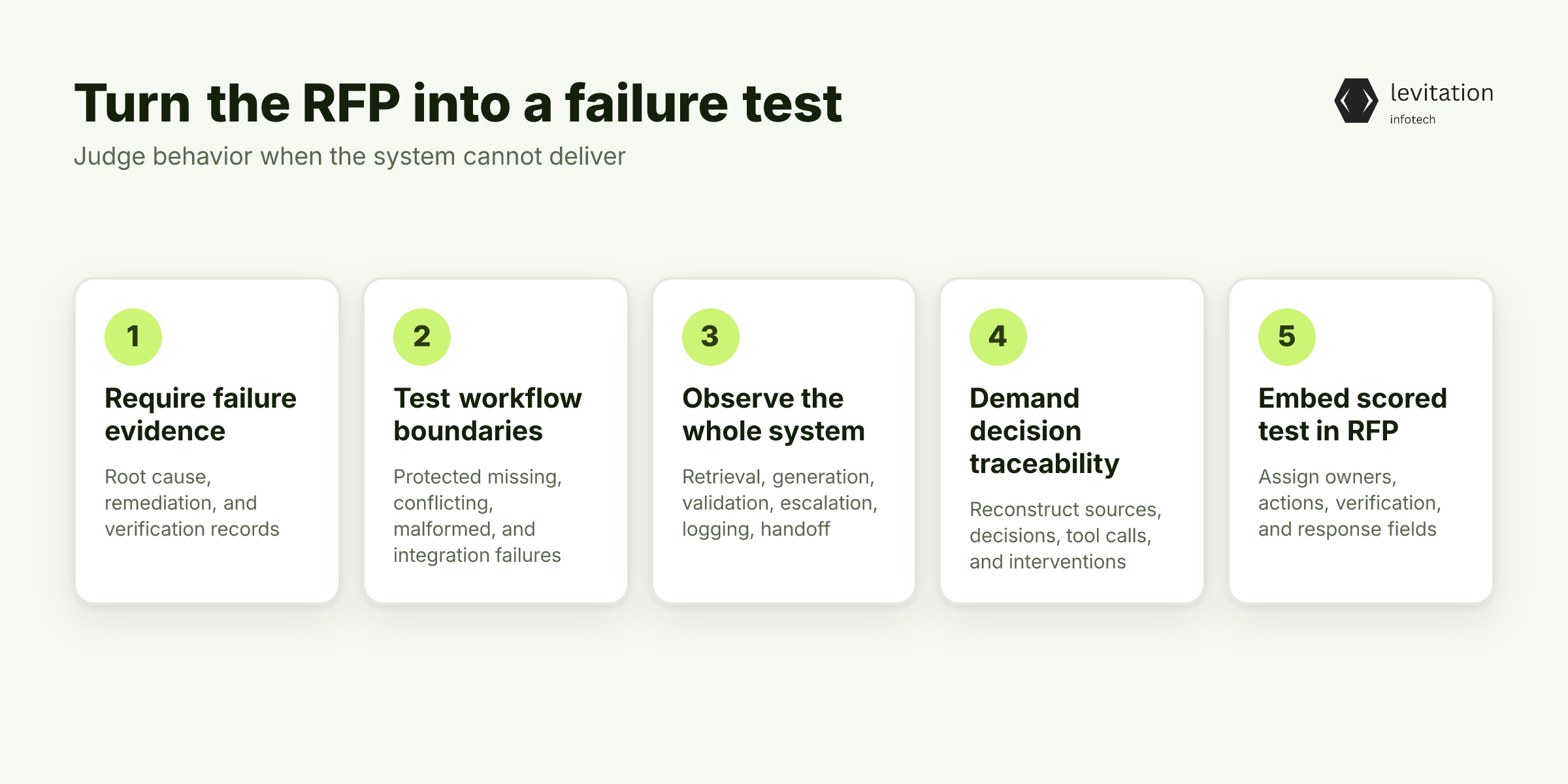
Most RFPs ask whether the system can work. Production buyers need to ask how it behaves when it cannot.
Ask for specific failure evidence
Request recent high-impact failures with root causes, remediation records, and verification results. General claims about model accuracy or security are not evidence.
Require each response to identify: - The failed workflow and business impact - The confirmed root cause - The remediation performed - The verification result - The control that prevents recurrence
Test real workflow boundaries
Use representative, appropriately protected data during evaluation. Include missing, conflicting, poorly structured, out-of-scope, and integration-failure conditions.
Do not let the vendor select only clean test cases. Difficult inputs often reveal more than another perfect response.
Observe the whole system
Observe retrieval, generation, validation, escalation, logging, and downstream handoff. Do not score only the final answer while ignoring the process needed to produce it.
Enterprise AI is judged on integration, not the model. A strong answer that never reaches the workflow is not production capability.
Demand traceability artifacts
Ask the vendor to show how sources, model decisions, tool calls, and human interventions can be reconstructed during review. Traceability should show what happened, not merely provide a citation.
This distinction matters because RAG citations are not necessarily an audit trail. A source reference does not explain the system's decision path.
Close with a scored debrief
Compare observed behavior with the production-readiness scorecard. Document unresolved risks. Every material gap needs an owner, remediation action, and verification method.
Do not average away a critical gap. One uncontained failure can outweigh several successful demos.
Put the test in the RFP
State the test in the RFP as explicit response fields before commercial review begins. Require failure evidence, test participation, model and data assumptions, support duties, and remediation commitments.
This makes AI development services comparable through behavior rather than presentation quality. Commercial review should begin only after the evidence is comparable.
Even a convincing workshop can conceal a commercial trap. The contract must answer what the demo cannot. Which answers must it settle before signature?
Negotiate for Model Change, Data Control, and Exit
A model can pass every test and still become a business dependency. If the vendor controls the model, artifacts, data path, and storage format, your exit options shrink after signature.
Make model decisions governable
Record which foundation or proprietary models are used and what can be substituted. Set notice requirements for model changes. Require revalidation after every material change.
Ask how substitutions affect prompts, evaluations, cost, latency, and liability. A replacement model should not silently reset accepted behavior.
Define access and ownership
Clarify access to source code and operational artifacts, ownership of generated intellectual property, and rights to customer data. Define export formats and what counts as a complete handover.
If managed code is withheld, require equivalent access to configuration, workflow logic, evaluations, and operational controls.
Price the business model, not only the demo
Examine usage tiers, model and infrastructure costs, support limits, change fees, and proprietary service dependencies. Ask what triggers a new charge and who owns cost control.
Make storage-format dependence visible. It can make future data migration harder than the initial contract suggests.
Require a credible roadmap and support plan
Ask who maintains the system and how incidents are escalated. Define what support is included and what happens if the vendor, model provider, or product direction changes.
Reference customers matter only if their production environment resembles yours. Your AI vendor's reference customers may run different models, so confirm the current setup.
Make exit a tested deliverable
Require a documented portability and exit plan covering: - Data export - Integration handoff - Knowledge transfer - Replacement responsibilities
Test it with a sample export. A PDF describing exit is not a tested exit.
A relevant enterprise track record shows capacity, not workflow evidence or contract protection. Evidence and contractual protection still have to be proven.
Once technical and commercial risks appear together, polish matters less. So who can carry the system after launch?
What Production Confidence Changes for the Business
The best vendor is not the one claiming it has no failures. It is the one that identifies material failures, explains them without evasion, demonstrates the fix, and assigns accountability.
Failure is not a reason to reject a vendor. Concealment is.
A completed failure debrief and production-readiness scorecard produce practical benefits: - Procurement sees likely surprises before signature. - Security and operations receive traceable evidence. - Finance sees the full support and usage cost. - Legal sees ownership and exit obligations earlier. - Engineering receives a shared definition of production readiness.
Make the scorecard and unresolved-risk register contract gates before signature.
Require every proposal for enterprise AI solutions to include the same failure evidence and remediation commitments. Use one final rule: judge AI development services by how the vendor exposes, contains, and resolves failure after the demo spotlight fades.
The demo wins attention, while failure evidence wins the contract. The remaining questions turn that principle into practice. How should buyers apply it?
Frequently Asked Questions
How should a CTO evaluate Indian generative AI vendors?
Evaluate every vendor with the same evidence-based process. Request recent failures, inspect causes and fixes, test workflow boundaries, and score production readiness.
Vendor nationality should not replace technical evidence, operational proof, or contract accountability.
What should a generative AI RFP checklist include?
The checklist should cover data quality, high-impact model failures, integration dependencies, traceability, human escalation, and proprietary model decisions.
It should also cover support, pricing, intellectual property, portability, and exit terms. Require vendors to join a failure-first evaluation instead of presenting only a scripted demo.
How can we test production readiness beyond a live AI demo?
Test the full workflow with representative, appropriately protected data. Include missing, conflicting, poorly structured, and out-of-scope inputs.
Observe failure behavior, escalation, traceability artifacts, and downstream handoff. Record results in a production-readiness scorecard.
How do we reduce lock-in when selecting an AI vendor?
Make access, ownership, portability, and replacement explicit contract terms.
Document artifact access, generated intellectual property, data exports, proprietary dependencies, model substitution, support, and a tested exit plan. Do this before signing.
How long does it take to deploy enterprise generative AI?
Each proposed deployment timeline is workflow-specific, not universal. It should be checked against your scope and acceptance criteria. Proceed only after the failure and production-readiness checks are complete.
About the author
Mayank Singh is a software developer at Levitation Infotech, where he builds web and AI-powered applications across the company’s fintech, healthcare, and enterprise projects.