


TL;DR: Clinical AI break-glass access can support urgent care while leaving auditors unable to rebuild events. Treat emergency authority as a short-lived access grant that a human approves. Preserve one evidence chain across the EHR, agent, model, data, and tools.
Key Takeaways: - A chart-view log does not explain agent reads, tool calls, or writes. - Emergency authority must bind a clinician, patient context, action scope, and expiry. - Outage survival requires lasting evidence, safe-to-replay events, and failure-path tests.
The Patient Is Saved, but the Digital Story Is Missing
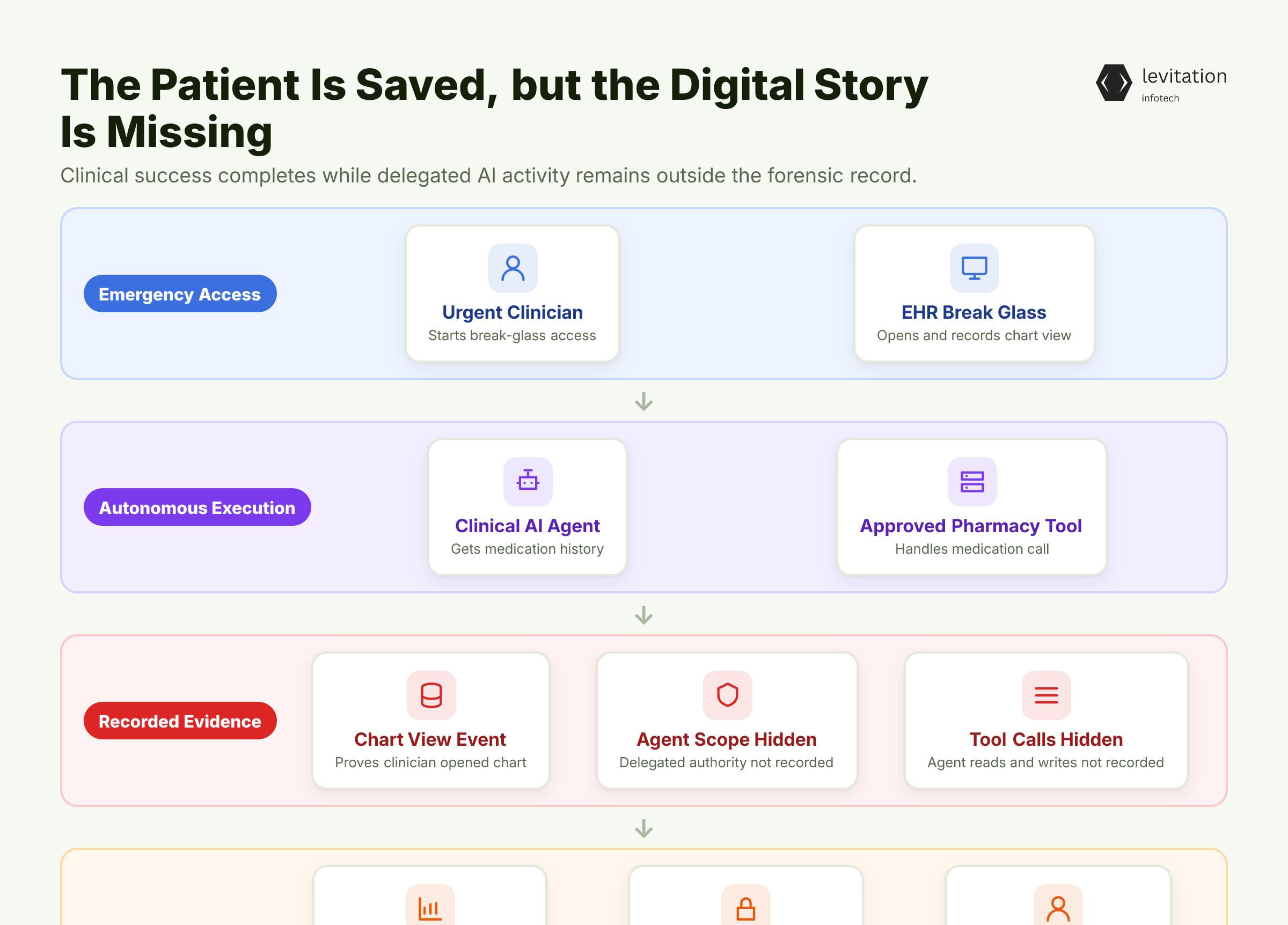
A clinician needs fast access during an urgent clinical episode. They use EHR break glass while an AI agent gets medication history and calls an approved pharmacy tool. The EHR records the clinician's chart view. However, the agent's delegated scope and tool calls stay hidden everywhere else.
That gap matters in AI in healthcare because clinical and audit work fail in different ways. The patient receives the right drug at the right time. However, the forensic record still cannot say who authorized what.
A successful emergency path can still produce weak evidence
The EHR proves that a clinician opened a chart. It does not prove what the agent saw, changed, or could change.
The evidence chain can fail in several ways: - No event was created: The system did sensitive work without any lasting record. - The event is incomplete: It names the chart view but leaves out the agent's reads and writes. - Correlation fails: Identity or timing cannot be matched across the EHR, agent, and tools. - Evidence is fragile: Records can be changed, lost during an outage, or impossible to match.
Care and forensics answer different questions. Clinical success asks whether the action helped. Forensic success asks who accessed what, under which authority, and why.
Emergency access must show why it was needed. It must also limit scope and time, and name who was responsible.
A good outcome cannot repair a missing chain.
What breaks when emergency access collides with autonomous execution?
Why Emergency Overrides Break AI Audit Trails
An extra EHR log line looks enough. It arrives too late.
The EHR event records the clinician and patient context. It misses the agent's full path unless another system links it on purpose. That path includes model use, tool calls, records pulled, delegated identity, and later clinical writes.
The operating test for break glass is strict. Access must respond to an urgent clinical or safety risk. It must also be temporary, name who acted, and have a later human review.
Convenience, broad curiosity, and a stuck noncritical workflow do not qualify.
Human break glass cannot simply pass to an agent. A licensed professional uses judgment. An agent acts through a software identity. It can also do work across many reads and writes.
Six discontinuities can break the chain - Identity: The EHR knows the clinician, while a tool sees only a shared service account. - Scope: Chart access does not show the agent's allowed tools, destinations, or write actions. - Action: Pulling records, using the model, running tools, and making clinical changes lack one shared event chain. - Time and ordering: Clock drift and async delivery can place authorization after the action it supposedly allowed. - Evidence durability: Agent memory can disappear easily. An outage can also erase logs before anyone can reconcile them. - Dependency availability: A failed resolver or audit store can silently change the approved path.
Tokenization also changes the emergency design. Real values should still resolve only at approved destinations. An override must not expose unrestricted PHI to the model.
HIPAA emergency access and EHR authorization do not define an AI agent's authority. Any clinical AI design needs its own delegated-access and evidence model.
The answer cannot be another role flag in the EHR. It must keep one chain of authority from the clinician to the agent and every tool it calls. How can that chain stay narrow during an emergency?
Bind Emergency Authority to a Capability, Not the Model
That chain starts with a signed emergency grant for one code-blue episode. It expires automatically, and every action must fit inside it.
A trusted access broker should bind the grant to the human actor and delegated agent identity. It should also bind the grant to the patient or encounter. The grant should contain: - Human actor and delegated agent identity. - Patient and encounter references. - Allowed action classes and reason. - Authentication evidence and policy version. - Issue time, expiry, and grant identifier.
An authorized clinician must declare the emergency and activate the grant. Model advice does not grant access. The model must never infer emergency status or approve expanded access for itself.
The broker should enforce the same grant at each boundary. This covers record pulls, model use, tool calls, and clinical writes.
Requests fail if the grant has expired. They also fail if the action falls outside its scope. They fail again if the destination is outside the grant's allowed audience.
Adding EHR AI to a chart workflow does not create authority. The broker must pass that authority to every downstream service.
Support two safe patterns and reject one shortcut
Two patterns keep both speed and control: - Clinician-facing retrieval: The agent shows emergency information through an approved interface. The clinician receives it directly. - Trusted execution proxy: A proxy resolves real values just in time for one specifically authorized destination. The model never receives unrestricted PHI.
Both patterns issue narrow grants. Neither turns an emergency into global PHI access.
An unknown-patient emergency needs a separate grant. Allow only bounded search or read actions, require elevated review, and deny indiscriminate writes.
The narrower pre-authorized path should be the fallback destination in degraded mode.
Availability must come from controlled redundancy, not a global fail-open state.
Once emergency authority becomes an explicit delegated access grant, the design becomes clear. Define the grant, record evidence at every step, and make degraded operation safe. The next test is harsher: can the evidence survive the failure that made the emergency necessary?
Build an Audit Trail That Survives the Emergency
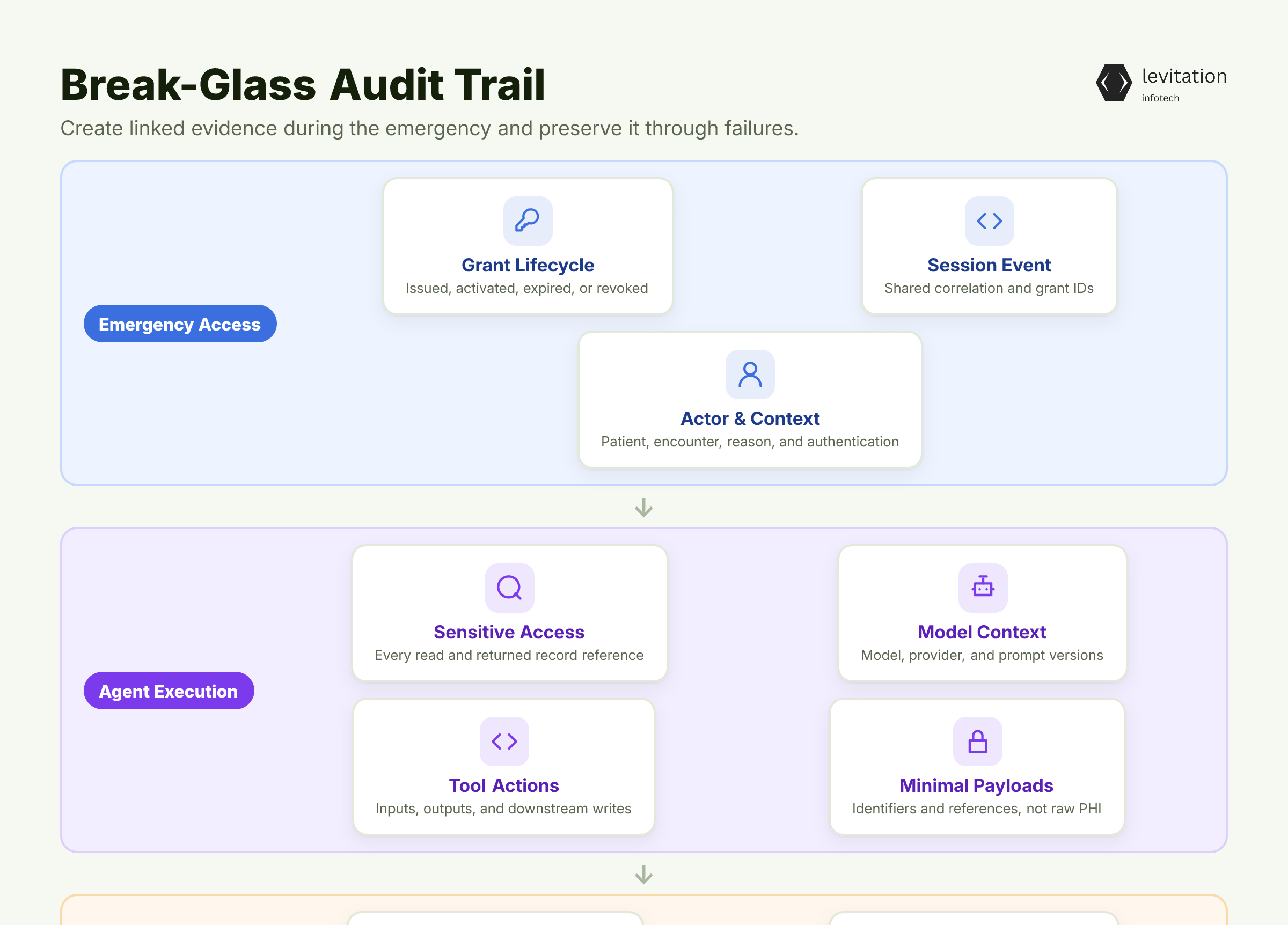
A break-glass design must create evidence during the emergency. Evidence assembled after recovery is not an audit trail.
Every emergency starts with one session event that has a shared link. A compact JSON payload should contain: - Event identifier, correlation identifier, and emergency grant identifier. - Actor user identifier and agent service identifier. - Patient and encounter references. - Reason code and authentication method. - Scope, policy version, and occurrence time.
Downstream events reuse the correlation and grant identifiers. They avoid copying raw prompts or unnecessary PHI into every payload.
Log the full chain, not just the opening door
The evidence chain must include: - Grant issuance, activation, expiry, or revocation. - Every sensitive read and returned record reference. - Model and provider version. - Prompt-template identifier. - Tool, input reference, output reference, and downstream write. - Later human review and outcome.
Write events through durable append-only or tamper-evident storage. Keep the source-of-truth ledger outside the agent's memory and application process.
Use idempotency keys, ordered event identifiers, retry-safe delivery, and synchronized clocks. Link the AI event with the EHR authorization and clinician session. Keep the reason that started the session and each step's action. One reason cannot explain every tool call.
Outages need a designed evidence path, not improvisation: - Signed, short-lived grants. - Protected local event queues. - Deterministic reconciliation after reconnection.
Use a manual log only as a last resort. It must capture actor, patient, time, action, reason, and reconciliation status.
Vendor claims also need checks in real use. When comparing top AI companies for healthcare in India, treat delivery credentials as a starting filter. Commercial claims do not prove break-glass evidence, so each system still needs separate tests.
That check also applies to the tool-call audit gap. Vendor claims should be checked against the real audit boundary. Review what was captured, where it was stored, and whether it can be rebuilt after failure.
An audit design that works only when every dependency is healthy is not a break-glass design. Can the control plane face the same failures it is meant to bypass?
Test the Failure Paths EHRs Rarely Exercise
Start with failures that change authority, timing, or data. A healthy-path demo misses the design that matters.
Build a scenario matrix around identity, time, and data: - Identity-provider outages. - Partial EHR failure. - Model-gateway timeout. - Unavailable value resolver. - Audit-store interruption. - Network partitions. - Expired credentials. - Wrong-patient selection. - Unknown-patient emergencies. - Concurrent sessions. - Agent and tool retries.
Retries cannot duplicate a clinical side effect. Use idempotency for event intake and downstream writes. Reconcile duplicate and out-of-order delivery afterward.
Clinical writes need the same idempotent-retry protections discussed in idempotent retries.
Establish five release invariants
Gate every release on five invariants: - No emergency-path sensitive action occurs without an active grant. - Every action stays within its patient and capability scope. - Every action carries a complete correlation chain. - Evidence survives an application crash. - A reviewer can reconstruct access without the agent's explanation.
For health tech AI, these invariants are the release gate. They are not an optional audit checklist.
Use synthetic patient data in automated integration, failure-injection, and recovery tests. As synthetic patient data is not a privacy guarantee explains, the test does not prove privacy by itself.
Run a separate tabletop exercise. Clinical, privacy, security, and platform owners review a sampled emergency session and a disputed agent action.
Test EHR authorization as an end-to-end contract. The trigger, broker decision, agent identity, tool permission, and audit event must agree. They must share the same actor, scope, patient, and time. A correct break-glass screen proves little if downstream services read the grant differently.
Once these paths are rehearsed, emergency access becomes an operating control. The remaining question is simple: how will you know it still works after launch?
Measure, Review, and Prove Every Emergency
Measure the gap between clinical action and defensible evidence. If that gap grows, the emergency path is drifting.
Monitor these signals: - Time from emergency declaration to authorized access. - Audit completeness for sensitive actions. - Events with no actor and orphan evidence. - Scope violations. - Event-sync lag. - Duplicate clinical side effects. - Manual-log reconciliation status. - Retrospective review findings.
Establish baselines first. Do not invent unsupported performance targets.
Give each discipline a different review question
One session can need three judgments: - Clinical leadership reviews care necessity. - Privacy and security teams review authorization and scope. - Platform owners review evidence completeness and recoverability.
Use a controlled reason taxonomy. Preserve the clinician's explanation as a linked reference.
Record policy and grant versions in the operating record. Reviewers must judge access against rules active at the time. A policy rewritten after the incident cannot fairly explain the earlier decision.
When evaluating ai for healthcare, require working evidence, not only a logo wall. Commercial deployment claims are filters, not break-glass acceptance tests.
Claims of HIPAA compliance for leading Indian hospital chains should be tied to current references and scoped checks. Deployment duration and delivery speed should be measured under the same scope and acceptance criteria.
When reviewing a provider such as Levitation, require production evidence for the specific emergency-access workflow. Do not rely on a broad deployment count.
Done well, the organization can deliver time-sensitive AI support without creating a hidden backdoor. It can rebuild every action with real impact after the fact.
About the author
Mayank Singh is a software developer at Levitation Infotech, where he builds web and AI-powered applications across the company’s fintech, healthcare, and enterprise projects.