


TL;DR: A synthetic patient record can still expose whether a person's source data was used. A defensible release needs lineage-aware threat modeling and reproducible membership-inference testing on the exact artifact. Privacy, training utility, and clinical use each need separate approvals.
Key Takeaways: - Fully synthetic data breaks row-level linkage, but source-participation signals can remain. - Privacy must be tested across the release chain, not inferred from the dataset label. - A release gate should combine threat modeling, reproducible attacks, clinical validation, and named ownership.
A Synthetic Record Can Still Carry a Membership Signal
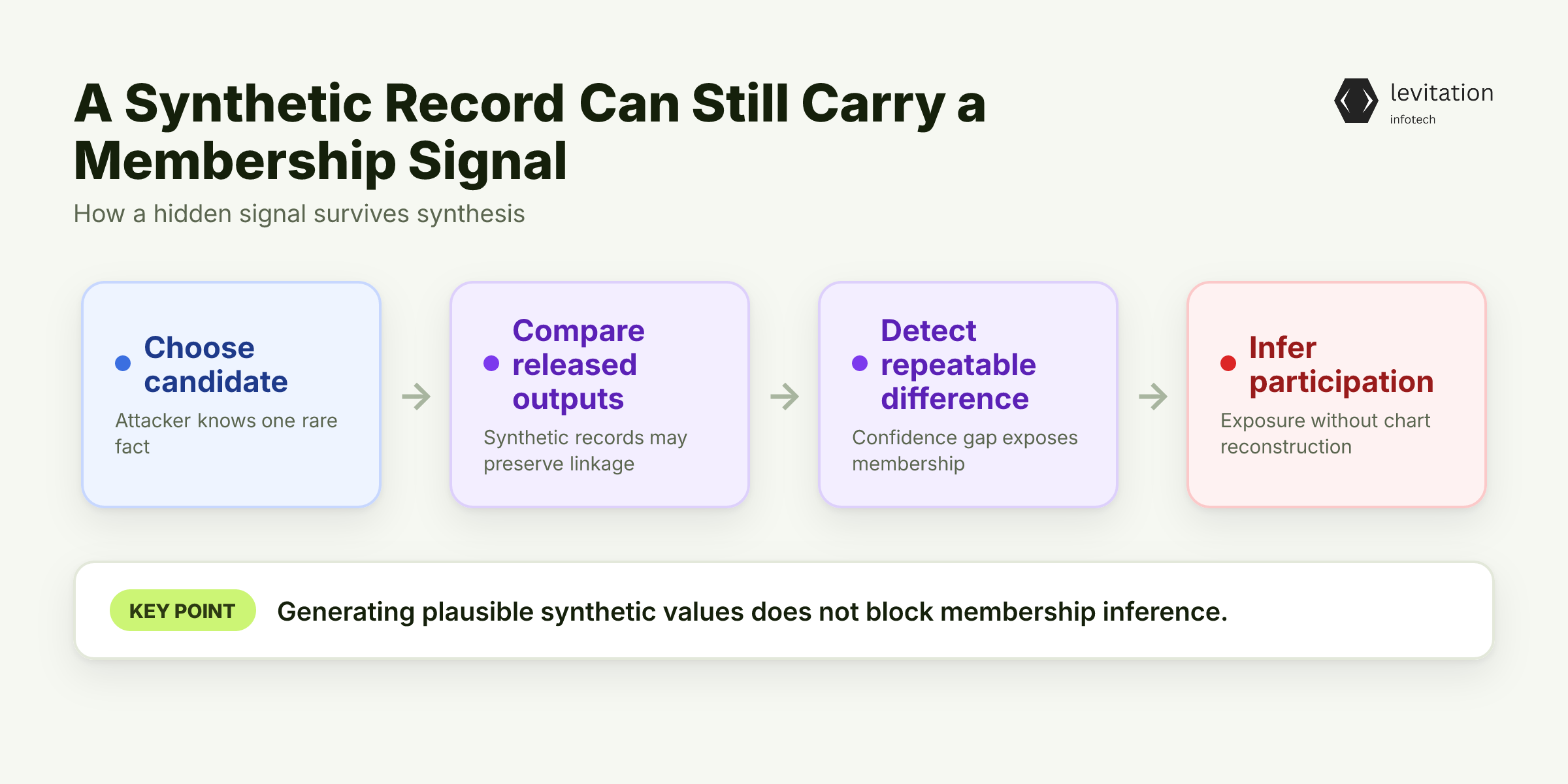
Generate a patient record with a fake name, fake age, and fake diagnosis. It can still reveal what the attacker wants to know: whether that person's source record was used.
That is the tension at the heart of synthetic patient releases. A dataset can look new while preserving signals from the people who shaped it.
Synthetic patient data describes how values are produced. It does not show whether membership inference is blocked. The next question is where those signals survive.
The False Privacy Shortcut
Teams often begin with a reassuring checklist: fake names, altered dates, and no direct identifiers. That proves less than it appears.
Generating plausible clinical values does not hide the source relationship. A fully synthetic record can still support membership inference.
This distinction matters within broader healthcare technology workflows. Synthetic data feeds software development, analytics, and AI model development.
Consider an attacker who knows one rare fact about a candidate. They compare confidence across released outputs. A repeatable difference can reveal participation without reconstructing the chart.
What the Attacker Learns
Membership inference asks whether an individual's source record entered the training process. Identity reconstruction tries to recover identity or sensitive values.
These are different outcomes: - Membership: Did this person's source data influence the release? - Reconstruction: Can the attacker recover the chart or identify the patient?
An attacker can fail at reconstruction and still succeed at membership inference. The first leak exposes participation. The second exposes content.
That difference makes the release artifact the next concern.
The Artifact That Matters
Privacy is not a property of a CSV file. It is a property of the complete release chain.
Build an inventory before testing: - Source dataset and cohort labels: Membership ground truth and access paths. - Generator model: Memorization, extraction, and inversion risks. - Synthetic training corpus: Repeated patterns and hidden linkage. - Released records: Row-level or corpus-level signals. - Downstream models: Source influence through model training. - APIs: Repeated query behavior and exposed responses.
Each artifact creates a different attack surface. The right test depends on what actually crosses the trust boundary.
This resembles the error behind a tenant filter treated as a complete PHI boundary. A control at one layer cannot secure the whole chain.
If the dataset label is not the security boundary, the generation method becomes the first place to look.
The risk changes sharply when fully and partially synthetic records enter the same release.
Fully Synthetic and Partially Synthetic Fail Differently
Fully Synthetic Generation
Caroline Morton's review separates two generation modes. In fully synthetic data, a model learns the source distribution and samples new records.
This breaks explicit one-to-one mapping between a synthetic row and a real patient. The research summarized in Morton's review finds this approach less susceptible to membership inference than partially synthetic data.
Less susceptible isn't immune. A generator can still encode source influence through rare examples or correlated outputs.
Generator controls belong in AI/ML training, not on a synthetic-data badge. A model's training process remains part of the privacy boundary.
That leaves a sharper question for partial synthesis: what does a direct source relationship preserve?
Partially Synthetic Transformation
Partial synthesis transforms each real record into a synthetic counterpart. The implicit one-to-one relationship survives.
Zhang, Yan, and Malin's comparison finds partially synthetic data more susceptible. Row-level lineage becomes a direct attack surface.
A release may mix generation modes, so the label must live at field and record level. Otherwise, one transformed field can hide inside a dataset called fully synthetic.
Before release, make the team label every field and record: - Real: Carried forward without meaningful transformation. - Transformed: Produced from one identifiable source record. - Generated: Created directly by the generator. - Sampled: Selected from a source cohort or model distribution.
Then trace where source membership can still influence the output. A generated diagnosis linked to one source patient needs more scrutiny than a fully sampled field.
The remaining question is whether full synthesis removes every path from source membership to output.
Why Fully Synthetic Is Not Immunity
Even without direct row linkage, membership inference can reveal whether individuals from the original dataset participated in generation. Risk must be evaluated, not inferred from a generation label.
Privacy testing must also cover downstream training. Whether a person influenced the generator and whether their data influenced a later model are different questions.
Switching from partial to full synthesis does not remove the need for privacy testing. A harder question remains for a CTO: which property should be demonstrated before synthetic data crosses the trust boundary?
Privacy Is a System Property, Not a Single Metric
Three Claims That Must Stay Separate
Privacy evidence must answer three separate questions: - Are direct identifiers absent? - Can outputs be linked back to source data? - Can membership inference detect source participation?
Passing one does not establish the others. A fake name can still accompany a source-driven diagnosis.
This distinction matters because each claim describes a different attacker capability. Removing identifiers does not defeat membership inference. Breaking row linkage does not eliminate correlated source influence.
That leaves the harder task of measuring privacy without a universal score.
No Universal Privacy Score
Morton's central warning is clear: privacy in synthetic data is not a single number. No metric works as a universal standard.
Report the threat model, tested artifact, attack assumptions, and result together. An AUC without cohort definitions and access conditions cannot support a release decision.
This follows the discipline in AI data provenance. A performance claim without lineage is incomplete.
The same separation applies when teams measure utility.
Utility and Privacy Are Different Gates
A dataset can look clinically realistic for AI/ML training while still exposing membership signals.
Keep separate scorecards for: - Task-specific model utility. - Distribution and schema fidelity. - Privacy attack results.
A model can pass one scorecard and fail another. Clinical realism does not cancel an inference signal.
A third gate is needed before any of those results inform patient care.
Clinical Validity Has a Third Gate
BMJ Evidence-Based Medicine notes that synthetic healthcare data is not broadly trusted as a standalone source for clinical decisions.
Training suitability, privacy, and clinical authorization therefore remain separate decisions. One approval cannot silently cover all three.
Package the result for AI governance: - Data lineage and generation mode. - Source manifest and released artifact. - Attack results and known limitations. - Named approver and accepted exceptions. - Conditions that trigger retesting.
The package must also identify the exact tested artifact and attack assumptions. Otherwise, approval applies to an untested release.
Once privacy becomes a release decision, the test must be concrete enough for another engineer to reproduce. The next release gate must make that reproduction routine.
Build a Reproducible Membership-Inference Release Gate
Define the Threat Model
Start with the attacker's question, not the security tool.
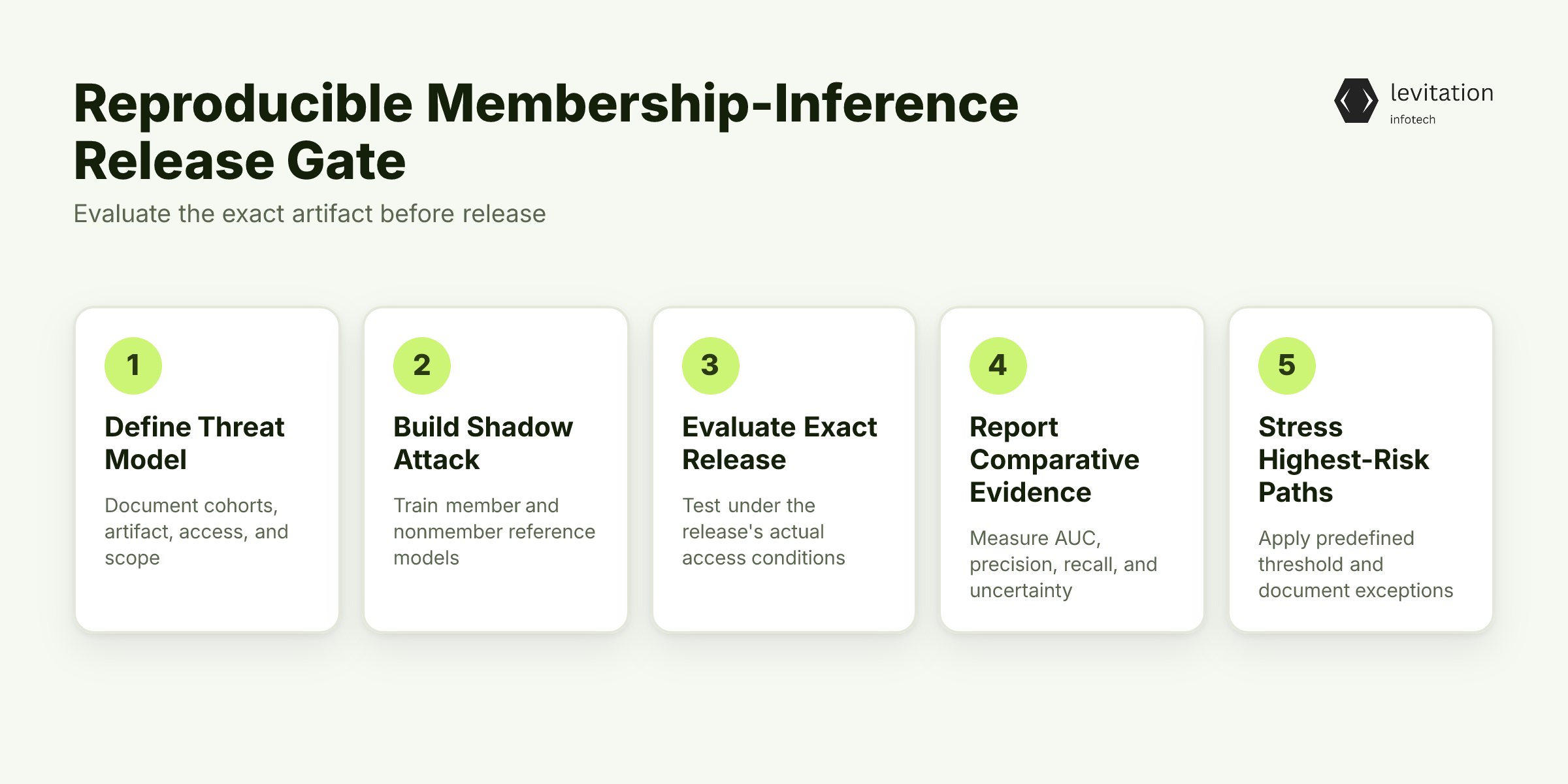
Document: - Source cohort and member definition. - Nonmember definition. - Generator training lineage. - Released artifact and interface. - Attacker access and auxiliary information. - Scope: source participation, downstream training, or both.
Members are people whose source records appeared in the generator's training set. Nonmembers did not. Evaluation supplies labels the attacker would not possess.
Testing on held-out members and nonmembers shows whether the signal generalizes beyond memorized examples.
Define membership at person level, not row level. Otherwise, duplicated records can distort the cohort, as shown in patient deduplication benchmarks.
With cohorts defined, the attack can test the release instead of a stand-in.
Run a Shadow Attack
Build member and nonmember shadow datasets. Train reference models on each. Use their outputs to train a membership classifier.
Evaluate the classifier against the exact generator, synthetic corpus, or downstream model being released. A generic synthetic-data benchmark says little about your release.
For a corpus, test the attack under the release's access conditions. For a model or API, test behavior visible through its interface.
Attack the released artifact, not a convenient proxy.
The results need context before they can guide a release.
Report Comparative Evidence
Include complementary measures: - Membership-inference AUC: Ability to rank members above nonmembers. - Precision: Share of flagged cases that were true members. - Recall: Share of actual members detected. - Baseline comparison: Advantage over a simple reference. - Uncertainty: Confidence intervals or another cohort-appropriate method showing estimate stability.
Treat these as evidence, not a certification score. No universal cutoff fits every artifact.
Set a context-specific decision threshold before testing. Then report exceptions explicitly, with evidence and a named approver.
The highest-risk paths still need a targeted stress test.
Stress the Highest-Risk Paths
Test conditions most likely to expose weak protection: - Partially transformed records. - Rare patient profiles. - Small cohorts. - Unusual attributes. - Memorization-prone examples. - Attackers with auxiliary knowledge.
Compare fully and partially synthetic pipelines under identical assumptions. Otherwise, differences may reflect the test rather than the data.
Even strong results depend on whether another team can repeat them.
Make the Test Repeatable
Package the attack code, cohort definitions, seeds, model checkpoints, release manifests, and results in version control.
Require: - A pre-agreed decision threshold. - A named release approver. - Automatic retesting after generator changes. - Retesting after source-data changes. - Retesting after downstream-model changes.
Tie the gate to model development and monitoring in AI/ML training. Record exceptions and approvals in AI governance.
Another engineer should reproduce the attack without asking tribal knowledge. A passing test proves only what was tested. It does not make synthetic records suitable for every clinical purpose.
The next question is how broadly the release can be reused.
Match the Synthetic Pipeline to the Clinical Decision
Prefer Stronger Isolation for Broad Reuse
Fully synthetic data is the stronger starting point for exploratory analysis, software development, and model training. The generator's residual membership risk still needs testing.
Broad reuse also means broader access. Match the test to the released artifact and its actual users.
That risk is harder to control when each real record keeps a traceable source.
Restrict Partially Synthetic Data
Keep one-to-one transformations inside controlled environments. Preserve row-level lineage, enforce least-privilege access, log access, and set retention limits.
Don't describe these outputs as anonymous. Their source relationship is part of their risk.
They can still support useful work, but they do not qualify for use in patient care without separate authorization.
Separate Training Utility From Clinical Authorization
A dataset that supports a useful AI/ML training workflow has not earned a role in patient care.
Validate the intended clinical use separately. Do not use synthetic-only evidence as a standalone basis for clinical decisions.
Even approved data must be used only in settings that match its purpose.
Preserve the Operating Context
Test schemas, longitudinal relationships, and clinical distributions against the target task. Keep those utility metrics separate from privacy claims.
Release inside the actual healthcare technology context. A safe research file can become unsafe through a downstream integration.
Use the intended purpose to set access and evidence requirements: - Research: Controlled cohort, lineage, membership test, and named approver. - Software development: Sandbox access, synthetic release, and restricted queries. - Model training: Task utility, privacy testing, and change-based retesting. - Exploratory analytics: Scoped cohort, query limits, and disclosure monitoring. - Clinical decisions: Clinical validation, real-world evidence, oversight, and formal authorization.
Each use case changes who can access data and what evidence must exist.
The remaining risk is organizational, not technical.
Make Membership Risk a Clinical AI Governance Decision
Assign Accountable Ownership
Name the data owner, security tester, clinical validator, release authority, and incident owner. Give each role a defined decision, not shared responsibility.
Define which changes require a new attack test, clinical review, or both. Record exceptions with an expiry and accountable approver.
Those decisions also need a record that survives outside one team's memory.
Preserve an Audit Trail
Version the source-data manifest, generator, synthetic releases, attack code, approvals, and exceptions. This creates a chain another reviewer can reconstruct.
Monitor access to partially synthetic outputs. Investigate unexpected membership-inference signals as privacy incidents, not model-quality noise.
The same evidence standard applies when a vendor supplies the pipeline.
Separate Build-Versus-Buy Evidence
When evaluating vendors through top AI companies for healthcare in India, ask for three items: - End-to-end dataset lineage. - Reproducible membership-inference results on the exact release. - Explicit boundaries for clinical use.
Use operational track record to assess delivery reliability. It cannot prove synthetic data resists privacy attacks.
Long-term control also depends on how the program handles change.
Make Longevity Part of Governance
A clinical AI governance program must survive model updates, staff changes, and new attack methods. Governance should extend across healthcare technology integrations, not stop at dataset release.
Model updates can change exposure, as clinical AI retraining outpaces audit reviews illustrates. A release gate must therefore remain active after deployment.
Teams can use synthetic patient data to widen access and accelerate AI development. Replace unsupported privacy claims with scoped, testable, and auditable decisions.
Who owns the release after the generator leaves the lab? That role turns a one-time test into durable control.
Frequently Asked Questions
Is synthetic patient data always private?
No. Fully synthetic data is generally less susceptible to membership inference than partially synthetic data. It is not immune. An attack can reveal source participation.
Privacy depends on the complete generation pipeline, released artifact, attacker assumptions, and release controls.
The difference starts with how each record is produced.
What is the difference between fully and partially synthetic patient data?
Fully synthetic data samples from a learned distribution, breaking explicit one-to-one patient mapping. Partially synthetic data transforms each real record, preserving implicit mapping.
That retained mapping is why partially synthetic data is more susceptible to membership inference.
Use that distinction to scope the next release, then retest whenever its lineage changes.
About the author
Mayank Singh is a software developer at Levitation Infotech, where he builds web and AI-powered applications across the company’s fintech, healthcare, and enterprise projects.