


If your MLOps pipeline cleared a model risk audit in 2024, it is now a liability. The 2026 review does not care what passed last year. It asks for evidence your current pipeline was never designed to produce.
TL;DR: A 2024 audit pass is a snapshot, not a shield. The 2026 model risk audit is a longitudinal investigation. It demands replayable lineage, acted-upon drift alerts, redacted inference logs, and a vendor risk ledger your stack likely cannot export. Surviving the re-audit takes a control-plane architecture, not a tool refresh.
Key Takeaways: - A prior audit sign-off is a snapshot. The 2026 review is a longitudinal investigation. - Auditors now demand four evidence categories most stacks cannot export on demand. - The gap is architectural. Siloed tools create disconnected ledgers no single export can stitch. - Incremental 90-day layering beats big-bang MLOps refactors when regulators are circling. - A pipeline that produces evidence continuously turns audits from fire drills into one-day exercises.
Approval Is Not a Shield, It Is a Starting Gun
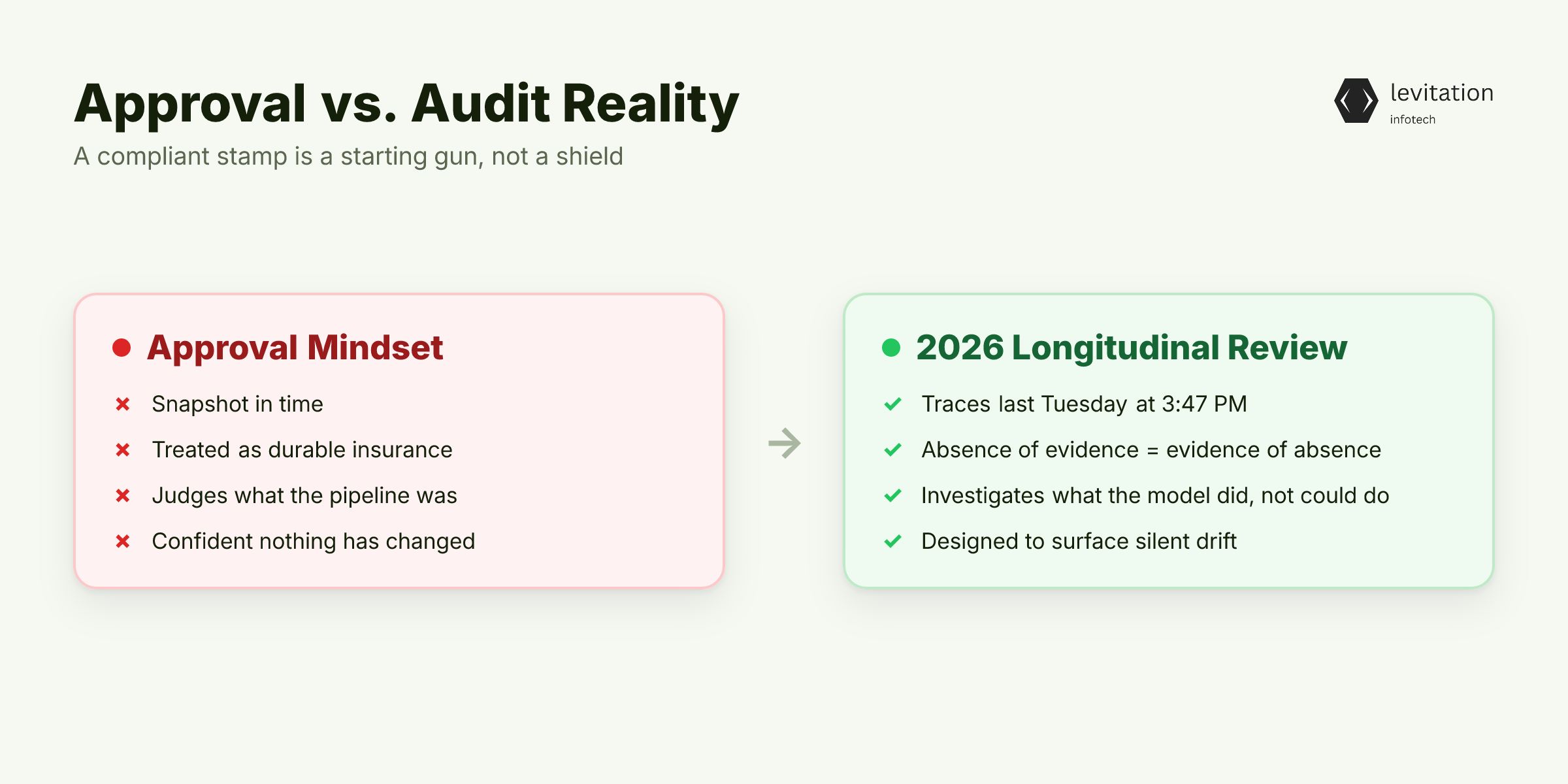
The moment your MLOps pipeline earned its "compliant" stamp is the moment the clock started. Compliance failures rarely happen at model approval. They happen in the gap that follows. The production system drifts, the team rotates, and the original controls stop matching what is actually running.
A pipeline that satisfied the 2024 review was judged on a snapshot. The 2026 review is a longitudinal investigation.
It traces what your model did last Tuesday at 3:47 PM, not what it could do under ideal conditions. That gap is where audit findings live.
CTOs who treat prior sign-off as durable insurance are the ones auditors flag first. They walk into the re-review confident nothing has changed. They leave facing a finding: the absence of evidence is itself the evidence of absence. The examiner does not need to prove you broke a rule. They only need to prove you cannot prove you did not.
This is why prior approval matters less than most leadership teams think. It measured what the pipeline was, not what it is. The drift between those two states is what the 2026 review was designed to surface. Your MLOps Pipeline Is Undermining Model Safety walks through how silent drift erodes the very controls the audit certified.
But here is the part most teams miss: the 2026 audit is not a more rigorous version of the last one. It is a different exam entirely. The syllabus has changed in ways most MLOps stacks have not caught up to. For a structured readiness walkthrough, our MLOps audit readiness framework maps the gap from current state to audit-survivable state.
The 2026 Audit Is Asking Four Specific Questions Your Stack Cannot Answer
The 2026 model risk audit does not begin with "show me your model card." It begins with four evidence requests, each harder than the last.
Evidence type 1: full model lineage. Not a summary. The complete chain: every data version, hyperparameter, code commit, and environment hash that produced the deployed artifact. Auditors want to reproduce a specific decision from the registry alone.
Evidence type 2: prompt and inference logs with PII redaction that can be replayed. A redacted log is useful only if the redaction preserves the analytical structure of the original. Auditors pick a random transaction, ask for the full input-output trace, and verify the redaction did not break the model behavior:
1{2 "trace_id": "req_8f3a2c",3 "model_version": "credit-llm-v2.4.1",4 "input_hash": "sha256:9a2f...",5 "redacted_input": "[PII_REDACTED] Customer requested limit increase for account ending 4421",6 "output": "approved_with_review",7 "latency_ms": 847,8 "timestamp": "2026-03-15T10:23:45Z"9}
If the redaction layer is a downstream filter, the replay fails. The redaction must happen at write time, before the log is stored.
Evidence type 3: drift-monitoring output that proves the team acted on alerts. A dashboard showing drift spiked on February 12 is not enough. Auditors want the runbook the alert triggered, the ticket it opened, and the model change (or non-change) that resulted.
Unactioned alerts are treated as ignored alerts. Ignored alerts are treated as governance failures. The full control mapping is in model risk management for LLM systems.
Evidence type 4: vendor risk assessment for every third-party LLM in the inference path. Not just the primary vendor. Sub-processors, embedding providers, the vector database, the API gateway. Each one needs a documented risk assessment with a defined review cadence.
For organizations where vendor procurement is already a security discipline, this ledger often exists in procurement. The audit question is whether it is wired into the MLOps evidence trail or sitting in a shared drive.
Knowing the four questions does not help if the SaaS vendors underneath you cannot produce the answers. And most cannot. The tools most teams chose in 2022 and 2023 are exactly where the gap comes from.
Why Standard MLOps Tooling Creates the Audit Problem
The tools most teams adopted in 2022 and 2023 were built to ship models, not to defend them. That distinction is where the audit gap lives.
Siloed operations. Feature stores are owned by data teams. Registries by ML engineers. Serving infrastructure by platform teams. Each silo maintains its own ledger.
Auditors see a stack of disconnected ledgers, not one audit trail. Stitching them together at audit time takes weeks of manual effort, and manual stitching is exactly what examiners distrust.
Silent breaking changes. Most MLOps failures trace back to architectural gaps no monitoring caught. A schema change in the feature store does not break a metric.
It silently feeds the model a column with the wrong type. A model interface drift produces invalid outputs that pass every dashboard check. The Blind Spot in Your AI Stack That Audits Always Find First documents how these gaps hide in plain sight.
Dashboards over evidence export. Traditional SaaS MLOps vendors optimize for visualization. They expose metrics, not the immutable, queryable history auditors require.
A Grafana panel showing AUC over time is not an audit artifact. An exportable, signed, point-in-time query against an immutable store is. Most platforms never built the second one.
Architecture beats tooling. The gap is not which platform you chose. It is whether the platform was wired into the control plane auditors can read.
The integration seams between the registry, the inference layer, the drift monitor, and the vendor ledger are what determine audit survival. Our MLOps compliance architecture reference lays out those seams.
It is less exotic than the vendor pitch decks suggest, and the next section walks through the five components it actually requires.
The Evidence Pipeline: What an Auditor-Ready Architecture Actually Looks Like
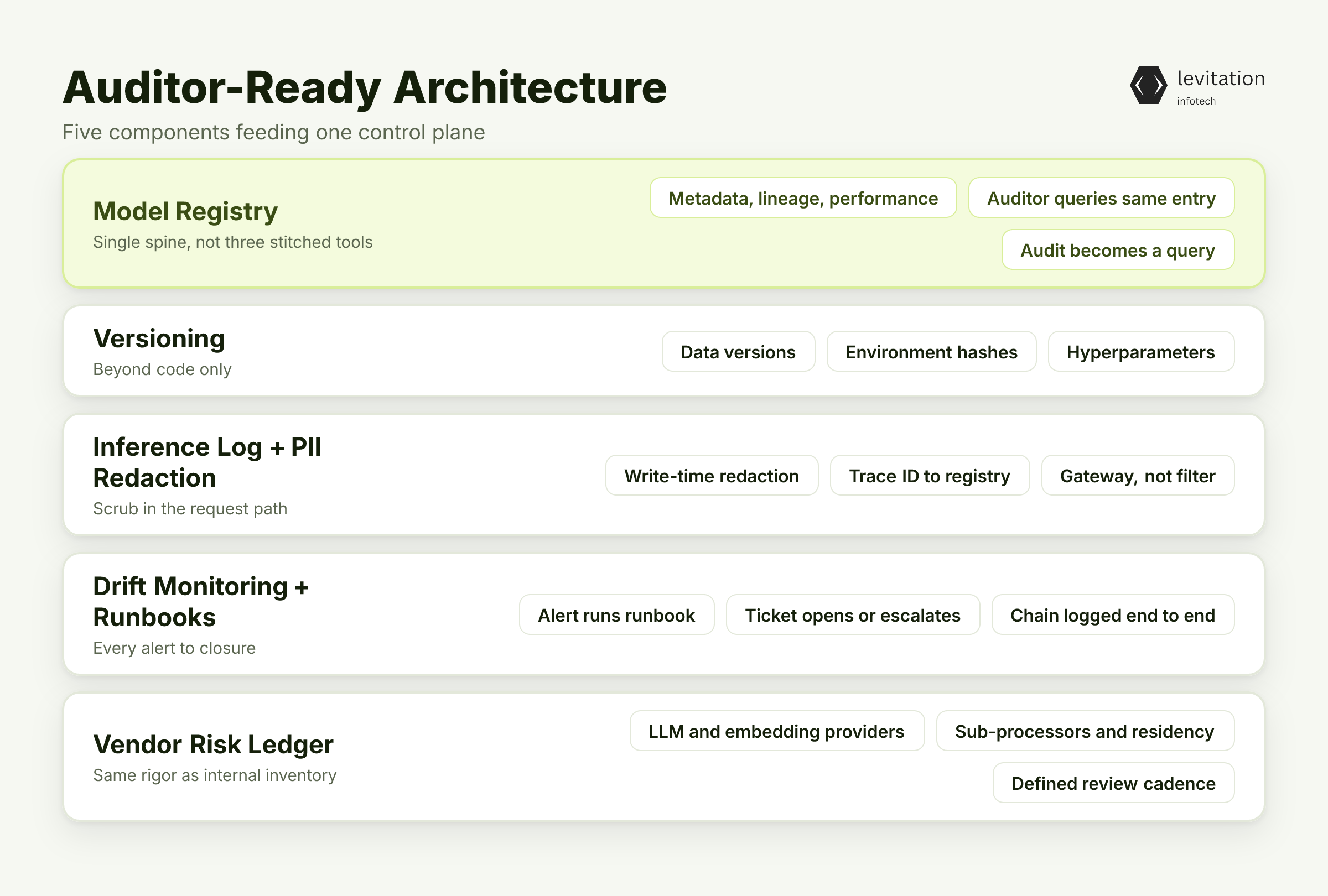
The architecture is not a stack of new tools. It is a single control plane that five existing components must feed into.
A single model registry. Not three tools stitched at audit time. One registry that records metadata, lineage, and performance as one queryable artifact.
The same entry a data scientist uses to look up a model should be the entry an auditor uses to reproduce a decision:
1model:2 name: fraud-detector3 version: 3.2.14 data_version: s3://lake/features/2026-02-155 code_commit: a1b2c3d46 environment_hash: sha256:7e8f...7 hyperparameters:8 learning_rate: 0.0019 epochs: 5010 performance:11 auc: 0.9412 drift_score: 0.0313 approved_by: risk-committee-2026-02-20
If your registry looks like this, the audit becomes a query, not a reconstruction. Your Model Registry Passes Tests. It Will Still Fail Audit. is the longer case for why the registry has to be the spine, not a side table.
Versioning that extends beyond code. Data, environments, and hyperparameters.
Any deployed model must be reproducible from the registry alone, with no tribal knowledge and no "ask Rahul, he remembers."
An inference log store with PII redaction at write time. The redaction layer must be a gateway in the request path, not a downstream filter.
It scrubs PII before persistence and stamps the trace ID back to the registry entry. This is the seam most teams retrofit wrong. Fast LLM Cold Starts Look Like Wins. Auditors See Gaps. explains why performance optimizations often bypass the redaction gateway.
Drift monitoring tied to runbooks. Every alert must link to a defined response procedure. The alert fires, the runbook opens a ticket, the ticket is closed or escalated, the chain is logged.
The auditor pulls a random alert from last quarter and traces it to closure.
A vendor risk ledger. Every LLM provider, embedding service, and sub-processor, updated on a defined cadence with the same rigor as internal model inventory.
Provider, sub-processors, data residency, redaction guarantees, last review date. The same fields your internal models have. For the field set and query patterns auditors actually run, our model registry design guide covers the schema.
Most teams lose months building it under a regulatory deadline. The next section shows how to sequence the work in 90-day increments while the pipeline keeps running.
Building It in 90-Day Increments Without Freezing the Pipeline
The teams that survive the 2026 audit will not be the ones with the biggest refactor. They will be the ones who ship in 90-day increments while the pipeline keeps running.
Days 1-30: consolidate the registry. The highest-leverage move. One source of truth for model metadata, lineage, and performance.
Every other control (gates, drift response, vendor ledger) eventually points back at the registry. Do not start anywhere else.
Days 31-60: layer automated gates. Data validation and model evaluation gates that stop bad artifacts before promotion. The gate decisions themselves are logged as evidence:
1gate_decision:2 artifact: fraud-detector-3.2.13 gate: data_validation4 status: passed5 evidence:6 row_count: 15000007 null_rate: 0.0018 schema_match: true9 decided_by: ci-pipeline-run-782110 timestamp: "2026-03-10T08:00:00Z"
The log is the evidence. A gate that decides silently helps no one at audit time.
Days 61-75: wire alerts to runbooks. Every drift or performance alert must produce a ticket linked to a documented response procedure. The integration is often one webhook. The audit value is enormous.
Days 75-90: stand up the LLM vendor risk ledger. A spreadsheet is acceptable at the start. It must capture the same fields (provider, sub-processors, data residency, redaction guarantees) your internal models have. Move it into the registry later.
Avoid the big-bang trap. Teams that try to refactor the entire MLOps stack in one quarter create the very audit exposure they are trying to eliminate. Mid-refactor, the registry is half-migrated, the gate logs are inconsistent, the drift alerts fire into a void.
The examiner sees chaos. The incremental path keeps the evidence trail coherent the entire time.
The variance between teams is almost entirely a function of how siloed the existing stack was on day one. Teams that start with a more integrated architecture can move faster; teams starting from heavy silos need to invest in consolidation first. Our incremental MLOps governance playbook details the week-by-week sequencing.
The week-by-week sequencing is what separates teams that pass the re-audit from teams that spend the next quarter rebuilding from a finding.
What Changes When Your Pipeline Survives the Re-Audit
A pipeline that produces evidence continuously turns audits from fire drills into one-day exercises. The examiner asks a question.
The team runs a query. The evidence comes back. The audit closes.
The compounding effect is structural, not cosmetic. Systems built on this architecture are durable because the lineage and monitoring are structural, not bolted on.
The controls do not erode between audits. They strengthen as more data accumulates.
For teams scoping a re-audit survival plan, the first conversation is the same regardless of vendor: show us the registry, the log store, the drift runbook, and the vendor ledger. The maturity of those four artifacts tells the whole story. If you are commissioning a regulated MLOps deployments engagement, that is the diagnostic that starts every conversation.
Frequently Asked Questions
What does the 2026 model risk audit focus on for MLOps pipelines?
Four evidence categories: full model lineage (data, code, environment, hyperparameters), replayable prompt and inference logs with PII redaction, drift output with documented response actions, and vendor risk assessments for every third-party LLM in the inference path. Pass/fail model validation is no longer the primary signal.
How is a model risk audit different from SOC 2 or ISO 27001?
SOC 2 and ISO 27001 certify that controls exist. A model risk audit asks for evidence that controls produced the right outcomes for specific decisions, including replayable logs, drift response records, and lineage to the deployed artifact. Evidence-of-outcome, not evidence-of-process.
Can a SaaS MLOps platform pass a model risk audit on its own?
Rarely. Most SaaS MLOps platforms expose metrics and dashboards, not the immutable, exportable, cross-system evidence trail. The platform is a component. The audit-ready architecture is the integration of registry, logging, monitoring, and vendor ledger into one queryable control plane.
How long does it take to make an existing MLOps pipeline audit-ready?
It depends on how siloed the existing stack is on day one. Teams with a more integrated starting architecture move faster; teams with heavy silos need to invest in consolidation work first. The 90-day increment model covers one workstream at a time, with the registry as the highest-leverage starting point.
Sources
Research and references cited in this article:
- Regulated MLOps Governance in 2026
- SOC 2 for AI Companies (2026): What Auditors Test First
- MLOps in 2026 — The Definitive Guide: tools, cloud ...
- MLOps Maturity Model 2026: 4 Stages to Resilient, Risk‑ ...
- MLOps Governance & Compliance for Enterprises
- A Multivocal Review of MLOps Practices, Challenges and Open Issues _(academic)_
- MLOps and model building pipelines: navigating the new frontier of AI | Land Rover
- MLOps and Model Lifecycle Management in Large Organizations
- MLOps and Model Governance
- PDF Integrating Security into MLOps: A Framework for Risk Mitigation
- 7 Steps to Build Your First MLOps Pipeline
- MLOps Pipeline Setup Guide From Development to Production AI
About the author
Mayank Singh is a software developer at Levitation Infotech, where he builds web and AI-powered applications across the company’s fintech, healthcare, and enterprise projects.