


TL;DR: Confidential computing is the only way to run AI inference on PHI without exposing it to the cloud operator's process. Confidential GPU instances carry a per-hour premium. That premium reflects attestation overhead and specialized hardware. The CFO conversation has to shift from peak-line-item shock to risk-adjusted TCO over a multi-year horizon, not capex sticker price.
Key Takeaways: - A signed BAA and a HIPAA-eligible cloud do not encrypt data in use; PHI is cleartext in GPU memory. - Confidential GPU VMs carry a premium that narrows the gap only when paired with vendor performance claims about near-native throughput. - The TCO model that gets signed compares owned cluster vs confidential VMs vs confidential AI-as-a-service, with attestation, key management, and audit storage on the line.
The CFO Problem Nobody Warned You About
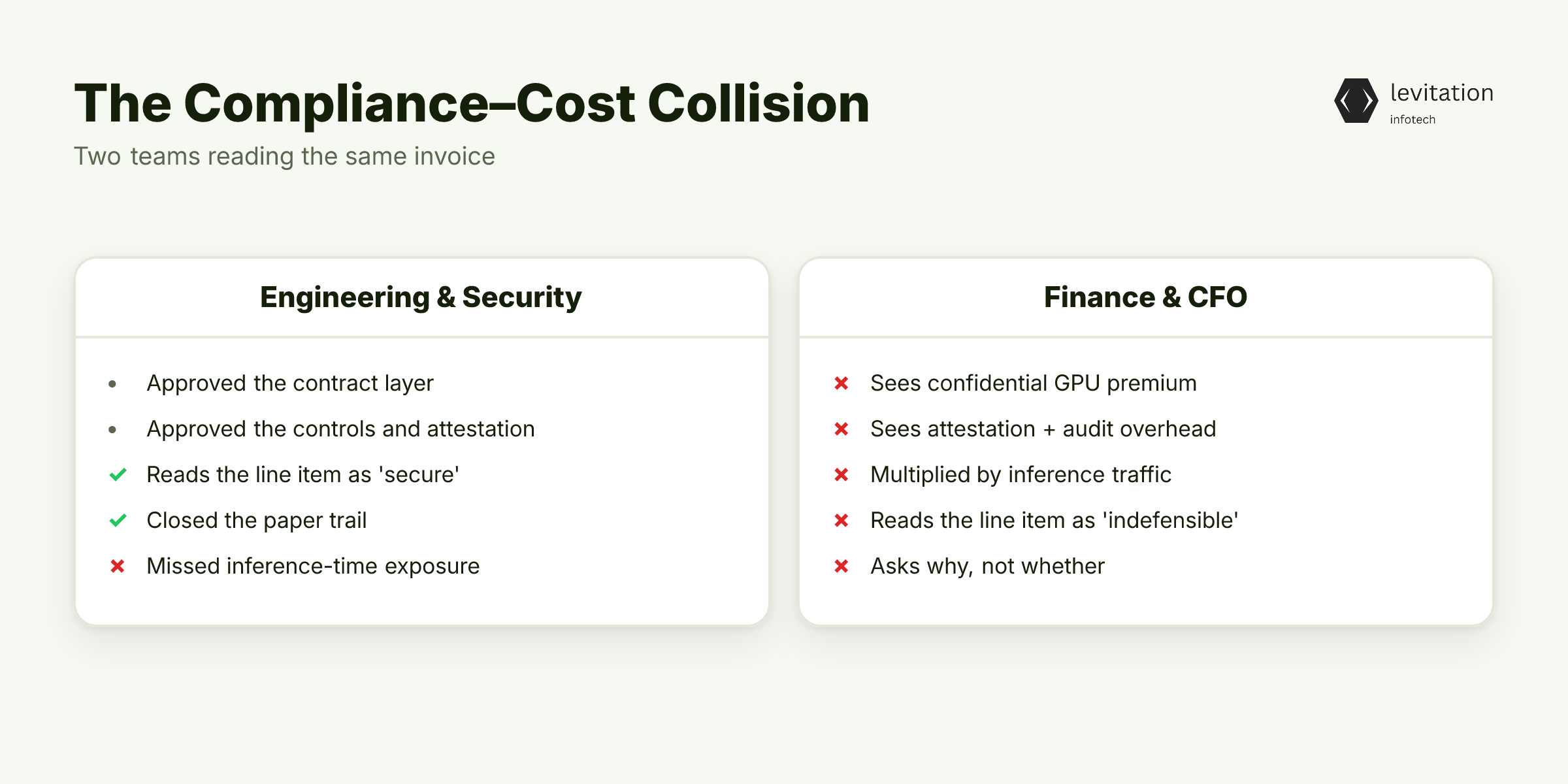
Your compliance team signed off on the architecture. Your security team approved the vendor. Then the invoice landed on your CFO's desk, and confidential GPU instances cost more, with the multiplier driven by attestation overhead and audit-log costs. Welcome to the gap between "HIPAA-eligible" and "actually deployable."
Nobody on the engineering side told finance that a signed BAA and a HIPAA-eligible cloud do not make AI inference HIPAA-safe. The data is still decrypted in GPU memory, visible to the cloud operator, the model host, and any insider with hypervisor access. The compliance team approved the contract layer. The security team approved the controls. Neither closed the inference-time exposure gap. That detail made the meeting worse.
Now look at the bill. Confidential GPU instances (H100 SEV-SNP, H200, and the upcoming Rubin NVL72) carry a premium over standard GPU VMs on every major cloud. That premium is driven by attestation infrastructure and audit requirements.
Multiply that by the inference traffic your AI/ML training pipeline will generate. The CFO sees a line item that looks indefensible next to the existing GPU budget.
The unit economics look brutal before the TCO model is built. Engineers see security. Finance sees the per-hour delta. Both are looking at the same invoice from different angles.
The CFO's first question is rarely "is this secure." It is "why is this so much more than the line item." Compliance-first CTOs feel this collision the hardest: the architecture is right, but the unit economics look indefensible to finance. This is the meeting that kills more HIPAA inference projects than any technical limitation.
The "just use a HIPAA-compliant cloud" advice is what put you in this meeting. Here is why it was never going to work for AI inference.
Why 'HIPAA-Compliant Cloud' Is Not the Same as 'HIPAA-Safe AI Inference'
A Business Associate Agreement covers storage, transmission, and access logs. It does not cover inference-time exposure of PHI to the model operator's process. That is the gap nobody reads in the contract.
When you call a standard cloud AI API, the platform decrypts your prompt and any RAG context inside the provider's GPU memory. The cloud operator, the model host, and any insider with hypervisor access can read that data. The BAA assigns liability, but it does not encrypt the bytes while a transformer is computing on them. Our earlier breakdown of the BAA inference gap shows exactly where the contract layer falls short.
Microsoft built Azure AI Confidential Inferencing to close this exact gap. It combines AMD SEV-SNP TEEs with NVIDIA H100 hardware, registers every model in a transparency ledger, and returns an attestation receipt with each completion. The client cryptographically verifies which model processed which prompt before the data leaves the trust boundary. This is the architecture that makes regulated AI inference deployable, not just eligible.
Healthcare confidential computing enables two things standard encryption cannot.
First, AI inference on PHI inside a hospital's own infrastructure, without exposing data to the inference platform. Second, multi-institution AI research, where each hospital's records stay sealed in their own TEE, and shared model training happens without pooling records.
Both are HIPAA patterns that standard cloud API deployments cannot serve. So confidential computing is required. The next problem is the performance-and-price claim every GPU vendor is suddenly making, and what it means for your bill.
The Near-Native Performance Promise: What the Marketing Leaves Out
NVIDIA Confidential Computing claims near-native performance for AI workloads on next-generation Rubin hardware. That sounds like a rounding error. It is not.
The performance delta compounds across attention layers and KV-cache operations. Per-token cost, not peak throughput, is what hits the P&L. A slowdown on a large-parameter model processing clinical notes adds extra GPU-seconds your budget did not plan for.
Our LLM cost tracking study walks through the curve from 100K to 100M tokens. The shape of the line is brutal.
Confidential GPU VMs (H100 SEV-SNP, H200) still carry a premium driven by attestation overhead and specialized hardware over standard H100 instances on every major cloud. The performance figure narrows the compute-overhead portion of that gap. It does not eliminate the hardware premium.
Engineers get excited about throughput. Finance pays the per-token invoice.
Rubin NVL72 promises a unified security domain across the rack's full GPU and CPU complement, stitched together with NVLink. That is rack-scale confidential AI. It is a capex event, not an opex line.
Buying an NVL72 rack is a data-center build-out with a standard depreciation schedule. It is not a line item you negotiate next quarter. Your AI/ML training team will love the throughput. Your CFO will want a second meeting.
Capex vs Opex: The TCO Math Your CFO Needs
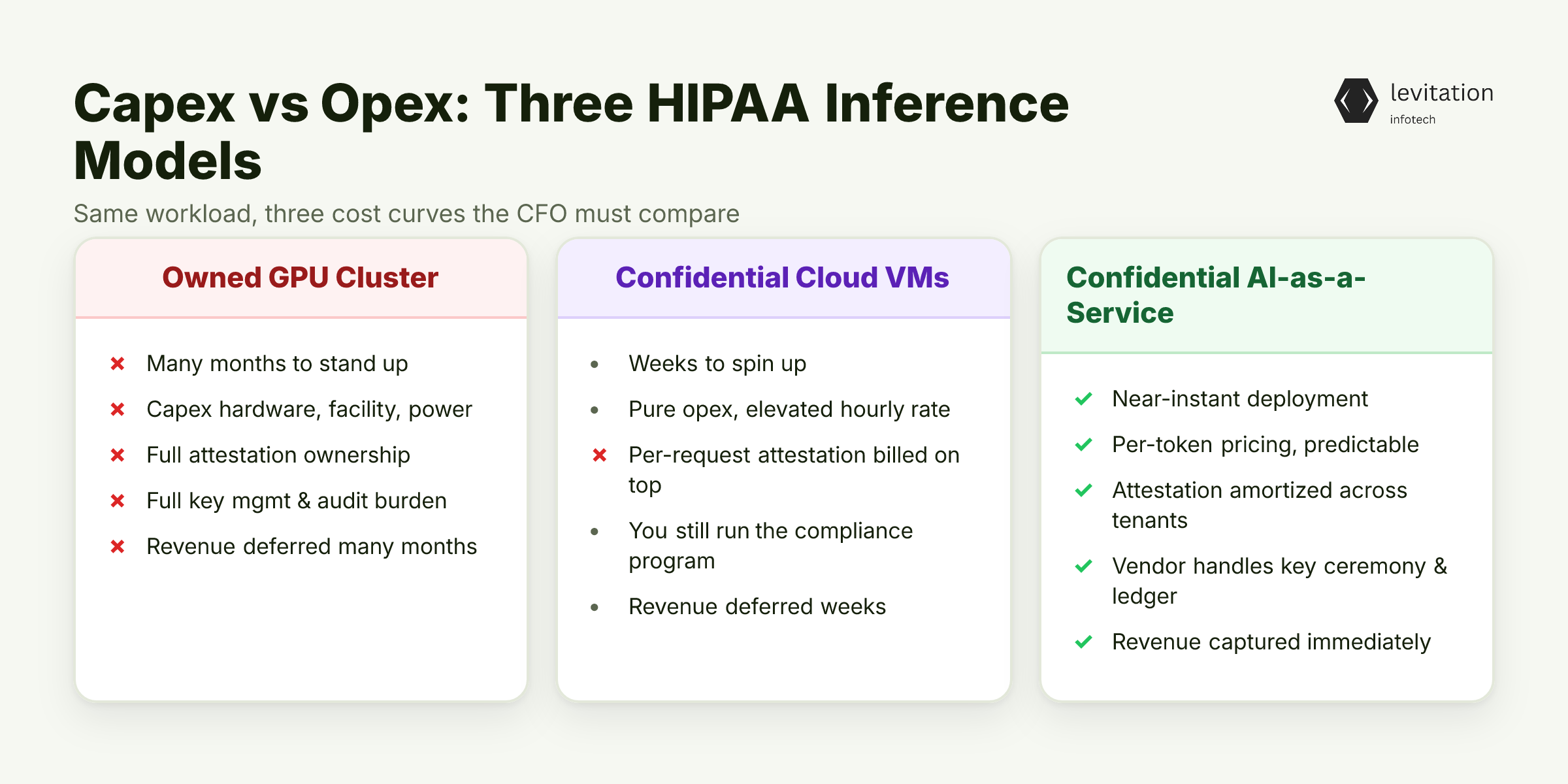
Three deployment models exist for HIPAA-safe AI inference. Each one has a different cost curve over a multi-year horizon. The CFO needs to see all three on the same page. - Owned confidential GPU cluster. Many months to stand up. Capex driven by hardware, facility, and power requirements. Multi-year amortization. You own every compliance audit yourself. Your team handles attestation, key management, and model registration end to end. - Confidential cloud VMs. Weeks to spin up. Pure opex. An elevated per-hour rate that reflects the TEE-enabled hardware. You still pay for attestation, key management, and per-request audit logs on top. The cloud handles the hardware, but you run the compliance program. - Confidential AI-as-a-service. Per-token pricing. Near-instant deployment. Attestation receipt per request, amortized across all tenants. The vendor handles the attestation overhead, the key ceremony, and the model ledger.
The deployment-speed gap is itself a line item. A typical deployment with a regulated-industry partner spans months. An in-house team takes many months.
That deployment-speed delta is the time your hospital is not running production AI inference. It lands on the TCO sheet as either revenue captured or revenue deferred. Our healthcare AI TCO analysis shows how year-two catches most teams flat-footed.
The HIPAA inference cost formula is wider than most models show. It includes: - GPU-seconds - Attestation overhead - Audit storage (per-request cost adds up fast) - Key management - Model swap cost when you upgrade from one LLM to another
Forgetting any one of these understates the bill. Each cost line compounds across the deployment lifecycle. Systems still running in production many years after deployment prove one thing: the TCO model holds, not just the launch announcement.
Once the CFO sees the TCO model, the next question is operational: what does a compliance-first deployment look like day to day? Your AI/ML training budget lives or dies by that answer.
What a Compliance-First Deployment Actually Looks Like
Five steps separate a signed BAA from a HIPAA-safe AI inference deployment. Each one is auditable, and each one maps to a control your security team already owns.
Step 1: Remote attestation.
Before any data leaves the client, the client verifies the TEE, the model, and the runtime against a known-good measurement. If the TEE is not the one you registered, the request never starts. No trust, no transmission.
Step 2: Model registration in a transparency ledger.
Every model gets a signed model card, registered in a public ledger. Every inference can be traced to the exact weights that processed it. No more "which model version answered the doctor's question?" investigations that go nowhere.
Step 3: Attestation receipts with every completion.
Each response comes with a cryptographic receipt showing which model handled which prompt. Auditors can verify the chain end-to-end without trusting the operator's logs. Our clinical AI log analysis explains the nine fields HIPAA actually counts, and receipts close most of those gaps by design.
Step 4: BAA + TEE + audit log.
The BAA covers the contract. The TEE covers the data in use. The audit log ties the two together for regulators. All three are required.
Drop any one, and the chain breaks.
Step 5: Vendor due diligence.
Ask every vendor five questions before signing: - TEE type (SEV-SNP, TDX, CCA) - Attestation protocol - Per-request receipt format - Model-weight encryption - Who holds the decryption keys
Edgeless Systems' Privatemode and Azure AI Confidential Inferencing are the two reference architectures most regulated buyers compare against. Retention on confidential-computing deployments is not a coincidence.
It is what happens when the AI/ML training stack and the compliance stack are designed together instead of bolted on. That is what "compliant" means in practice. Now the harder question: what does the CFO get in return?
The Quiet Payoff: Why CFOs End Up Signing the Check
The TCO model has been validated across regulated industries. The template exists. You are not the first CFO to see this line item, and you will not be the last.
Retention means the bill keeps arriving because the architecture keeps working, not because of contract lock-in. The unit economics hold over a full hardware refresh cycle.
That is the line that closes the deal: not peak performance, not sticker price, but durability. A HIPAA breach involving exposed PHI carries penalties that dwarf any confidential-computing premium.
Risk-adjusted ROI is what closes the deal, not peak-line-item comparison. A premium on a GPU hour is cheap next to a single OCR enforcement action.
The CFO is not paying for speed or features. They are buying optionality: the ability to run any model on any patient data without a re-architecture every time the model changes.
The decision lands on risk math, not line-item math.
Frequently Asked Questions
Q: Is confidential computing required for HIPAA-compliant AI inference?
A: Not explicitly named in the HIPAA Security Rule, but standard encryption only protects data at rest and in transit. Once a prompt reaches a GPU, it is in cleartext in memory, and any party with access to that host can read PHI. Confidential computing with a TEE is the only way to keep data encrypted in use. Regulators expect this when AI inference is the workload.
Q: How much more does confidential GPU computing cost than standard GPU instances?
A: On every major cloud, H100 or H200 confidential VMs (SEV-SNP, TDX) run at a premium driven by attestation overhead and specialized hardware over the equivalent non-confidential instance. NVIDIA claims near-native performance on next-generation hardware, which narrows the per-token gap but does not eliminate the hardware premium. For multi-year TCO, the bigger swing factor is whether you own the cluster (many months to deploy) or buy it as a service (faster, opex).
Q: What is the difference between Azure AI Confidential Inferencing and a standard Azure confidential VM?
A: A standard confidential VM gives you a TEE to run your own workload. Azure AI Confidential Inferencing layers model registration, a transparency ledger, signed model cards, and per-request attestation receipts on top. This lets the client cryptographically verify which model processed which prompt. For regulated AI inference, the receipt-per-request pattern is what auditors actually need.
Q: Can I deploy a proprietary LLM inside a TEE without exposing the model weights?
A: Yes. The model image is encrypted at rest, decrypted only inside the attested TEE. The weights never leave GPU memory in cleartext. Neither the cloud operator nor a host-level attacker can copy or exfiltrate them. This is the architecture that lets a model owner ship a frontier LLM into a customer's data center without losing IP control.
Q: Does a signed BAA with a cloud provider make AI inference HIPAA-safe?
A: No. A BAA assigns liability and covers storage, transmission, and access controls. It does not encrypt data during inference. If PHI is decrypted in GPU memory, anyone with host or hypervisor access can read it. The BAA does not retroactively make that exposure compliant. Confidential computing closes the inference-time gap that the BAA leaves open.
About the author
Mayank Singh is a software developer at Levitation Infotech, where he builds web and AI-powered applications across the company’s fintech, healthcare, and enterprise projects.