


You spent ₹4 lakh on a custom CRM. It replaced eight tools. Your sales team opened WhatsApp the next morning and never came back. The CRM you paid to build now sits empty while the real pipeline happens in a chat window you can't see, can't report on, and can't audit.
TL;DR: Most Indian sales teams abandon even custom-built CRMs because 60-80% of their leads originate on WhatsApp, and traditional CRMs force reps to context-switch away from the chat where the deal actually happens. The fix isn't training or gamification. It's a WhatsApp-first CRM architecture that lives inside the messaging workflow rather than fighting it.
Key Takeaways: - 60-80% of Indian sales leads originate on WhatsApp, not your website form or landing page - The adoption problem is architectural, not cultural, because reps resist the context switch, not the tool - A custom CRM built around WhatsApp Business API, payment webhooks, and template sync removes the friction that kills adoption - Tier 1 builds start around ₹40K and run 6-8 weeks, putting WhatsApp-first CRMs within reach of Indian SMBs
You Spent ₹4 Lakh. Sales Opened WhatsApp.
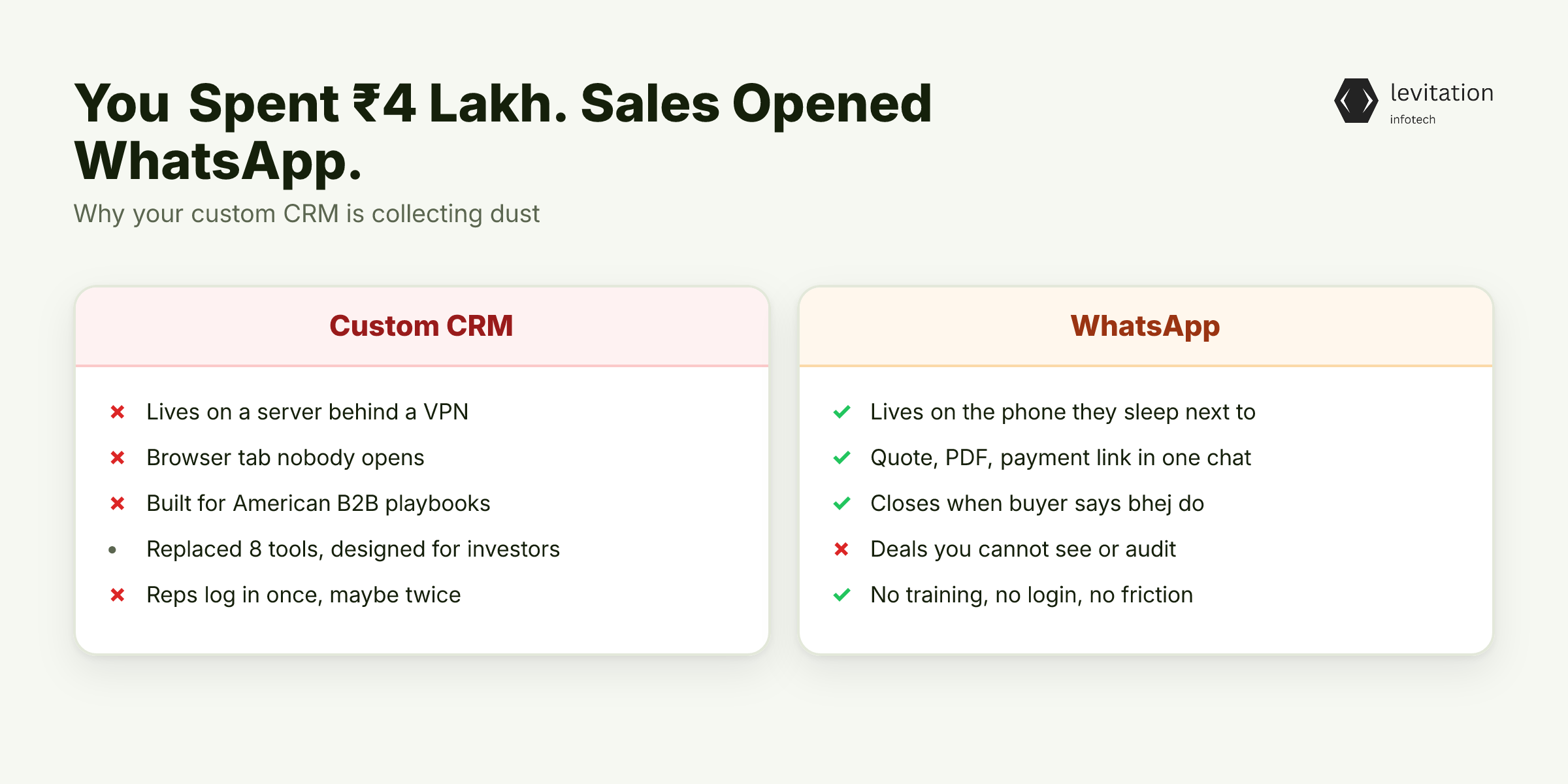
The paradox is brutal. You paid a vendor to build a custom CRM development project. The deal closed in six weeks. The vendor handed you a system that replaced eight tools, integrated with your email, tracked every deal stage, and generated reports your investors would love. It looked like the answer.
Then Monday morning happened. Your sales reps logged in once, maybe twice, and reached for the phone in their pocket instead. The CRM now lives in a browser tab nobody opens. The deals live in WhatsApp chats you can't see, can't report on, and can't audit.
Founders mistake "custom-built" for "will be used." The two ideas are unrelated. A custom CRM that doesn't match how your reps actually sell will collect dust just like the SaaS subscription you cancelled last quarter.
The problem isn't that you built it. The problem is what you built it to do. Most custom CRMs are designed around sales workflows borrowed from American B2B playbooks. Long email threads. Scheduled demos. Multi-touch nurture sequences. None of this maps to how Indian selling works, where the first conversation happens on WhatsApp, the quote arrives as a PDF in the chat, and the deal closes when the buyer says "bhej do" and the rep sends a payment link.
This isn't a training problem. It's an architecture problem. The CRM sits on a server your reps need a VPN to reach. WhatsApp sits on a phone they sleep next to. Guess which one wins the morning standup. Blaming the sales team for being "resistant to technology" misses the real problem. The CRM was never designed for how Indian selling actually happens.
The 60-80% Problem Nobody Mentions in CRM Demos
60-80% of leads in India originate on WhatsApp. Not your website form. Not your landing page. Not the CRM form your marketing team spent two months optimising. WhatsApp.
This single number explains why every CRM software development project you fund ends up underused. The CRM is the system of record for leads that don't exist. The real leads, the ones with budget and intent, are sliding into your reps' DMs while your CRM dashboard shows a pipeline built from demo requests and newsletter signups.
Sales reps don't resist the CRM out of laziness. They resist the context switch. Finish a WhatsApp chat. Open CRM. Type summary of the conversation. Switch back to WhatsApp. Repeat the loop for every lead. Each switch breaks the rep's train of thought and pulls them out of the conversation they're managing. Most CRMs force data entry AFTER the conversation, when context is already gone and the next lead is already ringing.
By the time the rep types "Customer asked about EMI, follow up tomorrow," the deal details are fuzzy and the next conversation has already started. The CRM then becomes a place to write fiction, not a source of truth.
The 24-hour WhatsApp session window makes this worse. Meta's rules let you message a customer freely for 24 hours after their last reply, then require pre-approved templates after that. Generic CRM reminders fire hours too late, missing the moment when the buyer is still warm. The lead goes cold not because the rep forgot, but because the system didn't know when to remind them.
Even Salesforce customisations in India fail here. The platform wasn't built for chat-first sales. You can bolt on WhatsApp integrations through AppExchange, but you're configuring an American product to mimic a workflow it was never designed for. Adoption metrics continue to slide despite heavy implementation spend.
So the obvious fix, train harder, mandate logging, add gamification, keeps failing for the same reason. The fix is to flip the architecture entirely.
The CRM That Lives Inside WhatsApp Beats the CRM That Fights It
Stop trying to replace WhatsApp. Embed the CRM inside the WhatsApp workflow. The shift sounds small. The implications are large.
When a lead messages your business number, the CRM should know before the rep does. When the rep sends a follow-up template, the CRM should log the message and update the deal stage. When the buyer pays through a Razorpay link sent inline, the deal should close itself. No copy-paste. No manual reconciliation. No "I forgot to log it."
WhatsApp Business API integration is the unlock. Every inbound message auto-creates or updates a deal record. The rep never opens a browser tab. The pipeline is built from the conversations that actually happened, not the ones the rep remembered to type up at 11pm.
Pre-approved message templates sync into the CRM so reps send compliant follow-ups, not copy-paste chaos. The template library lives in one place. The rep picks a template, personalises a line, and sends. The CRM logs the send time, the template used, and the customer's response. Audit trail solved.
Payment links from Razorpay, PayU, or Cashfree go inline. When the buyer pays, the deal stage auto-advances. No more asking "did the customer pay?" and waiting for the rep to check their phone. The CRM knows. The finance dashboard knows. The founder knows.
The 24-hour session timer triggers automated follow-ups from inside the CRM, not from a separate marketing tool. Miss the window, and a template fires at the right moment. Hit the window, and a polite nudge lands in the chat while the lead is still thinking about you.
This is precisely the use case where custom CRM development outshines Salesforce. Salesforce can be configured, but not reshaped this fundamentally without rearchitecting the entire system. The chat-first architecture is the wrong shape for a platform designed around email-based B2B selling. A custom build, scoped to your actual workflow, ships in weeks instead of quarters and costs a fraction of the configuration effort.
This sounds clean in a deck. Here's what it actually takes to build.
What a WhatsApp-First CRM Actually Looks Like Under the Hood
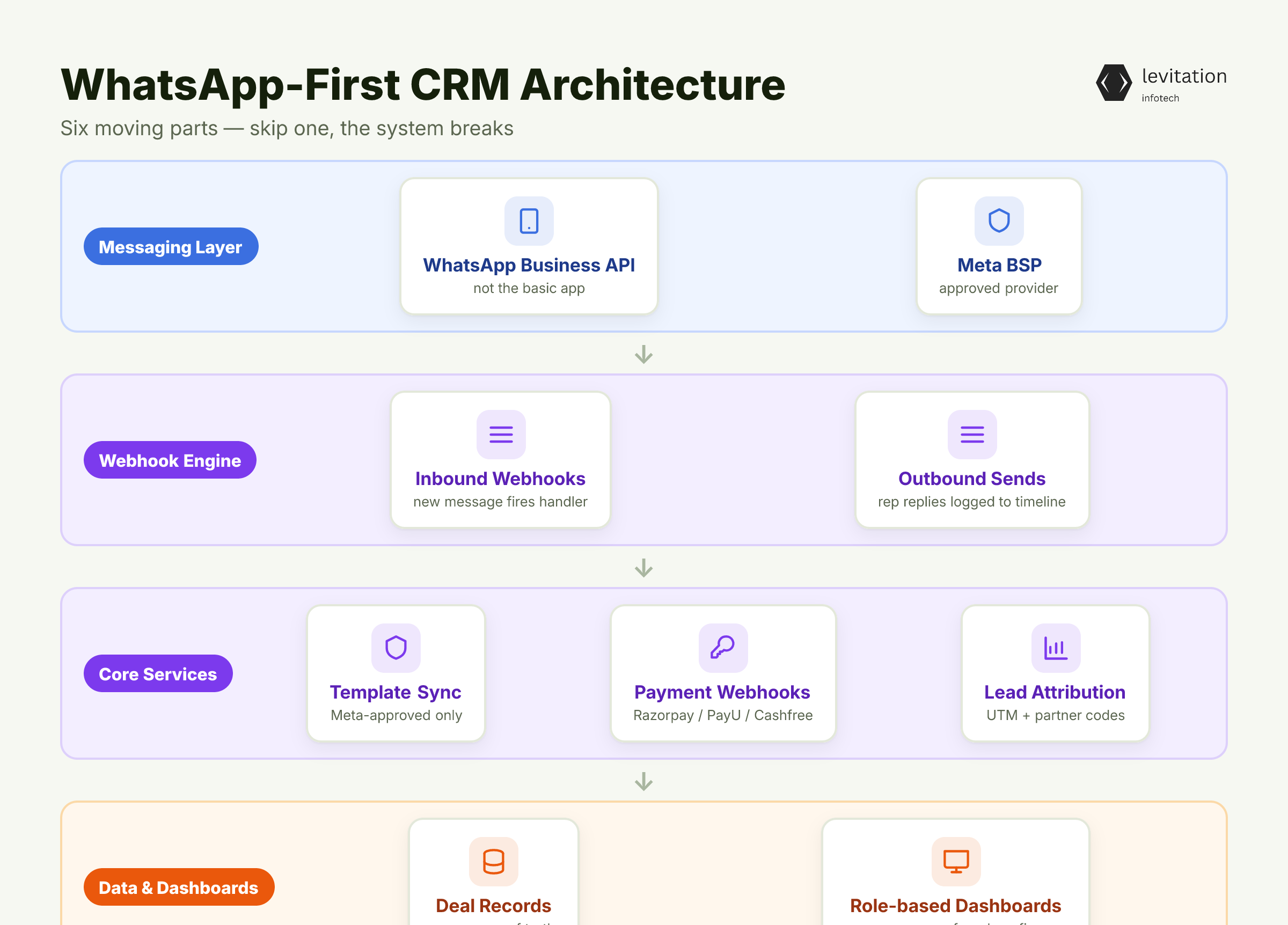
The architecture has six moving parts. Each one matters. Skip one, and the system leaks data or breaks adoption.
First, WhatsApp Business API access comes through a Meta-approved Business Solution Provider, not the basic WhatsApp Business app. The app caps you at broadcast lists and manual replies. The API unlocks webhooks, templates, and automation. Choose your BSP based on uptime, support quality, and template approval speed, not just per-message cost.
Second, the webhook architecture. An inbound message fires a webhook to your CRM backend. The CRM creates or updates a deal record. The rep gets notified inside the app or via push notification. No browser tab required. The rep replies from inside the CRM, which sends the message through the API, which logs the send and updates the deal timeline.
Third, message template sync with Meta's approval system. Every broadcast is pre-vetted by Meta before it goes out. Your CRM holds the template library, tracks which templates are approved, and blocks unapproved sends. This isn't optional. Meta bans numbers that send unapproved template messages.
Fourth, payment gateway webhooks. Razorpay, PayU, and Cashfree all fire webhooks on payment success. Wire those to your deal stages. Customer pays the invoice you sent on WhatsApp. The webhook fires. The deal moves from "Quote Sent" to "Paid" automatically. The rep doesn't lift a finger. Finance doesn't chase confirmations.
Fifth, lead source attribution. The CRM should know which Facebook ad, which referral partner, or which campaign started the chat. UTM parameters and partner codes attach to the inbound message and flow into the deal record. Now you can see that Partner A drove more revenue last month than Facebook ads, and the budget conversation gets easier.
Sixth, role-based dashboards. Reps see their pipeline. Managers see team velocity. Founders see conversion rates and forecast. Finance sees collections and outstanding invoices. One database, four views, zero manual reporting.
Now the budget question. Because if this costs ₹40 lakh, only enterprises can afford it, and they already have Salesforce.
The Three-Tier Build That Fits Indian SMB Budgets
The build doesn't have to be expensive. The CRM development cost in India for a WhatsApp-first system follows three tiers based on scope, not on vendor markup. - Tier 1 starts from ₹40K and runs 6-8 weeks. You get WhatsApp Business API integration, basic pipeline management, and contact storage. This fits teams under ten reps who need the chat-to-deal loop closed but don't need multi-channel automation yet. - Tier 2 starts from ₹80K and runs 8-12 weeks. You add payment-link integration, automated follow-ups inside the 24-hour window, and basic reporting. This is the sweet spot for most Indian SMBs with five to twenty reps. - Tier 3 starts from ₹1.5 lakh and runs 12-20 weeks. You add multi-channel support (WhatsApp plus email plus SMS), custom approval workflows, and advanced dashboards with revenue forecasting. This is for teams past thirty reps or those with complex approval chains.
The speed advantage of vendor delivery comes from reusable components and a defined delivery process, not from cutting corners. A vendor with repeat experience in this stack reuses proven integration code, while an in-house team starts from scratch on each layer. But build custom isn't always the right answer. Three cases where you should walk away: - Under five leads per month. Use Google Sheets and WhatsApp directly. A CRM is overkill and your reps will abandon it within a month. Revisit when you hit 30+ leads/month. - Over ₹100 crore revenue with a dedicated Salesforce admin team. Stay where you are. Migration cost exceeds benefit. We've covered why founders in this bracket bleed money on Salesforce in our skip-Salesforce analysis. - Banking, insurance, or pharma. Vendor certifications in these sectors take years to replicate. Salesforce and Microsoft Dynamics already have the badges your compliance team needs. Don't rebuild what regulators already approved.
The number to ask any vendor isn't the build price. It's how many of their builds are still running a year later. A build that gets abandoned costs more than one that runs for years. Our year-two cost analysis breaks down where the real CRM costs hide.
When the CRM finally becomes invisible, when reps don't even know they're using it, something shifts in the business.
When Adoption Stops Being a Lecture
Reps stop logging calls because the system logs them. The data entry disappears. Not because you begged them at the Monday standup. Not because you added a leaderboard. Because the system captured the conversation as it happened, and the rep never had to type a thing.
Managers see pipeline live, not in Friday Excel dumps that are three days stale. The deal velocity chart updates in real time because the data is live, not scraped from notes the rep remembered to write. The standup shifts from "what's in your pipeline" to "here's where the pipeline is," and the conversation moves to coaching instead of status collection.
Deal velocity improves because the 24-hour follow-up window is enforced by automation, not by memory. The lead who said "send me the details" gets the details within the session window. The lead who said "I'll think about it" gets a template reminder before the session closes. The rep who used to forget half their follow-ups now misses none, because the system does the remembering.
The ₹4 lakh stops being a sunk cost on an unused tool and becomes the infrastructure underneath every closed deal. The CRM becomes the asset you describe to investors, not the embarrassment you avoid in board meetings.
What changes isn't the software. It's that your sales team finally has a system that works the way they actually sell, and the founder can finally see what's happening without asking for reports. That's the moment a CRM application stops being software and starts being leverage.
If your team is already living in WhatsApp and your CRM is already empty, the answer isn't more training. It's a different architecture, built by engineers who understand chat-first sales. Teams that ship these systems daily, not consultants who sell Salesforce seats, are the ones who turn the ₹4 lakh into a closed pipeline.
Frequently Asked Questions
How much does custom CRM development cost in India in 2026?
Custom CRM development in India typically ranges from ₹40,000 for a basic Tier 1 build (6-8 weeks) to ₹1.5 lakh and above for a Tier 3 system with multi-channel automation (12-20 weeks). Pricing scales with integration complexity, since adding WhatsApp Business API, payment gateway webhooks, and custom dashboards moves you up the tiers. Full pricing breakdowns are outlined in our CRM development cost guide.
Why do Indian sales teams refuse to use the CRM we built or bought?
Because 60-80% of their leads come through WhatsApp, and most CRMs force a context switch away from the chat where the deal is actually happening. Reps don't resist the CRM. They resist doing double work. A WhatsApp-first CRM that auto-logs conversations removes the friction entirely.
Can a custom CRM really integrate with WhatsApp Business API?
Yes. Through a Meta-approved Business Solution Provider, a custom CRM can receive inbound messages via webhooks, auto-create deal records, sync pre-approved message templates, and trigger automated follow-ups inside the 24-hour session window. This is the core architecture of any modern custom CRM built for the Indian market.
About the author
Mayank Singh is a software developer at Levitation Infotech, where he builds web and AI-powered applications across the company’s fintech, healthcare, and enterprise projects.