


TL;DR: A 30-person NCR brokerage spends more on Salesforce over five years than it would cost to build a custom CRM from scratch. The custom version captures leads the moment a form fills, instead of waiting through Salesforce's CSV import workflow. For brokerages where the first call wins the deal, that speed gap is worth more than any enterprise feature list.
Key Takeaways: - Salesforce's 5-year TCO for a 30-broker NCR team runs over 16 million CZK (₹54-56 lakh). It includes integration, admin, and customization once modeled honestly. - The 45-minute CSV import lag kills deals when buyers submit forms on multiple competitor sites in the same hour. - A ₹4 lakh custom CRM ships in phases. It carries the features that close NCR deals, not the broad catalog brokers will never open. - Per-seat tax disappears at year two with custom. That is where the math flips decisively.
The Salesforce Bill Most NCR Brokerages Don't Model Honestly
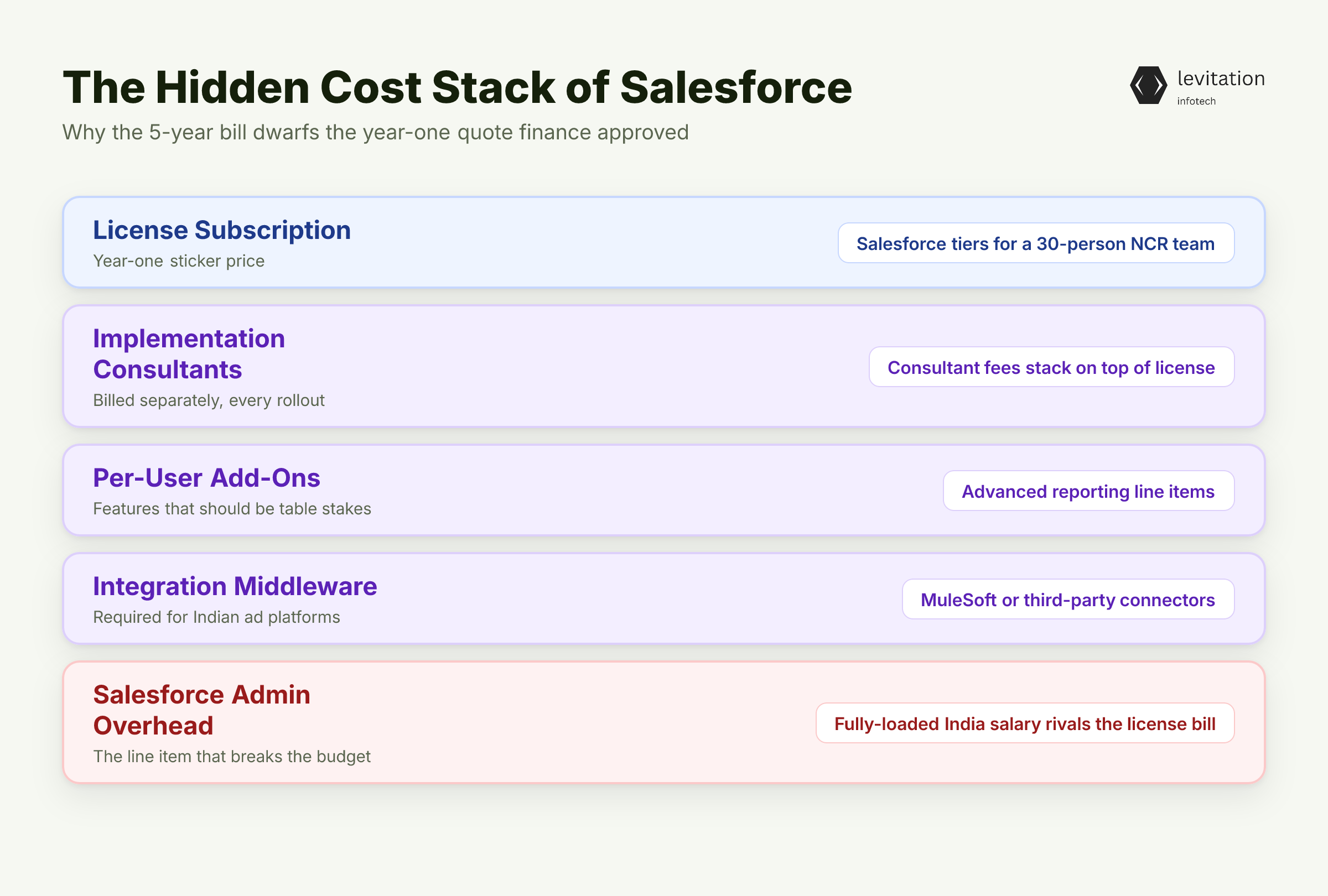
Your Noida brokerage is spending over 16 million CZK (roughly ₹54-56 lakh) on Salesforce over five years. Meanwhile, the calls that actually close happen in the first few minutes after a Google Ads form fills.
Your CRM sees the lead 45 minutes late. That gap is not a rounding error. It is the deal going to the broker down the street.
The sticker shock starts with Salesforce list pricing. A 30-person NCR brokerage team needs multiple Salesforce product tiers to match what a modern brokerage workflow actually uses.
Add the per-user add-ons for advanced reporting, and the annual line item on your finance review already looks uncomfortable. Most Operations Heads stop comparing there.
They shouldn't. The hidden costs stack fast: - Implementation consultants whose fees are billed separately from the license subscription and stack on top of every rollout - Per-user add-ons for features that should be table stakes - Integration middleware (MuleSoft or a third-party connector) to plug into Indian ad platforms - A Salesforce admin, based in India, whose fully-loaded cost often approaches or exceeds the license bill they manage
The 5-year total is what kills budgets, not the year-one sticker price that finance approved. By the time you add the consultant bill, the admin salary, and the middleware licenses, the total dwarfs what finance signed off on.
Rising per-seat renewals compound the damage. At that point, custom CRM development stops looking like a luxury. It becomes a cost-control lever.
But cost is only half the problem. The other half is what Salesforce actually does once it starts running in a brokerage that closes on speed.
Why 'Unlimited Customization' Breaks Down in a Volume Business
NCR real estate operates at extreme speed. A homebuyer who submits a form on your site also submits on three or four competitor sites within the same hour. The agent who calls first wins.
That is the entire game in Gurgaon's micro-markets. Sector 57 versus Sector 150. Resale versus new launch. ₹60 lakh versus ₹2 crore.
Salesforce's default CSV import workflow introduces a 45-minute lag between form fill and broker notification. By the time the lead lands in a queue, the buyer has already spoken to two competitors.
The lead is cold. The deal is gone.
The "unlimited customization" pitch assumes you can fix this with custom objects, Apex triggers, and Flow logic. You can.
But the people who build those are Salesforce-certified admins, not brokers. Certified admins command premium rates.
A small-to-mid Noida operation cannot easily justify a full-time Salesforce admin. So the customization either never happens, or it gets outsourced to a partner who charges by the sprint.
Either way, the workflow drifts away from what brokers actually do in the field. The "unlimited customization" promise quietly becomes "unlimited backlog."
This is where brokerages that run CRM systems built for Indian real estate pull ahead. The system is opinionated about the workflow from day one. Locality-based routing, Razorpay hooks, and MagicBricks ingestion ship in the core product.
They are not a customization layer your admin has to build. The same engineering discipline that handles security-critical workloads in regulated industries applies to broker data. The system is built to be auditable, not retrofitted for it.
So if Salesforce is too slow, too expensive, and too dependent on specialists, what does a CRM that actually fits NCR brokerages look like?
What a ₹4 Lakh Custom CRM Actually Delivers (And What It Strips Away)
Stripped down does not mean weaker. It means the features that close NCR deals. It does not mean the broad feature catalog Salesforce ships to serve every industry from pharma to non-profits.
The narrowing of scope is the entire point.
A ₹4 lakh custom CRM, designed around the brokerage's actual workflow, delivers: - Direct API sync with Google Ads, Meta Ads, Housing.com, MagicBricks, 99acres, and your IDX site. No CSV downloads. No middleware. - Auto-assignment rules based on locality (Sector 57 vs Sector 150), budget band (₹60L vs ₹2Cr+), and broker specialization (resale vs new launch) - Native Razorpay, PayU, and CCAvenue hooks so token payments, booking amounts, and milestone collections auto-reconcile to the deal record - A broker mobile app that works offline at the project site and syncs the moment connectivity returns - Site visit check-ins with geofence verification, so managers see where visits actually happened - Manager dashboards built around the metrics a brokerage operations head actually tracks: lead-to-visit ratio, visit-to-booking ratio, broker-wise closure rate - AI lead scoring trained on your own historical deals, not a generic model - IDX feed sync that updates inventory in near-real-time across portals
The decisions that get made during custom CRM application architecture are the ones most in-house teams waste months figuring out. Which data model fits Indian real estate? How do you handle locality-based assignment when the same broker covers three sectors? How do you reconcile token payments when the developer and the seller both touch the deal?
These are not generic questions. They are NCR-shaped questions, and they deserve NCR-shaped answers.
The features sound simple. But the architecture decisions behind them are where most in-house teams burn the first year. They burn it figuring out what to skip.
How does the stack actually fit together to close deals in the field?
The Feature Stack That Actually Closes Deals in Gurgaon and Noida
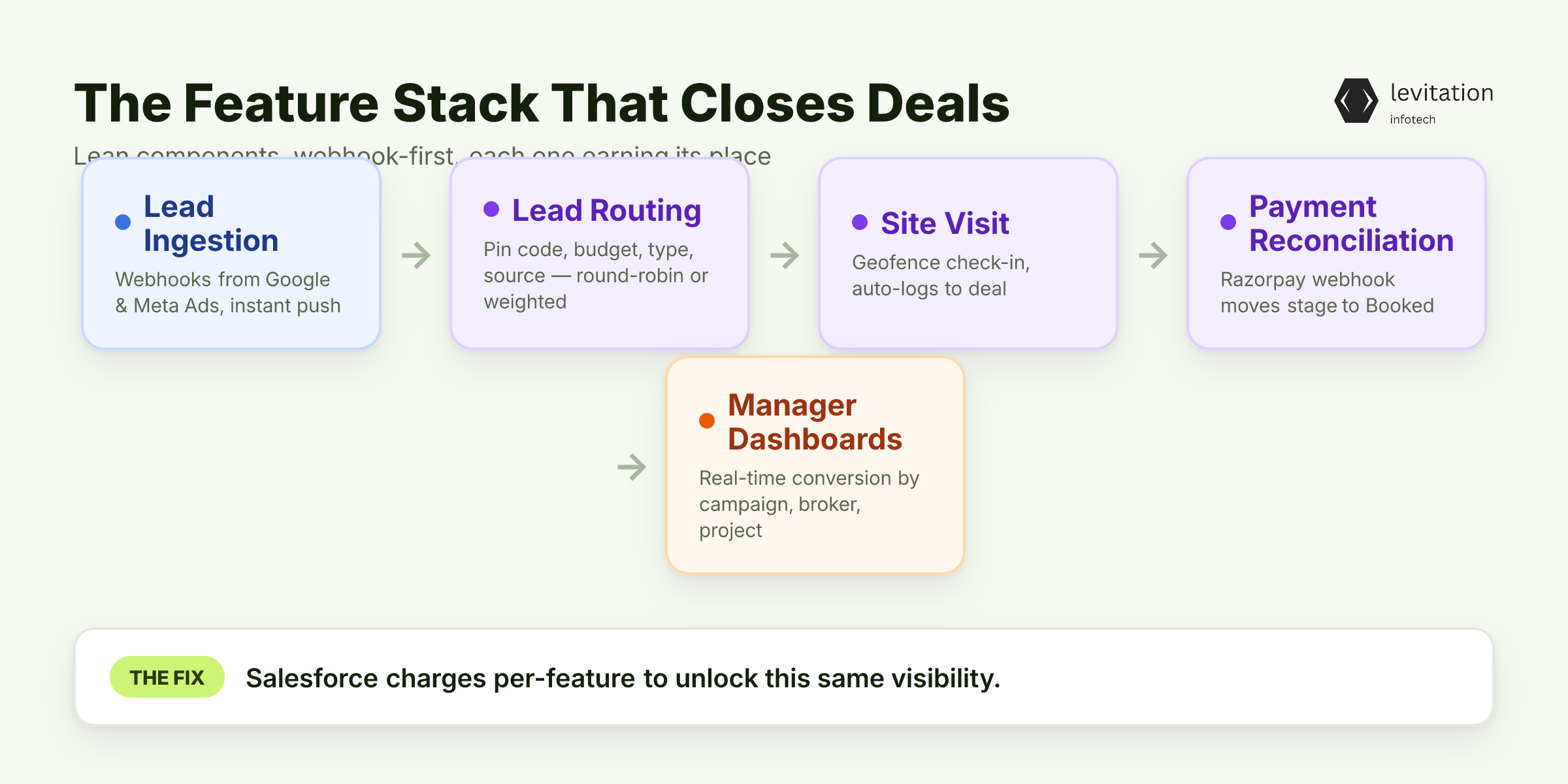
The stack is lean. Every component earns its place by doing one thing well and connecting cleanly to the next.
Lead ingestion runs on webhooks. Google Ads lead forms and Meta Ads instant forms push directly into the CRM the moment a buyer hits submit. No CSV. No 45-minute lag. The lead lands in the broker's mobile app before the buyer closes the browser tab.
CRM integration with Indian payment gateways follows the same pattern. The webhook-first architecture handles Razorpay, PayU, and CCAvenue events.
Lead routing engine assigns by pin code, budget range, property type, and source campaign. Round-robin or weighted, whatever fits the brokerage's commercial logic. The broker gets the right lead, not the next-in-line broker who happens to be on shift.
Site visit module lets brokers check in via mobile. Geofence verifies the project site. The visit auto-logs against the deal. Managers see a real-time map, not a Friday report assembled from WhatsApp screenshots.
This is the kind of operational visibility most brokerages would buy a separate tool for. Salesforce charges per-feature to unlock it.
Payment reconciliation fires the moment a Razorpay webhook confirms a token. The deal stage moves from "Visit Done" to "Booked" without manual entry.
No back-office team re-keying payment data. No reconciliation spreadsheet at month-end.
Manager dashboards show conversion metrics by campaign, by broker, by project, in real time. No custom report building. No waiting for the admin to build the view.
The stack is lean. But how fast can it actually be built? What is the realistic timeline versus the long in-house trap?
3-6 Months to Deploy, Not the Long In-House Trap
Speed is the input that matters most. Every month the brokerage runs on a slower CRM is a month of leads lost to faster competitors. A well-scoped custom CRM runs in three phases: - Phase 1 (Month 1-2): Lead capture, routing, and the broker mobile app. These are the 20% of features that handle 80% of NCR lead flow. By the end of month two, the brokerage runs on a faster system than Salesforce. - Phase 2 (Month 3-4): Payment gateway integration, site visit tracking, IDX site sync. The operational backbone is complete. - Phase 3 (Month 5-6): Advanced analytics, AI lead scoring, manager dashboards, third-party MLS feeds. The polish that turns the CRM into a competitive weapon.
Compare this to the CRM app development timeline most in-house teams experience. Months of slow progress. Multiple engineering hires. A product that ships half-done because the scope was never narrowed.
The difference is not effort. It is decision quality at the architecture stage.
Skip the Salesforce migration overhead. No data backfill from a generic tool. No consultant onboarding. No admin certification path.
The pattern repeats across enterprise deployments in regulated industries. Scope hard, ship in phases, and let the brokerage's real workflow dictate priorities.
Speed is the input. What matters is the output. That is where the year-two math starts to look very different from a Salesforce TCO model.
Year Two: What Changes When the CRM Fits Your Brokerage
The first year of a custom CRM is about replacing what Salesforce was doing. It replaces it faster, cheaper, and with workflows that match the brokerage. Year two is where the math flips.
Per-broker cost drops to near-zero. Salesforce per-seat renewals keep compounding, year after year. A custom CRM has no per-seat tax.
The hosting bill on AWS or GCP is small and predictable. The codebase is owned, not rented.
Lead response time drops from the 45-minute Salesforce default to a webhook-driven few seconds. That is measurable in won deals per month. Any operations head who has tracked funnel velocity knows the multiplier.
Faster response is not a vanity metric. It is the leading indicator of every revenue number the founder cares about.
A custom CRM uses the broker's language, the brokerage's terminology, and the brokerage's deal stages. That drives sustained adoption.
Generic CRMs typically hit a plateau in mid-size teams. Those teams fall back on WhatsApp and Excel.
Operations Heads regain control. Every workflow change is a sprint, not a Salesforce admin ticket. Every new integration is a planning conversation, not a vendor negotiation.
For brokerages evaluating Salesforce alternatives for Indian brokerages, this is the part that does not show up in a feature comparison. It is the part that compounds year after year.
Frequently Asked Questions
Q: Is a ₹4 lakh custom CRM really enough for a 30-person NCR brokerage?
A: Yes, for the features that drive 80% of NCR deal flow. That includes lead ingestion, locality-based routing, site visit tracking, payment reconciliation, mobile app, dashboards, IDX sync, and AI scoring. You skip the capabilities Salesforce ships that your brokers will never use. Total ownership cost stays well under Salesforce's cost over the same period.
Q: How is a custom CRM different from Zoho CRM for real estate in India?
A: Zoho is a configured product. You adapt your workflow to its data model. A custom CRM is built around your exact workflow: locality-based lead routing, Razorpay webhook hooks, Housing.com and MagicBricks API ingestion, and project-level geofencing. For NCR brokerages with specific locality logic, custom wins on fit. For generic sales teams, Zoho is fine.
Q: What about data security and compliance for a custom-built CRM?
A: A custom CRM built by a team with regulated-industries experience inherits enterprise-grade security. It comes with encryption at rest, role-based access, audit logs, and DPA-grade data handling. Ask the vendor for their security certifications and whether they handle regulated workloads. That is the strongest credibility signal.
Q: Can a custom CRM integrate with our existing IDX website and Google Ads account?
A: Yes. That is actually where custom CRMs outperform Salesforce. Direct API integration with Google Ads lead forms, Meta Ads instant forms, Housing.com, 99acres, MagicBricks, and your IDX provider is built in from day one. Salesforce requires middleware for most of these, adding cost and latency.
Q: What happens if our brokerage grows from 30 brokers to 100?
A: A well-architected custom CRM scales horizontally. The same codebase serves 30 or 300 users. The only cost that grows is hosting (a small monthly bill on AWS or GCP) and incremental feature builds. There is no per-seat tax, which is where the year-two savings compound most sharply.
Sources
Research and references cited in this article:
- Real Estate CRM Features 2026: What Matters Most? - iHomefinder
- Top 10 Real Estate CRM Software in India 2026
- 15 CRM Software Examples 2026: Features & Pricing
- The 10 Best Real Estate CRM Software Platforms for 2026
- Top 5 Salesforce CRM for Commercial Real Estate 2026
- Custom CRM vs Salesforce: 2026 Real Costs for SMB Teams | Bitvea
- Custom CRM vs Salesforce 2026 — Build or Buy? | Aftershock Network
- Custom CRM Development Cost in 2026: Pricing Breakdown & Timeline
- The Hidden Cost of CRM Customization: When to Build vs. Buy
- Custom CRM vs Salesforce cost: When does building your own system actually get cheaper? - Pretius
- 10 Best Real Estate CRM Software India 2026 – With INR Pricing – Cleomitra Blog
- 24 Best Real Estate CRM Software in 2026 (Ranked and Compared)
About the author
Mayank Singh is a software developer at Levitation Infotech, where he builds web and AI-powered applications across the company’s fintech, healthcare, and enterprise projects.