


₹3 lakh can buy flawless answers and still leave every booking to staff.
TL;DR: Spend it on one tightly scoped booking workflow. The bot must create, confirm, and correctly route appointments through website and WhatsApp, with clean escalation when a request needs human judgment.
Key Takeaways: - A booking agent must complete the transaction, not collect a qualified lead. - Workflow contracts and acceptance tests should define chatbot quality. - Vendor selection should prioritize booking completion, reliable support, and verifiable operations.
A Chatbot That Cannot Book Is an Expensive FAQ
A ₹3 lakh AI chatbot can answer clinic FAQs flawlessly and still leave every booking to staff. For a Delhi NCR operations head, the costly failure isn't weak replies. It is a conversation that never becomes a confirmed appointment at the correct clinic.
Here, ₹3 lakh is a scope constraint, not a universal market price. The commercial question is which narrow, high-volume workflow the budget can support end to end. Which transaction should the bot own from start to finish?
Apply the ₹3 lakh test
A budget should buy a completed operational outcome, not an impressive chat interface. The outcome is a confirmed, correctly routed appointment. The test is simple: did the patient receive a confirmed appointment at the right clinic?
Map the unfinished funnel
Map the request through these steps: - The patient expresses an intent to book. - The chatbot collects contact details and a preferred time. - Staff check availability in the scheduling system. - The patient receives confirmation at the correct clinic.
That path has four distinct steps. A bot that stops after collecting details has moved friction from the patient to staff. Where does your current bot stop?
Define the operational promise
Routine bookings should be completable 24/7 through website and WhatsApp, without staff intervention. Ambiguous or complex cases should receive a human handoff with context. Can the bot keep that promise across both channels?
Evaluate the transaction
Evaluate AI chatbot development by transaction completion, location accuracy, and confirmation quality. Don't score it on how natural the replies sound. Readers comparing top AI companies for healthcare in India should treat sector experience as a starting point, not a verdict.
Test every candidate against booking outcomes. Connecting the bot to a calendar seems like the obvious fix, but it does not complete the booking transaction. Why would a calendar connection leave the job half done?
Why a Calendar Connection Still Leaves the Job Half Done
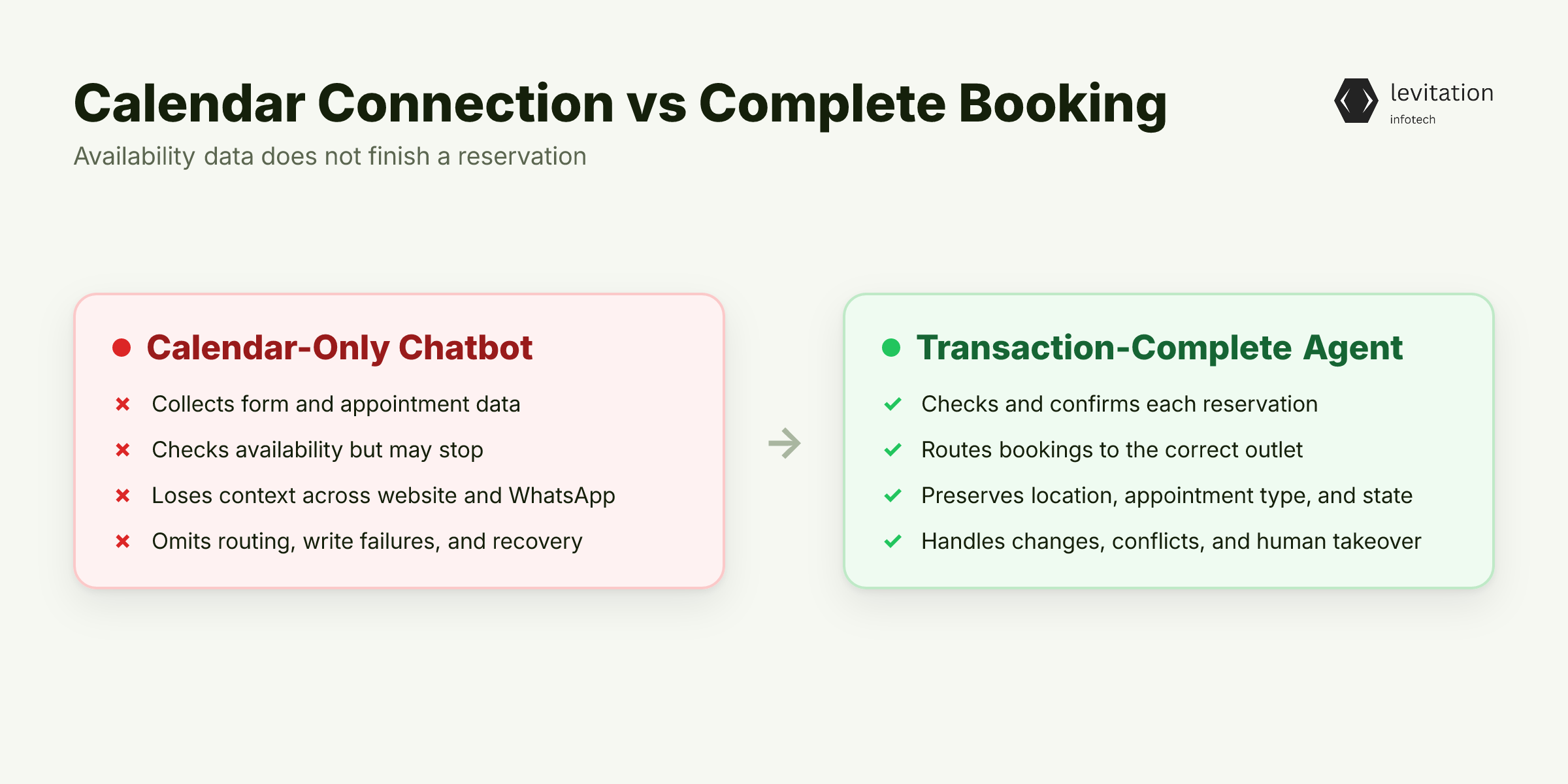
Connecting a calendar looks like the fix. It isn't.
A calendar supplies availability data, but it doesn't own the whole booking transaction. What else must complete the reservation?
Collection is not completion
A conventional appointment chatbot collects form data through chat and stops. A booking agent checks availability, confirms the reservation, and routes it to the correct outlet. This is the same false equivalence exposed in why most Noida AI agent quotes are chatbots in disguise.
A smooth conversation can still end with an unbooked patient. How do you tell the difference before signing?
Expose the multi-location failure mode
If a patient starts on the website and then switches to WhatsApp, the context must travel with them. A single calendar connection won't automatically preserve location, appointment type, or booking state.
Without shared state, the bot may repeat questions, route to the wrong outlet, or create conflicting bookings. These aren't chat defects. They are transaction-state defects. Which state would your current setup lose?
Include operations after the happy path
A production booking flow must also handle: - Slot changes and simple modifications - A slot that was available but becomes unavailable - Conflicting availability or failed booking writes - Incomplete patient information - Human takeover for complex requests
Each exception needs a defined trigger, recovery action, and owner. Otherwise, every rare event becomes an improvised staff task. Which failures are missing from your launch checklist?
Reframe the architecture
Conversational AI becomes useful when it retains context and takes action across connected systems such as a scheduling platform or CRM. A polished answer isn't the difficult engineering problem.
Preserving state while systems change is. Where should your architecture place that responsibility?
Tie architecture to cost
Integration depth, workflow complexity, channel coverage, testing, and maintenance drive cost. Model choice and chat UI matter too. Use the AI chatbot development cost in India breakdown to require itemized proposals.
Each proposal should separate conversation design, system integration, deployment, testing, and support. A cheap chat build can still carry a costly scheduling change. The real product isn't a chatbot with a calendar attached.
It is a transaction workflow that happens to be operated through conversation. Can the proposed quote explain what each rupee buys?
Define Done as a Confirmed, Routed Appointment
A team can agree on the word "booked" while meaning different things. That's where expensive ambiguity enters. What record should prove that the transaction is complete?
Specify the booking state machine
Define the booking as a state machine. Each state should have one clear owner and one exit condition. - Intent qualification: confirm that the patient wants an appointment. - Location selection: resolve the correct clinic or department. - Availability retrieval: query live bookable slots. - Slot selection: present the selected slot for confirmation. - Patient details: collect required scheduling and contact fields. - Appointment creation: write to the scheduling system of record. - Confirmation: issue a patient-facing confirmation. - Routing: send the appointment to the correct outlet. - Aftercare: handle modifications, cancellations, or handoffs.
Can every state name both its owner and its exit condition?
Build the pass conditions
For every state, identify four things: - What the bot asks - Which system it calls - What constitutes success - Where the flow fails and who recovers it
The availability call must return a bookable slot. The scheduling system must accept the appointment record. The patient must receive matching details.
"The patient said yes" isn't a completed booking. A durable booking record and a matching confirmation are. Which test catches a reply without a record?
Make website and WhatsApp share one state
Both channels should access the same availability and appointment records. A patient should be able to continue the booking without repeating information or creating conflicting bookings.
This shared state turns two interfaces into one booking operation. Separate channel flows can disagree about what happened. Can each handoff preserve the same booking state?
Separate autonomy from escalation
Let the AI appointment booking agent complete routine reservations. Define explicit escalation triggers for: - Identity mismatches - Ambiguous clinic or department - No available slot - Unsupported requests - Conflicting modifications
A human handoff should include the conversation summary, selected location, attempted actions, and current booking state. A blank queue ticket isn't a handoff. Does your handoff preserve the same booking state?
State the definition of done
Done means the booking is confirmed and assigned to the right location. It exists in the system of record, and the patient has received matching details. Staff can review or change it later.
Use this outcome model when comparing top AI companies for healthcare in India, rather than comparing chat interfaces in isolation. Once "done" is explicit, the project becomes a sequence of testable workflow contracts. This shifts the project away from an open-ended race to build the smartest model. Which outcome will you put in the contract?
Turn the ₹3 Lakh Scope into Workflow Contracts
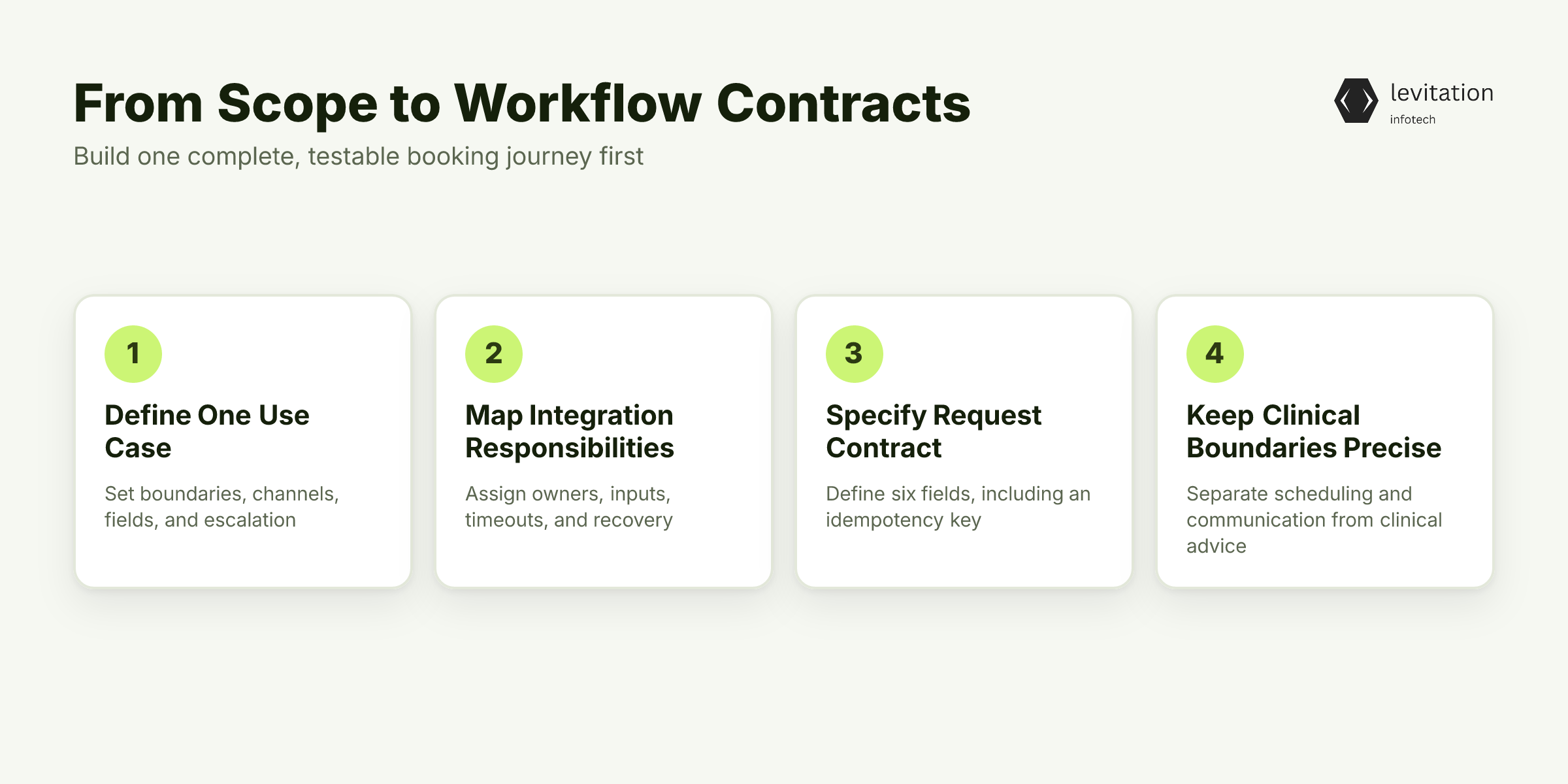
A budget becomes safe when every deliverable maps to a workflow contract. Conversation polish comes later. A booked appointment comes first.
Which contract will you write first?
Start with one complete use case
Define the boundary before asking a vendor to design the bot. - Selected services and appointment types - Approved locations and routing rules - Website and WhatsApp channels - Required patient and contact fields - Modification and cancellation rules - Clinical boundaries - Human escalation conditions
Defer unrelated FAQs, extra locations, and extra appointment types until this journey passes acceptance testing. This follows the same lesson as when the model didn't break, the feature contract did.
Which part of this journey can your bot own today?
Document six integration responsibilities
Require vendors to map these responsibilities: - Availability search - Appointment creation - Appointment update - Confirmation - Routing - Human handoff
For each responsibility, specify the system that owns the record and the required input fields. Also define response meaning, timeout behavior, and recovery after a failed write.
A named API isn't enough. Its failure semantics matter. Have you asked what happens when the write fails?
Include a concrete request contract
Require a compact JSON request record with six fields: - Location - Appointment type - Slot identifier - Patient reference - Contact preference - Idempotency key
For example, a dermatology request should carry the location token, appointment type, live slot identifier, patient reference, WhatsApp preference, and idempotency key.
The idempotency key matters during retries. If the first write succeeds but its reply is lost, a retry can return the same booking. The retry won't create a second appointment.
What happens if that key is missing?
Keep clinical integration precise
Keep the clinical AI chatbot integration precise. Collect only the information needed to schedule and communicate.
Diagnosis, treatment recommendations, and broader clinical decision support should remain separate use cases. A booking agent that answers medical questions has crossed a different boundary. Where should that boundary appear in the workflow?
Build exceptions into the first release
Define and test: - Incomplete prompts - Unavailable slots - Stale availability - Conflicting modifications - Identity mismatches - Unsupported clinical questions
Staff escalation should include a conversation summary and the actions already attempted. A handoff without that context is only a queue ticket. Does the first release assign an owner for each exception?
Put the budget on the worksheet
Put the ₹3 lakh figure on a worksheet. Separate discovery, conversation flows, integrations, testing, deployment, monitoring, support, and maintenance.
Don't let a low build quote hide expensive changes to scheduling or hospital-system access. Use the AI chatbot development cost in India framework to compare the quote with the workflows, systems, channels, and support commitments actually promised.
Which line items could grow after launch?
Make verification part of vendor selection
Request a security and reliability packet. A vendor's claim of HIPAA-compliant deployment is useful context, but it must support, not replace, the buyer's own due diligence.
Check access control, audit logs, data retention, incident handling, and vendor responsibilities. The buyer should know who can read each patient conversation and change each appointment record.
A well-written contract cannot save a bot that can't survive messy conversations and live system changes. Testing must target the transaction rather than the wording. What proof will you require before accepting the claim?
Test the Transaction, Not the Chat
A clean contract can still describe a bot that fails against a real patient conversation. That's why the test must follow the transaction. Which customer journey will you test first?
Run a scenario matrix
Test the same set of scenarios across every candidate: - A successful routine booking - No available slot - A slot that becomes unavailable - Wrong-location routing - A simple modification - An ambiguous location - Incomplete patient details - An unsupported request - Website-to-WhatsApp continuation
Which scenarios expose failures in your current workflow?
Score business outcomes
For each scenario, verify the business result: - The availability call - The authoritative booking write - The correct outlet - The patient-facing confirmation - The modification result - The handoff context
Grammar and tone matter, but they support the experience. They aren't the acceptance criterion. Which outcome will fail first when the system changes?
Test clinical boundaries
A request for medical advice should trigger identification and handoff. The booking agent shouldn't answer as if it were a clinician.
A clean refusal can still pass. The failure is answering confidently and implying the patient's request was handled. How will your test recognize that failure?
Roll out in controlled stages
Begin with internal simulation or shadow evaluation without exposing patients. Then move to a limited live journey. Expand only after the acceptance suite and operational review pass.
Preserve logs for every state transition, API result, confirmation, and escalation. That evidence turns support into an engineer's audit trail. What will your team need to reconstruct a failed booking?
Ask for longevity evidence
Ask whether the vendor can show evidence of systems still running in production at least five years after deployment. That longevity claim matters because schedules, staff, and integrations change over time. Use the top AI companies for healthcare in India directory to identify candidates.
Then make each one demonstrate the same end-to-end scenarios under identical conditions. Once the transaction passes that suite, the buyer's question changes from "Can it chat?" to "Can we trust it to complete and support bookings?"
The Payoff Is Fewer Manual Exceptions, Not More Chat Traffic
The payoff isn't more chat traffic. It is fewer manual exceptions. What should happen to the staff queue when routine bookings finish without help?
Describe the operational change
Routine booking requests should complete across website and WhatsApp. Staff should receive only the exceptions that need judgment, with relevant context ready on arrival.
Each handoff should include the conversation summary, chosen location, attempted actions, and current booking state. Staff shouldn't reconstruct the journey from scratch. Could staff act on the handoff without opening the full chat?
Remove false expectations
The goal isn't to remove every human interaction. Stop manually handling every routine confirmation, slot check, location-routing task, and simple modification.
Automation succeeds when judgment moves to the cases that need it. Which tasks should move first?
Use a buying checklist
Before signing, require: - A live end-to-end booking demonstration - The workflow and API map - Acceptance-test results - Exception and handoff behavior - Support commitments - Maintenance terms - An itemized total cost
Also request security evidence and references from comparable deployments. Are those claims backed by a test you can rerun?
Distinguish product proof from partnership proof
A defined and verifiable client retention rate helps assess long-term partner quality. It cannot prove that your booking workflow works. Functional acceptance tests must still prove that.
A demo ends when the appointment is durably booked, routed, confirmed, and reviewable. Can the vendor show that result under your test conditions?
Make the commercial decision
Select the partner that can show a confirmed appointment, not merely a convincing conversation. Do that before expanding the budget to more locations, appointment types, or channels.
For readers still comparing quotes, revisit the AI chatbot development cost in India and top AI companies for healthcare in India with the acceptance criteria as the filter. The next question is simple: which location or appointment type can you add without breaking the transaction?
Frequently Asked Questions
How much does AI chatbot development cost for appointment booking?
A ₹3 lakh figure should be treated as a planning ceiling for a tightly scoped pilot, not a universal market rate. Require separate estimates for conversation design, scheduling-system integration, testing, deployment, and maintenance. Use the AI chatbot development cost in India framework.
What is the difference between a chatbot and an AI appointment booking agent?
A conventional chatbot collects information and produces replies. A booking agent also checks live availability, creates and confirms the appointment, routes it to the correct location, and handles modifications.
The latter completes a transaction instead of stopping at a qualified lead. Which one are you actually buying?
About the author
Mayank Singh is a software developer at Levitation Infotech, where he builds web and AI-powered applications across the company’s fintech, healthcare, and enterprise projects.