


TL;DR: Production failures that look like model failures often begin at the feature interface. A versioned feature contract exposes incompatible inputs before release. Shared transformations and parity tests keep training and serving aligned.
Key Takeaways: - Schema checks confirm field structure, but they can't detect changed meaning, timing, or freshness. - AI data contracts work as dependency protocols between producers and every downstream consumer. - Contracts need enforcement at both boundaries, plus shared code and parity tests across training and serving.
The Model Is the Last Place Feature Drift Appears
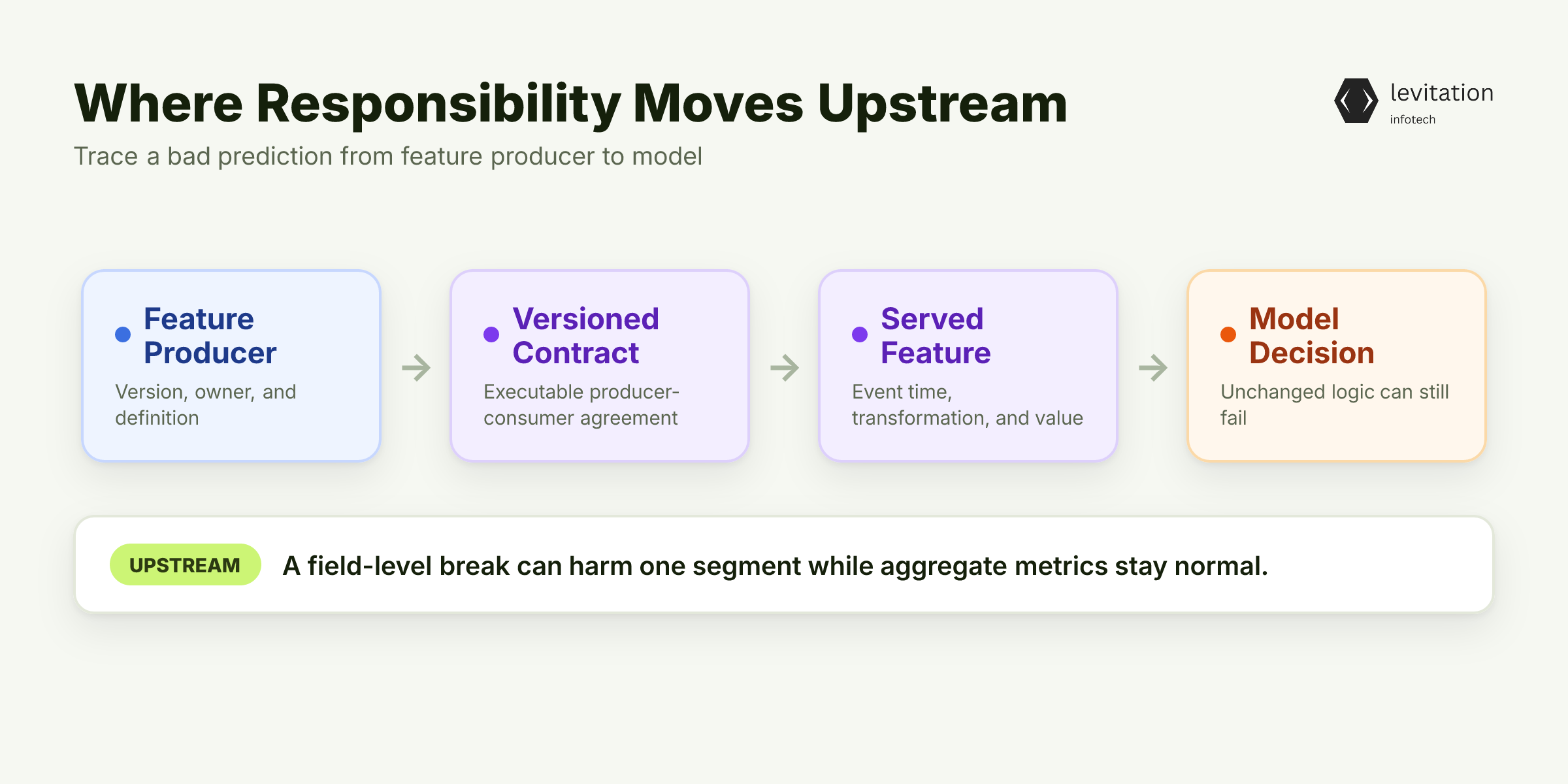
Your model can keep its weights, code, and offline metrics intact while production behavior collapses. The tempting conclusion is that the model failed.
Yet the problem often sits upstream when a feature changes shape, meaning, timing, or freshness. Training and serving then drift apart without a machine-checked agreement.
The common signature is seemingly clean. An upstream release lands while traffic, latency, and aggregate accuracy look normal. Yet one important customer segment starts receiving different decisions.
Stop treating the model as the first suspect. Trace one bad prediction through this chain. Start with the model version, feature name, producer version, and transformation version. Then check the event-time semantics and the served value. If one link is missing, incident triage becomes guesswork.
Use feature lineage to rebuild that chain. Then apply model incident triage to separate model failure from interface failure. Wider model drift monitoring helps, but only when lineage reaches both producer and consumer.
A feature contract turns that chain into a clear, versioned agreement for each model input. It isn't another broad governance document or a model card. It is an executable interface between producer and consumer.
Aggregate dashboards mislead because they describe systems, not individual fields. A healthy service masks a field-level incompatibility that affects only one segment. Because the broken field affects a narrow slice of traffic, aggregate metrics stay normal.
Start with a simple exercise: - List the most important model inputs. - For each, find the version, owner, and definition recorded by the producer. - Find the consumer's requirements for the same three items. - Mark every disagreement or missing record.
Keep the claim narrow. Feature contracts protect input compatibility. They cannot repair flawed labels, target leakage, a bad objective, or a compromised runtime.
The model still deserves blame when its logic fails.
If the model is often the last component blamed, where exactly does responsibility move upstream?
Why Schema Checks Miss Semantic Breakage
Responsibility moves to the interface between producer and consumer. A schema proves that a field is numeric. However, it cannot prove that the number means the same thing.
These drift classes can pass basic type checks: - Structural drift: A column is renamed, dropped, or changed from optional to required. - Semantic drift: Revenue changes from gross to net, while its numeric type stays unchanged. - Temporal drift: Days become seconds, local time replaces UTC, or a lookback window expands. - Freshness and availability drift: A source becomes late. A fallback may fill missing values, or stale events may enter the feature.
Feature pipelines hide these changes because transformation logic lives across SQL, notebooks, stream jobs, and user-defined functions. A supposedly reviewed feature becomes a collection of branch points. The schema versus semantic drift distinction matters because structural checks alone cannot establish semantic equivalence.
Training-serving skew is the sharper case. Training materializes historically correct features. Serving computes the same field through another code path or event-time policy.
The name matches. The feature does not.
Checking a dashboard after the incident proves the symptom, not the cause. A useful diagnosis maps evidence to invisible drift: - Predictions shift after a producer release: inspect contract diffs, producer versions, and the raw-to-served trace. - One segment degrades: compare null masks, fallback use, and category mappings for that segment. - Replay differs from live traffic: inspect event timestamps, late arrivals, and timezone rules.
Schema registries protect compatibility. They cannot settle whether two owners mean the same unit, missing-value treatment, or source event. That disagreement becomes a machine-readable failure only when the contract requires a decision.
If structural validation cannot see these failures, what kind of interface must replace it?
AI Data Contracts Are Versioned Dependency Protocols
The replacement is not a richer catalog. It is a versioned dependency protocol. This protocol links a feature producer to every model, service, or agent that consumes the feature.
An AI data contract is not a schema plus documentation. Documentation drifts silently. A contract defines allowed behavior, exposes dependencies, and lets a release system decide whether a change is safe.
Every enforceable contract has five layers: - Structural schema: Names, types, requiredness, and format. - Semantic meaning: Definitions, units, category meanings, and null behavior. - Temporal behavior: Source events, event time, lookback windows, and late-arrival rules. - Operational quality: Freshness, completeness, ranges, allowed values, and lineage. - Compatibility and ownership: Versions, owners, consumers, dependencies, and change classification.
At minimum, require a stable name, type, unit, and definition. Also require null semantics, a source event, a lookback window, a freshness expectation, and quality bounds. Require producer version, transformation version, and required consumers as well. The feature contract manifest turns these promises into reviewable metadata.
Make compatibility explicit. Classify each change as additive, backward-compatible, or breaking. - An additive change introduces an optional field that existing consumers can ignore. - A backward-compatible change leaves existing inputs valid without changing their meaning. - A breaking change removes, renames, or alters the semantics of an existing field.
A rename looks harmless in a diff but breaks every consumer by name. A gross-to-net change keeps the type and breaks meaning. Both are breaking unless a versioned translation path preserves the old contract.
Machine-readable contracts enable dependency-aware CI. The producer publishes a contract diff, and the dependency graph finds affected consumers. Then compatibility tests run before deployment, as described in the contract compatibility rules.
Expose contract metadata at inference time. Services and agents select a compatible feature version before they retrieve it. They discover incompatibility before a model or tool consumes bad input.
ODCS provides a portable base for structure and quality. Feature contracts still need extensions for event-time rules, transformation pins, consumer dependencies, and parity tests.
Even a better specification remains a promise until both ends of the feature path enforce it. How do you enforce that promise at both ends?
Enforce Contracts at Producer and Consumer Boundaries
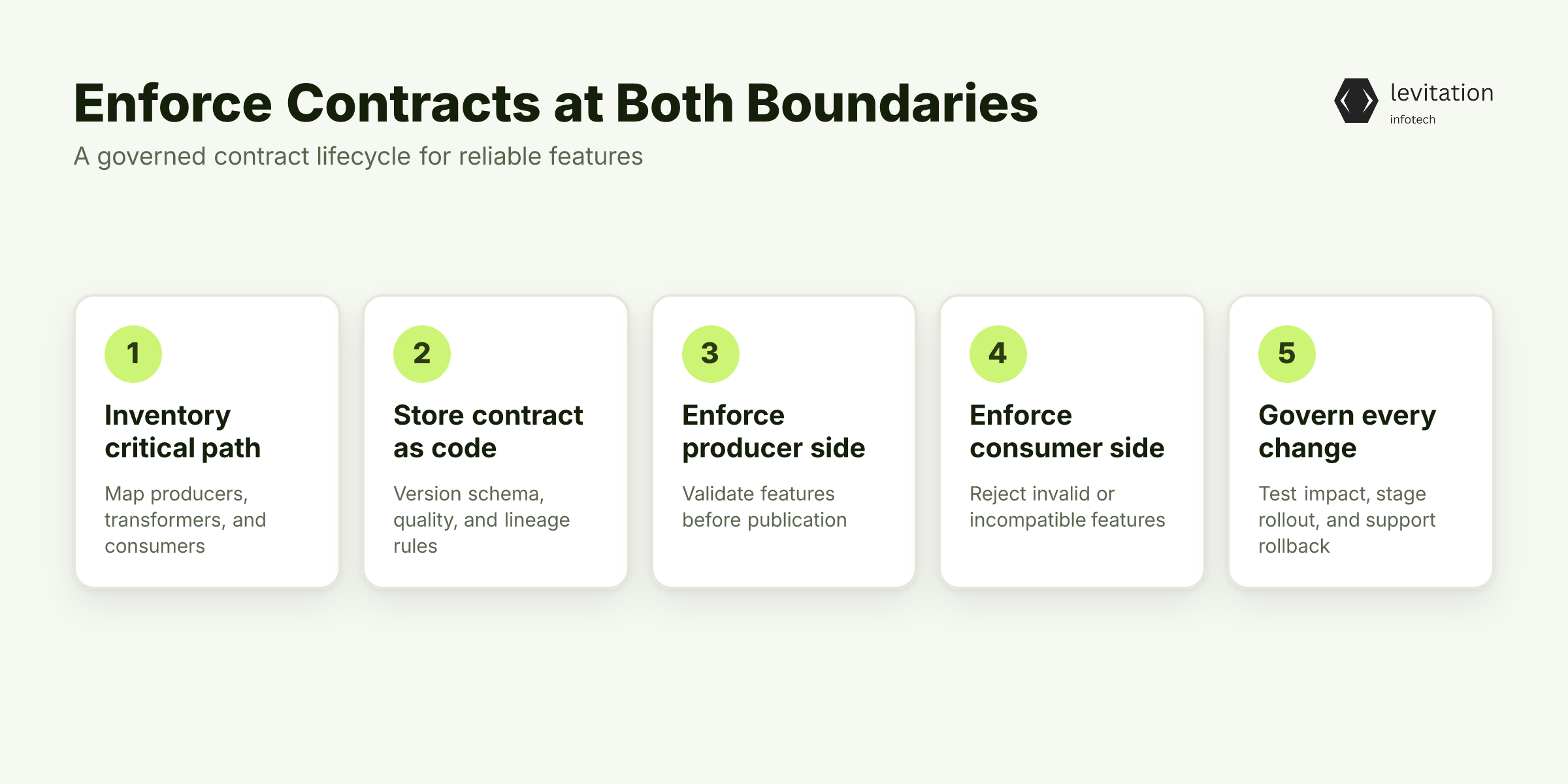
That promise fails unless both sides enforce it. A producer publishes a valid field, but a consumer still interprets it incorrectly. Contract enforcement therefore belongs at publication and feature access.
1. Inventory the critical path. List model-critical features and rank them by business and operational impact. For each, identify the producer, transformer, training consumer, and serving consumer. Ownership gaps here become enforcement gaps later.
2. Store the contract as code. Keep it in Git using YAML or JSON. Consider a revenue feature with a manifest. It records the version, owner, type, unit, definition, null behavior, event time, freshness, quality bounds, and compatibility. It also pins the producer, transformation, and required consumers.
3. Enforce the producer side. Run checks in CI and during materialization or publication. Validate schema, nullability, allowed values, ranges, freshness, and required lineage. Tools such as dbt model tests and Soda scans execute parts of the contract.
4. Enforce the consumer side. Reject missing required features, incompatible versions, unit mismatches, or unavailable fallback semantics before serving traffic. A model request must not proceed because a field happened to contain a plausible number.
5. Govern every change. A change follows a diff, consumer impact analysis, compatibility tests, staged rollout, and reversible deployment plan. The contract change management guide covers the release sequence. The producer and consumer checks show where each gate belongs.
Failure behavior should follow business importance: - Fail closed for security, fraud, or financial decisions. - Permit an explicit, visible fallback path for lower-risk recommendations. - Never silently substitute a default.
With requirements aligned and written in code, data contracts prevent quality issues before downstream workflows are affected.
Log the contract version, transformation version, source-event timestamp, and model version with every prediction. This turns a disputed feature value into a traceable event, not an argument.
The same contract produces different features when two environments apply it differently. How do you close that gap?
Close the Training-Serving Parity Gap
Different execution breaks the contract agreement. A shared contract says "revenue over 30 days." Offline SQL and online code still disagree about which events belong. They also disagree about how nulls behave or which clock governs the window.
Move feature transformations into a shared, versioned package used by offline materialization and online serving. Remove notebook-only and deployment-specific branches from the critical path. The package owns behavior, dependencies, and version identity.
Create deterministic parity fixtures from historical events, then compute each feature through both paths. Compare values, null masks, timestamps, units, and categorical mappings. Do not compare averages.
Require exact equality for deterministic values. Allow documented tolerances only for floating-point calculations. Never hide a material mismatch inside an aggregate error metric.
Test point-in-time correctness with as-of joins and event-time windows. Also cover late events, duplicates, out-of-order delivery, timezone boundaries, and historical backfills. The contract test matrix turns those cases into repeatable checks. Point-in-time correctness matters because historically correct data still generates the wrong feature at decision time.
Pin contract, transformation, and dataset versions in the training manifest, model artifact, serving configuration, and feature-store metadata. Each path then names the exact logic used to create it.
Run a shadow or canary comparison in a production-like environment before promotion. Make rollback automatic when parity fails. A green canary dashboard is insufficient if it omits input-level parity.
This is the same lesson behind healthy dashboards hiding wrong answers. Service health doesn't prove input correctness.
Keep two questions separate. Parity proves both paths compute the same definition. Population monitoring detects when incoming data changes beyond expected ranges.
One cannot replace the other.
If upstream systems keep evolving, how do you stop parity from decaying after launch?
Make Contract Governance an Operating System
CI alone is a snapshot. The contract becomes an operating system only when ownership, metrics, and lifecycle rules outlive individual releases.
Assign semantic ownership to feature-producing teams. They define meaning because they understand the business event.
Give the platform team tooling, standards, enforcement, and observability. Centralizing every definition inside the platform team will make it slower and less accurate.
Track the operating system, not just contract creation: - Critical-feature contract coverage. - Incompatible releases blocked. - Parity failures and affected consumers. - Consumer adoption and unresolved changes. - Rollback time and unresolved producer dependencies.
The feature platform operating model assigns these responsibilities. The contract ownership checklist helps teams review them.
Design for longevity. Systems still running in production need backward-compatible versions, migration windows, deprecation policies, and reversible releases. Contract history is part of that continuity.
In fintech and other high-assurance settings, add a trust check without confusing trust with architecture. The architecture still needs explicit semantics, enforcement, and parity.
Operationally, the payoff is release coordination. Feature and model releases become linked version changes. Incident diagnosis starts from pinned inputs.
Retraining and rollback stop depending on guesses about upstream behavior.
The next upstream release is the test. Will it arrive as a coordinated, reversible change, or expose another hidden gap?
Frequently Asked Questions
What is an AI data contract?
An AI data contract is a machine-readable agreement between two sides. One side is a feature or data producer. The other is the model or AI system that consumes the feature. It specifies schema, semantic meaning, event-time behavior, quality, freshness, ownership, and compatible versions.
How do AI data contracts reduce training-serving skew?
AI data contracts reduce training-serving skew. They pin the same feature definition, transformation version, and compatibility rules in training and serving. Contract tests then compare historical, point-in-time feature values with values produced by the online path before release.
What should an AI feature contract include?
A useful feature contract includes a stable name and owner. It also includes type, unit, definition, null behavior, source event, time window, and freshness. It also needs quality bounds, dependency versions, and compatibility rules. The minimum viable version is machine-readable, versioned, and enforced at both producer and consumer boundaries.
How do you detect schema drift in feature pipelines?
Detect schema drift by validating produced data against the contract in CI and at publication. Then compare the deployed contract version with each consumer's requirements. Combine structural checks with semantic and temporal tests. A type check misses changed meaning or event-time behavior.
Can ODCS be used for AI feature contracts?
Yes. ODCS provides a vendor-neutral foundation for structure and quality. Use ODCS as the base for an enforceable feature contract.
Which boundary can your team enforce first without waiting for a perfect platform?
About the author
Mayank Singh is a software developer at Levitation Infotech, where he builds web and AI-powered applications across the company’s fintech, healthcare, and enterprise projects.