


TL;DR: Delhi-NCR chatbot development cost starts with support time because faster eligible resolutions release agent minutes before they change payroll. Separate time, capacity, and cash; price the full workflow; then prove the benefit through a controlled pilot before seeking headcount savings.
Key Takeaways: - Track released minutes, queue pressure, and wait time before promising headcount reductions. - Price the build, recurring model use, integrations, and maintenance as one operating commitment. - Convert validated minutes into avoided hiring, slower team growth, or redeployment toward complex work.
Support Time Moves Before the Headcount Line
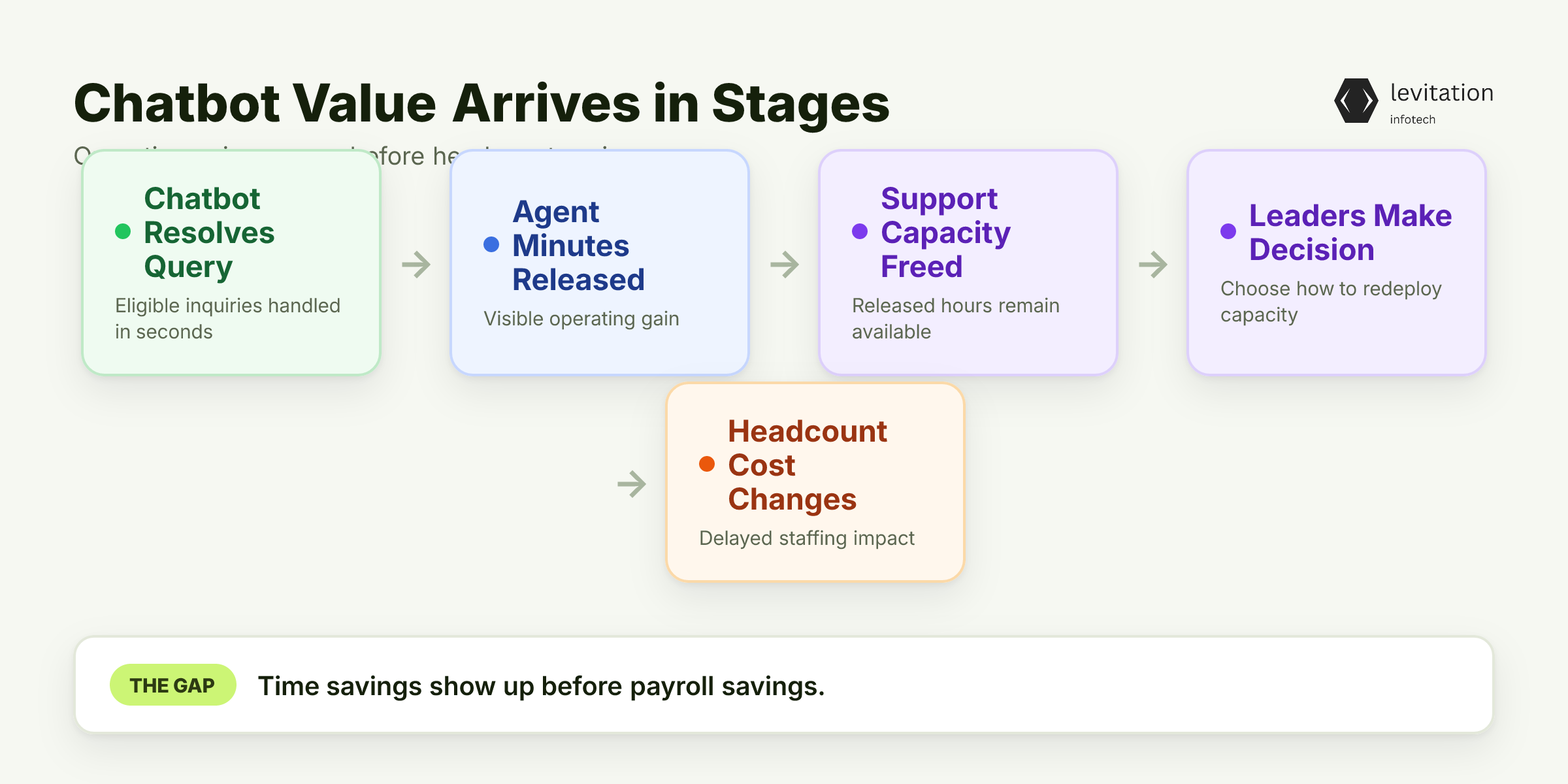
Faster chatbot resolutions release agent minutes long before they change payroll. That gap leaves leaders defending higher costs while promised savings stay theoretical.
Published comparisons place a human-handled support interaction at 6 to 10 minutes. Under those benchmarks, a chatbot resolves the same query in under 30 seconds.
That operating gain arrives before the support budget changes. Delhi-NCR operations leaders face an awkward sequence: build, integration, model, hosting, and maintenance costs arrive immediately.
Any staffing savings appear later in the budget. Released hours must first become an operating decision.
Separate the visible gain from the delayed gain
The visible gain is time released. The delayed gain is a management decision about that capacity.
A policy question handled in seconds saves several human-handling minutes. Enough eligible queries create room without changing payroll.
Frame the bot as an AI customer support agent handling eligible, repetitive inquiries. Human agents retain exceptions and sensitive conversations. The open question is how much capacity the bot can release without shifting complexity elsewhere in the support operation.
Make the first dashboard about time
For an operations head, the first dashboard should track: - Released agent minutes: How much human handling capacity eligible queries no longer consume. - Queue pressure: Whether incoming work still exceeds available agent capacity. - Customer wait time: Whether faster initial handling produces a better service experience.
Headcount reduction is a poor first metric. It arrives last and offers the least control.
But if faster answers do not automatically lower spending, where does the business value actually land?
Why Faster Answers Do Not Automatically Lower Spend
Faster answers do not guarantee lower cash cost. The initial increase is normal, but it must remain visible in the business case.
Track three ledgers, not one
Track these ledgers separately: - Interaction time: The full resolution path, including waiting, escalation, and repeat contacts. - Support capacity: The staffed hours available for customer work and the volume they can handle. - Cash cost: Development, recurring platform and model charges, integrations, maintenance, and payroll.
Keeping these ledgers separate prevents a common mistake: a quick answer that transfers a complex case moves the queue instead.
Measure the full resolution path. Escalation waits and repeat contacts belong in the calculation. A faster first response isn't enough if the customer still needs another interaction: did the bot complete the resolution, or merely transfer it?
Price the commitment, not just the build
Upfront expenditure covers chatbot development, workflow integration, model usage, hosting, maintenance, knowledge updates, and monitoring. It is not a single licence fee.
Estimating AI chatbot development cost in India without including transfers creates a false bargain. Unresolved and transferred queries still consume agent time, service capacity, and customer patience.
Released hours initially absorb rising ticket volume. They can also protect service quality during hiring, reduce future recruitment needs, or shorten onboarding.
None requires an immediate payroll reduction. Once those three ledgers are separated, the time benefit becomes measurable rather than rhetorical.
Where does that released time appear across the operation?
Three Places Support Time Is Released
The value isn't one total. It appears across several operational layers, each with a different owner.
Interaction compression
When an eligible query finishes in under 30 seconds instead of consuming 6 to 10 human minutes, it releases handling capacity.
Multiply eligible interactions by the difference between human and bot handling minutes. Then divide by 60 to calculate released agent hours.
The published comparison is a useful external reference point. Replace it with observed values from your own support workflows. Different policies, tools, and customer language will produce different results.
What happens when those minutes meet a busy queue?
Queue smoothing
Routing common, policy-based questions to an AI customer support agent shortens queues. Human agents then focus on cases needing judgment, context, or authorization.
Consider a delivery-status question during a busy shift. If the bot resolves it without an agent, the queue becomes shorter. If it transfers the same question, the queue merely changes shape.
This distinction matters because queue smoothing improves customer wait time without reducing total handling effort. Both the wait and the work must be measured.
How much of the next gain comes from onboarding rather than live handling?
Onboarding and training compression
The bot doesn't require onboarding or repetitive product training. Approved knowledge changes can reach its responses without another agent training cycle.
New agents spend less time learning frequently asked questions. They still need training for exceptions, judgment, and sensitive conversations. That distinction keeps the benefit credible.
Which measure separates training relief from completed resolutions?
Report containment and deflection separately
Use two metrics: - Containment: The query is resolved without a human handoff. - Deflection: The system avoids creating a human-handled ticket.
A fast transfer leaves resolution unchanged. Reporting both metrics prevents routing activity from masquerading as completed work.
With time separated from routing, does every vendor quote cover the same workflow?
Price the Complete Support Workflow
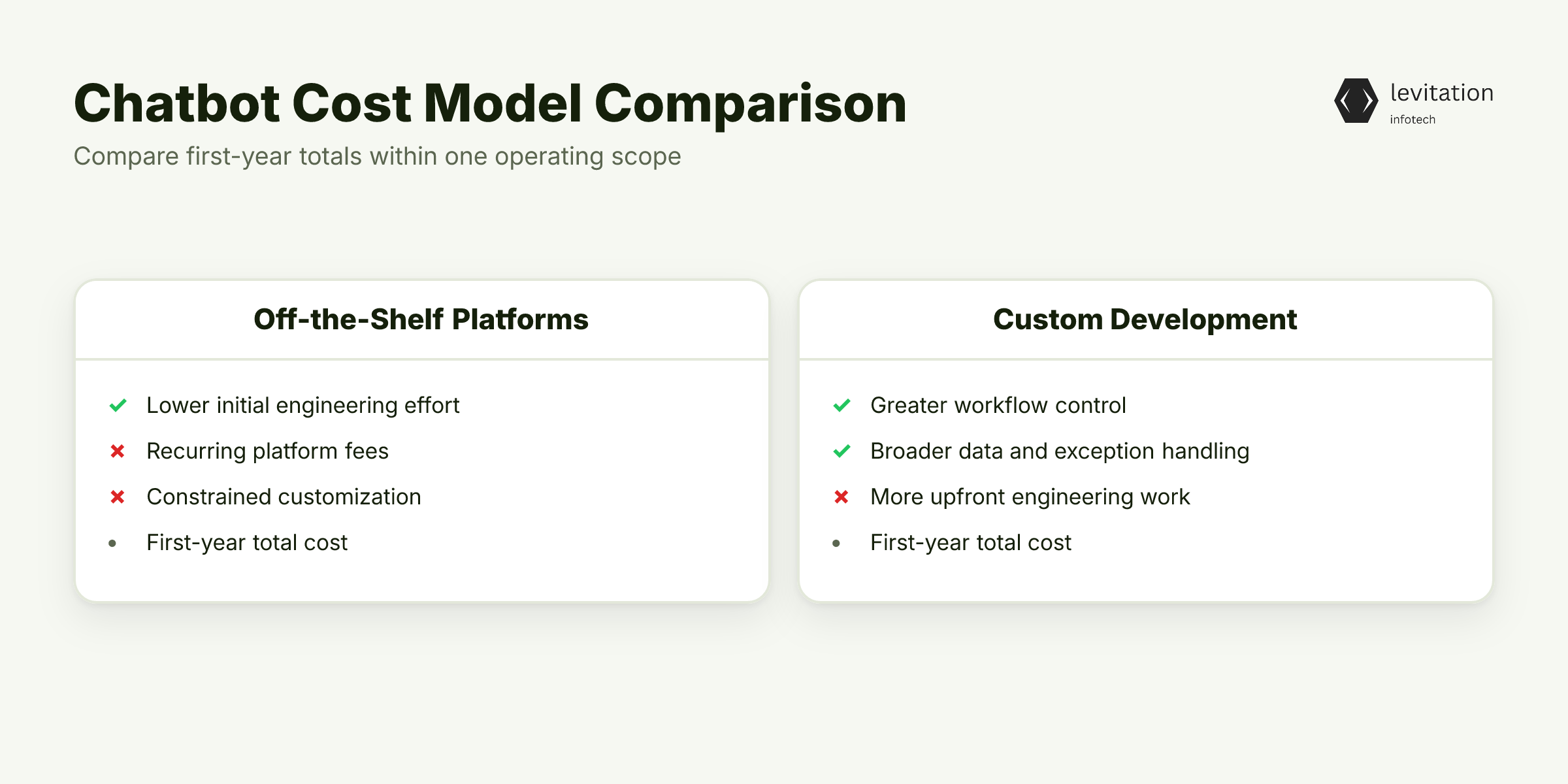
A low quote becomes meaningless when each vendor has priced a different system. Every proposal needs the same operating boundary.
Write one scope for every quote
The common scope should identify: - Channels: Web, WhatsApp, email, or other supported entry points. - Eligible use cases: Repetitive questions the bot fully resolves. - Knowledge sources: Approved documents, product data, policies, and their owners. - Integrations: CRM, ticketing, order management, identity, and agent handoff systems. - Languages: Each supported language and its content requirements. - Human handoff rules: The triggers, context passed, and ownership after escalation. - Operations: Analytics, security, monitoring, support, and service expectations.
Without this boundary, the issue described in how hidden return work expands chatbot scope becomes a post-launch surprise.
What does each vendor charge for work inside that boundary?
Use a transparent cost model
Estimated cost equals development hours multiplied by the hourly rate. Add model fees, integration costs, and a maintenance allowance.
This structure exposes what drives the quote. It also separates one-time engineering from recurring operating commitments.
Compare off-the-shelf platforms and custom development on first-year total cost. - Off-the-shelf platforms cut initial engineering effort. They add recurring fees and constrain customization. - Custom development requires more upfront work. It offers greater control over workflows, data, and future exception handling.
Neither model wins automatically. The right choice depends on workflow complexity, integration depth, and how much control the operating model needs.
Which recurring costs will change as the bot handles more exceptions?
Price the work that keeps changing
For chatbot pricing in Delhi-NCR, require itemized figures for the one-time build, recurring model and infrastructure charges, integration effort, maintenance, and every commercial assumption behind them.
The work around an AI chatbot changes over time, including knowledge-base updates, prompt or workflow changes, monitoring, model upgrades, and new exception categories.
Ask vendors to price the same pilot, query set, and success criteria. Otherwise, chatbot development cost comparisons reflect different definitions of scope.
How can a pilot test whether those controls work?
Launch Against a Baseline, Not a Demo
A polished conversation proves that a model can respond. It doesn't prove that your support operation improved.
Capture the baseline before launch
Record the current operating state: - Average human handling time and queue wait. - First response time and total resolution rate. - Transfers, repeat contacts, and reopened tickets. - Agent hours used for onboarding and recurring training.
A credible AI chatbot development cost in India estimate must connect these baseline measures to future results. Otherwise, it only forecasts vendor activity.
How will the knowledge system keep pilot answers accurate?
Prepare the knowledge system
Connect approved content and assign a named owner to every source. Version policy changes and remove expired guidance before it reaches customers.
Define exactly when a question must escalate. Ensure sensitive conversations have clear ownership, even when the bot handles the surrounding workflow.
Will the pilot test escalation as carefully as it tests resolution?
Run a controlled pilot
Release a defined set of eligible queries. Compare the results with the baseline instead of with a vendor demonstration.
Set gates for accuracy, resolution, escalation, and repeat contacts. Treat under 30 seconds as a reference point, not an automatic service guarantee.
The pilot must test the full AI customer support agent, including its handoff path. A contained query that later returns as a ticket has not released time.
Will access, monitoring, and fallback controls hold under real traffic?
Review operational and engineering risk
Test access controls, monitoring, audit logs, change management, fallback handling, and incident ownership. Know who acts when the bot gives a wrong answer or an integration fails.
Vendor longevity matters, but it cannot replace workflow testing. How AI vendor contracts hide lock-in deserves the same scrutiny as model accuracy.
A clean before-and-after record changes the finance conversation. It shifts from chatbot cost to capacity already released.
How should released capacity reach the P&L?
Convert Released Minutes Into a P&L Decision
Released time creates capacity, and capacity creates a management choice. That choice turns into a financial outcome.
Build a benefits ledger beside the invoice
Track: - Agent minutes released. - Queue and wait-time changes. - Repeat-contact changes. - Onboarding hours avoided. - Queries safely contained without a handoff. - Escalations that moved work between teams rather than resolving it.
This ledger should sit beside the cost record. It gives Finance evidence that connects system behavior to operating capacity.
Which operating outcome should this capacity support first?
Choose the management outcome
Present three defensible uses for the released capacity: - Absorb growth: Handle rising ticket volume without matching every new query with additional staffing. - Redeploy capacity: Move agents toward complex exceptions and higher-value customer work. - Avoid planned growth: Skip a planned backfill when released capacity covers the operational requirement.
The strongest case isn't automatic layoffs. It's deliberate control over when capacity becomes cash savings.
Scale only when measured time reduction persists, quality gates remain intact, and first-year total cost stays aligned with operational value. This follows the principle in what to measure instead of AI ROI.
The payoff is control. An AI customer support agent shortens queues and reduces repetitive training before the support budget visibly changes.
What can a controlled pilot prove before any budget decision?
Frequently Asked Questions
What is the chatbot development cost in Delhi-NCR in 2026?
There is no universal Delhi-NCR price. A quote depends on integrations, channels, eligible use cases, model usage, maintenance, knowledge updates, monitoring, and exception handling.
Request a scoped quote that separates one-time build work from recurring operating costs. Compare vendors using a common pilot scope, query set, success criteria, and first-year cost boundary.
How quickly can an AI support chatbot save support time?
Time savings become visible as soon as a controlled pilot routes eligible queries without a human handoff. Cash savings follow later. Released hours must first become avoided hiring, slower team growth, or redeployment.
How do you calculate the ROI of support chatbot automation?
Use released agent hours multiplied by the fully loaded cost of those hours. Subtract model, platform, integration, and maintenance costs. Also track containment, transfer, repeat-contact, and onboarding metrics so apparent deflection isn't confused with actual resolution.
Is the lowest chatbot pricing in Delhi-NCR always the cheapest option?
No. Some low build quotes exclude recurring model usage, integrations, knowledge updates, monitoring, or exception handling. Compare vendors using the same scope and a first-year total-cost view.
Will an AI support chatbot reduce the need for support agents?
The chatbot handles repetitive work and trims onboarding requirements. Human agents remain necessary.
The stronger business case centers on faster queues and more agent capacity for complex work. Headcount savings should be a management outcome, not an automatic promise.
Start with released minutes, then test which P&L choice they support before changing the budget. Which released-minute outcome can be demonstrated first without compromising service quality?
About the author
Mayank Singh is a software developer at Levitation Infotech, where he builds web and AI-powered applications across the company’s fintech, healthcare, and enterprise projects.