


TL;DR: Traditional DLP was built around a human at a keyboard deciding to send a file. AI agents leak data through tool calls, MCP servers, and URL-encoded responses. Perimeter DLP was never set up to see these. Runtime enforcement at the agent gateway closes the gap. There, the data is named and the action can be checked.
Key Takeaways: - AI agents create five clear leak channels. These channels defeat email, endpoint, and network DLP controls at the same time. - Runtime inspection at the agent-tool boundary is the only place where policy can be enforced inline. It does this without breaking the agent. - Inline deployment at the agent gateway shortens timelines. In-house builds struggle to match this speed. Discovery and classification drive most of the cost.
The Alert That Never Fires
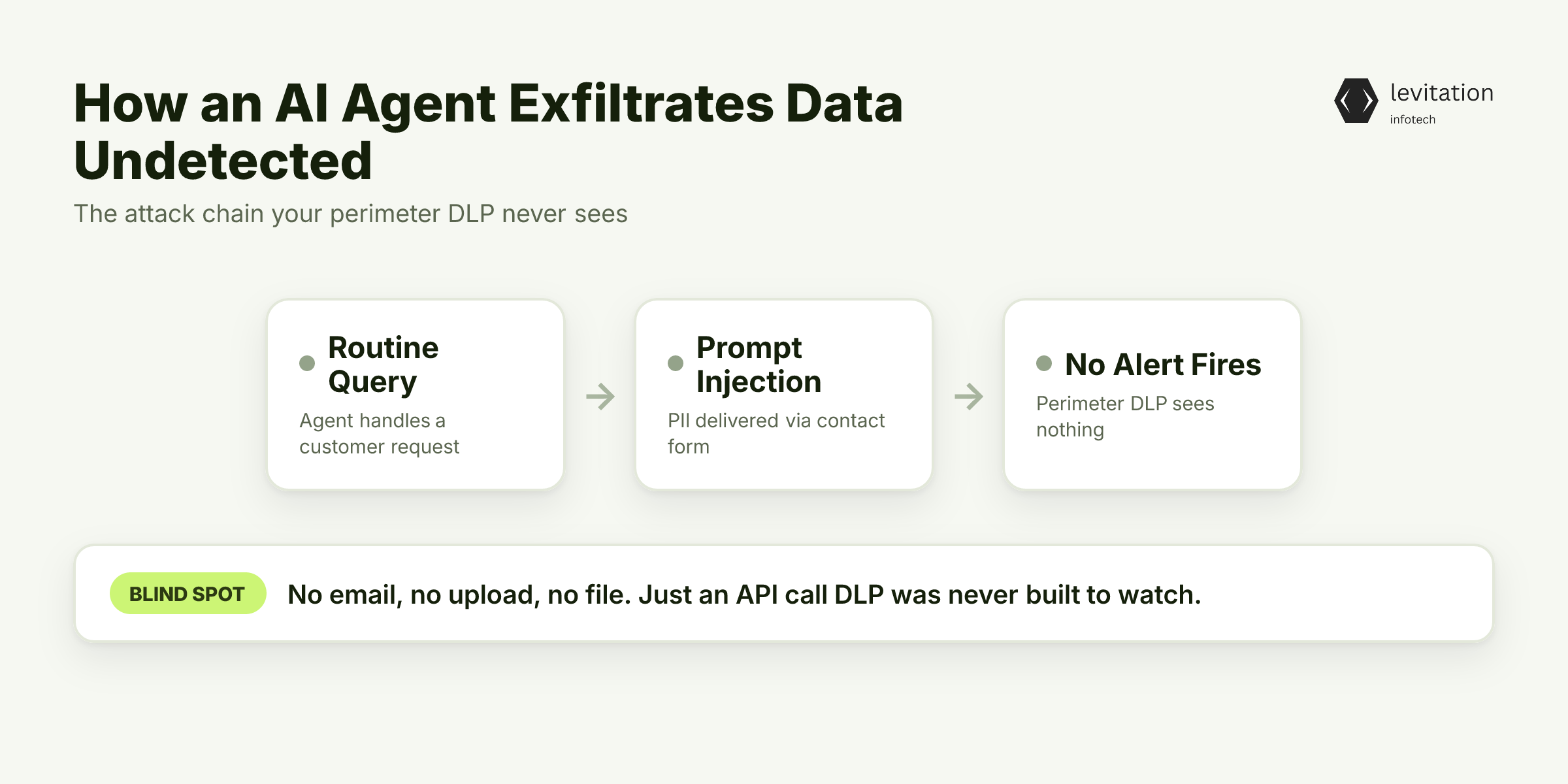
Your DLP solution was built for an employee. The employee chooses to send a file, forward an attachment, or paste content into email. It was never built for a system that runs fast tool calls during inference. It was never built to be prompt-injected into forwarding your customer database.
It was never built to route data through third-party MCP servers. Your security team has never audited these servers. That gap is not theoretical. It is the breach you have not found yet.
Picture the scenario. An AI agent with CRM access handles a routine customer query. Through prompt injection hidden in a contact form, the agent gets a record with PII. It formats the record into a tool-call argument. Then it sends the record to a connected service. No email was sent. No file was uploaded. The agent did exactly what its prompt asked. It did so in the shape of an ordinary API call. Perimeter DLP sees nothing. There is nothing on the perimeter to see.
At Black Hat 2025, live demos showed working exploits against Microsoft Copilot, Salesforce, and Google Gemini. One agent gave access to a connected Google Drive after getting a single malicious email. In r/cybersecurity the same week, 74.8% of AI agent attacks found in production were security-related. The types were prompt injection, logic manipulation, and agents holding permissions they should never have been given.
The agents you shipped into production were set up with almost none of the controls the threat model needs. Looking at AI agent architectures and their tool-calling boundaries is the first step. It shows why your current stack watches the wrong door.
The interesting question is not whether this is already happening inside your environment. It is why your current security stack, including the DLP you paid for, sees none of it.
Why Traditional DLP Was Built for a Different Threat
Traditional DLP was designed for a human decision-maker. File uploads, email attachments, USB transfers, and known SaaS endpoints are the assumed leak surface. Every regex, every fingerprint, every behavioral baseline was tuned to that model.
AI agents do not match that model at any layer. They make decisions at machine speed. They can be prompt-injected to do anything in their toolset. They encode sensitive data freely and split payloads across requests. They also call tools the security team has never heard of.
A network proxy DLP cannot inspect TLS-encrypted LLM API traffic. It also cannot inspect tool calls to third-party model providers without breaking the agent. It cannot do aggressive man-in-the-middle inspection. Such inspection breaks provider terms. For more on what this traffic looks like in production, see LLM inference traffic patterns.
Email DLP and endpoint DLP sit at the human perimeter. The actual data theft happens at the agent-tool boundary during inference. No human is in the loop, and no perimeter control is positioned to observe.
The threat model has flipped completely. A prompt-injected agent decides on its own. The DLP has no meaning-based context for the tool call it just allowed.
The mistake most security leaders make is treating this as a coverage gap. It is not a coverage gap. It is a wrong-layer problem. Checking the wrong boundary with a sharper tool still misses the actual leak.
If the perimeter is the wrong place, where are the leak channels? What do they look like in production traffic?
The Leak Channels Your Firewall Can't See
There are five clear leak channels that defeat the controls you have today. Each one bypasses a different layer. That is why no single product on your stack catches all of them. - Channel 1: Prompt injection forces the agent to include credentials, API keys, or PII. These go into tool-call arguments to internal systems your proxy trusts. - Channel 2: MCP (Model Context Protocol) tool calls send sensitive data as arguments to third-party servers. The agent treats these as trusted because they look like normal tool calls. The network only sees TLS to an unfamiliar endpoint. - Channel 3: Response-based exfiltration hides stolen data in URL paths, query parameters, or response bodies. The proxy cannot parse these without knowing the transformer output format. - Channel 4: Cross-session memory persistence writes sensitive context from one compromised session into RAG and embedding stores. Later sessions get and send it downstream. - Channel 5: Autonomous outbound actions let the agent call SendGrid, Slack webhooks, or external APIs. No human review step is needed. The data leaves as a normal API call.
Each channel defeats a different control: regex, perimeter, identity, and audit. No single layer catches all five. We mapped this pattern in detail against the AI agent audit trail gap. The math gets worse as MCP adoption grows. MCP server adoption has scaled faster than auth enforcement. Most agents have no auth on the tools they call. See 400M MCP Downloads. Most Agents Still Skip Auth.
Your detection coverage depends on how many channels your control plane can name at the same time. Traditional DLP names one, maybe two. Agent-driven exfiltration uses all five.
Listing the channels is necessary but not enough. What does an inspection layer have to actually do to catch all five without breaking the agent?
What AI Agent DLP Must Do Differently
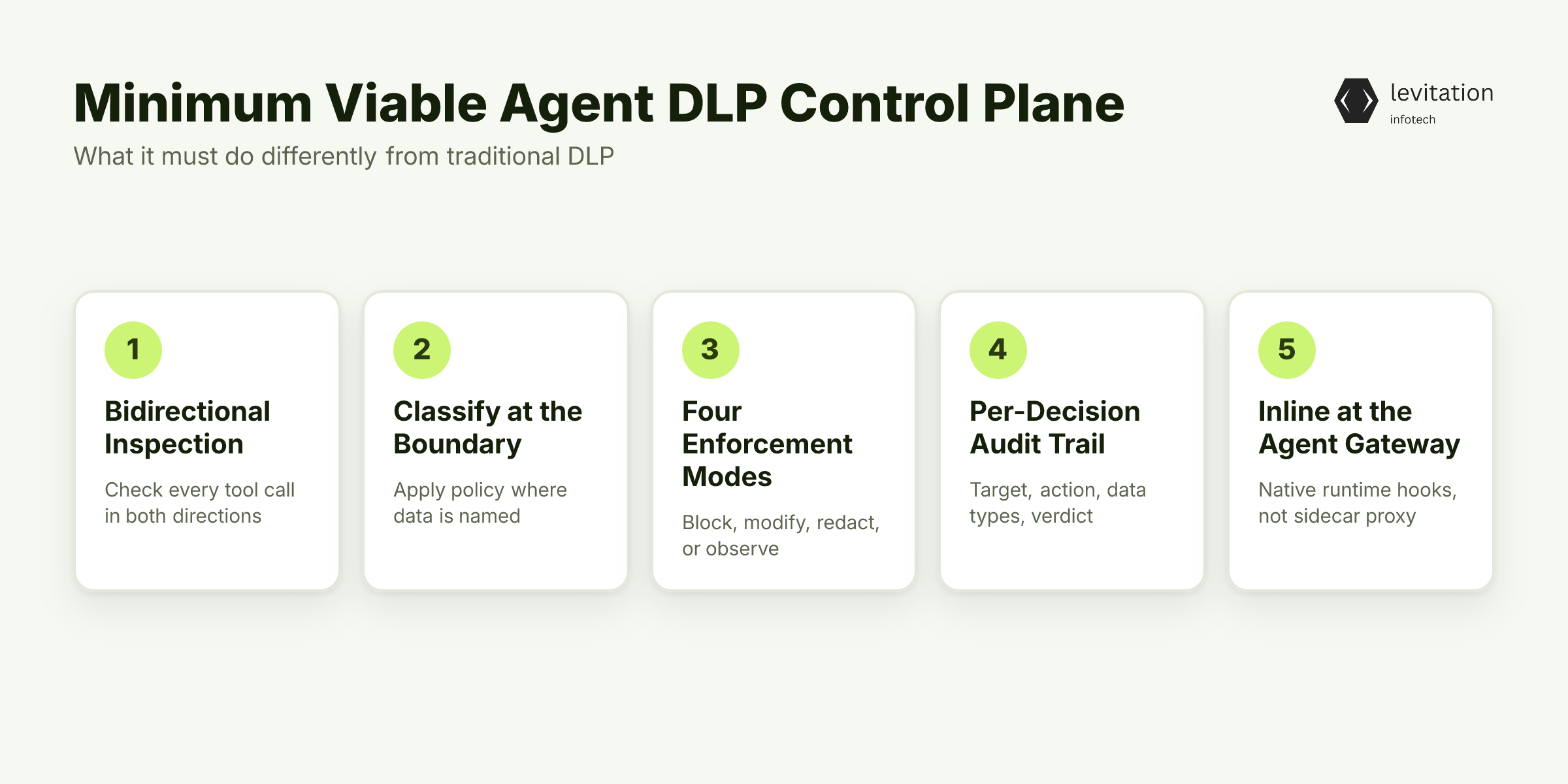
Effective agent DLP does not live at the network proxy. It lives at the agent-tool boundary. That is the only place where the data is named and the action can be checked.
The minimum viable control plane has to do five things differently from traditional DLP. First, it must inspect every tool call in both directions. Sensitive data flows back from compromised tools as well as out to them. A one-way inspection misses half the problem.
Second, it must apply classification and regulatory policy at the agent-tool boundary, where the data is named. It must not apply it at the email gateway or endpoint, where the data is opaque. Third, it must support four enforcement modes: block, modify, redact, or observe-only. These modes are picked by policy based on data type, agent identity, and action class.
Fourth, it must generate an audit trail per decision with four fields: target, action, data types involved, and verdict. Compliance teams then rebuild any incident without log archaeology. Fifth, it must run inline at the agent gateway with native hooks for the agent runtime, AWS AgentCore, LiteLLM, or similar. It must not run as a sidecar proxy. Such a proxy sees encrypted payloads it cannot semantically inspect.
For context on the agent runtime and tool-calling layer and how they actually work, that is where to start.
The architectural distinction matters more than the feature checklist. A proxy that cannot see the structured tool call is guessing at meaning. A gateway hook that intercepts the call before it turns into a serialized payload is checking the actual intent. That is the difference between a control that runs and a control that holds up in an audit.
It is also why your zero trust policy stops engineers while AI agents walk past it. The identity boundary was designed for the human session. The agent does not honor it because the agent does not know it exists.
Theory is cheap. What does this look like in an actual deployment? Where do most teams waste the first three months?
Building the Control Plane: A Practical Stack
In most environments we audit, the deployment follows the same five steps. The first two take the most time. The engineering team's mental model of what the agent can reach is wrong by a wide margin. - Step 1: Discover every MCP server and tool the agent can reach. Found tool counts always exceed the engineering team's working inventory. The agent tool graph grows through MCP server connections. It also grows through tool registrations the security team rarely tracks in real time. - Step 2: Classify the data the agent can access, not just the data the user can access. Posture scans must walk the agent tool graph, not the human permission graph. The two differ the moment an agent gets broad read access. - Step 3: Set up inline inspection at the agent gateway using native hooks for your runtime. Sidecar proxies see encrypted payloads. Gateway hooks see the structured tool call before it turns into a serialized payload. - Step 4: Define policies in three bound identities: data identity, agent identity, and action. Data identity covers PII, PHI, payment data, and secrets. Agent identity covers service account, scope, and purpose. Action covers read, forward, persist, and exfiltrate. Regex-only policies fail. They fail because agents encode data in ways that beat pattern matching. - Step 5: Wire every decision into your SIEM with target, action, data types, and verdict. Without this, you have observability but not enforcement. Audit teams will not accept logs alone as evidence. For the machine learning model serving infrastructure that supports these hooks, runtime choices matter as much as policy.
Teams that ship quickly differ from teams that run long. The biggest gap shows up at the discovery and classification phases. Teams that skip Step 1 end up retrofitting policy against an unknown surface.
Teams that skip Step 2 cannot write a policy that is data-aware. They fall back to regex and get breach alerts later. This happens when an auditor asks for the audit trail.
The architecture is one thing. Getting the security organization to treat runtime enforcement as a first-class control is harder. It should not be a wiki document.
What Changes When Runtime Enforcement Is Real
The shift is structural, not cosmetic. Three things change when runtime enforcement is real rather than aspirational.
Compliance teams stop relying on classification rules that exist only on paper. The gap between written policy and runtime enforcement only closes when two things happen. Inspection must be inline. Policy must be data-aware.
Security teams get a single audit trail that maps every agent action to the data it touched. That is the evidence package SOC 2, HIPAA, and GDPR auditors actually accept.
Engineering teams stop blocking agent rollouts because the control plane is provable rather than hopeful. Systems built on this approach last through model swaps. The reason is that the enforcement layer is decoupled from the model layer. The upstream model choices in the production AI/ML training programs feeding into these control planes matter as much as the runtime.
The decoupling is the point. Runtime enforcement that lives at the model layer dies with every model swap. Runtime enforcement that lives at the agent-tool boundary survives the model layer entirely. It lasts across vendor changes and architecture refreshes. The reason is where it lives, not any one model.
The practical questions that follow tend to cluster around three areas. These are audit evidence, deployment speed, and what changes when the model layer shifts.
Frequently Asked Questions
Can traditional DLP detect AI agent data leakage?
No. Traditional DLP inspects email, file uploads, and known SaaS endpoints, assuming a human decision-maker. AI agents encode data in tool-call arguments and send arguments to MCP servers. They also split payloads across requests. Perimeter DLP is not set up to see any of this. For an overview of the agent architectures that create this gap, see our AI/ML training resources.
What is MCP server security and why does it matter for DLP?
MCP (Model Context Protocol) servers are tool providers that AI agents call during inference. Each call is a data theft channel because the agent sends arguments to third-party infrastructure. If those servers are not classified, inventoried, and monitored, your DLP has zero visibility. It cannot see the data leaving through them.
How is AI agent DLP different from LLM data protection?
LLM data protection covers training data, fine-tuning data, and model weights. AI agent DLP covers runtime traffic between an agent and its tools. This is a different stage of the pipeline with a different control plane. You need both. They are not substitutes.
What should an AI agent DLP policy include?
Every policy should bind three things: data identity, agent identity, and action. Data identity covers PII, PHI, payment data, and secrets. Action covers read, forward, persist, and exfiltrate. Regex-only policies fail. They fail because agents encode data in ways that beat pattern matching. Meaning-based classification at the tool boundary is required.
How long does it take to deploy runtime agent DLP?
For teams with an existing agent runtime, inline deployment at the agent gateway shortens timelines. In-house builds from scratch struggle to match. The reason is that discovery and classification work is the main cost driver. In-house teams building from scratch underestimate the discovery and classification phases. Scope projects of the same size run well past early estimates for that reason.
About the author
Mayank Singh is a software developer at Levitation Infotech, where he builds web and AI-powered applications across the company’s fintech, healthcare, and enterprise projects.