


TL;DR: Indian mid-market companies pay ₹1.5L to ₹8L for an ERP license. Then they discover they need extra staff just to keep the software fed, reconciled, and explained. The shadow team that forms around the ERP routinely absorbs cost that the licence quote never mentioned. The fix is not firing those people. It is redesigning the system so the people are no longer needed.
Key Takeaways: - The ERP license is the cheapest part of ERP ownership in India. The shadow team is the expensive part. - Off-the-shelf ERPs fail at integration, reconciliation, and reporting. Each gap creates a full-time role to patch it. - Year-three TCO in India climbs beyond the year-one cost. It is driven by the people the software demands, not by the software itself. - Cutting the shadow team requires API integrations, a thin custom layer, and one accountable ERP owner. Not layoffs. - Vendors who deliver in a focused window outperform drawn-out in-house builds. They collapse the shadow team before it forms.
The ₹8 Lakh ERP That Quietly Demands a Team Behind It
You budgeted ₹8 lakh for an ERP. Two years later, you have the software, the dashboards, and a quiet team whose only job is to keep the ERP alive. Nobody warned you about them.
The license landed between ₹1.5L and ₹8L, right in the range every ERP sales deck in India advertises. Implementation was priced at roughly 2x the license, which felt reasonable at signing. You went live, your team got trained, and the sales rep moved on to the next account.
Then the shadow team started forming.
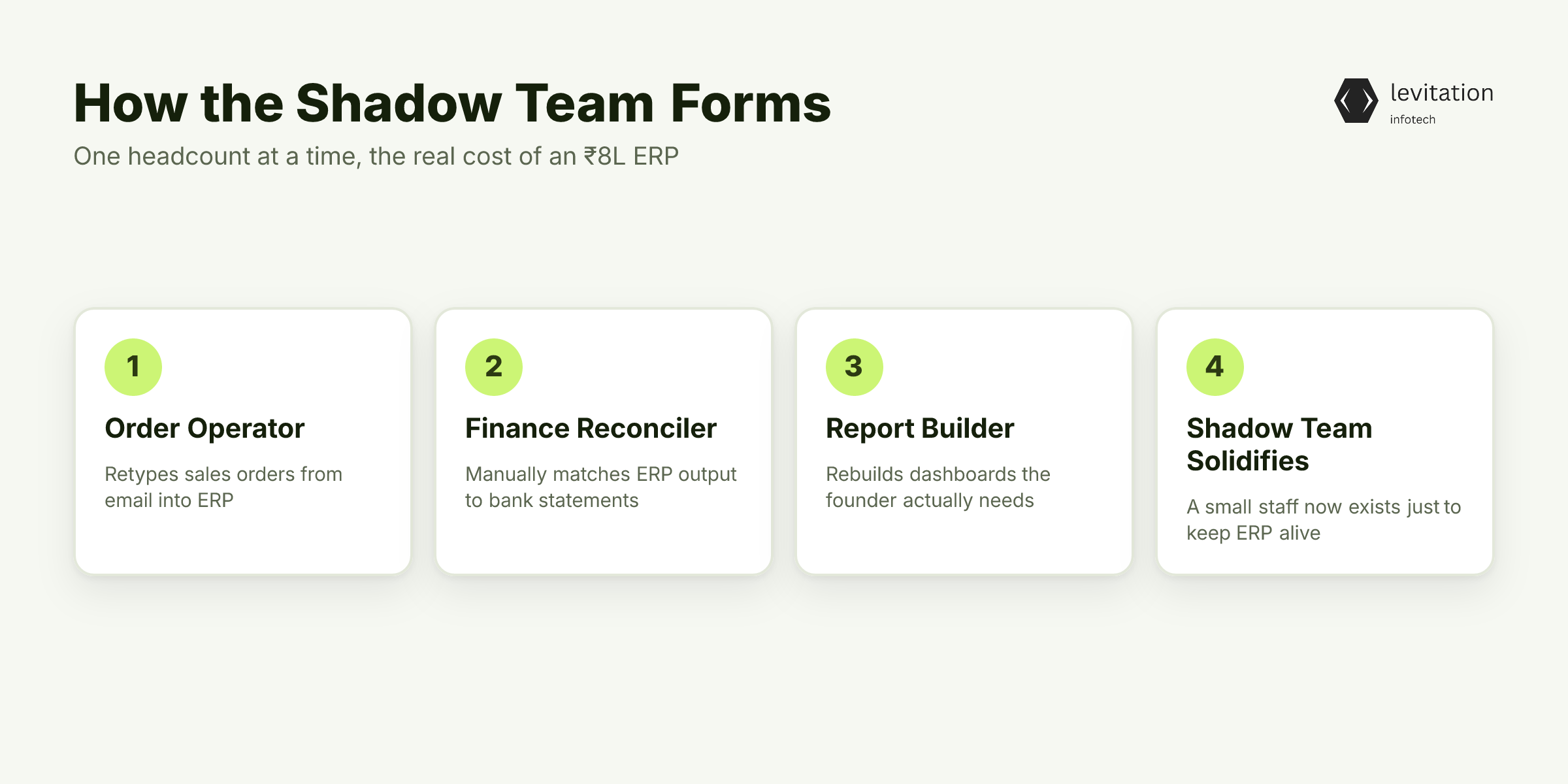
It usually starts with one operator. Someone has to retype sales orders from email into the ERP because the system does not pull them in automatically. Then a reconciler shows up in finance, matching ERP output to bank statements by hand.
Then a report builder appears, because the canned dashboards never match how the founder actually thinks about revenue or inventory.
Before year one ends, you have a small team. Their entire job is to compensate for what the ERP does not do on its own. Every new integration gap tends to add another head to the roster.
This is the ERP implementation cost in India nobody quotes. The line item that makes the difference between a healthy deployment and a budget hole grows quietly, one headcount at a time.
The frustrating part is that almost no vendor quote in India includes this line item. Here is why.
Why No ERP Quote in India Includes the Shadow Team
ERP vendors price three things and three things only. The software license, the modules you turn on, and the implementation days their consultants spend at your office. Every quote you have ever received, from Tier-1 brands in Noida, Gurgaon, and Bangalore, follows the same template.
Implementation services usually run about 2x the annual license, sometimes more. That covers the months of configuration, training, and go-live support.
The salesperson's commission is tied to the license value plus the implementation days sold. Once the contract is signed, their incentive is gone. The next conversation happens at renewal.
The gap between "software is live" and "software runs the business" is where the shadow team lives. Vendors do not price it because pricing it would shrink the deal.
A founder who sees a licence quote that flags the people cost on top is going to slow down. A founder who sees only the licence signs the deal fast.
The ERP implementation cost breakdown published online almost never includes staffing. Staffing is treated as your operations problem, not their deliverable.
By the time you realise the gap, the implementation partner is long gone. Your team owns the mess, and the next module is being sold to you.
So who exactly is on this shadow team, and what are they doing that the software isn't?
The Roles Sitting Behind Every Off-the-Shelf ERP
Each role exists because of a specific gap in the ERP. They are not a sign your team is slow or inefficient. They are a sign the system was never designed to do the work alone.
Role 1: Data entry operators. Off-the-shelf ERPs do not talk cleanly to your shop floor, your sales calls, or your logistics partner. A purchase order arrives by email, gets retyped into a form, then retyped again when it reaches inventory. The operator's full-time job is bridging systems the ERP was supposed to replace.
For a deeper look at why integration gaps force manual work, the patterns in ERP development and integration mirror the ERP implementation cost in India story closely.
Role 2: ERP coordinator or admin. This person owns master data, user permissions, and the endless stream of "why is this report blank" tickets. Off-the-shelf systems scatter configuration across dozens of screens. Without a dedicated owner, the configuration drifts and reports quietly break.
Role 3: Reconciler. Usually a finance team member, manually matching ERP output to bank statements and GST filings. The ERP produces numbers, but the numbers rarely tie out without intervention. Someone spends hours every week closing the gap.
Role 4: Report builder. Canned dashboards answer generic questions. The moment the founder asks "what is our real margin on this SKU after returns," the canned dashboard falls short. A report builder stitches custom views, exports, and ad hoc queries together.
Role 5: IT support. One person, often on a retainer, handling the local server, backups, and integration glue. If the ERP runs on-premise, this role is unavoidable.
Year one is painful. But year two and three make the math worse.
The True ERP TCO in India: Year 1 vs Year 3
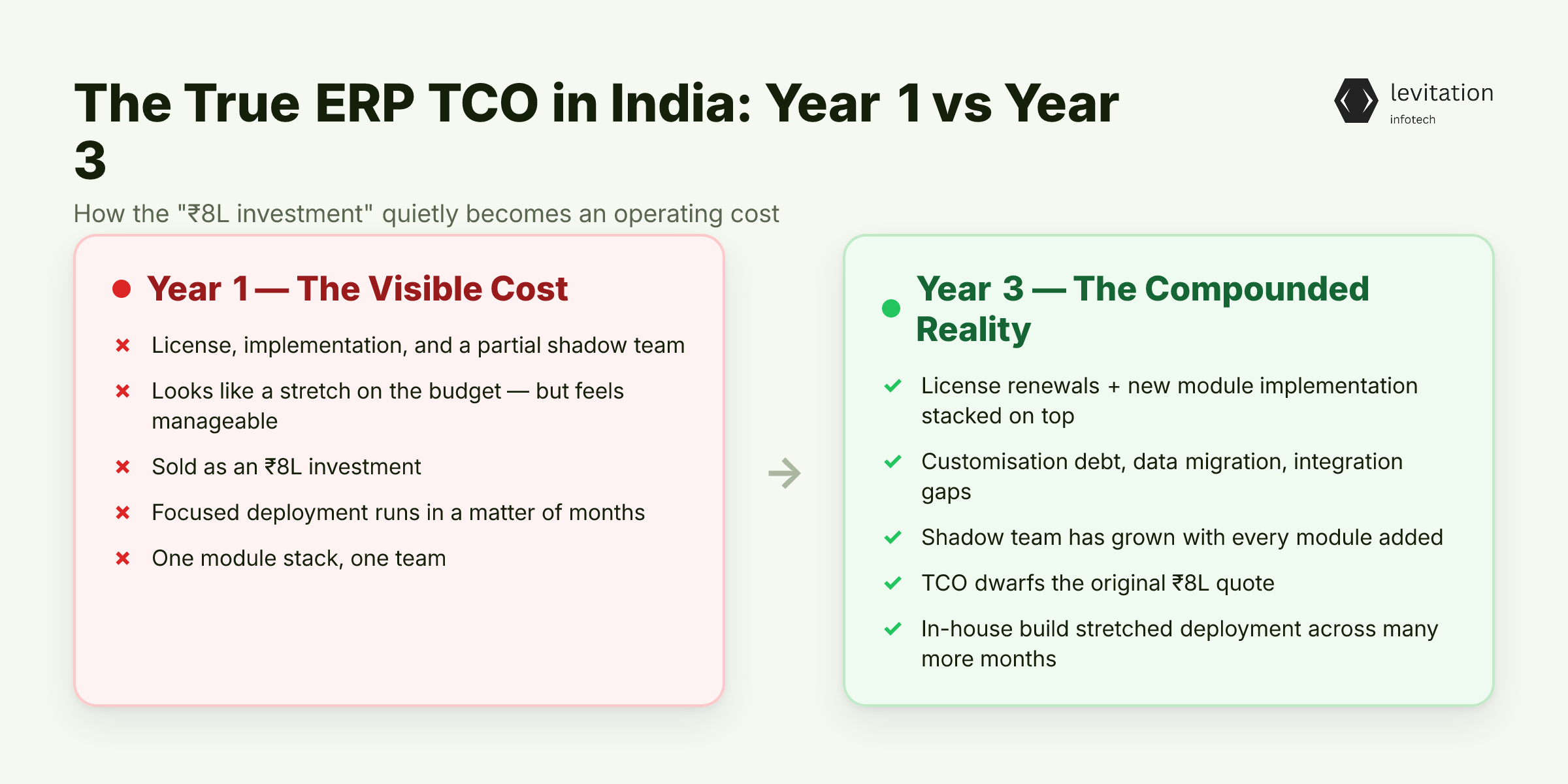
Year one is the visible cost. License, implementation, and a partial shadow team. It already looks like a stretch on the budget.
Year two is when the module catalog opens up. You add a CRM module, then inventory, then payroll. Each new module adds to the shadow team. It never shrinks it.
A common pattern in Noida-based mid-market firms is that every new module brings its own master data, reports, and integration gaps. Each gap tends to demand its own person, because the off-the-shelf system does not adapt to the new workflow on its own.
By year three, the ERP TCO in India climbs well beyond the year-one spend. You stack license renewals, implementation services for new modules, customisation debt, data migration, and a shadow team that has grown with every module added.
The compounding effect is invisible at the line-item level. It only shows up when a founder adds up payroll for the shadow team and compares it to the original license quote.
The other compounding variable is deployment time. A focused deployment with an experienced partner runs in a matter of months. An in-house build stretches across a much longer window.
Every extra month of deployment is a month the shadow team is forming in the background. They patch gaps that should never have existed.
The result is an ERP sold as an ₹8L investment that quietly grows into an operating cost. By year three, it dwarfs the original quote.
Cutting the shadow team sounds dangerous. The counterintuitive move is to build a different ERP, not to fire the people.
Cutting the Shadow Team Without Killing the ERP
Most founders try to fix this by trimming headcount. That is the wrong move. The people on the shadow team are usually your most patient employees. The fix is to remove the work the system forces them to do.
Step 1: Map every shadow task to a system gap. Spend a week listing what each shadow team member actually does. Almost every task traces back to a missing integration, a missing field, or a missing workflow. Once you see the pattern, the problem is structural, not staffing.
Step 2: Replace the reconciler with real API integrations. When the ERP talks directly to your bank and your GST tooling, reconciliation happens in seconds. The reconciler is freed for actual finance work, not data plumbing.
Step 3: Build or commission a custom ERP layer for the two or three processes where the shadow team spends 80 percent of its time. Most off-the-shelf systems miss the same handful of workflows in every Indian mid-market deployment. A thin custom ERP development layer that wraps the off-the-shelf core solves more than a thousand hours of annual manual work.
Step 4: Consolidate the admin, IT support, and report builder into a single ERP owner role with proper dashboards. One accountable person, with the right tooling, replaces three. This is where the ERP implementation cost in India conversation shifts from licence to real value.
Step 5: Negotiate the next license renewal only after the shadow team has visibly shrunk. Once the manual work is gone, you have the power to ask for better terms, fewer modules, or a move to a lighter system. Vendors respond to deployed integrations, not to arguments.
When the shadow team shrinks, the ERP starts paying for itself. Want to see what a clean ERP bill looks like for a mid-market company?
What Your ERP Bill Should Actually Look Like
Stop budgeting for software. Start budgeting for software, people, and integration together.
A clean ERP setup in India for a mid-market company looks like this. One license. One ERP owner. One integration partner. Minimal data entry.
Reconciliation that happens in the background. Reports that match how the founder actually thinks about the business. The shadow team is gone or reduced to one person handling exceptions, not the whole system.
The difference between this and the typical setup is the deployment model. Off-the-shelf deployments stretch across long in-house build windows when teams try to retrofit a one-size-fits-all system into a specific business. The shadow team grows through every one of those months.
Focused deployments with an experienced partner run in a much shorter window. This collapses the period where shadow cost compounds.
Levitation works with mid-market founders on this exact pattern, collapsing the shadow team before it forms rather than retrenching it after.
The lesson is simple. The ERP is not the cost. The people the ERP creates around itself are the cost. Engineer the people out, and the software finally pays you back.
Frequently Asked Questions
What is the typical ERP implementation cost in India for a mid-sized company?
Most mid-sized Indian companies see a year-one spend that combines the software license (₹1.5L to ₹8L) and implementation services (often 2x the license). Add the shadow team cost on top and total year-one TCO climbs well beyond the licence alone.
Why is ERP so expensive to maintain after go-live?
Off-the-shelf ERPs require manual data entry, reconciliation, and report building because they do not integrate cleanly with bank, GST, and shop-floor systems. This creates a shadow team whose salaries tend to exceed the annual license fee.
Is a custom ERP cheaper than SAP or Oracle in India?
For companies with focused processes, custom ERP development often costs less over 3 years than SAP or Oracle licensing plus the shadow team. The break-even depends on how many modules and workflows the off-the-shelf system forces you to patch manually.
How long does ERP implementation take for a Noida-based mid-market firm?
A focused deployment with an experienced partner runs in a matter of months. In-house ERP builds without external support stretch across a much longer window, which is where shadow team costs compound the fastest.
What is the hidden cost of ERP implementation most founders miss?
The biggest hidden cost is staffing, not the license, not the consultant, but the ongoing team required to feed, reconcile, and explain the ERP. This shadow cost routinely equals or exceeds the visible ERP bill.
About the author
Mayank Singh is a software developer at Levitation Infotech, where he builds web and AI-powered applications across the company’s fintech, healthcare, and enterprise projects.