


TL;DR: An ₹8 lakh ERP quote from a Noida vendor almost always excludes the multi-location ledger, advanced GST, integrations, custom workflows, BI, and HR or payroll, six modules that consistently drift to Phase Two. A clean contract names, prices, and delivers all six in Phase One. That is why realistic mid-market ERP projects require budgets aligned with full functional scope, not the ₹8 lakh headline. The defense is a normalized three-quote comparison, line-item pricing, and a contract that locks Go-Live to full functional scope.
Key Takeaways: - The ₹8 lakh quote works because vendors strip scope to one module, one location, and basic compliance. It is structurally not a complete ERP. - Six modules reliably migrate to Phase Two and compound the original contract value well beyond the headline figure. - A normalized comparison, a five-year TCO with support separated from license, and a contract that defines Go-Live as full functional scope are the only defenses that hold.
The ₹8 Lakh Quote Is a Doorway, Not a Destination
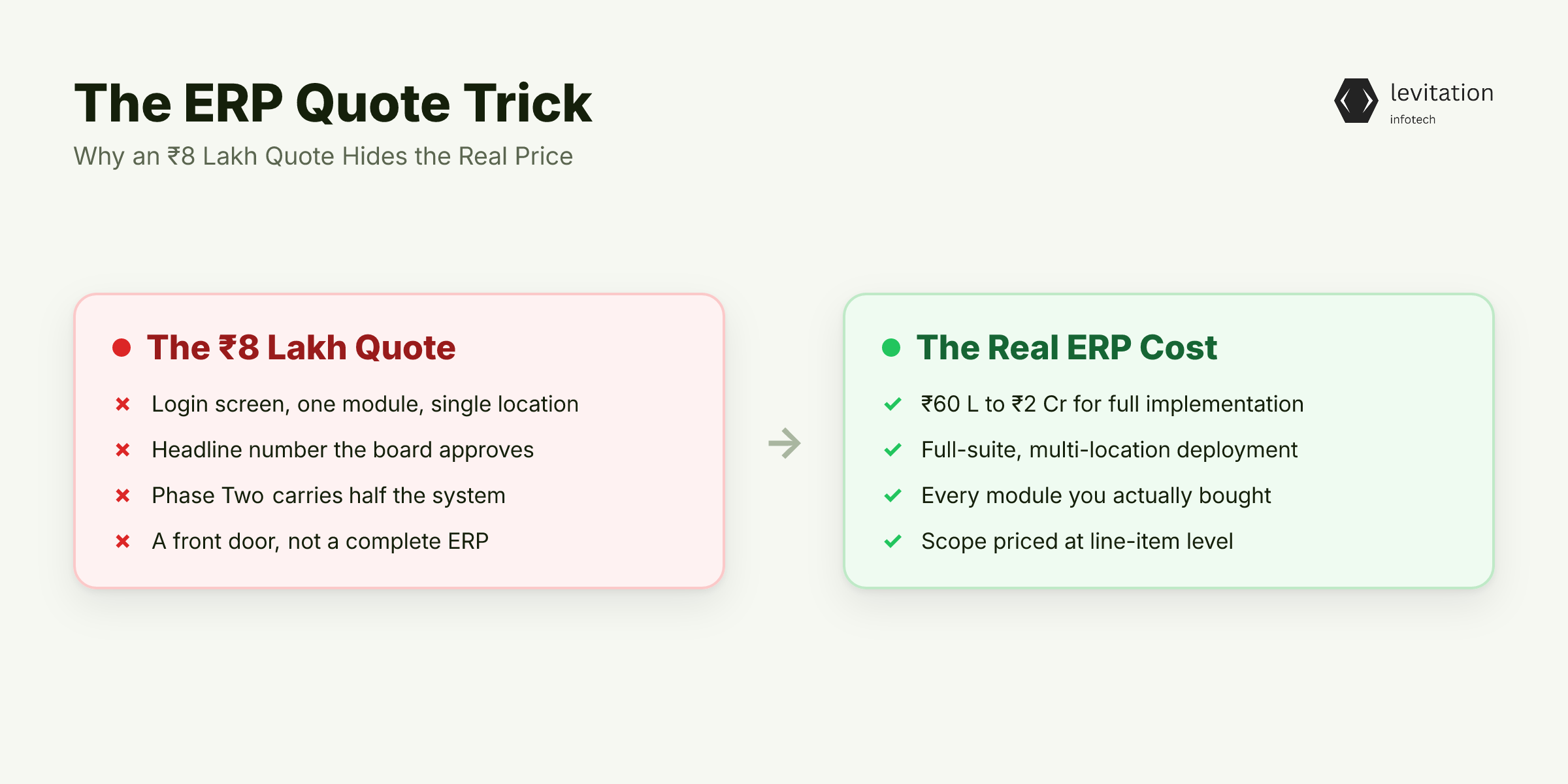
An ₹8 lakh ERP quote from a Noida vendor looks like a deal until you discover Phase Two carries half the system you actually bought.
The headline figure is real, the contract is signed, and the vendor has not lied. The number simply does not describe a complete ERP. It describes the front door.
The math makes the trick visible. Realistic mid-market ERP implementation cost in India starts around ₹60 lakh and routinely runs to ₹2 crore or more for full-suite, multi-location deployments.
An ₹8 lakh quote works only because scope has been stripped to a login screen, one module, and a single location. That is not aggressive pricing. That is a different product.
Noida sits in a special position here. It is one of India's densest ERP vendor clusters, with partner offices for Odoo, ERPNext, SAP Business One, and Tally-flavored custom stacks competing for the same mid-market deals.
Price competition is fierce at the headline number and hidden at the line-item level. Vendors know the board will approve a low figure. They also know the CFO will struggle to refuse Phase Two once the system is already half-live.
The same bait-quote tactic shows up in adjacent spaces. It is the playbook behind Noida SaaS quotes that cover only a fraction of the requested feature set and the silent deprecation of ERP modules once the contract is signed once users discover what is missing.
The CFO sees a number the board will approve. The vendor sees a Phase Two contract worth a multiple of the first. The bait-quote pattern is a market-wide play, not a one-off sales tactic.
If the numbers are this distorted, why do experienced CFOs keep signing?
Why Smart CFOs Sign the Quote Anyway
The decision is not irrational. It is engineered to feel rational.
Budget cycles force a binary choice: approve the ₹8 lakh figure this quarter or push the ERP decision into the next fiscal. Most controllers will trade a known overspend for an unknown delay. Vendors understand this and price the first phase to fit the smallest plausible ERP budget.
The sales framing is equally deliberate. Vendors describe Phase Two as "best practice" and "progressive rollout," language that mirrors how consulting decks describe staged transformation.
A phased implementation sounds mature, not suspicious. It sounds like the vendor is protecting you from risk, when in fact they are guaranteeing a second contract.
Anchor pricing does the rest of the damage. Once the brain sees ₹8 lakh, every later addition feels like a small delta rather than a structural overrun.
A typical Phase Two line item is presented as a small addition against a baseline that was already incomplete. That framing is precisely what the buyer is meant to absorb. Noida sales teams reinforce the bias with reference customers in similar industries, making the deferred scope feel like a non-issue.
What looks like a CFO mistake is actually a buyer behavior that vendors have spent a decade learning to exploit. This same dynamic is documented in ERP vendor patterns past user-count thresholds, where the deferred scope becomes a structural wall rather than a line item.
The deferred scope is not random. It follows a predictable six-module pattern.
The 6 Modules That Always Drift to Phase Two
Across the mid-market ERP market, the same six functional blocks reliably migrate from the first quote to the change-order pipeline. Knowing them by name is the first line of defense. Each one is non-negotiable for a business that wants the system to actually run the company. - Module 1 - Multi-location or multi-company ledger. Every additional plant, branch, or subsidiary is quoted as a separate configuration license, priced per entity. The base quote covers one location only, so a second plant alone consumes the savings the buyer thought they had locked in. - Module 2 - Advanced GST and statutory stack. E-invoicing, e-way bill, TDS, and reversal flows live outside the base compliance bundle and are priced as separate statutory integrations. Basic GST filing in the base is not the same as the statutory stack a real finance team needs. - Module 3 - API and integration layer. Bank reconciliation, payment gateways, e-commerce, and Tally sync are priced as REST connector projects, with cost scaling per endpoint cluster. Without these, the ERP is an island. - Module 4 - Custom approval workflows and role matrices. Anything beyond a three-tier approval ladder becomes a custom development line item, billed per workflow. Most growing businesses have more than three tiers by month six. - Module 5 - BI, reporting, and executive dashboards. Data warehousing, scheduled reports, and Power BI or Tableau connectors rarely sit in the base price. The CFO who approved ₹8 lakh for ERP is the same person the board will ask for dashboards. - Module 6 - HR, payroll, and attendance. For any business above a small headcount this is almost always Phase Two. A separate HRMS tool is sometimes proposed, which doubles the integration cost.
A base quote that excludes all six modules is structurally incomplete and understates the true project value. This is consistent with what published ERP implementation cost in India benchmarks describe as a complete mid-market build.
It is exactly the gap a disciplined ERP software development scope document is supposed to close. Vendors that price this way do it because the alternative, an honest quote, rarely wins the deal at the proposal stage. The bait wins, and the change order pays for it.
Knowing the six modules is only half the battle. The real control is in how you compare competing quotes against them.
Your Three-Quote Comparison Test
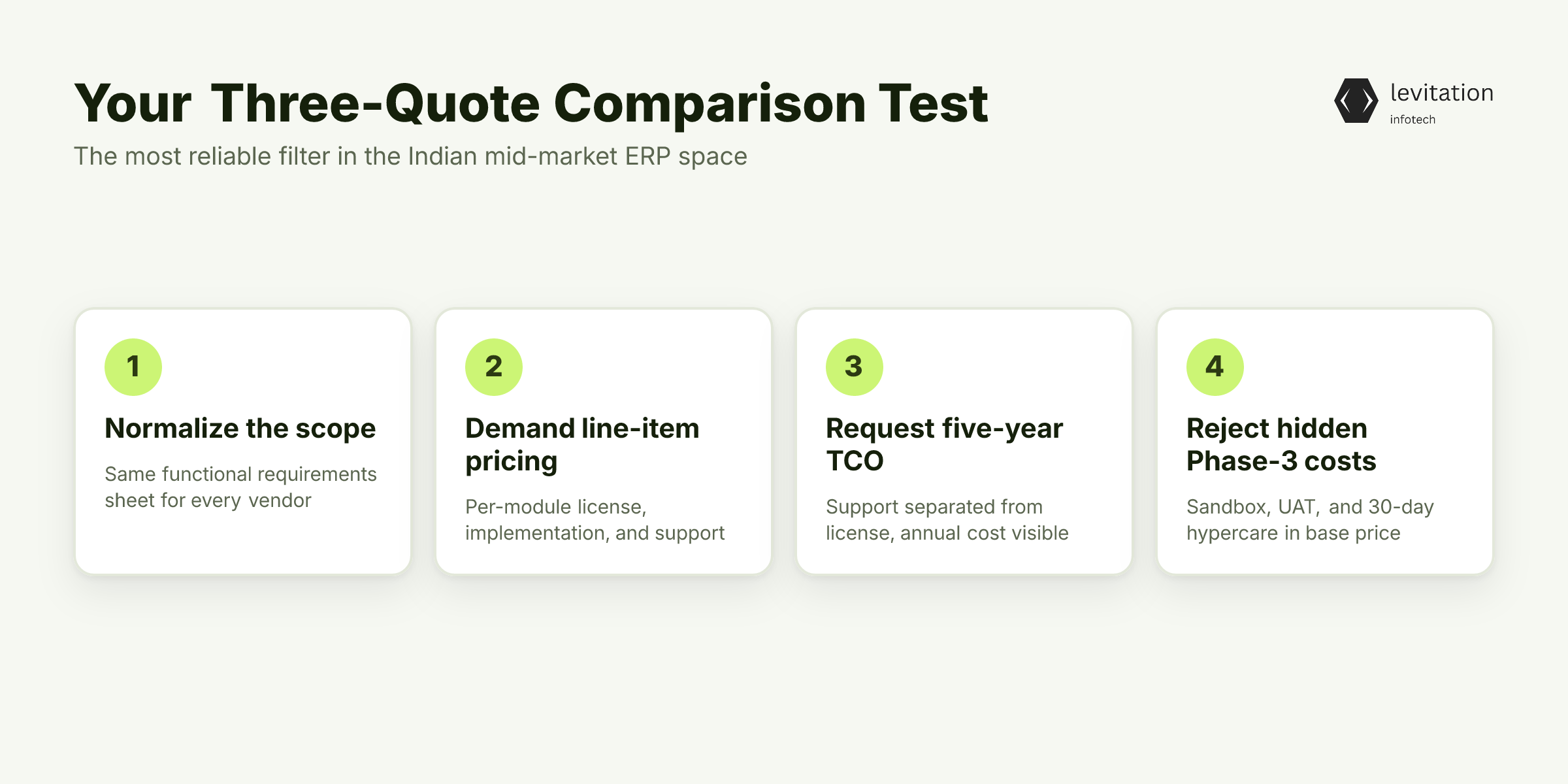
A line-item comparison forces every vendor to price the same scope. Without it, you are comparing an ₹8 lakh shell to a fully scoped system, and the shell will always win on paper. The test below is the most reliable filter in the Indian mid-market ERP space. - Step 1 - Normalize the scope. Write a one-page functional requirements sheet listing all six deferred modules plus your real user count, location count, and integration list. Hand the same sheet to every vendor before any quote is written. No exceptions, no verbal scope. - Step 2 - Demand a line-item cost per module, not a phase total. Any vendor who refuses to break out module pricing is already running the Phase Two playbook. A clean ERP implementation cost in India quote shows per-module license, per-module implementation, and per-module support as separate lines. - Step 3 - Ask for a five-year TCO with annual support separated from license. Support contracts typically carry their own annual cost line, which compounds over the life of the system. Vendors that hide support inside the license line are padding the headline. Five years is the minimum horizon. Anything shorter is a sales artifact. - Step 4 - Reject any quote that does not include a sandbox environment, UAT, and at least 30 days of post-go-live hypercare in the base number. Anything else is a Phase Three invoice waiting to happen. A vendor who treats UAT as a paid extra signals that they plan to bill you for every defect found in production.
A normalized three-quote test is the single most effective counter to the bait-quote playbook. It is also the one tactic vendors dread, because it strips the bait away before the contract is drafted.
Even with a clean comparison, the proposal document itself contains traps you have to read past.
Reading the Proposal Like a Contract Lawyer
Proposals are written to be signed, not read. The defensive move is to read them the way an auditor reads a balance sheet, looking for what is missing, not what is present. - Flag any clause where the vendor defines "Go-Live" as a single module rather than full functional scope. This is how they later argue the remaining modules are out of contract. Insist on a single Go-Live event tied to the full scope you signed. - Watch for "customization" versus "configuration" as a pricing lever. A button rename should be free, but most vendors bill any UI change as custom development. Define both terms in the MSA, and cap custom-development hours per phase. - Lock user-based pricing tiers in writing. A vendor who prices per concurrent user versus per named user can double your cost the moment you add a sales team. The two pricing models look identical on a five-user demo and diverge sharply at fifty. - Require a defined change-request rate card in the MSA. Every Phase Two addition is priced against a contractual ceiling, not a fresh quote. Without it, the change-order pipeline runs at whatever rate the market will bear. - Insist on source-code escrow or a documented handover plan for any custom Odoo or ERPNext development. This is standard practice in regulated deployments and non-negotiable in finance. If the vendor disappears, your customizations should not disappear with them.
The contract is where accountability lives or dies. Everything else is sales deck. If your vendor cannot meet a clear, written accountability bar, the ERP software development engagement is already on a short runway.
Strip the bait and the traps, and the actual ERP cost reveals itself, one that bears no resemblance to the first quote.
What a Clean Quote Actually Looks Like
A fully loaded mid-market ERP quote for an Indian manufacturer lands in the published range for full-suite projects. The range typically starts around ₹60 lakh and scales upward based on users, locations, and platform, and it is wide because platform choice matters.
Cloud-based Odoo or ERPNext implementations sit at the lower end of that range. SAP Business One and Oracle NetSuite sit at the upper end once integration is counted. The license gap is real, but the bigger gap is in implementation overhead.
The partner ecosystem in Noida and Bengaluru is far more competitive on open-source stacks, which keeps services pricing honest. That said, hidden costs show up in every platform, which is why Odoo's per-seat pricing carries multiple hidden line items and Indian ERP vendors hide costs that compound across multi-year contracts.
When scope, support, and the six deferred modules are itemized upfront, surprise over-runs drop sharply. The doubling and tripling that the bait-quote model produces no longer happen. A clean quote is one you can hand to your auditor and your board without footnotes, and that is the only kind worth signing.
A clean ERP implementation cost in India built on ERP software development discipline, not sales incentives, makes the difference. The finance team trusts one. The board quietly writes off the other by year two.
A clean quote is not the cheapest. It is the one with nothing behind the door.
Frequently Asked Questions
How much does ERP implementation actually cost in India for a mid-size company?
A fully loaded mid-market ERP implementation in India runs from around ₹60 lakh to ₹2 crore or more. Users, modules, and platform drive the final figure. Cloud-based Odoo and ERPNext projects cluster around the lower end. SAP and NetSuite projects cluster around the upper end once integration and compliance are counted. Any quote well below the published baseline should be treated as a Phase One bait figure. Strict one-module, one-location quotes are the only exception.
What is usually included in ERP Phase 1 versus Phase 2?
Phase 1 almost always covers core finance, basic inventory, and a single location. Phase 2 typically absorbs multi-location ledgers, advanced GST, API integrations, custom workflows, BI and reporting, and HR or payroll. The structural problem is that Phase 2 is not optional for most growing businesses. It is a delayed invoice for work the system was always going to need.
Is an ₹8 lakh ERP quote realistic in India?
Only if you genuinely need one module, a very small user count, and have no integration, no HR, no multi-location, no advanced reporting, and no statutory stack beyond basic GST. For most CFOs that scope describes a fraction of the business, not the whole operation. That is why ₹8 lakh quotes reliably grow into multi-lakh projects within eighteen months as deferred scope arrives.
How do I compare Odoo, ERPNext, and SAP implementation costs in India?
Odoo and ERPNext typically price well below SAP and NetSuite once five-year TCO is calculated. The license cost is lower and the partner ecosystem is more competitive in Noida and Bengaluru. SAP wins on functional depth for complex manufacturing but carries heavier implementation, support, and integration overhead that erodes the licensing savings.
What are the most common hidden costs in ERP projects quoted by Noida vendors?
Common post-signing line items include data migration beyond CSV imports, sandbox and UAT environment fees, custom workflow development, and API rate limits. Advanced GST and e-invoicing connectors, per-user licensing tier upgrades, and post-go-live hypercare also appear. A line-item quote that names them all upfront is the single best filter for separating serious vendors from sales-led ones.
Run your last ERP quote through this same test before you sign the MSA.
About the author
Mayank Singh is a software developer at Levitation Infotech, where he builds web and AI-powered applications across the company’s fintech, healthcare, and enterprise projects.