


TL;DR: The build-vs-buy ERP math flips at 50 users in India. It doesn't flip because licenses get more expensive. It flips because integration tax, customization debt, and maintenance curves compound on both sides at different rates. Below 50 users, off-the-shelf wins on time-to-value. Above it, a well-scoped custom build or buy-and-extend on Odoo or ERPNext undercuts buying over five years. Founders who use US-style TCO calculators misread the crossover. They end up overpaying on systems misaligned from day one.
Key Takeaways: - The 50-user threshold is where per-user licensing outpaces the marginal cost of extending an existing system. - Off-the-shelf ERP carries hidden geometric costs: integration tax, customization debt, upgrade re-validation, vendor lock-in. Most founders don't model these. - Full custom builds are rarely the right answer. Buy-and-extend on open-source ERP like Odoo or ERPNext compresses long builds into short deployments. - The decision framework is workflow-driven, not vendor-driven. Commodity workflows stay standard. Differentiation workflows get custom attention.
The 50-User Illusion: Why ERP Cost Comparisons Mislead Indian Founders
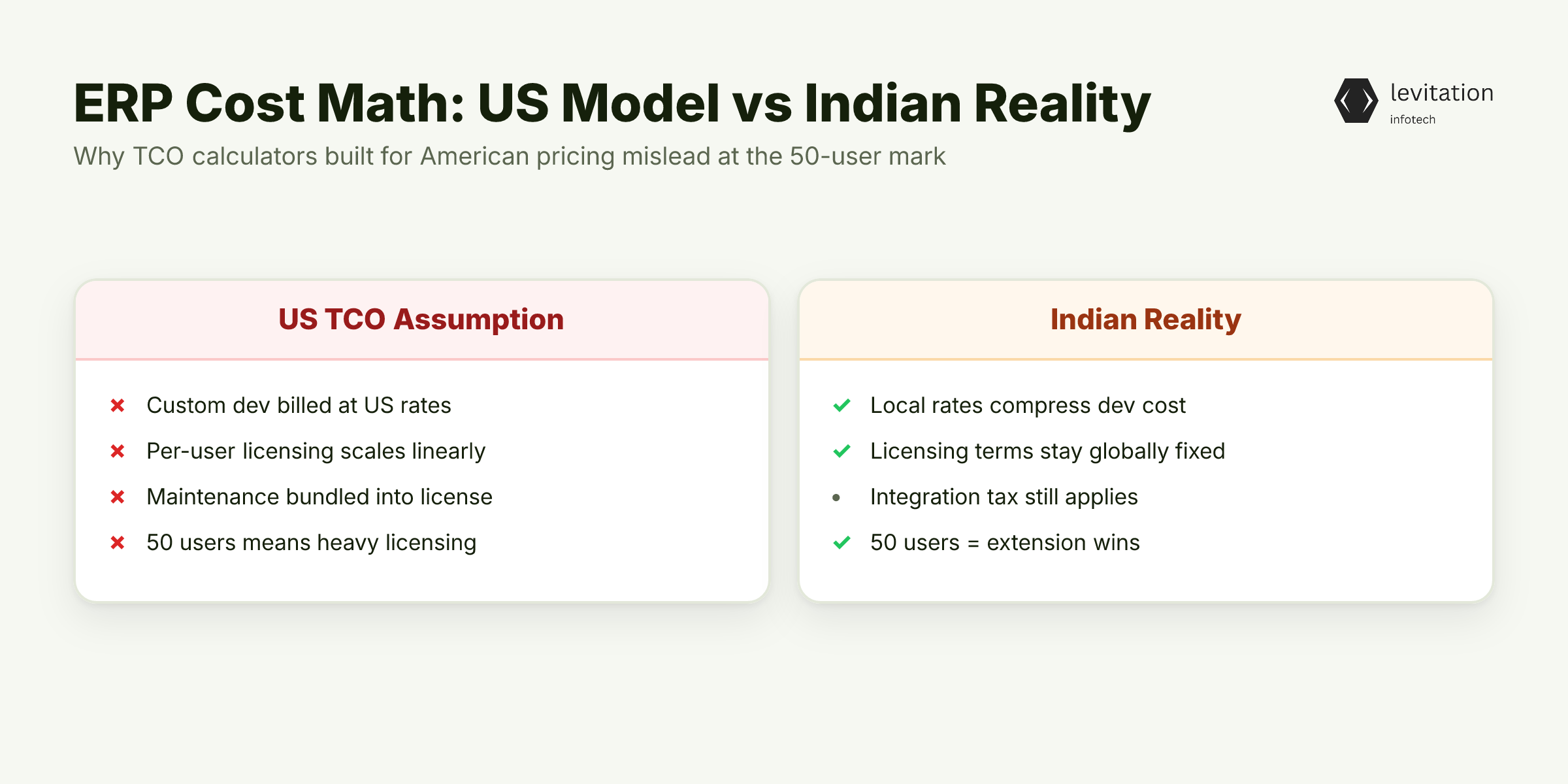
Most ERP cost comparisons are built on American pricing models. They assume custom development costs US hourly rates. They assume SAP is the default mid-market choice. They assume a five-year TCO calculator from a US vendor gives the right answer. In India, the math is different.
Indian regional pricing compresses both sides. SMB ERP deployments run from around ₹60,000 for minimal setups to ₹2 million for mid-sized rollouts. That's a fraction of equivalent US projects. Large enterprise deployments here land in the ₹2.5 million to ₹10 million range. A comparable US project would clear several times that. At 50 users, the per-user licensing curve overtakes the marginal cost of extending a system. Founders who anchor on US-built TCO calculators misread the actual crossover.
The mismatch happens because those calculators assume: - Custom dev costs US hourly rates - Per-user licensing scales linearly with no integration tax - Maintenance on off-the-shelf is "included" in the license
None of those assumptions hold in India. ERP cost benchmarks for India tell a different story. Local pricing compresses dev cost sharply. Licensing terms stay globally fixed. That's where the crossover hides.
But the cost math that looks clean in a spreadsheet hides something most founders discover too late.
Why Off-the-Shelf ERP Quietly Becomes a Cash Drain at Scale
Per-user licensing compounds linearly. The integration tax grows geometrically. Every new module you bolt on adds professional services hours. Every third-party tool you connect adds more. Every legacy system you keep talking to your ERP adds more. These hours scale with complexity, not headcount.
A 25-user SAP Business One deployment and a 75-user deployment don't differ proportionally in integration cost. The integration surface expands non-linearly. Each new connection point multiplies testing and validation work. It also multiplies regression work for what already exists.
Customization debt is the second silent tax. Every workflow the platform doesn't support natively becomes a paid professional services engagement.
Want your purchase approval to follow your actual org chart instead of the vendor's default? That's a customization. Want your inventory valuation to match Indian GST treatment rather than the US GAAP default? Another customization. Each one feels small. They compound.
Then there's vendor lock-in. Migrating off a deeply configured SAP or Oracle instance can cost as much as the original implementation. The data model is custom. The reports are custom. The workflows are custom. Recreating them elsewhere is its own project. ERP integration costs are where the real money disappears. Most founders budget for the license, not the integration.
Upgrade cycles force re-validation of every custom report, integration, and workflow. The vendor ships a new version. You test every customization against it. You discover three things broke. You pay to fix them. This is a recurring tax most founders don't model. It shows up as maintenance, not as a new line item.
The flip side is just as dangerous, and far more common than founders expect.
The Custom ERP Trap: Hidden Costs Most Founders Underestimate
The "just build it" camp has its own hidden costs. They turn an initial fixed-price quote into a multi-year engineering engagement. The total cost dwarfs the original estimate.
Senior ERP developers in India command premium fully-loaded compensation. You need a small team of senior engineers to build and maintain a real system. The annual payroll alone, before architects, QA, DevOps, and product management, becomes a recurring line item. It grows with team size. Custom ERP development is sold to founders as a one-time capital expense. In practice, it's a permanent payroll line.
Maintenance typically runs a recurring percentage of the original build cost annually, forever. A custom ERP that costs ₹60 lakh to build incurs a multi-lakh annual run-rate. You need that to keep it patched, secure, and extended. After five years, cumulative maintenance spend approaches the original build cost.
The opportunity cost is the one founders feel least. Your engineering team isn't building the product. They're not building the customer-facing edge that grows the business. They're writing procurement approval workflows. Every hour on internal tooling is an hour not spent on the thing that pays customers.
Scope creep is the silent killer. Every "small" addition compounds into an extended project. A "quick" custom approval matrix becomes a full workflow engine. A "simple" reporting dashboard becomes a real-time analytics layer. The original scope and the shipped scope almost never match, and the gap shows up in the next funding round.
Where the Math Actually Flips: A 50-User Cost Breakdown for India
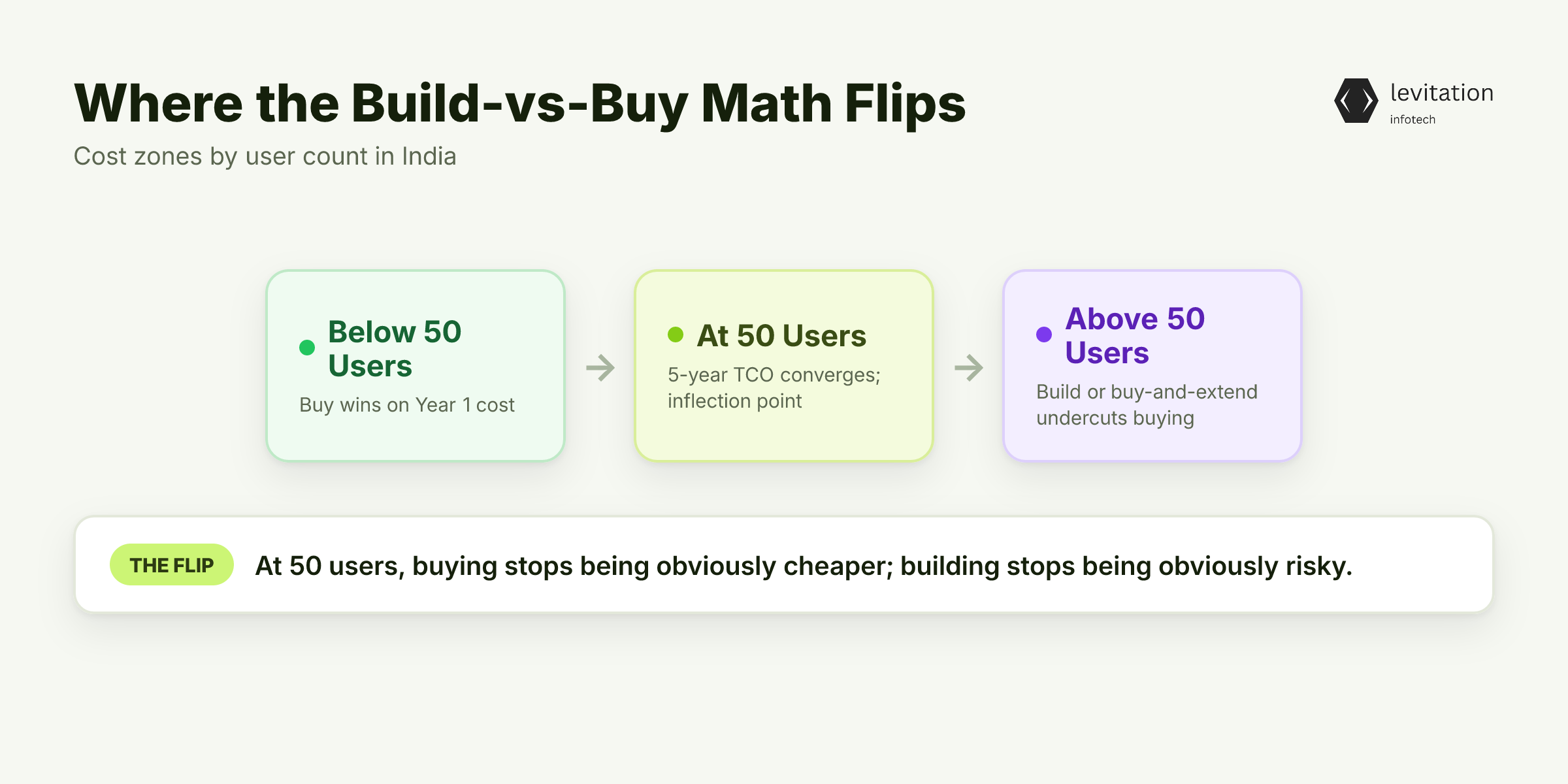
The decision tree isn't binary. It's a curve with three distinct zones.
Below 50 users, off-the-shelf wins on Year 1 cost, even with customization. You're paying for time-to-value. A small business can have SAP Business One or Zoho ERP running in weeks, not months. License cost is manageable. Integration surface is small. Customization debt stays low. ERP implementation cost in India at this scale is driven mostly by the vendor's setup fee and a few professional services days.
At 50 users, the five-year TCO of buying starts converging with the five-year TCO of building. The license, integration, and customization curve crosses the dev and maintenance curve. This is the inflection point. Building isn't obviously cheaper here. But buying stops being obviously cheaper.
Above 50 users, a well-scoped custom build or buy-and-extend undercuts buying over five years. Per-user license penalty compounds. Integration tax explodes. Customization debt becomes a balance sheet item. This is the zone where founders who chose SAP at 30 users and grew to 80 start looking for exits.
The real comparison isn't build vs buy. It's three options: pure buy, buy-and-extend (starting from Odoo or ERPNext), and full custom build. Most founders only model option one and option three. That's why they get the answer wrong.
For healthcare-adjacent businesses, the calculation shifts further toward custom. Compliance requirements, audit trails, and patient data workflows make generic ERP modules expensive to retrofit. Off-the-shelf paths add months of compliance configuration on top of license cost. Healthcare founders often default to buy-and-extend or fully custom, then discover the compliance tax hits every layer. That same pressure is exactly what makes the build decision feel deceptively simple when it isn't.
The mistake most founders make next: assuming the choice is binary.
The Third Path: Buy-and-Extend With Open-Source ERP Like Odoo
Odoo and ERPNext give you most of an ERP out of the box. You pay a flat hosting and support cost. You avoid the per-user license penalty that makes SAP and Oracle untenable past 50 users. The per-seat economics are different because you're paying for infrastructure and support, not for named-user access.
You extend only the workflows that actually edge your business. Commodity accounting, inventory, and HR modules stay standard. The custom work focuses on the 20% of workflows where your business model diverges from the vendor's default. That's where engineering investment pays back.
SAP vs Odoo cost in India is stark. SAP mid-market deployments can run into the crores once you factor licensing, deployment, customization, and ongoing support. Odoo deployment partner engagements with custom modules typically land at a fraction of that. The gap is big for a mid-market founder's capex planning.
The buy-and-extend model compresses the in-house build to 3-6 months vs 18-24 months for in-house teams. You're not reinventing commodity modules. Your engineers start from a working ERP and add the custom layer. That's a different risk profile.
A Founder's ERP Decision Framework for the Indian Market
Step 1: Count your users and map your top 10 workflows. If 7 or more are commodity (standard accounting, standard HR, standard inventory), start from open-source ERP. Don't build. The 40-user wall kills more custom projects than any other failure mode.
Step 2: Calculate five-year TCO three ways: pure buy, buy-and-extend, and full custom. Use actual Indian pricing, not vendor quotes built for US markets. The numbers will surprise you. For most 50-user companies, the ERP cost in India for buy-and-extend lands well below pure buy once you include integration and customization.
Step 3: Score your workflows on differentiation. Anything that gives you a competitive edge gets custom attention. Everything else stays standard. This is where most founders fail. They try to custom-build workflows any commodity ERP handles fine. Then they run out of budget for the ones that matter.
Step 4: Run a 4-week prototype with a partner who has shipped in your vertical. Do this before committing to a multi-year build. A 4-week prototype on Odoo or ERPNext with selective custom modules tells you more than three months of vendor demos. The 60-user threshold is where most ERP vendors stop being honest about ongoing costs. Validate before you sign.
The default rule: if you're below 50 users, default to Odoo or ERPNext with selective custom modules. If you're above 50 with complex workflows, buy-and-extend with a serious deployment partner. Full custom is reserved for cases where compliance or differentiation makes even buy-and-extend unworkable. Most founders who think they need full custom actually need buy-and-extend with better scoping.
What Changes When You Get the ERP Decision Right
You stop bleeding capital on per-seat licensing. A business growing 60% year-over-year shouldn't have its ERP bill growing in lockstep with headcount. The right model decouples those curves.
Your team gets workflows that match how your business operates, not how a vendor imagined it. The difference between an ERP your team opens daily and one they work around in spreadsheets is the difference between a system that pays for itself and one that becomes shelfware.
You avoid the migration hostage scenario. Switching costs keep you locked into a platform that no longer fits. This is real. Companies spend more on migrating off ERPs than they spent deploying them. Getting the choice right the first time eliminates that future tax.
The right deployment partner becomes a long-term systems partner, not a one-time vendor. Long-term retention matters more than initial license savings. Enterprise resource planning is a multi-year relationship, not a transaction. The partner who understands your workflows today is the partner who can extend them tomorrow.
The build-vs-buy decision isn't a philosophical debate. It's a math problem with a specific crossover point. In India, that point sits at 50 users. Founders who see it coming reduce their five-year TCO. Founders who don't end up paying multiples of the original quote over time.
Frequently Asked Questions
What is the actual cost of ERP deployment in India for a 50-person company?
For a 50-user company, costs vary widely. It depends on workflow complexity, integration scope, and whether you choose pure buy, buy-and-extend, or full custom. Off-the-shelf SAP and Oracle deployments carry premium licensing that scales with users. Odoo or ERPNext with custom modules avoids the per-user license penalty. Full custom builds start higher and scale with engineering team size and timeline.
At what company size does building a custom ERP make financial sense in India?
The crossover happens at 50 users. The five-year TCO of buying (licenses plus integration plus customization) converges with the five-year TCO of building (dev plus maintenance). Above 50 users with custom workflows, custom or buy-and-extend usually wins over five years once the per-user license penalty compounds.
Is Odoo cheaper than SAP for Indian mid-market businesses?
Yes, by a wide margin. A mid-market SAP deployment in India runs into the crores when you factor in licensing, deployment, and ongoing support. An equivalent Odoo deployment with custom modules typically lands at a small fraction of that. There's no per-user license penalty as you scale.
How long does ERP deployment take for a 50-person company in India?
With an experienced partner, a buy-and-extend deployment on Odoo or ERPNext takes 3-6 months. A full custom build with an in-house team typically takes 18-24 months. The gap is almost entirely in commodity modules (accounting, inventory, HR) you don't need to reinvent.
What are the hidden costs of custom ERP development that founders miss?
Three hidden costs matter most. First, recurring annual maintenance (a percentage of original build cost, perpetual). Second, senior developer salaries (premium fully-loaded, requiring a small team minimum). Third, opportunity cost (your engineering team isn't building product). Most founders model only the initial build cost and miss all three.
About the author
Mayank Singh is a software developer at Levitation Infotech, where he builds web and AI-powered applications across the company’s fintech, healthcare, and enterprise projects.