


TL;DR: Real-time AI agents make decisions in milliseconds. But audit teams rebuild those same decisions weeks later from batch extracts. The fix is not more logging after the fact. The fix is treating the event log itself as the audit trail. The trail should have replay, lineage, and exactly-once guarantees built into the same pipeline.
Key Takeaways: - Streaming and auditing fail together because they run on two different models of time. One runs in milliseconds. The other runs at quarter-end. - Bolt-on audit pipelines produce evidence that does not match what the AI actually did. Regulators can tell. - Event sourcing turns Kafka topics into the audit trail. The infrastructure is already in production. - Replay, lineage, and exactly-once are the three properties that turn a log file into an audit tool.
Your AI flagged a fraudulent transaction in milliseconds. By the time your auditor puts the evidence package together, the regulator has already asked a question. The question is why you did not catch the fraud three months earlier.
This is the new shape of governance risk for any company running AI agents in production. The decision happened in real time. The audit happens in a quarter. Both sides are right. That is the problem.
The Millisecond vs. The Quarter-End: Where Event-Driven AI and Audit Diverge
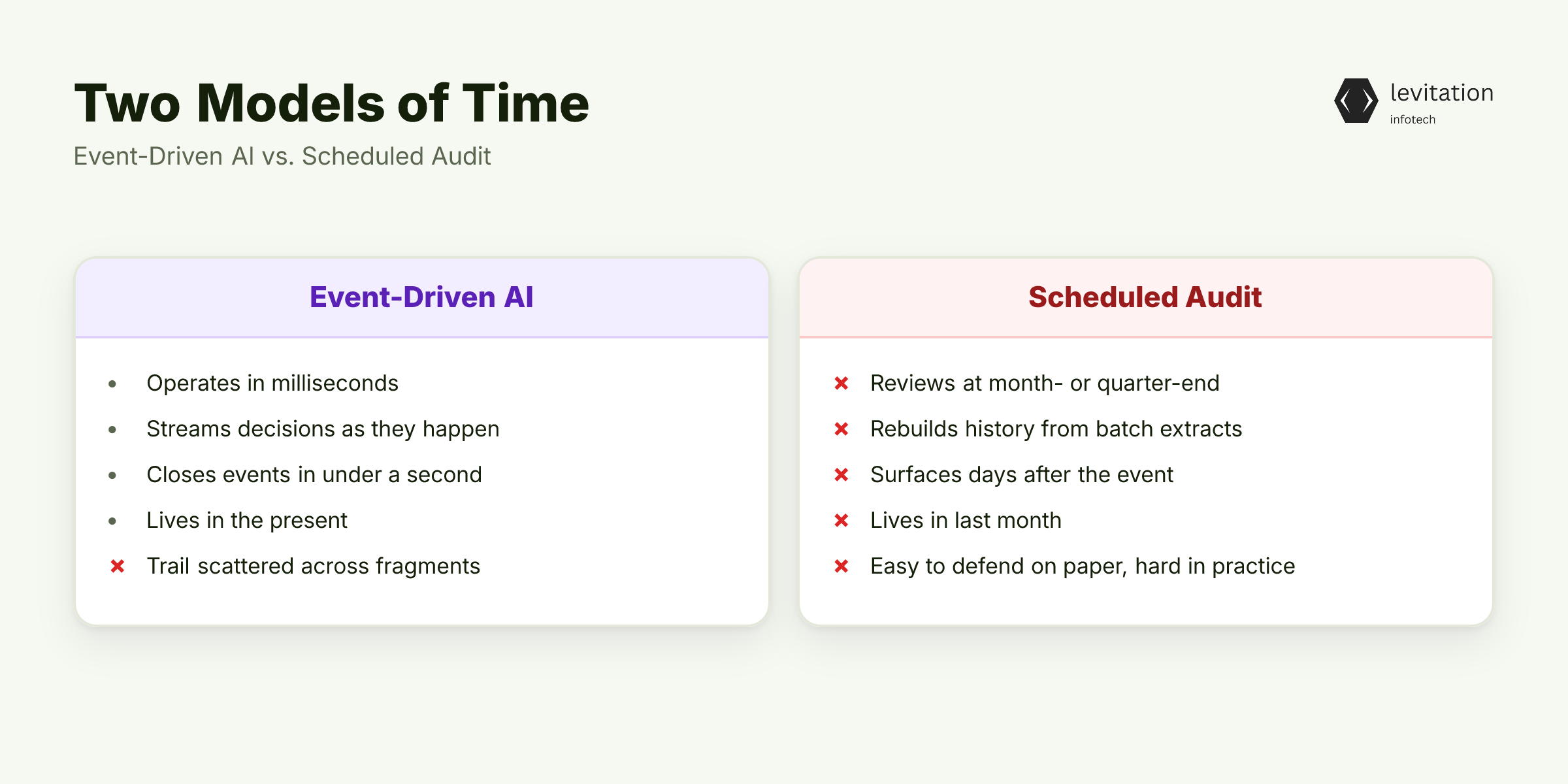
Consider a hospital. A wearable streams an abnormal heart rate. An AI agent triages the patient in under a second. A doctor is paged. A life is saved.
Now look at the audit trail. It lands in a nightly ETL job. It surfaces in a report two days later. That is well after the clinical event closed. The same gap shows up everywhere AI governance is asked to certify live systems.
In finance, the pattern is sharper. An AI trading agent reacts to a market signal in milliseconds. The compliance team reviews the same activity at month-end. They rebuild what happened from a database export.
By then, the position is closed and the counterparty is gone. The trail has been stitched together from fragments.
The core tension for CTOs is design-based. AI agents are event-driven. They operate in windows shorter than a second. Governance and audit functions still rely on scheduled batch extracts. They also rely on quarterly sampling and after-the-fact rebuilding.
This is not a tooling gap. It is a design mismatch between two different models of time.
One team lives in the present. The other lives in last month. Every day the gap widens, the audit gets harder to defend.
A similar dynamic plays out in clinical AI, where models retrain daily while auditors read back through weeks of accumulated activity. The pipeline does not know it is being watched. The auditor does not know what the pipeline knew.
So most teams try to close the gap by adding logging after the fact. That is where the real damage starts.
Why Bolting Audit Onto Streaming Pipelines Fails
After-the-fact application logs capture what the system did. They rarely capture why.
The causal chain of inputs, model version, retrieved context, and confidence score vanishes. It vanishes the moment the response is returned. As a result, you end up with a record of actions and no record of reasoning.
Batch ETL windows create late-arriving events. These events contradict the real-time state your agent acted on. The audit evidence says one thing. Operational reality says another. Auditors notice. Regulators notice faster.
Polling-based observability makes the gap worse. Metrics scraped at fixed intervals miss sub-second decision windows entirely. The evidence a regulator needs existed for milliseconds and then vanished. You cannot recover what you never wrote down.
Teams end up maintaining two parallel systems. One is a streaming pipeline. The other is a reporting pipeline. There is no consistent bridge between them. Drift between the two is where audit findings live.
This is a data engineering problem, not a compliance problem. The pipeline design determines what evidence is even possible to produce. In lending, the same flaw shows up when sub-second loan approvals are backed by audit windows that lag by hours. The decision engine and the audit engine never agreed on the time.
When your agent calls a tool and your audit trail goes dark at the call boundary, the evidence chain breaks. It breaks at the exact point regulators care about most.
The fix is not more logging. The fix is making the event log itself the source of truth.
There is a pattern that already solves this. Your event log is already producing it.
Event Sourcing Is the Audit Trail You've Already Built
Event sourcing stores every state change as an ordered, unchangeable entry in a log. It does not overwrite the current record. The same log that drives your real-time agent decisions is, by design, a complete history. It is also a history you can replay.
You are not adding audit. You are recognizing that the audit is already in the stream.
Any past state can be rebuilt by replaying the event sequence. For an auditor, this means answering "what did the system know, and what did it decide?" at any timestamp, without guesswork. You are not pulling a snapshot. Instead, you are replaying the exact decision moment.
Every agent decision becomes a first-class event with a parent_event_id. This ID links it to the trigger event. This causal chain is what regulators want when they ask for decision origin. The decision is not floating in space. It is anchored to the input that caused it.
Unlike traditional databases that change rows, an event-sourced system makes every action add-only. You cannot go back and edit a decision. That is the property auditors care about most.
The same pattern shows up in ledger design. Event-sourced systems pass unit tests but fail reconciliation at the regulator when the schema is not built for audit from day one.
This is not new infrastructure. If you are running Kafka or Flink, you are already event-sourcing. The shift is recognizing that your AI compliance evidence is sitting in your topics, not your data warehouse.
Most teams are double-paying. They pay once for the streaming infrastructure. Then they pay again for an audit pipeline. The pipeline rebuilds what the stream already captured.
Recognizing the trail is one thing. Designing the event schema so that trail holds up under regulatory review is another.
Designing the Audit-Grade Event Schema With Kafka and Flink
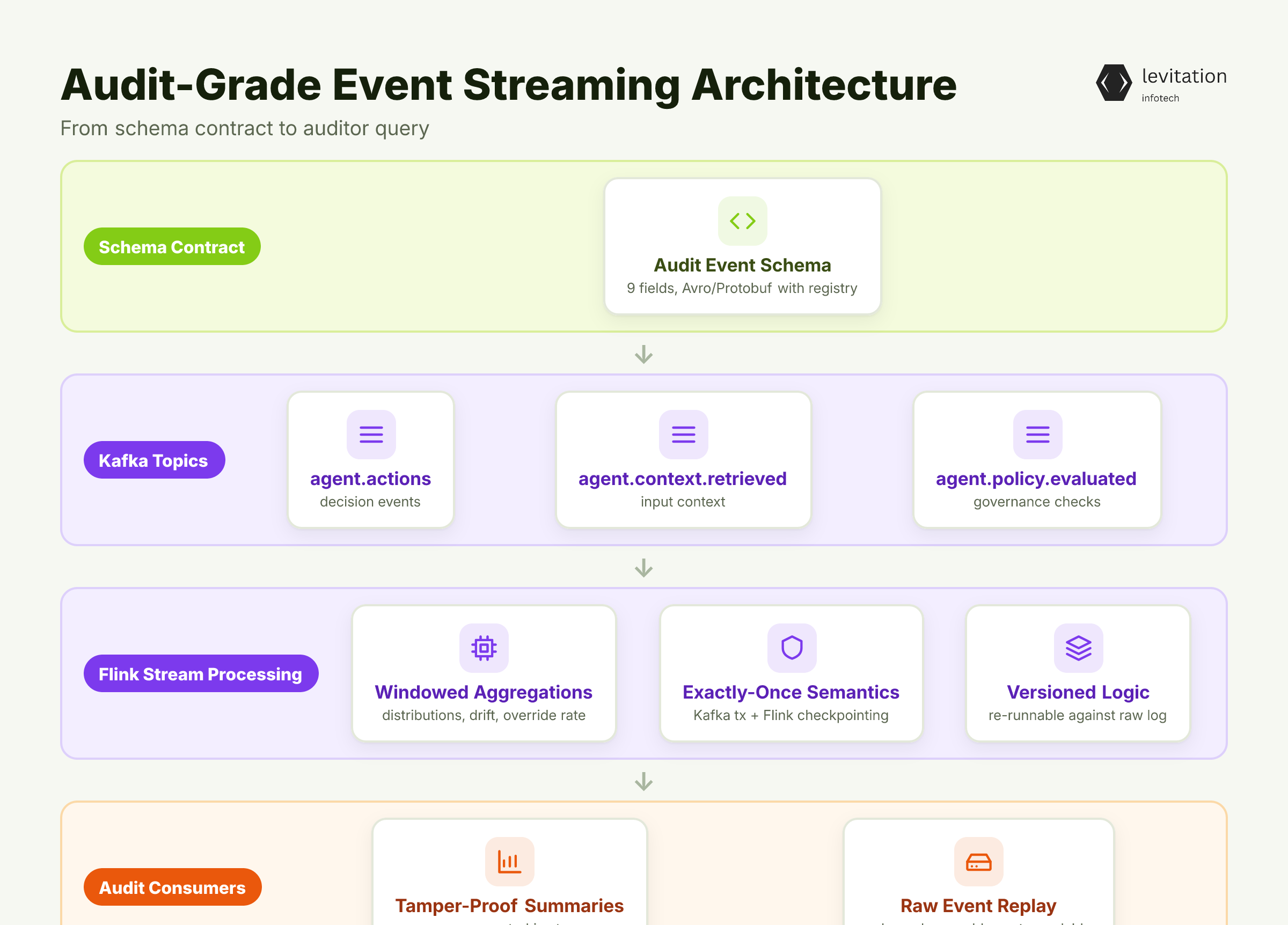
The minimum working audit event carries nine fields. Skipping any one of them creates a gap an auditor will find.
The Minimum Viable Audit Event - event_id: a unique ID for the decision. - parent_event_id: the trigger event that caused this decision. - timestamp: event-time, not processing-time, so causality is preserved. - agent_id: which model or agent produced the decision. - model_version: the exact version of the model at decision time. - input_context_hash: a fingerprint of the inputs and retrieved context. - output_decision: the action taken or recommended. - confidence_score: the model's self-reported certainty. - human_override_flag: whether a human stepped in.
Kafka Topic Strategy
Separate decision events, context events, and governance events into distinct topics. A clean split follows. agent.actions is for the decision. agent.context.retrieved is for the inputs. agent.policy.evaluated is for the policy checks.
This lets auditors query one stream without sifting through operational noise. It also lets you reason about each layer on its own. You can apply different retention policies to each.
Flink for Audit Aggregation
Use Flink windowed aggregations to compute derived metrics before they hit the warehouse. Decision distributions per hour, override rates per model, and drift indicators should be pre-computed in the stream.
Auditors then query tamper-proof summaries rather than scrolling through raw events. The aggregation logic itself becomes a versioned artifact. It can be re-run against the raw log to prove the summary was correct.
Exactly-once semantics are required for audit soundness. Configure Kafka transactions and Flink checkpointing. Then a crash mid-decision will not produce a duplicate or missing audit event.
Versioned schemas (Avro or Protobuf with a schema registry) keep older events readable when an auditor reviews them. This holds true even after model updates.
This is the layer where engineering quality compounds. Systems still running in production long after deployment share one trait. The event schema was treated as a contract, not an afterthought.
The teams that treated audit as a database problem rebuilt it twice. The teams that treated it as a schema problem shipped it once. When data engineering services are scoped around the audit contract, the rest of the design gets easier.
Three properties separate a streaming log from an audit-grade trail. Miss any one and regulators will find the gap.
Replay, Lineage, and Exactly-Once: The Three Properties Auditors Demand
Replay
Replay is the ability to rewind and rebuild any past state from the event log. It is what makes a question answerable in minutes instead of weeks. The question is "show me what the model knew on March 14".
Without replay, every audit is a forensic investigation. With replay, every audit is a query. The difference in cycle time separates two things. It separates a mature governance program from a quarterly fire drill.
Lineage
Lineage is tracing from the raw signal through every agent change to the final decision output. A sensor reading. A transaction event. A retrieved document. A model call. A policy check. The final action.
Without lineage, an auditor sees a decision but cannot check whether the input was trustworthy. Lineage data can also feed into active metadata platforms. It surfaces the end-to-end visibility that governance teams currently rebuild by hand.
Exactly-Once
Exactly-once means no duplicate, no missing, no reordered audit events. This holds even under consumer failure, rebalancing, or network split. For AI governance, this is the foundation of proof soundness.
A duplicate event can imply a duplicate decision. A missing event can imply a missing review. Either one is enough to undermine a regulator's confidence in the entire pipeline.
Achieving it through Kafka transactions, idempotent consumers, and coordinated Flink checkpointing is standard practice. Skipping it is how audits get contested.
These three properties are the difference between a log file and an audit tool. They are also achievable in a typical deployment measured in months. The deployment is measured in months, not years. An in-house team usually spends years building the same infrastructure.
The teams who try to build replay and lineage into a batch system spend years. They still cannot answer "what did the model know at 14:23:07 on March 14?"
When those three properties hold, something unexpected happens to your audit cycle.
From Batch Evidence to Continuous Compliance
The audit cycle inverts. Instead of putting evidence together at quarter-end, your compliance team queries a different source. They query a continuously updated, replayable event log. As a result, regulatory response time drops from weeks to hours.
Dashboards become real-time. Decision distributions, override rates, and model drift surface the moment they occur. They do not surface 90 days later.
Successful deployments share one trait: the event stream is the system of record. The audit trail is a query, not a project.
The teams that get this right treat the event schema the same way they treat an API contract. They version it. They gate changes through review. They document every field with the same care. A database team shows the same care when it documents a column.
At Levitation, we have seen this pattern show up across healthcare, finance, and insurance deployments. The moment the event log becomes the system of record, the audit function stops being a cost center. Then it starts being a query layer. That shift is what changes everything.
Frequently Asked Questions
What is an event-driven AI audit?
An event-driven AI audit uses the same unchangeable, ordered event log that powers real-time AI decisions. It is the source of audit evidence. Instead of rebuilding decisions from a batch extract, auditors replay and query the live event stream. They can then trace any decision back to its inputs, model version, and causal chain.
How does Kafka support AI audit trails?
Kafka's add-only log with exactly-once semantics provides the unchangeability and ordering guarantees an audit trail requires. Each agent decision is published as an event with a unique ID, timestamp, and parent reference. This creates a tamper-proof record that can be replayed at any point to rebuild system state.
What is the difference between event sourcing and traditional logging?
Traditional logging records application messages for debugging. Often it has no enforced schema, ordering guarantees, or retention contract. Event sourcing treats every state change as a first-class, schema-checked, ordered event in a log. That log is the system of record. It is auditable, replayable, and queryable for compliance.
How do you ensure exactly-once semantics in audit event streams?
Exactly-once delivery is achieved through Kafka transactional producers, idempotent consumers, and Flink's two-phase commit sink with coordinated checkpointing. This ensures that even under consumer failure or rebalancing, every audit event is written exactly one time. In practice, this preserves proof soundness.
Can real-time AI systems meet NIST AI RMF and ISO 42001 audit requirements?
Yes, but only if the audit evidence is generated as a byproduct of the event stream. It should not be rebuilt after the fact. NIST's Accountability and ISO 42001's decision-logging requirements are most reliably met when every agent action is an unchangeable event with full origin. This is what an event-sourced design provides.
If you are checking how to make your data engineering services stack audit-ready, start with a schema review against the nine fields above. Most teams find their biggest gap in input_context_hash and human_override_flag. These are the two regulators ask about first.
About the author
Mayank Singh is a software developer at Levitation Infotech, where he builds web and AI-powered applications across the company’s fintech, healthcare, and enterprise projects.