


TL;DR: AWS's enhanced EventBridge custom bus can replace a web of domain buses with one organization-wide transport plane. A shared bus does not create shared meaning. Govern event types, then migrate through dual publishing, parity tests, and measured cutover.
Key Takeaways: - A shared enhanced bus removes routing hops but cannot reconcile incompatible event contracts. - Keep one transport plane while domain teams own event definitions, versions, filters, transformations, and recovery guarantees. - Prove delivery parity with stable IDs and idempotent consumers before retiring classic routes.
The Subscriber Limit That Built a Bus-per-Domain Estate
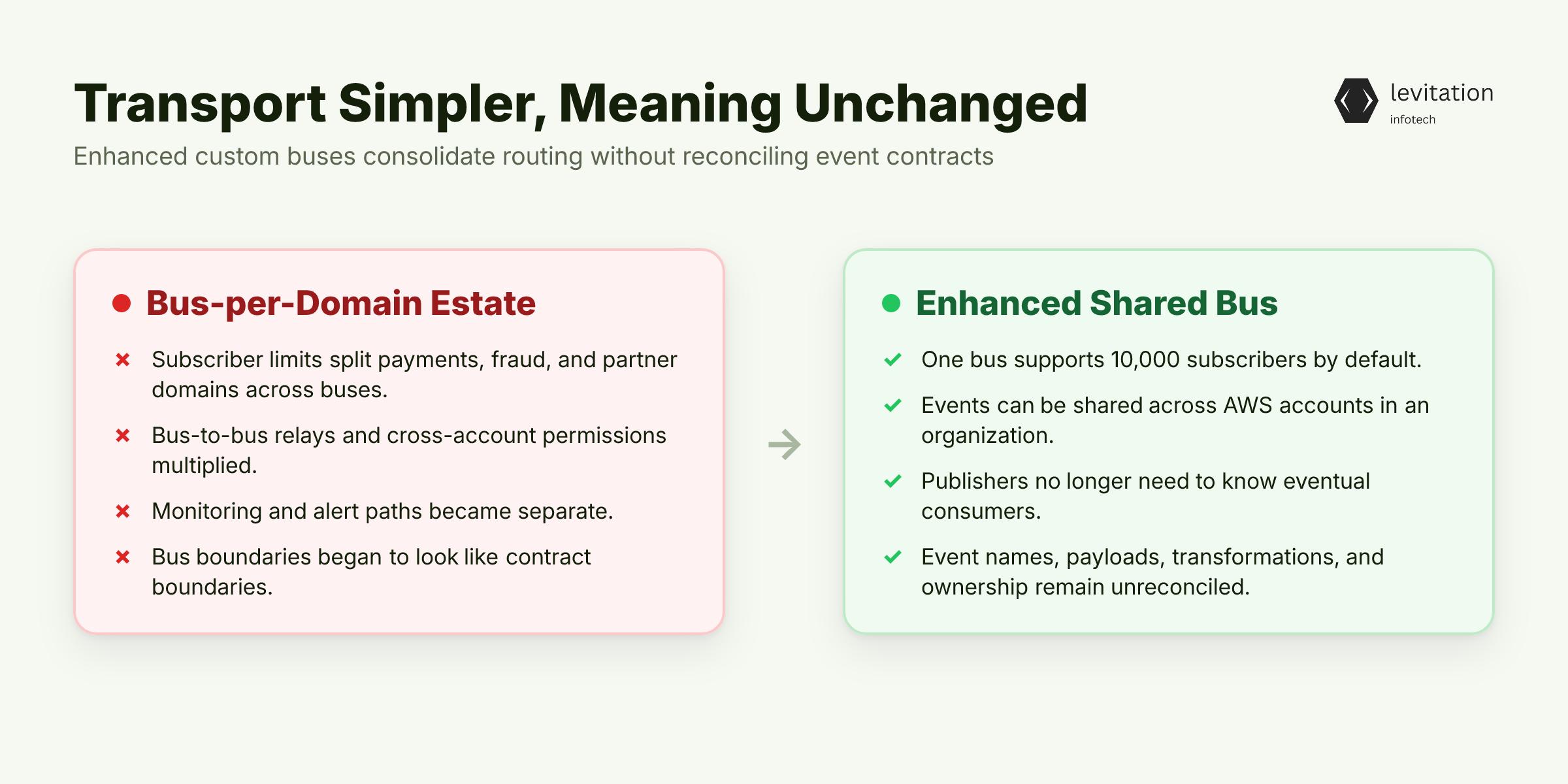
One enhanced EventBridge custom bus can remove cross-account routing sprawl and support 10,000 subscribers by default. Yet subscriptions chosen by each team can leave data contracts more fragmented than the old bus estate.
Transport got simpler. Meaning did not.
The original scaling trap
Consider payments, fraud, and partner integrations, each with several consumers. Classic custom buses used rules and targets. Subscriber limits encouraged teams to split these domains across multiple buses.
Each split added: - Bus-to-bus rules for relaying events - Cross-account permissions for every relay - Separate monitoring and alert paths - More places for events to stall or vanish
These paths increase operational work. They also make a bus boundary look like a contract boundary.
What the enhanced model changes
Teams manage subscriptions separately under AWS's enhanced model, which supports 10,000 subscribers per bus by default, with higher quotas available by request.
One enhanced bus supports sharing across AWS accounts in an organization. Publishers send events without knowing which consumers will receive them. Subscribers create subscriptions independently.
That removes the need for a routing bus for every consumer domain. For platform leaders, this belongs in data engineering services, not only infrastructure planning.
The transport gain is immediate; the contract risk becomes visible only after consolidation.
The hidden trade
Transport consolidation doesn't reconcile event names, payload conventions, transformations, or ownership.
Keep two questions separate: - Routing topology: Where events travel and which accounts can publish or consume. - Contract topology: Which event types exist, who owns them, and how versions evolve.
Choose the organizational unit with both views in mind. Otherwise, visible bus fragmentation becomes hidden semantic fragmentation.
The shared bus exposes a harder problem: incompatible definitions still remain.
Why Physical Consolidation Creates Logical Contract Sprawl
One order-created fact can become `OrderCreated` in one team and `OrderAccepted` in another. If both names survive, a shared bus carries the ambiguity forward.
Shared transport makes it easier to cross bus boundaries, but it does not make their schemas compatible.
Bus boundaries become implicit schema boundaries
Each team defines event names, payload shapes, filtering rules, transformations, and retention assumptions around its own transport boundary. Those local decisions become inherited behavior.
That's how enterprise event-driven architecture turns infrastructure segmentation into contract fragmentation.
Shared transport does not mean shared meaning
Publishers remain unaware of consumers. Subscribers independently select events through filters.
One team filters by source. Another filters by detail type. Both paths work technically while telling different business stories.
Where drift becomes expensive
Drift becomes expensive when you see: - Near-duplicate event types representing the same business fact - Incompatible payload versions across producers - Unclear ownership of input transformations - Conflicting expectations about replay or ordering
The symptoms look local. Together, they make cause analysis and recovery hard.
Build the first diagnostic
Build one inventory before changing routes. For every event type, record: - Source - Detail type - Producer account - Subscriber filter - Transformation - Schema version - Accountable owner
Flag any business event represented by multiple incompatible definitions. Resolve those before expecting a shared bus to improve consistency.
Treat shared-bus migration as contract discovery, not infrastructure replacement. Make the event type the unit of control. If the shared bus owns only transport, where should event meaning live?
Treat the Bus as a Contract Registry, Not a Message Bucket
A payments event and an order event can share one bus without sharing a payload. That distinction keeps centralization from merging unrelated schemas.
The bus should answer where events travel. Domain contracts answer what they mean.
Separate topology from taxonomy
Keep one organization-wide transport plane. Retain domain-owned contract domains. - Payments own payment events and their compatibility rules. - Orders own order events and their evolution. - Fulfillment owns fulfillment events and recovery expectations.
Keep event schema governance attached to domain ownership. The shared bus carries events; it doesn't merge their schemas.
Define one canonical envelope
Define one canonical envelope with shared metadata: - Event identity - Event type - Schema version - Producer - Accountable owner - Correlation or idempotency identifiers
Require domain payloads to evolve through an explicit compatibility policy. Don't let accidental consumer expectations set that policy.
Make subscription criteria executable contracts
Link each subscriber filter to a documented event definition and owner. Review filters whenever schemas change.
Otherwise, each new subscription can silently introduce a second interpretation.
Match guarantees to semantics
`EventGroupId` allows EventBridge to deliver events sharing that identifier in sequence to subscribers that choose ordered delivery. Other subscribers can remain asynchronous.
Reflect retention and replay capabilities in recovery expectations. A consumer that expects replay needs a different contract from one that tolerates loss.
Include deduplication and cost
Content-based deduplication is a bus capability. Publishers pay for ingested events, while subscribers pay for delivered events.
Route ownership therefore includes duplicate suppression and delivery-cost decisions. Broad filters can expose consumers to more delivered events than they need.
Give platform teams a concrete governance unit: the event type, not the infrastructure resource carrying it.
Once contracts have a governance unit, migration can proceed without forcing a high-risk, big-bang cutover.
The next challenge is building that contract spine without losing delivery behavior.
Build the Enhanced Bus and Its Contract Spine
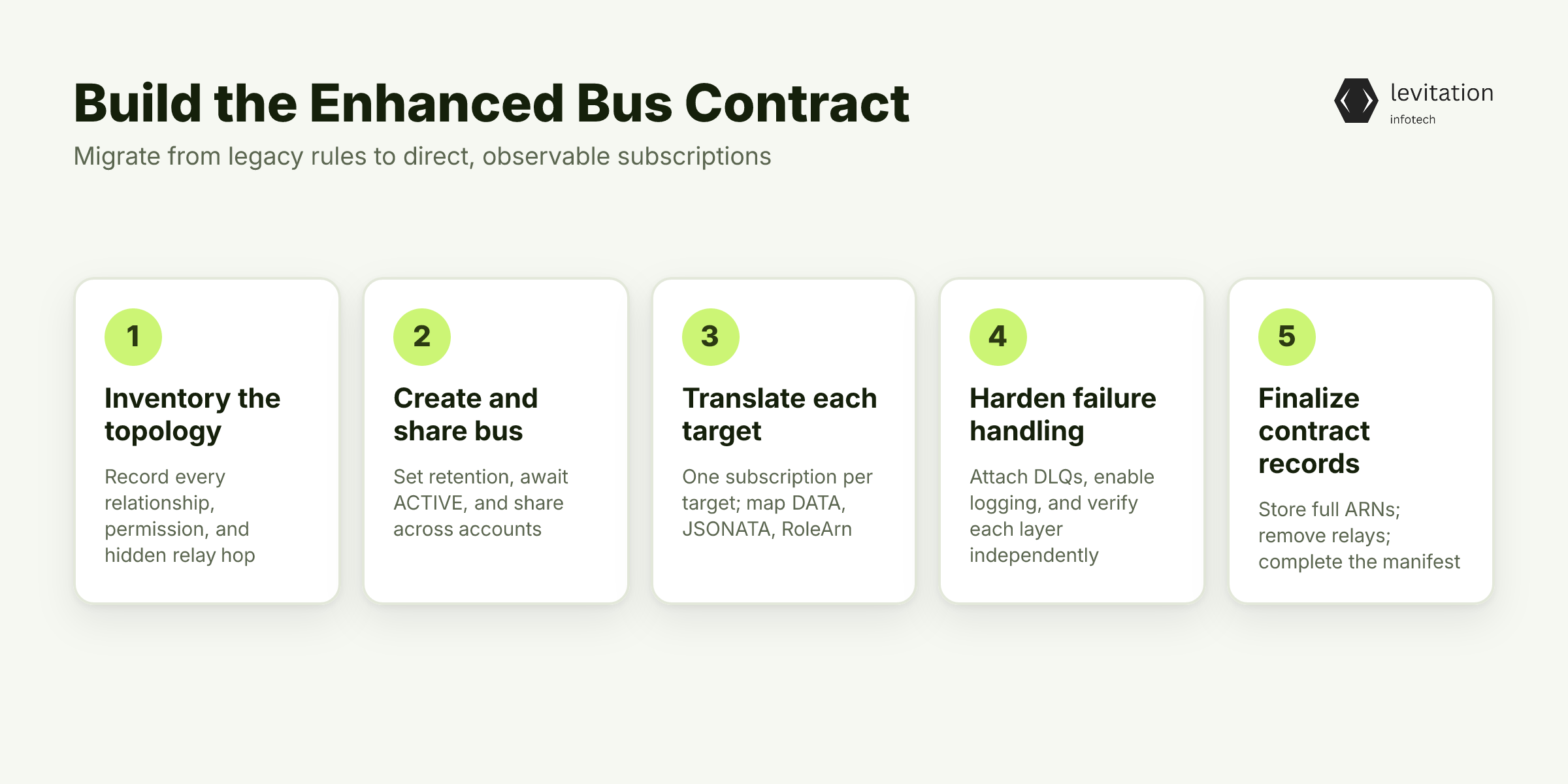
Start with one classic rule and trace every hidden hop. If its target, transformation, role, or recovery destination is missing, the migration map is wrong.
Baseline the classic topology
Inventory every bus, rule, target, event pattern, input transformation, target role, dead-letter queue, cross-account permission, and downstream consumer.
Record relationships, not just names. A rule can look harmless while relying on a relay permission two accounts away.
Create and share the enhanced bus
Create the enhanced custom bus with the required retention period. Wait for its status to become `ACTIVE`. Configure organization-wide sharing.
Use fine-grained controls to decide which accounts publish and which consume. Producers and subscribers then participate directly on the shared backbone.
Translate rules into subscriptions
Plan one subscriber for each existing target. Use the rule's event pattern as the subscriber `DATA` filter. Map the rule's input transformation to a JSONATA transformation.
Reference the target's role through `RoleArn`. One rule with two targets becomes two subscriptions. The target is the delivery endpoint, not the bus contract.
Design for failure from the start
Attach dead-letter queues and enable logging before production traffic. Verify subscriber permissions, target roles, transformations, and filters independently.
If one layer fails, operators should see that layer's error, not a downstream symptom.
Store complete ARNs
Store complete EventBridge ARNs. Never reconstruct them from resource names. Recreating a bus or subscriber with the same name changes its generated identifier.
Keep the full ARN in infrastructure code and policy documents.
Keep cross-account routing explicit
Replace bus-to-bus hops with direct organization-wide publishing and subscriptions. Review remaining policies so former relay permissions don't become unnecessary standing access.
This simplifies cross-account event routing because policy follows direct participants instead of hidden relays.
Build a complete migration manifest
Create one migration manifest entry per old rule. It maps: - Old bus and rule - New subscriber - `DATA` filter - JSONATA transformation - Target - `RoleArn` - Dead-letter queue
Add the expected target and parity status. Otherwise, the manifest records intent but not proof.
Creating the new bus is only half the work. The harder task is proving that both delivery paths behave equivalently before producers rely on them.
Dual-Publish, Prove Parity, Then Cut Over
The new bus exists. That doesn't prove it behaves like the old route.
Dual-publish temporarily
Send each event to both the classic path and the enhanced bus during migration. Compare the complete transformed delivery path because enhanced subscriptions replace rules and targets.
Test semantic parity, not just receipt
Test four forms of parity: - Matched events before and after transformation - Expected target receipt for each event - Dead-letter behavior under failure - Replay from the enhanced bus's retained history
Receipt parity is weak evidence. Transformed parity is operational evidence.
Validate ordering deliberately
Publish a sequence with the same `EventGroupId`. Confirm ordered-delivery subscribers receive it in sequence while asynchronous subscribers continue.
Ordering belongs to the subscriber choice and contract, not a global promise from the bus.
Guard downstream side effects
Content-based deduplication on the enhanced path does not provide exactly-once processing across two independent paths. Each path can deliver the same business action.
Use stable event identifiers and idempotent consumers before switching destinations.
This side-effect boundary is similar to why more Kafka partitions kill Flink exactly-once. Transport labels don't remove duplicate business actions.
Canister the migration
Move one low-risk event type first. Monitor failures and delivery counts, then expand by producer, account, or domain.
Retire each classic route only after its producers and recovery procedures have migrated.
The production lesson behind why event-driven banking wins demos and fails in production is simple. Test recovery, not just demos.
Account for the overlap
Having both paths active means duplicate ingestion and delivery. Budget for the overlap and assign a named owner to reconcile mismatches.
Temporary duplication without an owner becomes permanent debt.
The same handoff discipline matters for real-time data pipelines. When comparing partner-led and in-house deployment, divide the review into build work, operational work, and handoffs. Note who controls acceptance criteria and where schedules depend on those handoffs.
Treat the comparison as planning guidance, not a guarantee.
Keep the architecture team in control of design and acceptance criteria. Speed helps only if control survives.
After cutover, the meaningful measure is whether the organization became easier to operate without hiding more ambiguity inside one shared resource.
That measure points to two planes: routing performance and contract health.
Measure Contract Health, Not Just Routing Simplicity
Retiring every classic bus does not create a healthy event system. The failure now hides inside one shared resource.
Track the routing plane
Measure the routing plane directly: - Buses retired - Bus-to-bus hops removed - Cross-account relay rules eliminated - Subscription coverage - Delivery failures - Dead-letter volume - Operational workload
These results show whether physical simplification occurred. They do not show whether teams can trust the events moving through the shared resource.
Track the contract plane
Measure the contract plane separately: - Percentage of event types with an owner and version - Conflicting filters - Duplicate semantic definitions - Unowned transformations - Schema compatibility failures - Unexplained replay differences
Physical simplification does not prove contract health.
Make governance operational
Turn governance into routine practice. Require contract review for: - New publishers - Subscription changes - Schema updates - Changes to ordered or replay-sensitive delivery expectations
Store each decision with the event definition and subscriber change. These measures belong in data infrastructure operations, not only in a migration status report.
The same discipline matters when event-driven AI is real-time, but auditors read it in batches.
The next question is whether those controls remain visible after the migration is over.
State the real payoff
The outcome is not merely one EventBridge bus. It is: - One organization-wide event backbone - Direct cross-account participation - Independently managed subscriptions - A governed definition for each event type
At Levitation, the same principle applies: treat the shared bus as transport and the event type as the governed product.
Centralization without contract controls merely turns many visible bus boundaries into one invisible semantic boundary.
Can a new team publish safely without asking the bus owner for permission? If not, you moved ambiguity, not risk.
Frequently Asked Questions
Q: What is the difference between an EventBridge Custom Event Bus and a Classic custom bus?
A: The enhanced Custom Event Bus uses independently managed subscriptions, while the former rules-and-targets model is now called Custom Event Bus - Classic. Both remain available and share the `events` IAM namespace and `events.amazonaws.com` service principal.
Q: How many subscribers can an enhanced EventBridge custom bus support?
A: An enhanced custom bus has a default quota of 10,000 subscribers per bus. AWS supports requests for higher quotas, reducing the need to split one organizational event domain across multiple buses.
Q: Does one shared custom bus eliminate cross-account event routing configuration?
A: An enhanced custom bus supports sharing across AWS accounts in an organization. This removes bus-to-bus routes and separate relay configurations. Platform teams retain fine-grained control over publishing and consuming access.
Q: Does putting all events on one bus guarantee consistent schemas?
A: No. A shared bus centralizes transport, but independent subscriptions and filters don't create one payload contract. Teams still need canonical definitions, explicit ownership, versioning, and compatibility rules.
Q: Does every subscriber receive events in order on an enhanced custom bus?
A: No. Ordered delivery is available for events that share an `EventGroupId`. Other subscribers can receive the same events asynchronously, so ordering belongs in each event contract.
Before approving the shared bus, ask one question: are you consolidating transport, governing meaning, or assuming one bus can do both?
About the author
Mayank Singh is a software developer at Levitation Infotech, where he builds web and AI-powered applications across the company’s fintech, healthcare, and enterprise projects.