


TL;DR: Factory ERP cost tracks the number of operational variations the system must control, not the number of people who need a license. Build the budget by normalizing scope, pricing all three cost types, then testing assumptions through a fixed-fee discovery sprint.
Key Takeaways: - Employee count affects licensing and administration, but it misses the factory work created by exceptions and interfaces. - Variability multiplies configuration, testing, data work, and integration effort. - A credible budget needs a normalized baseline and a short discovery process before implementation.
The Headcount Quote Is the Wrong Cost Model
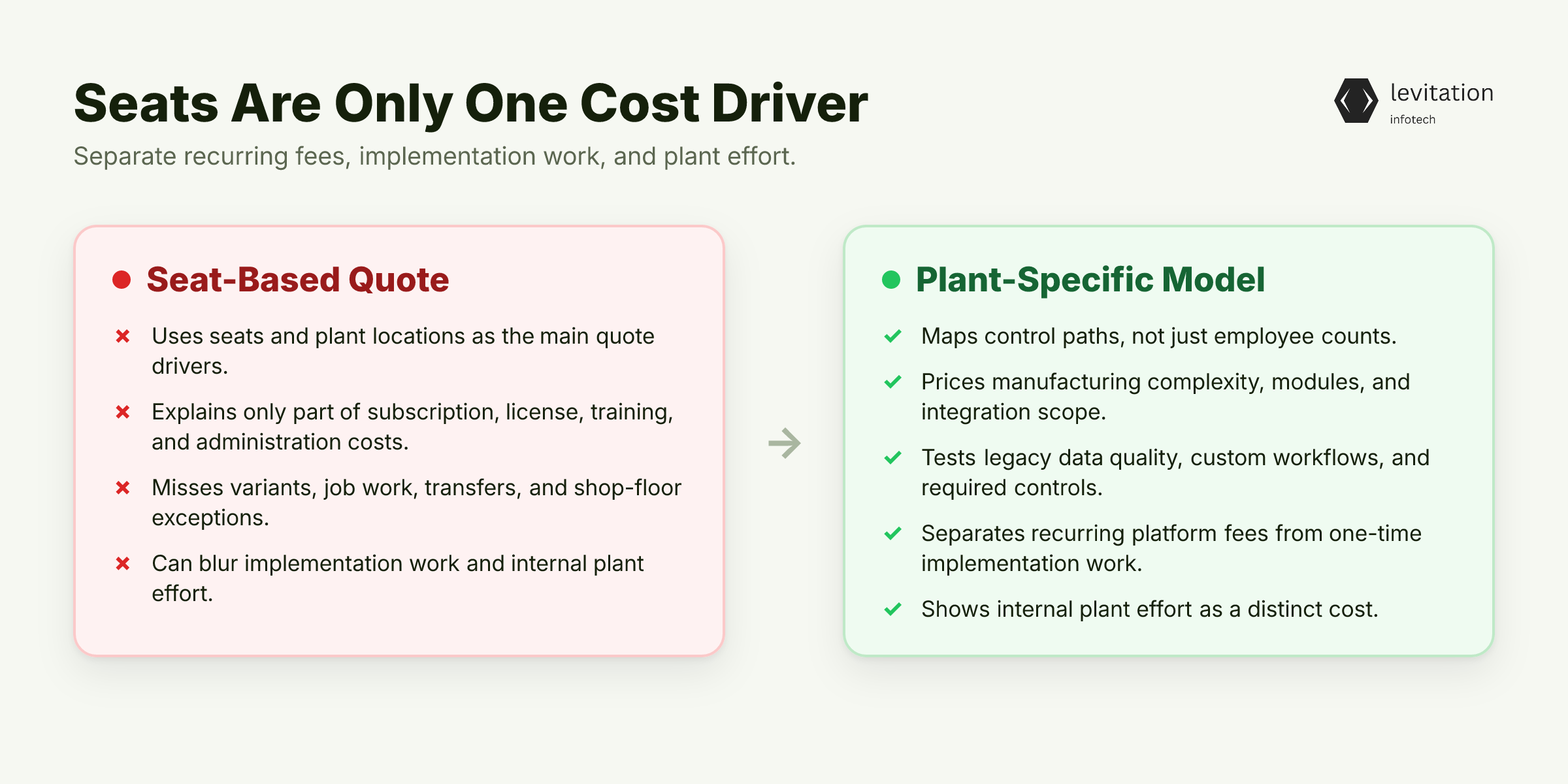
Two Delhi-NCR plants can employ the same number of people and still receive very different ERP quotes. One runs standardized lines. The other must encode variants, job work, inter-plant transfers, and shop-floor exceptions.
The difference lies in control paths, not seats.
Cost per user explains only part of the gap. It affects subscription or license fees, training, and administration volume. ERP cost research points to broader drivers: - Users and plant locations. - Manufacturing complexity. - Required business modules. - Integration scope. - Legacy data quality. - Custom workflows and controls.
Published estimates vary widely because ERP scope, company size, and required capabilities differ. Treat sources such as Cudio and Itransition as context, not as substitutes for a plant-specific breakdown.
Evaluate implementation and configuration separately from licensing. A cheap license does not guarantee a cheap factory ERP project.
Require each quote to separate three things: - Recurring platform fees. - One-time implementation work. - Internal effort from the plant.
A useful ERP implementation cost in India guide must expose all three. This is the wider problem behind The ERP Quote Lie: Your Real Cost in India.
If seats are only one input, what factory variables actually create the cost gap?
Why Equal-Size Plants Need Different ERP Scopes
The gap becomes concrete in two hypothetical plants with the same employee count.
The first operates a standardized line. Its bill of materials is stable, routings repeat, and outsourced work follows a clear pattern.
The second makes product variants, moves jobs between plants, and handles exceptions that rarely follow the standard workflow.
Identical headcounts still produce very different ERP footprints: - The first needs fewer item masters, work-order types, status paths, and approval rules. - The second needs alternative routings, transfer documents, exception handling, and detailed permissions. - Their reports, interfaces, reconciliation rules, and test scenarios also differ.
These differences reflect six broad scope drivers: users and locations, manufacturing complexity, modules, integration requirements, data quality, and custom workflows.
Every exception that enters the ERP becomes configuration, development, integration, testing, documentation, and training work. Implementation effort therefore does not rise in proportion to headcount.
A line exception that still lives in WhatsApp becomes another workflow to design, secure, reconcile, and teach. That hidden work sits inside factory ERP integration costs.
Before asking a vendor to price a requirement, classify it: - Standard: Included without major changes. - Configurable: Delivered through settings or templates. - Extendable: Supported through targeted extensions or custom ERP development. - Integration-only: Owned outside the ERP and connected through an interface.
Those differences become expensive when translated into transactions, exceptions, and interfaces the ERP must enforce. Which variables should the factory map before asking vendors to price them?
Map Variability Before You Price the Software
A quote cannot price a factory the buyer has not fully described. Start with operational variability, not feature wish lists.
Product and process variability
Map how products and work actually move through the plant. - Product structures: Product families, bill-of-material variants, work-order types, and make-versus-buy decisions. - Execution paths: Routing alternatives, outsourced operations, alternate work centers, rework, scrap, quality checks, and traceability requirements.
Do not record only the normal flow. Record what happens when material is short, a machine fails, a batch fails inspection, or customer specifications change.
Site and integration variability
Identify every place and system that must participate. - Every plant, warehouse, legal entity, and stock location. - Inter-plant transfers and the documents that prove custody. - Legacy applications, plant systems, and external interfaces. - The master data and transactions exchanged in each direction.
An interface is not one task. It needs ownership, error handling, reconciliation, security rules, monitoring, and a tested failure path.
Data and control variability
Assess the conditions surrounding the records, not just their volume. - Master-data quality and historical transaction depth. - Approval paths and role-based controls. - Reporting needs and reconciliation rules. - The effort required to clean, map, and reconcile legacy records.
Variability multiplies system behavior. Each distinct combination expands the design with new objects, fields, statuses, permissions, exception routes, interfaces, and test scenarios.
Turn the map into an action sheet. For each driver, record: - An owner. - A priority tied to operational risk or value. - A delivery method: standard, configure, extend, or integrate. - A proposed implementation phase.
Do not invent a universal rupee-per-complexity-point formula. Cost research supports these drivers, but not a reliable conversion rate.
That evidence is the honest starting point for custom ERP development: estimate the work before naming a delivery model.
Once variability is mapped, how should the plant compare packaged and custom ERP?
Packaged vs Custom ERP Changes the Cost Shape
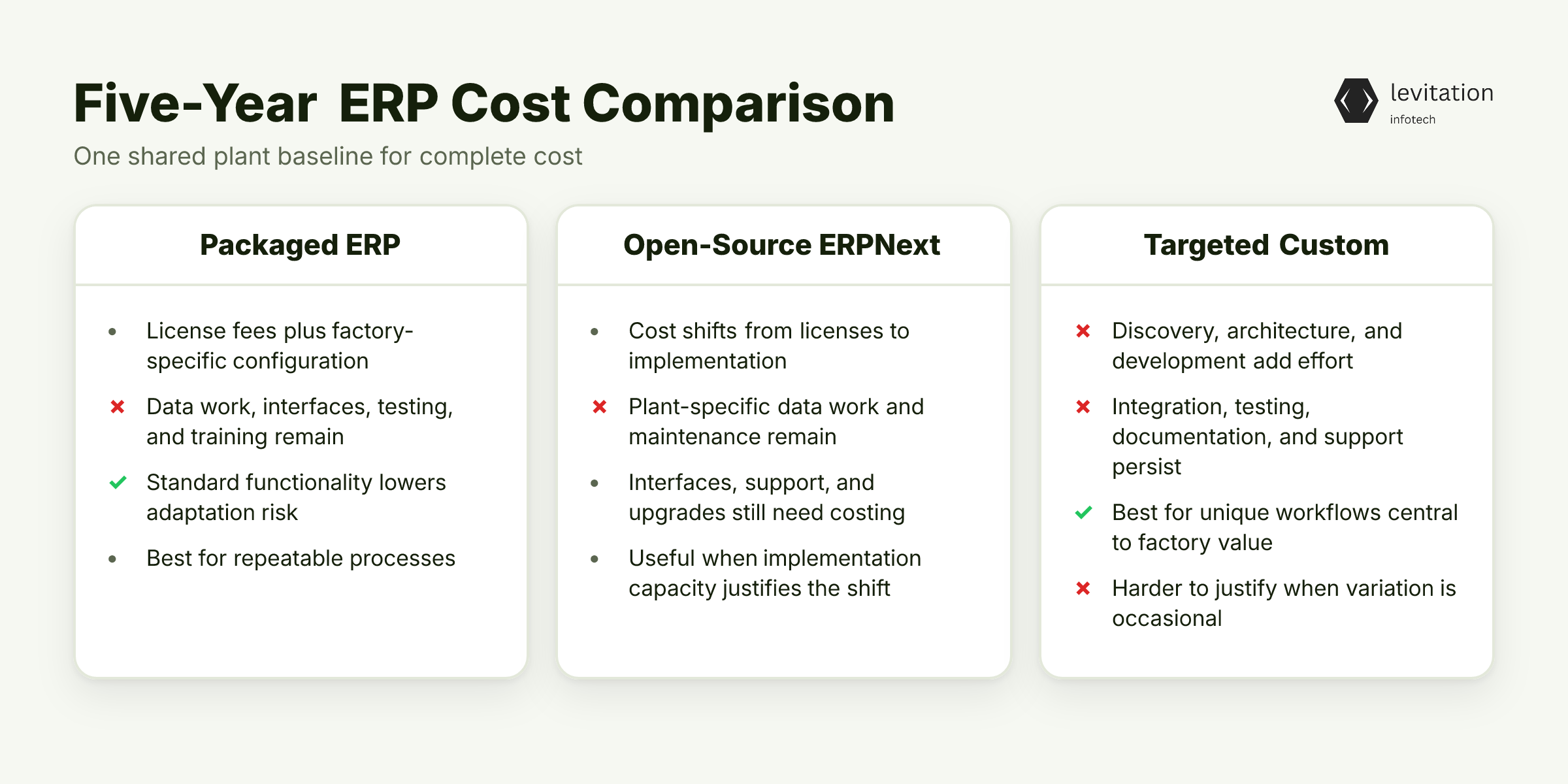
Packaged and custom ERP are not two prices for the same thing. They create different cost curves.
Packaged ERP combines subscription or license fees with: - Configuration and factory-specific adaptation. - Data assessment, cleanup, and migration. - Interfaces and testing. - Training and change management. - Support, hosting, and future upgrades.
Standard functionality lowers adaptation risk but does not remove factory-specific implementation work.
Custom ERP puts more effort into discovery, architecture, development, integration, testing, documentation, support, and ongoing upgrades. That work does not disappear after launch.
Use a simple decision rule: - Standard, repeatable processes: Favor packaged ERP. - Moderate exceptions: Favor configuration with controlled templates. - Unique, important workflows: Consider targeted extension or custom ERP.
Custom development becomes harder to justify when the variation is occasional rather than central to how the factory earns money.
An implementation estimate is useful only when it distinguishes license cost from implementation and integration work. A low first-year license fee does not determine the total cost of a proprietary ERP.
The comparison must also account for open-source ERP. ERPNext shifts more cost from licenses to implementation and maintenance.
Per-user averages, including those discussed by ERPFocus, give only rough guidance. They cannot become a factory quote without a plant-specific scope.
Compare packaged mid-market ERP, open-source ERPNext, and targeted custom development over five-year total cost. Include implementation, data work, interfaces, support, upgrades, and internal effort. The packaged versus custom ERP costs decision depends on that complete model, not ERP software development and integration work alone.
That comparison needs one shared baseline. How should that baseline normalize every quote?
Build a Quote-Normalized Factory Cost Baseline
Quote normalization is accounting discipline, not another estimate. Put every proposal into the same first-year structure.
Build the baseline in three layers.
Start with recurring platform costs: - Subscription or license. - Hosting and infrastructure. - Support and ongoing administration.
Then add one-time delivery work: - Discovery and process design. - Configuration and development. - Data assessment and migration. - Integrations and testing. - Training and change management. - Initial support.
Add internal effort and contingency as separate lines because internal work is not free.
An executive sponsor must reserve time for decisions and escalations throughout the project. Department leads should reserve time for discovery and testing. Data owners must allocate time to cleaning records.
Budget for a productivity dip around go-live. Cost that time using salary plus benefits, even if no external invoice appears.
Carry administrator effort, reporting rework, upgrades, hosting, and ongoing support into the five-year model.
Use one normalization checklist across suppliers: - Modules, locations, users, and roles. - Product families, routing variants, and exceptions. - Interfaces, data history, and data quality. - Environments, training, support, and upgrades. - Assumptions, exclusions, and internal effort.
Compare three supplier proposals in the same worksheet. Tag every line as one-time, recurring, internal, excluded, or conditional.
This creates a clearer manufacturing ERP implementation cost comparison. It does not create a universal price per employee or complexity point.
A normalized baseline exposes assumptions. Can a short discovery sprint test them before the budget is locked?
Use Discovery to Turn Assumptions Into Scope
A normalized quote still rests on assumptions. Test them in a fixed-fee discovery sprint before committing to a large implementation.
This matters most when routing, quality, inventory, and plant-level exceptions remain unclear. Discovery should produce: - A documented to-be process design. - A platform recommendation with clear reasoning. - An integration and customization list. - A data assessment. - A phased implementation budget.
Test each bidder against the plant's actual recurring order, a difficult variant, an exception workflow, and a reconciliation scenario. Generic sales demonstrations do not expose these behaviors.
Require a fit-gap matrix that classifies every item as standard, configured, extended, integrated, or excluded. Set acceptance criteria and name one owner for every custom item.
Before signing, ask for relevant manufacturing references and a five-year commercial model. Require an upgrade path, support escalation terms, and a post-go-live ownership plan.
The Odoo and ERP software development discovery process should resolve more assumptions than a polished generic demo.
That discipline changes more than the quote. Can the plant then operate the ERP without reopening the budget every month?
What Better Scoping Changes at Go-Live
Good scoping changes how the plant operates, not just how the project is priced.
The intended gains include: - Clear ownership of exceptions and approvals. - Traceable work orders and inventory movements. - Fewer unpriced change requests. - Visible reconciliation problems before they become operational losses. - Faster decisions when a standard workflow does not fit.
Sequence rollout by dependency and operational value. Do not divide the project into arbitrary equal phases.
Establish master data, interfaces, and critical controls before adding wider process coverage. Then expand into adjacent processes that depend on those foundations.
Use a firm approval rule. Do not approve the implementation budget unless its quote is attached to: - The plant and location map. - The product and process variation inventory. - The exception register. - The data assessment. - The interface map. - The internal-effort plan.
This is also the answer to why an ERP can be ignored after go-live. Adoption weakens when users must work around undefined process behavior.
A credible scope reduces budget uncertainty and makes five-year costs comparable. It does not justify promising savings without a measured operating baseline.
The ERP implementation cost and scope planning document should therefore read like an operating plan, not a software brochure.
The next question is practical: what should a Delhi-NCR plant ask for before it accepts any ERP number?
Frequently Asked Questions
What is the ERP implementation cost in India for a manufacturing plant?
Published estimates are broad. Sources such as Cudio and Itransition offer rough context. They do not replace a plant-specific breakdown.
A factory quote becomes meaningful only after it is broken down. Include locations, modules, workflows, interfaces, data history, custom work, and internal effort.
Why do ERP quotes rise even when employee count does not?
Employee count affects licensing and administration. It does not capture additional plants, product variants, manufacturing exceptions, required modules, integration scope, or poor legacy data.
Each factor creates design, testing, migration, training, or support work that does not scale directly with the number of users.
Is packaged or custom ERP cheaper for a Delhi-NCR factory?
Packaged ERP requires less adaptation when plant processes are standard. Configuration or targeted extension is the better economic choice when workflows differ from the standard.
Compare five-year total cost, including implementation, data work, integrations, support, and upgrades. Do not decide from license or initial development cost alone.
What costs are usually missing from an ERP implementation quote?
Common omissions include data cleanup, migration, interfaces, training, change management, internal project time, productivity loss, support, upgrades, and reporting rework.
Reduced productivity near go-live is easy to omit because it does not appear on an external invoice. Department-lead and data-owner effort are easy to omit for the same reason. Cost all internal time using salary plus benefits.
How can a plant head get an ERP quote he can trust?
Run a fixed-fee discovery sprint before committing to the full implementation. Require a documented to-be process, platform recommendation, integration and customization list, data assessment, and phased budget.
Reject quotes based only on employee count or headline license price. The harder question is whether the bidder can prove that its scope covers the plant's real exceptions before the contract is signed.
About the author
Mayank Singh is a software developer at Levitation Infotech, where he builds web and AI-powered applications across the company’s fintech, healthcare, and enterprise projects.