


TL;DR: Indian ERP quotes almost always measure software licences, not the system. The real five-year cost of a 50-user mid-market deployment runs into multiple crores. Build services cost several times the first-year licence. The gap is structural, not vendor dishonesty. A process-by-process scoping protocol before contract signature is the only way to close it.
Key Takeaways: - Mid-market Indian ERP benchmarks show per-user five-year costs that scale with deployment size and complexity. Build services run several times the first-year licence cost. - The customisation line item is where every quote underestimates. "Configuration" and "customisation" are fiction in practice. - A fit-gap matrix, a 30% customisation cap, and a 15% contingency are the three controls that lock the quote to the bill.
The Quote Measures the Software, Not the System
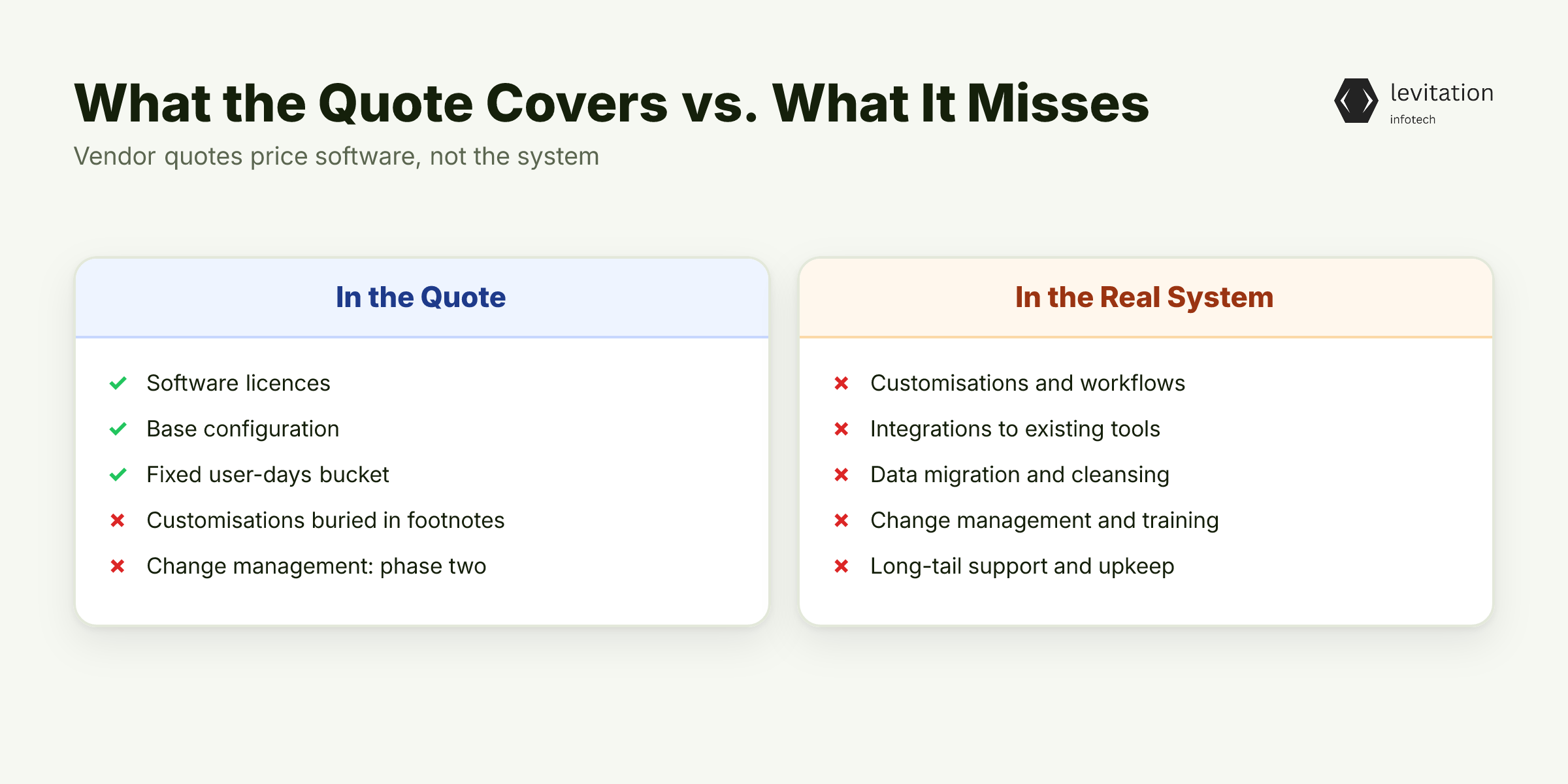
Here's how the gap gets built. Vendor quotes in India almost always price three things. They cover licences, base configuration, and a fixed bucket of user-days. They almost never price customisations, integrations, data migration, or change management as line items. Those get buried in footnotes. They also wait for a "phase two" conversation after the deal is signed.
An Odoo or ERPNext licence plus a thin build wrapper is a legitimate deliverable. The trouble is that nobody budgets the rest of the system.
Industry data shows build costs run several times the first-year software price. That holds once you account for the work the quote didn't include. The gap appears reliably across vendors, platforms, and industries. It is not because the market is dishonest. It is because the quoting framework itself is wired to hide it.
CFOs approve the number they see, not the number they will pay. That mismatch, between the headline figure and the real five-year bill, is the structural failure. We unpack it below.
Why Customisations Are Never Really 'Optional'
Indian mid-market businesses run on process variation that off-the-shelf ERP cannot absorb. Multi-rate GST logic, state-wise compliance rules, branch-level pricing matrices, and bespoke approval hierarchies are the norm.
Try to push a manufacturer in Coimbatore into a vanilla SAP template. The workarounds start on day one. The same pattern hits a distributor in Lucknow.
The standard sales answer is to split "configuration" from "customisation." Configuration is free. Customisation is billable.
In theory, this looks clean. In practice, the line is fiction.
A real Indian deployment blurs the line within the first sprint. A multi-warehouse transfer with tax-invoice splitting is not configuration. A region-specific discount cascade is not configuration either.
An approval matrix that varies by branch, entity value, and product category is not configuration. Not even if the vendor insists on the call.
The economics are stark. Custom ERP work at partner rates varies by region and complexity. A single non-trivial workflow can absorb large engineering effort before it touches integration or testing.
Two workflows of that size can dominate the build budget. That is not an edge case. That is the second month of most projects.
Partners know this. They quote low to win the deal. Then they spread the gap through change requests. The misaligned incentive is structural. It is baked into the sales process across the entire ERP software development market. That incentive is what makes the numbers below hard to argue with.
The Real Math: A Verified Benchmark for India
Industry benchmarks consistently show the real five-year cost. For a 50-user mid-market deployment, it runs into multiple crores. That is far beyond the typical headline quote. Build services alone typically cost several times the first-year software licence.
For Odoo build in India, the licence cost is lower but the build ratio holds. The gap between quote and bill is structural, not vendor-specific.
Industry ranges for mid-market software licences span tens of lakhs. Build then doubles or triples that visible figure. The same multiplier applies whether the platform is SAP, Odoo, or a custom build.
Hidden line items that never appear in the headline quote: - Data cleansing from legacy spreadsheets and Tally masters - Third-party API development for payment gateways, e-invoicing, and logistics - Sandbox environments for testing without polluting production - Parallel-run staffing during cutover - Post-go-live hypercare, usually several weeks or months of dedicated support
Together, these add a large percentage to the visible scope. The work is not optional. It just does not fit on the first slide of the sales deck.
The quoting framework matters as much as the technology choice.
Knowing the real number is half the battle. The other half is deciding what should be configured versus built from scratch.
The Build vs Buy Decision: Where the Real Money Shifts
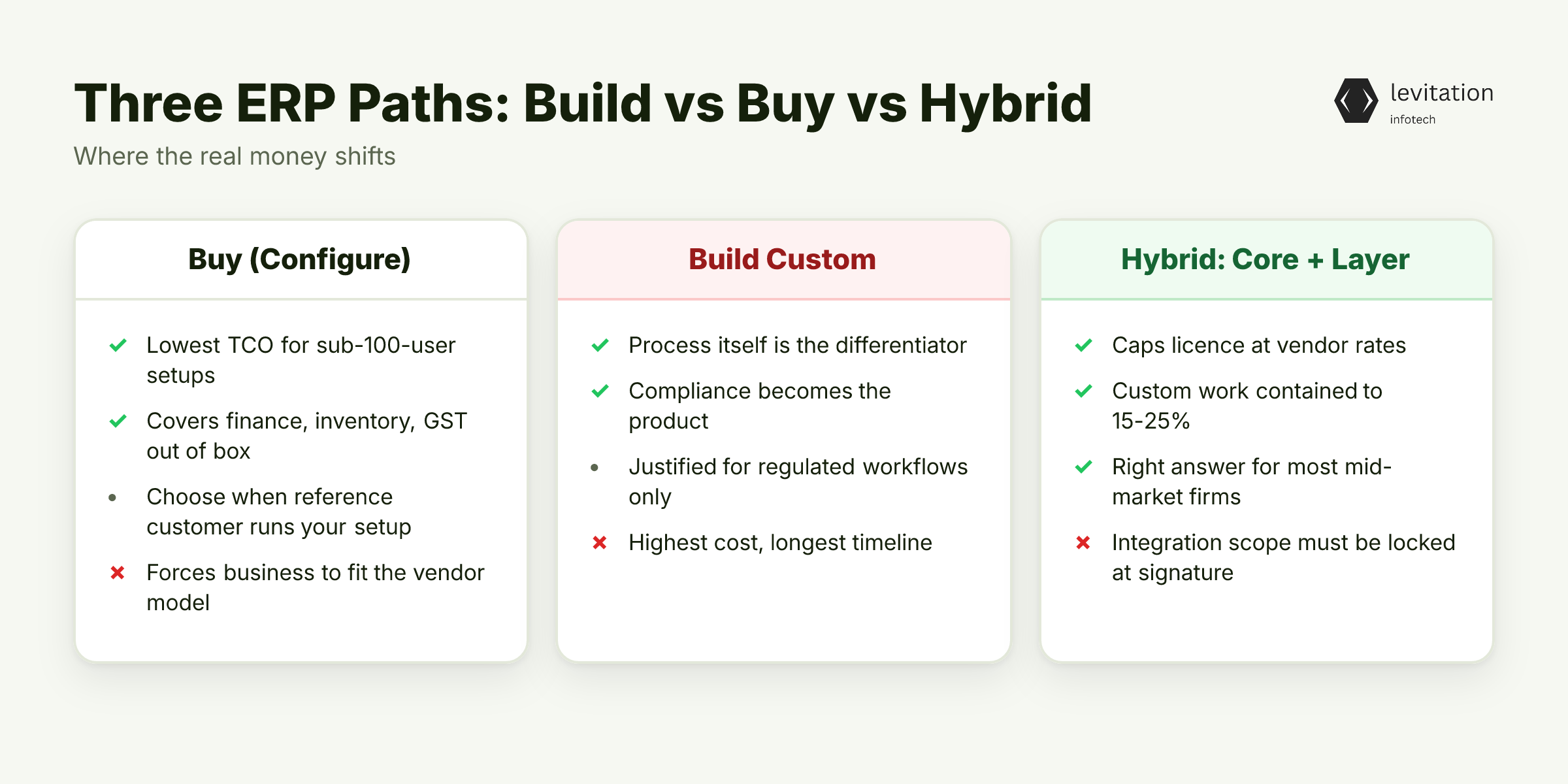
The temptation is to treat build-versus-buy as a binary. It is not. There are three paths, and most CFOs only see two.
Buy (configure Odoo, ERPNext, or SAP Business One) in many cases. This works when most of your core processes map to the vendor's reference model. Finance, inventory, basic manufacturing, and standard GST logic are usually covered. If you can describe your process on a single page, buy. The vendor should have a reference customer running the same setup.
Build custom when your differentiator is the process itself. A proprietary pricing engine, a unique supply-chain algorithm, or a regulated workflow can be the case. In these, compliance is the product.
Custom ERP in this bucket is justified. Off-the-shelf would force the business to change instead of supporting it.
The third path most CFOs miss: buy the core. Then build a thin integration and customisation layer on top. This caps the licence at vendor rates. It also contains custom work to the 15-25% of the system that actually differentiates the business. For most Indian mid-market firms, this is the right answer.
A quick orientation by platform: - Odoo wins on total cost of ownership for sub-100-user deployments with standard processes. - SAP wins on multi-country consolidation and complex manufacturing rollups. - Custom ERP wins only when off-the-shelf cannot model a critical workflow.
Healthcare and pharma deployments show the build case clearly. Regulated workflows (patient identity handling, drug-recall traceability, NABH-aligned access controls) rarely map to reference models. The regulated-industry case almost always justifies a build layer on top of a core platform.
The decision rule is simple. If the vendor's reference customer does what you need, buy. If they "kind of" do it, build the layer that closes the gap.
The same logic applies to ERP integration and Odoo development work. The 15-25% custom layer is where the actual business value lives. Locking that scope down before contract signature is the next step.
The Scoping Protocol That Locks the Quote to the Bill
Five controls separate a well-scoped project from a runaway one. None of them are exotic. All of them are routinely skipped.
First, demand a process-by-process fit-gap matrix before signing. Every workflow gets scored as Configure, Customise, or Out-of-Scope. Each row also has effort estimates.
This is non-negotiable. A build partner who refuses to produce one is telling you they intend to bill the gap later.
Second, cap customisation as a percentage of total scope. If custom work exceeds 30% of effort, the project is either under-quoted or on the wrong platform. Both are fixable, but only before contract signature.
Third, separate the pricing models. Fixed-price bids on Configure work. Time-and-materials on Customise work, with a shared change-control board. The hourly rate should reflect partner market rates. Mixing fixed and T&M is how vendors hide overruns.
Fourth, insist on a data migration line item with a sample-size clause. Vendors routinely under-price migration because they have never cleaned your master data. The clause forces them to scope against a real extract, not a guess.
Fifth, build a 15% contingency into the board-approved budget from day one. Projects that do not hit it become the reference case for the projects that do.
The contingency is not pessimism. It is how serious organisations budget for ERP system work.
When this protocol runs, the gap between quote and bill collapses.
What a Well-Scoped ERP Deployment Actually Delivers
The financial outcome is the most visible. Quote-to-bill variance drops from runaway overruns to a manageable percentage. This happens because the customisation bucket is sized honestly before contract signature.
We have seen this pattern repeat across Indian mid-market deployments. The same logic applies to adjacent systems. The vendor lock-in cost of custom CRM follows a similar path.
The operational outcome matters just as much. Go-live happens on the agreed date. The change-control board has absorbed mid-project surprises instead of letting them detonate at the end. Teams stop firefighting scope and start using the system.
The longevity outcome is the one CFOs underestimate. Systems scoped this way are the ones still running in production five-plus years after deployment.
The architecture was sized for actual use, not the demo. The pattern holds across ERP development and enterprise resource planning work. Honest scoping at the start is the single biggest predictor of multi-year system life.
For CFOs specifically, the gain is decision quality. A real number at the start lets you model cash flow, debt servicing, and ROI properly.
You stop discovering the true cost after the money is committed. You also stop explaining to the board why the headline quote bore no resemblance to the final bill. You start running the business on a system that was actually built for it.
Frequently Asked Questions
What is the actual cost of ERP build in India for a mid-market company?
For a 50-user mid-market deployment, industry benchmarks put the five-year cost into multiple crores. Build services alone run several times the first-year software licence. A typical quote almost always refers to the licence component only, not the total system.
How much does ERP customisation cost per hour in India?
Custom ERP work globally runs at rates that vary by region and complexity. Indian partner rates typically sit at the lower end of that range. A single non-trivial workflow can absorb large engineering effort before integration and testing. Think multi-warehouse inventory, branch-level pricing, or state-wise GST logic.
Is Odoo cheaper than SAP for Indian businesses?
On licence cost, yes. Odoo's per-user pricing is a fraction of SAP's. On total build cost, the gap narrows because the same customisation multiplier drives overruns on both. Odoo wins decisively for sub-100-user deployments with standard processes. SAP wins for multi-country consolidation and complex manufacturing.
When should a CFO choose custom ERP development over Odoo or ERPNext?
Choose custom development when the process itself is the differentiator. That means a proprietary pricing engine, a regulated workflow, or a supply-chain algorithm. Off-the-shelf cannot model these without forcing the business to change. For everything else, configure Odoo or ERPNext. Reserve custom budget for the 15-25% that genuinely differentiates the business.
How do you prevent an ERP project from going over budget in India?
Demand a process-by-process fit-gap matrix before signing. Cap customisation at 30% of total scope. Separate fixed-price configure work from time-and-materials customise work. Require a data migration line item with a sample-size clause. Build a 15% contingency into the approved budget on day one. Projects that follow this protocol typically land within a tight variance band of the original quote.
About the author
Mayank Singh is a software developer at Levitation Infotech, where he builds web and AI-powered applications across the company’s fintech, healthcare, and enterprise projects.