


TL;DR: A polished CRM demo can hide costly delivery gaps. Replace it with five buyer-specific tests. These cover platform depth, data discipline, integration readiness, automation resilience, and delivery ownership. Score the evidence and set stop conditions. Then turn each gap into contract-ready pass conditions before signature.
Key Takeaways: - Treat every claim about a feature as unproven until evidence supports it. - Test each bidder against your workflow, data, and delivery model. - Make the scorecard binding with written deliverables, owners, and change triggers.
Why a Great Demo Can Hide a Weak Delivery Engine
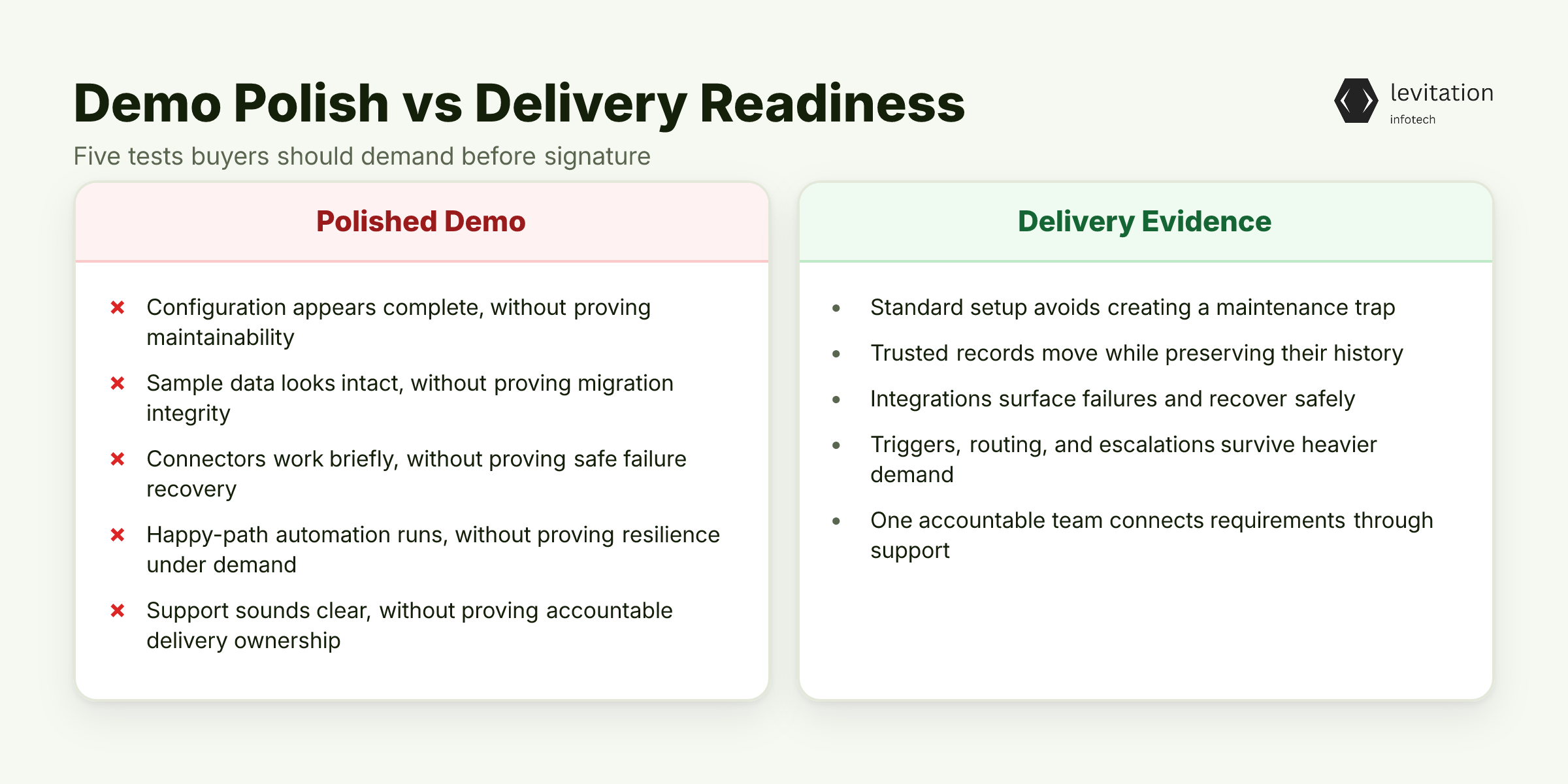
A convincing CRM demo can still hide the weakest part of an Indian CRM engagement. That weak part is the handoff from sales to delivery. Before signature, buyers need five tests. Each test must make partners prove migration, integration, and automation under pressure. A polished screen demo is not enough.
The demo proves configuration, not operating readiness
A scripted walkthrough can hide weak data handling, brittle integrations, incomplete automation, and an unclear sales-to-delivery handoff.
A setup only proves that a screen can look right. It does not prove that records survive migration. It also does not prove that systems recover from failures or that work reaches delivery.
Five tests turn that doubt into clear behavior: - Platform depth: Can standard setup support the process without creating a maintenance trap? - Data discipline: Can the partner move trusted records while preserving history? - Integration readiness: Can systems exchange data, surface failures, and recover safely? - Automation resilience: Will triggers, routing, and escalations survive heavier demand? - Delivery ownership: Will one accountable team connect requirements through support?
A low bid can still leave room for an expensive rollout. Migration surprises, missing connectors, repeated testing, and unclear support boundaries all push work into later phases.
Treat every partner claim as unproven until you see an artifact, test result, or working demo.
Use the top CRM development companies in India comparison as a starting point. Then narrow the list through evidence rather than familiarity.
The more confident a proposal sounds, the less buyers know about the risks it hides.
Why Feature Comparisons Reward Familiarity, Not Delivery Fit
A familiar Salesforce or Zoho track record creates false confidence. Buyers recognize the names, while the bidder's actual fit remains untested.
Fit beats familiarity
Every bidder should face the same five criteria. Each bidder should use the buyer's own workflows and data. Otherwise, a strong résumé can hide weak migration discipline. It can also hide a poor delivery model.
Generic lists of project phases rarely expose that weakness. Consultation, planning, design, development, testing, migration, and deployment are useful labels. Each label matters only when it has a named output and a clear pass condition.
The difference appears under pressure. During a seasonal peak, demand for leads, follow-ups, and service rises. Then incomplete automation becomes expensive. Manual work returns quietly. Delivery teams also receive records they cannot trust.
Clarify what the proposal actually buys: - Salesforce implementation sets up and deploys a standard platform. - Zoho configuration adapts standard modules, fields, and rules. - Salesforce customization extends objects, workflows, and user journeys. - Custom CRM work builds and runs app-specific software.
Buyers comparing a Salesforce implementation partner in India should examine setup depth. Also examine migration discipline and who owns integrations. Do not hide all of this behind the phrase “CRM development.”
Use the CRM development cost in India and CRM software development resources. They help you separate quoted development work from the full implementation lifecycle.
This pattern also appears in Delhi-NCR's cheapest Salesforce quote can become the costliest rollout. A low headline price cannot reveal work left ambiguous.
The fix is not a longer feature checklist. It is a set of tests designed to make each partner show working evidence.
Tests 1-2: Platform Depth and Data Discipline
Give each bidder one real workflow. A lead-to-fulfilment process or service escalation will reveal more than a generic product tour.
Test 1: Can the partner configure the platform without creating a maintenance trap?
Require a map showing how the workflow is split across these layers: - Standard platform setup - Low-code or platform custom work - Custom app development - Permissions and role-based access - Day-to-day dashboards - Expected path for future changes
Ask where platform setup ends and custom development begins. The answer should identify who maintains each layer after an upgrade.
A generic feature matrix proves little. A solution design tied to the buyer's process shows that the partner understands daily use. It also shows that the partner understands upkeep.
Stronger evidence includes a working walkthrough, design document, and change plan. The partner should also explain how new requirements will reach the right owner. The more convincing the setup, the more expensive a failed migration can become.
Test 2: Can the partner move trustworthy data into the CRM?
Provide a controlled sample that represents real data. Then ask the bidder to show: - Field mapping and data-change rules - Validation and rejection handling - Source-to-target record matching - Handling duplicate and conflicting records - Keeping contact and account history
A migration plan must also define what gets tested before cutover. It should name the person who signs off on record integrity. It should also explain how unresolved differences are handled.
A verbal promise of a “clean migration” is incomplete. The relevant evidence is a mapping document, validation output, record-matching report, or a test migration you can inspect.
This is where setup quality becomes visible. The app, data model, and integration design matter more than the CRM name. This point is explained in CRM software development.
But even a clean data model becomes an expensive island. This happens if nearby systems cannot exchange trusted records.
Tests 3-5: Integrations, Automation, and Accountability
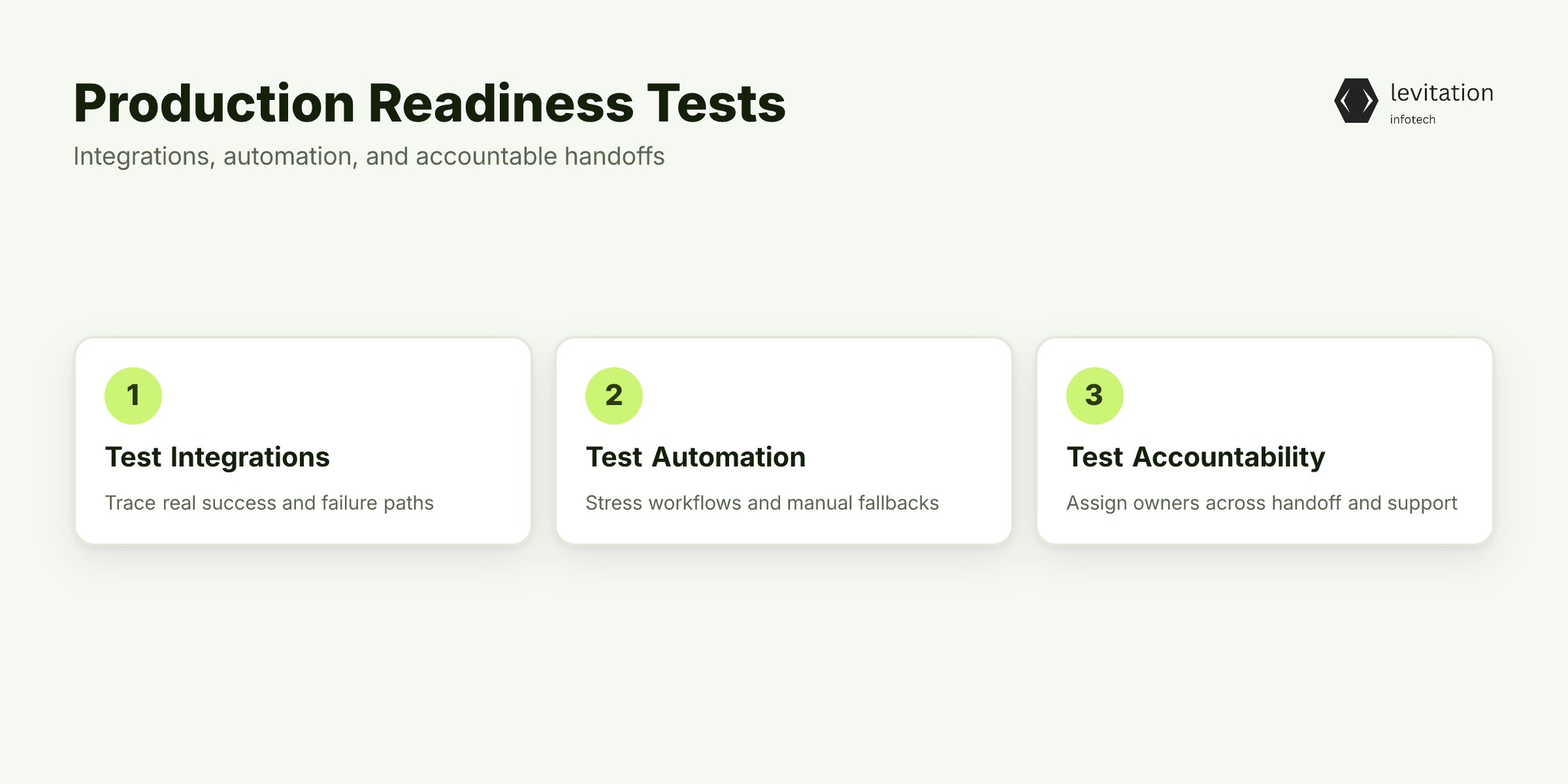
The remaining failures happen between systems and teams. They rarely appear in a clean demo environment.
Test 3: Can the partner integrate the systems your revenue process already depends on?
Trace one real flow through the relevant ERP, email, marketing, telephony, commerce, or billing connections. The partner should use APIs or middleware with clear documentation. It should also show where records start, change, and stop.
Ask for the successful path and the failure path. Strong evidence covers: - Monitoring and alerts - Error handling and message recovery - Retry ownership and limits - Escalation when an upstream or downstream system fails - A named owner for operations
Reject a list of supported connectors as proof of readiness. A connector proves only that a route is listed. It does not prove that the buyer's actual flow works when demand rises or exceptions increase.
Test 4: Will automation hold up when demand rises?
Run a representative lead or case workflow through its full life cycle. Test triggers, routing, assignments, escalations, exception handling, and any manual fallback.
Then test the workflow against a seasonal peak. Ask what happens when more records enter and exceptions increase. Also ask what happens when staff cannot absorb failures manually.
A good setup fails safely and visibly. It then recovers in the same way each time. A weak one leaves work in inboxes while dashboards continue to show green. Without clear ownership, recovery becomes a dispute after launch.
Test 5: Does one accountable team own the sales-to-delivery handoff?
Require a project plan that links requirements, system design, sprint planning, migration, and testing. It must also link rollout, support, and escalation to named outputs and owners.
Ask how project management updates stay visible to commercial and operational stakeholders. Ask how delivery messages stay visible too. The partner should show one handoff method rather than several disconnected status reports.
This is the critical missing piece. Fragmented ownership, system links, or post-launch support can cause even a capable team to fail.
That ownership problem appears in Your NCR CRM demo cannot prove who owns leads. The top CRM development companies in India comparison becomes useful only when providers explain these duties. Check the CRM development cost in India to confirm that these duties also appear in the contract scope.
Once these tests expose gaps, the buyer needs a way to compare them. The buyer must also make the result binding before signature.
Run a Five-Day Evidence Sprint Before You Sign
The tests work best within clear limits. Give bidders scenarios, artifacts, and pass conditions instead of open invitations to present their company.
Day 1: Select real workflows
Define two or three priority processes. For each one, identify the data it touches and the systems it must connect. Also identify the business outcome it supports.
Day 2: Inspect the data
Provide each bidder with a controlled sample. Ask them to show mapping and validation. Also ask them to show reconciliation and their approach to preserving historical records.
Days 3-4: Test behavior
Request a working integration and automation walkthrough. Then ask the partner to test exceptions and the handoff between sales, delivery, and support.
Day 5: Score and negotiate
Compare responses and turn missing evidence into written deliverables. Also set out pass conditions, team duties, and cost assumptions.
Use a simple evidence scale: - Zero: No relevant evidence. - One: A verbal claim or generic demo. - Two: A tested artifact tied to the buyer's scenario.
Set stop conditions before evaluations begin. An absent or failed data, integration, or delivery-ownership test should prevent signature until resolved.
Compare the full cost on the same basis. It should cover setup, custom changes, custom development, migration, integrations, testing, training, rollout, and support. Require written assumptions and change-order triggers for every excluded item.
Make the contract mirror the tests. Specify migration record checks, integration pass rules, automation outcomes, deployment criteria, support escalation, ownership boundaries, and extra-cost triggers.
Use the CRM development cost in India framework to compare quotes. Start with the top CRM development companies in India list, then apply the same evidence standard to every finalist.
A good scorecard does more than select a vendor. The real proof arrives after launch, when the system carries live work rather than demo data.
Choose for Evidence, Then Demand Continuity
What improves after go-live
Choosing based on evidence creates clearer handoffs and more trusted records. It also leads to monitored integrations and tested automation. You also get fewer surprise change requests.
The commercial payoff is not the prettiest demo. It means less delivery uncertainty. It also means working with a partner whose delivery model can support the system after launch.
Retain control of the decision: - Require the same five tests from every shortlisted provider. - Publish the scorecard internally. - Attach every missing evidence item to a deliverable and owner. - Revise scope, choose another partner, or delay signature when a stop condition remains unresolved.
The practical question is simple: can this process fit inside a normal RFP? It must do so without turning the RFP into another consulting project.
Frequently Asked Questions
What are the five tests for evaluating an Indian CRM partner?
The five tests examine platform depth, data discipline, integration readiness, automation resilience, and delivery ownership. Each test requires a working demo, tested artifact, or documented plan. None should rest on a general feature claim.
How should I compare the cost of building a CRM with a CRM implementation quote?
Compare the full lifecycle. Include platform or license costs, setup, custom changes, and custom CRM development. Also include migration, integrations, testing, training, rollout, and support. Ask each bidder to document assumptions and change-order triggers. The CRM development cost in India framework helps you compare those quotes.
What evidence should I request from a CRM implementation partner before signing?
Request a workflow-based solution design and sample migration or validation output. Also request an integration flow, an automation walkthrough, and a delivery plan with named owners and pass conditions. These artifacts show delivery ability more clearly than a polished product demo.
Should I choose a Salesforce implementation partner in India or a custom CRM team?
Choose a platform setup when standard features can support the core process. Look for a bidder who shows good setup and integration work. Choose a custom CRM team when unique workflows justify the extra build and upkeep burden. Apply the same five tests either way, using the CRM software development decision framework.
Can these five tests fit into a normal CRM RFP?
Yes. Convert each test into a buyer scenario, required artifact, pass condition, and named evaluator. A five-day evidence sprint can run inside the technical evaluation without turning the RFP into an open-ended consulting project.
Which test would your current shortlist fail first?
About the author
Mayank Singh is a software developer at Levitation Infotech, where he builds web and AI-powered applications across the company’s fintech, healthcare, and enterprise projects.