


TL;DR: A CRM assignment is not proof of ownership. For an NCR real-estate team, require an append-only ownership ledger and a live demo audit. The evidence should identify who owned the lead, when, why, and under which rule.
Key Takeaways: - An owner name shows state. An ownership ledger preserves the decision path. - A live NCR lead can reveal gaps that a polished sample record conceals. - Compare packaged, configured, and custom CRMs with the same pass-or-fail operating test.
The Demo Can Assign a Lead Without Proving Ownership
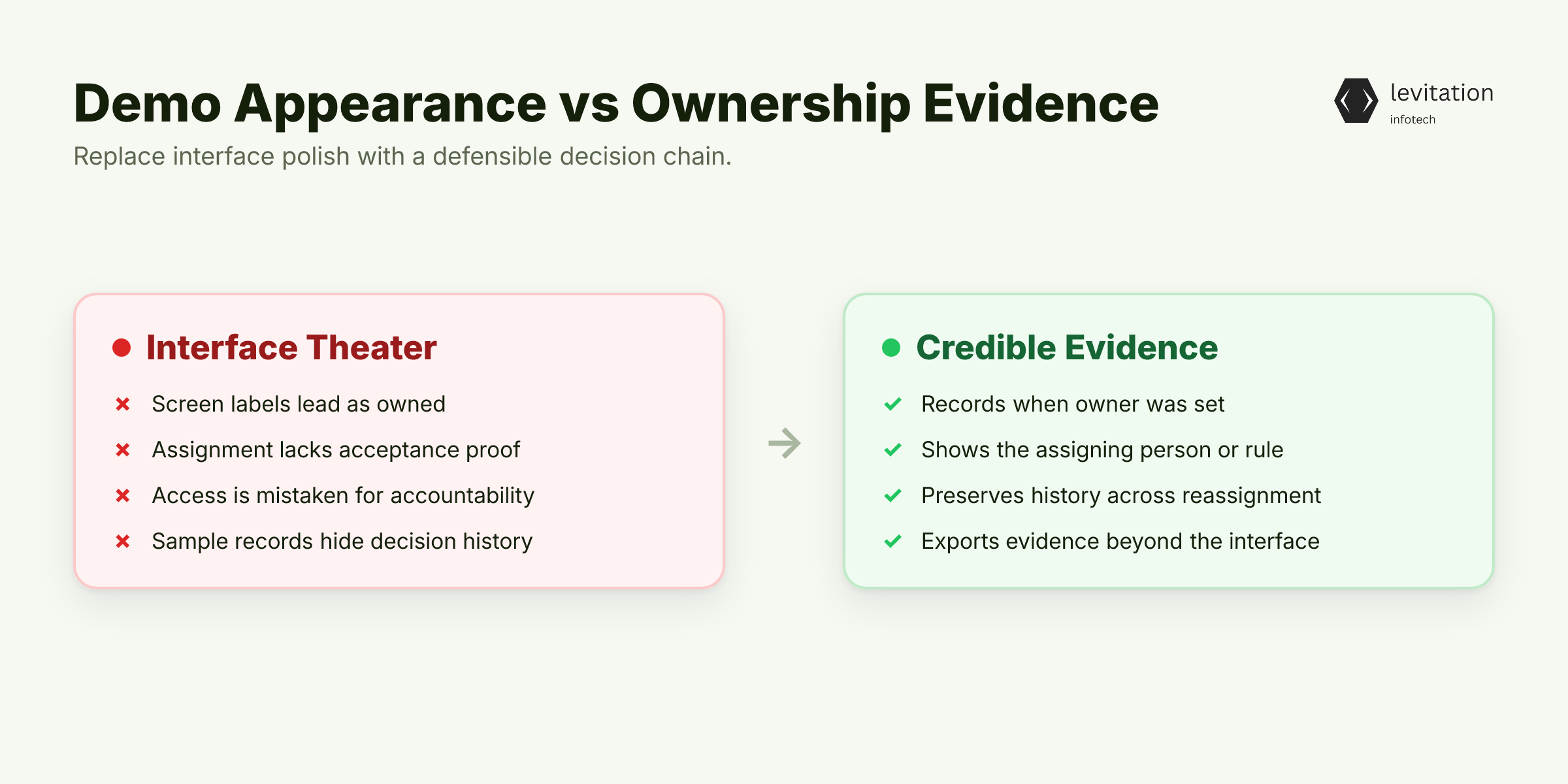
A polished CRM demo can assign an NCR lead to an agent and still leave ownership unproved. The screen shows a label, not evidence that the agent is accountable for the lead. A credible CRM must show the decisions that created it.
Separate assignment, access, and ownership
The available feature evidence suggests that some CRMs support lead allocation to users or roles. It also suggests support for role-based access control in some systems.
Neither feature, by itself, proves responsibility was accepted, transferred, or acted on. The screen can show access without showing accountability.
Imagine Priya receives a buyer inquiry for a Noida property. The lead says Priya is owner. Who assigned it, under which rule, and did she accept it? Assignment, access, and ownership answer different questions.
Why feature tours miss the gap
A feature tour may show a polished lead and contact record, automated follow-up, and task reminders. It may also display pipeline stages, communication tools, and analytics dashboards that suggest control.
These features can appear in a real-estate demo without showing how ownership was established or changed. Each feature can look complete in isolation. Together, they can hide the missing decision chain.
A polished sample record starts after the difficult decisions have already been made. It proves the workflow can display a result, not that it can defend the result.
Ask four evidence questions
Buyers should demand direct answers to four fundamental questions. The first question asks when the owner was set. The second asks which person or rule set the owner. The third asks what history survives a reassignment. Finally, the fourth asks whether the evidence can be exported outside the interface.
Use one live NCR lead during evaluation. Trace it from capture through assignment instead of relying on a polished sample record.
Ask any vendor or CRM software development team to expose that path. A vendor should welcome the test because it separates operating evidence from interface theater.
The assignment looks complete on screen, but the accountability gap appears only when the sales process branches into exceptions.
Why Generic Assignment Creates Accountability Gaps
When a lead is left unassigned, rejected, transferred, and later reintroduced through another source, the CRM can show a neat pipeline stage while obscuring which handoff broke accountability.
Responsibility can become fragmented across stages instead of remaining attributable to a recorded decision.
Expose the hidden cost of partial workflow ownership
Generic software may store part of the real-estate process. It can miss the operating relationships among records and decisions.
A complete real-estate system must connect leads and contacts with their lifecycle history. It must link properties and units to their associated property-ownership and tenancy details. It also needs to integrate documents, tasks, follow-up, and communications while tying permissions and responsibilities directly to the accountability trail.
Storing those pieces isn't enough. The CRM must preserve why one person became responsible for another person's inquiry.
When comparing top CRM development companies in India, ask how they model this relationship. A generic lead-status field isn't an answer.
Distinguish visible delay from durable damage
Delay is the visible cost when a lead stalls. The deeper cost is poor durability.
Records without preserved decisions may not support reliable reporting, training, ownership decisions, or future AI initiatives.
A manager may know the deal failed. If that explanation is absent from the record, the CRM cannot explain which handoff caused the failure. That missing explanation turns a sales problem into an unanswerable management problem.
Audit the current CRM
Select records that were transferred, rejected, duplicated, or left without activity. Try to reconstruct four facts: who owned the lead, when responsibility changed, which rule or instruction caused the change, and what work happened afterward.
If the answer depends on messages, spreadsheets, or memory, the record isn't auditable.
Make unassigned, stale, rejected, duplicated, and escalated leads visible as clearly labeled exception queues. Don't let them disappear into another stage.
The cure is not another status field; it is a record that can defend every ownership decision after the fact.
Build an Ownership Ledger, Not Another Owner Field
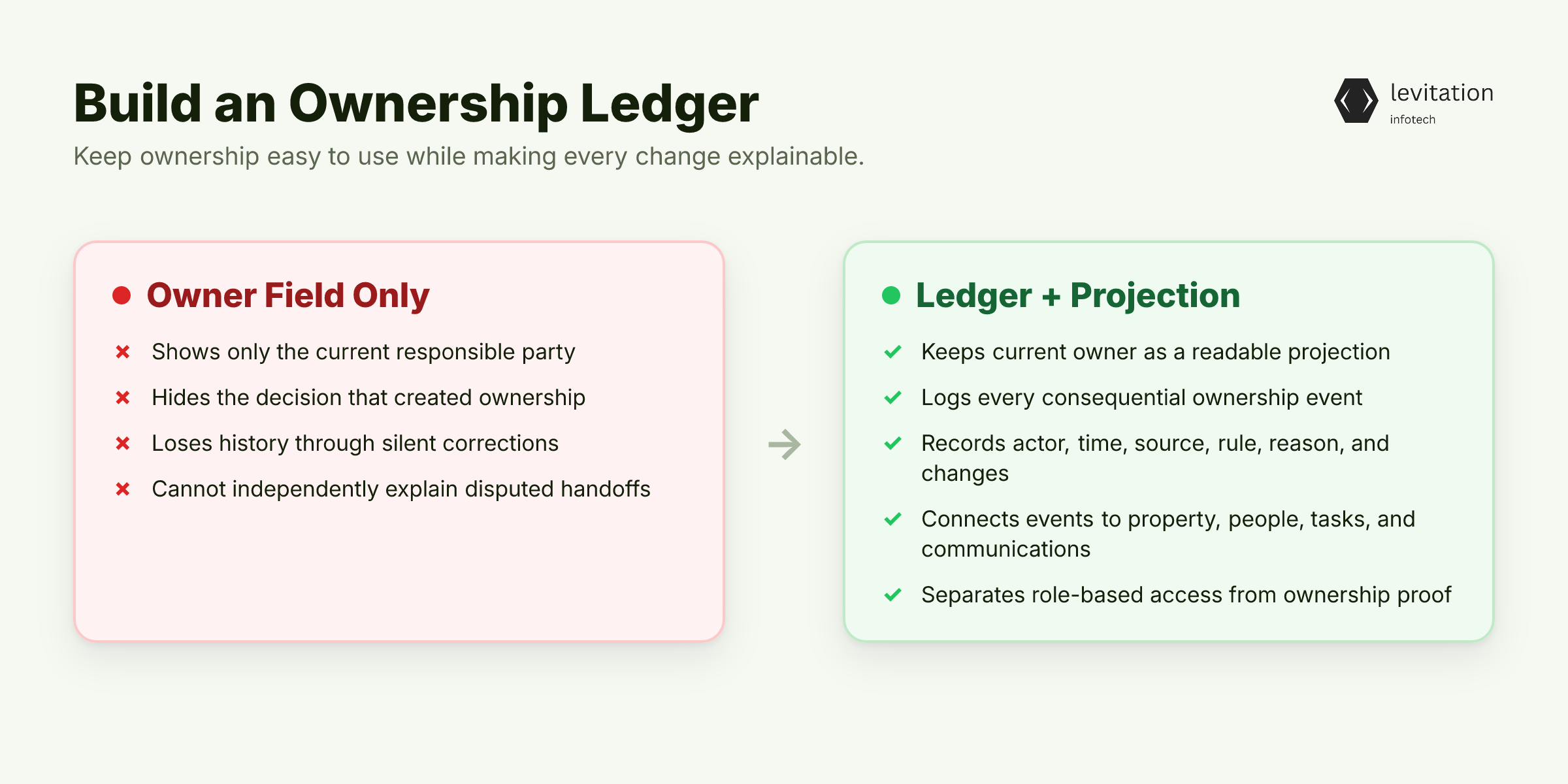
A current owner is useful but insufficient because it hides the decision that created it.
Keep the current owner as a readable projection
The lead record should show the current owner for daily sales use. A separate ledger preserves every change behind that value.
Here, owner means the agent or team responsible for the next action, not the property's legal owner.
A dashboard is the balance. The ledger is the transaction history.
Log every consequential event
Record each consequential event, including the creation, claim, assignment, and acceptance of the lead, as well as its rejection, transfer, release, and subsequent re-entry.
For each event, retain the actor, timestamp, source, applicable rule, reason, and previous and new owner where relevant.
Distinguish a rule-based assignment from a manual override. Otherwise, two different decisions look identical.
Corrections should be new events, not silent edits. A replacement history preserves evidence that the system changed its mind.
Connect the ledger to the real-estate graph
Ownership becomes meaningful when the system connects the lead to its operating context. This context includes contact, buyer, property-owner, and tenant relationships, along with the specific property and unit details. It also includes associated documents, tasks, follow-up actions, and communications.
The system should explain which property or unit created the inquiry, who represents it, and which documents and tasks followed.
Activity metrics can still mislead. The NCR real-estate CRM critique highlights the broader distinction: counting visits cannot by itself prove closings.
The harder test is whether the linked records can explain a disputed handoff without relying on anyone's memory.
Keep permissions and proof separate
Role-based access determines who may open or change a record. The ownership ledger records who was responsible and when it changed.
Access is a control. Proof is evidence.
Acceptance test: Any ownership dispute should be answerable from the record using four facts: who, when, why, and under which rule.
If the answer needs a phone call, the model failed.
Use a custom CRM when generic workflows cannot represent these relationships, exceptions, and approval paths without forcing a misleading process.
The ownership model becomes credible only when a procurement test can try to break it.
Run a Reproducible CRM Demo Audit
Put the CRM on the table. Ask the vendor to open one existing NCR lead, not a polished sample.
Trace one existing lead
Follow it from source capture through assignment. Inspect every actor, timestamp, rule, and reason recorded along the way.
Include the creation event. If history begins after capture, the source cannot be reconstructed.
Replay the operating rules
Ask the vendor to replay a manual override, transfer, rejection, and release. Then change the order of those events.
History should remain intact, and no lead should silently lose accountability.
Example: transfer the lead, reject it, then return it through another source. Ask who can explain every state.
Test two roles, not one screen
View and edit the same record through two permitted roles. Confirm that access and ownership evidence remain separate.
A manager may review ownership history, while an agent's access remains constrained. A visible owner doesn't grant every permission.
Require portability
Export the ownership history. Confirm actor, time, event, and reason fields remain usable for audit, reporting, or migration.
A screenshot is not portability. Neither is a dashboard that cannot survive a vendor change.
Score operational evidence
Use pass-or-fail checks across the workflow. Verify source capture, allocation rules, and exception handling. Also confirm audit history, permissions, integrations, and data migration. Test reporting, admin effort, and support just as rigorously.
Compare packaged CRM, configured platforms, and custom CRM options with the same proof test.
When reviewing Salesforce alternatives in India, do not let feature count or brand familiarity replace this audit.
The option with the longest feature list may still be the weakest when the first disputed lead appears.
Estimate total ownership cost
Estimate total ownership cost, not just the initial license or build. Include configuration or development, data migration, integrations, training, administration, support, and future changes to allocation rules.
Use CRM development cost in India to compare proposals, not headline build prices. Do not let a cheap quote hide the cost of making ownership defensible.
Also test the team behind the product. Use the Noida CRM vendor staffing warning to assess how continuity can become a delivery risk.
Treat vendor delivery claims, including those published by Levitation, as diligence context rather than proof that a CRM will pass the ownership audit.
Use customer references and claimed production longevity only as questions for diligence, not as a substitute for testing the real-estate workflow.
Once the system passes this audit, the benefit is not a prettier pipeline; it is a different management conversation.
Turn Lead Records Into an Accountability System
Start with a disputed lead. A sales head should determine whether it was assigned, transferred, rejected, or left unworked.
The answer should come from the CRM, not reconstructed from messages and spreadsheets.
Resolve disputes with evidence
Ownership history turns a disagreement about memory into a review of recorded decisions.
Each answer should identify the responsible actor, event time, stated reason, and applicable rule.
The record should preserve responsibility for the decision even as current ownership changes.
Report responsibility, not only pipeline volume
Dashboards should connect current owner, ownership age, pending action, and exception status.
Pipeline volume may count records that moved. Responsibility reporting can show who acted, who waited, and where work escaped the process.
Automation can save time, but it can also distribute records without explaining them. How CRM Automation Saves You Time, Leads and Sanity covers the productivity side. Ownership history supplies the accountability side.
Make coaching and training durable
Consistent ownership events can reveal how work actually moves through the team.
They can expose handoffs that create delay, repeat exceptions, and depend on informal coaching.
Training can then reflect actual behavior rather than a process diagram that exists only in the CRM manual.
Create trustworthy inputs for future AI
Durable accountability history gives future automation a clearer record of who acted, why, and under which rule.
The ownership problem raised in AI pilots that stall on ownership is the same one. Reliable automation needs reliable records before it needs more intelligence.
Make ownership an operating policy
Define how leads enter, who can claim or override them, how exceptions are reviewed, and what evidence must remain before closure.
Shortlist top CRM development companies in India using the same ownership-evidence test. Then request a proof of concept against one live workflow, not a feature-only presentation.
These are the practical questions buyers should resolve before signing a CRM contract. If the vendor cannot answer them on live data, what exactly are you buying?
Frequently Asked Questions
Use these answers as screening questions, not as a substitute for the live audit.
Can a CRM for real estate prove who owns a lead?
A CRM can support an ownership claim only if it records more than a name beside the lead. A CRM for real estate should preserve assignment, acceptance, rejection, transfer, and release events with the responsible actor, timestamp, reason, and applicable rule.
What should I ask to see in a real estate CRM demo?
Ask the vendor to trace one existing NCR lead from capture through ownership changes, including any manual override or exception. Then require an export of that history so you can confirm the evidence is complete rather than merely displayed.
Do I need a custom CRM to track lead ownership?
Not always. A packaged or configured CRM works if its audit trail and exception workflows match your process. Custom development becomes justified when generic workflows cannot represent ownership rules across properties, contacts, units, documents, and roles.
How should I compare Salesforce alternatives in India?
Compare every option with the same evidence test: auditable ownership, permissions, exception handling, integrations, data migration, administration, and total cost. Brand recognition and feature count should come after those operational checks.
What does it cost to implement reliable lead ownership?
The cost depends on existing data, integrations, allocation rules, and audit requirements, not merely on adding an owner field. Evaluate migration, configuration or development, training, support, and future rule changes as one operating decision.
Packaged software may suffice, but only after the buyer validates ownership history, exception workflows, integrations, and total operating cost. If a proposal cannot show those controls against a live NCR workflow, the missing evidence is the decision.
The real question is simple: what evidence will your team own when the sale goes wrong?
About the author
Mayank Singh is a software developer at Levitation Infotech, where he builds web and AI-powered applications across the company’s fintech, healthcare, and enterprise projects.