


TL;DR: Delhi-NCR's cheapest Salesforce quote can become its costliest rollout when low rates come with junior-heavy staffing, more handoffs, and longer timelines. Choose using named-team evidence, a shared lifecycle-cost model, a controlled workflow pilot, and clear support terms after go-live.
Key Takeaways: - Compare every bid against one scope, one acceptance standard, and one delivery schedule. - Price delay, rework, internal effort, and support alongside vendor fees. - Test one real workflow, then bind delivery and support terms in the contract.
The Lowest Rate Is Only the First Cost Line
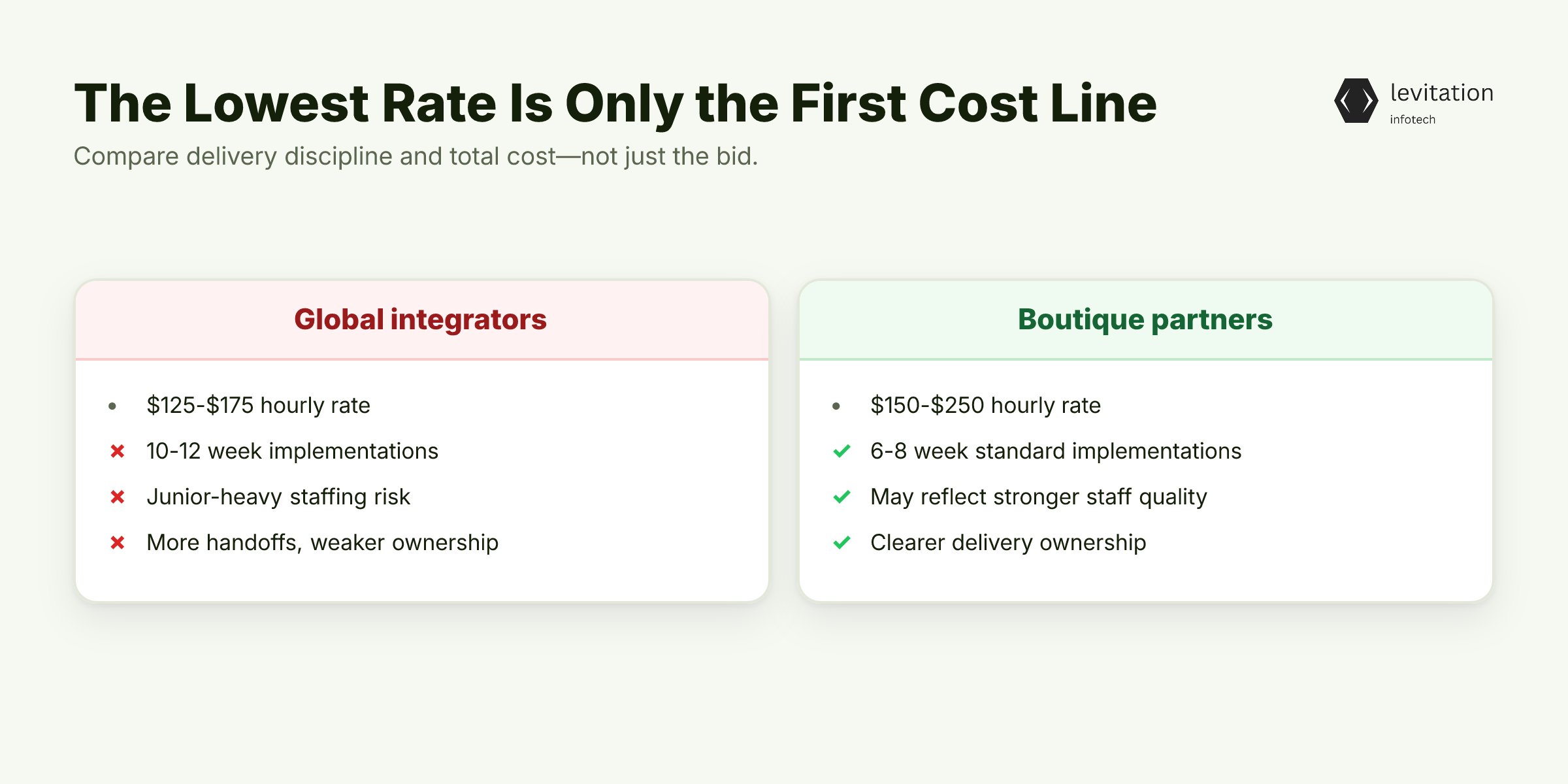
A Salesforce quote with the lowest hourly rate can become the costliest rollout. A rate of $125 to $175 per hour can hide junior-heavy staffing, extra handoffs, and a longer launch.
In the partner-type benchmark, lower-rate global systems integrator teams took 10 to 12 weeks. Boutique teams completed standard implementations in 6 to 8 weeks.
That schedule gap turns a purchasing decision into an operating decision. More weeks on the calendar mean more management attention and a later start to CRM benefits.
Separate the quote from the total cost
The hourly rate and proposal total cover only part of the rollout. They rarely capture every consequence of a delayed or poorly executed implementation.
Your comparison should include: - Discovery and process mapping - Configuration, data migration, and integrations - Testing, training, and change management - Rework, internal delays, and change requests - Post-go-live administration and support
Broader scope assumptions belong in your Delhi-NCR CRM implementation costs model. If standard Salesforce features cannot cover the required process, compare custom CRM development as a separate option.
Heavy customization deserves its own cost and risk. Which hidden costs could return as internal work?
Frame the Delhi-NCR decision
Global systems integrators often quote rates of $125 to $175 per hour. Boutique partners often charge $150 to $250.
The higher rate can reflect staff quality, schedule confidence, and clearer delivery ownership. The lower rate can conceal junior-heavy staffing, more handoffs, and weaker ownership.
Treat the cheapest bid as an assumption. Test it against the same business scope, acceptance criteria, and delivery schedule used for every proposal.
Use one worksheet across the bids: - Vendor fees and internal team hours - Delay-related business costs - Rework and change requests - Ongoing administration and support - Future configuration and integration work
The core argument is simple. A lower selling price can create a costlier rollout when staffing and delivery discipline are weaker. If the quote is only the visible number, where does the hidden cost come from?
Why Junior Staffing Turns a Lower Rate into More Calendar Time
The hidden cost begins with the people assigned to the work. Hourly rates describe what the vendor charges, not how quickly your business receives a usable CRM.
Junior-heavy teams need more oversight. Split specialist teams create handoffs between discovery, configuration, development, data, and testing. Inflexible methods then make feedback harder to absorb.
Imagine a data-migration decision during configuration. A senior architect can resolve an ambiguous field rule while preserving its business meaning. A less experienced specialist often waits for another team, creating rework for both the buyer and vendor.
The same principle applies to CRM software development. Development speed depends on how quickly decisions are made and validated, not just how many hours are logged.
The staffing multiplier appears in operations
Lower-rate staffing often shows up as: - Additional billable hours for review and rework - More management attention spent chasing decisions - Repeated data and integration corrections - Delayed user training and adoption - A longer wait before the business receives value
Delivery time also affects working capital. Without a reliable CRM, teams often keep spreadsheets or parallel processes while the implementation stabilizes. How much does that overlap add to the true cost?
Make staffing part of the bid
Don't accept a generic global delivery capability deck. Ask who will perform the work locally and how that team will fit your project.
Before comparing totals, request: - The proposed org chart and role ownership - The named delivery lead - The seniority of each execution role - The escalation path and response ownership - Coverage for architecture, administration, development, data, and integration
A named lead matters. So does a team that can make decisions without waiting for another time zone. The timeline gap exposes a deeper issue: what exactly is the bidder buying with your money?
Price the Delivery System, Not Just the CRM
The answer is not another software license. You're buying a delivery system that turns your process into day-to-day operations.
That system includes people, methods, assumptions, and support. Price those elements together.
Build a total-cost model
Combine the following costs into one decision view: - Implementation fees - Internal effort and management attention - Delay and rework exposure - Future configuration changes - Integration maintenance - Training refreshes and ongoing support
This prevents the proposal from looking cheap simply because work has moved outside the original estimate.
The cost to build a CRM also needs a lifecycle view. A lower initial build can still be expensive if ownership, maintenance, and changes remain unclear. Which costs will keep growing after launch?
Separate configuration from construction
Use Salesforce configuration when standard objects and workflows support the process with manageable customization.
Consider a custom CRM when unique workflows, integrations, or control requirements outweigh the build and maintenance burden. That means comparing custom CRM development with configuration, integration, administration, training, and future change costs.
The decision isn't "Salesforce versus custom." It is "managed platform capability versus code your team must own."
A custom system starts with development work. It continues with upgrades, security changes, documentation, and every future process adjustment. How does the delivery method change that choice?
Examine AI as a delivery system
Generic LLM demos don't prove faster implementation. Ask whether the bidder uses purpose-built AI agent harnesses instead.
An agent harness is a controlled delivery layer. It gives AI defined tasks, permissions, review points, and records.
Claims that these harnesses speed implementation, improve quality, and reduce support demand need evidence.
Require each bidder to state the assumptions behind its estimate. Show how staffing, scope, rework, and support assumptions change the total-cost range.
A transparent cost model still fails if the proposal hides the team and method behind it.
Audit the Team and Method Behind the Bid
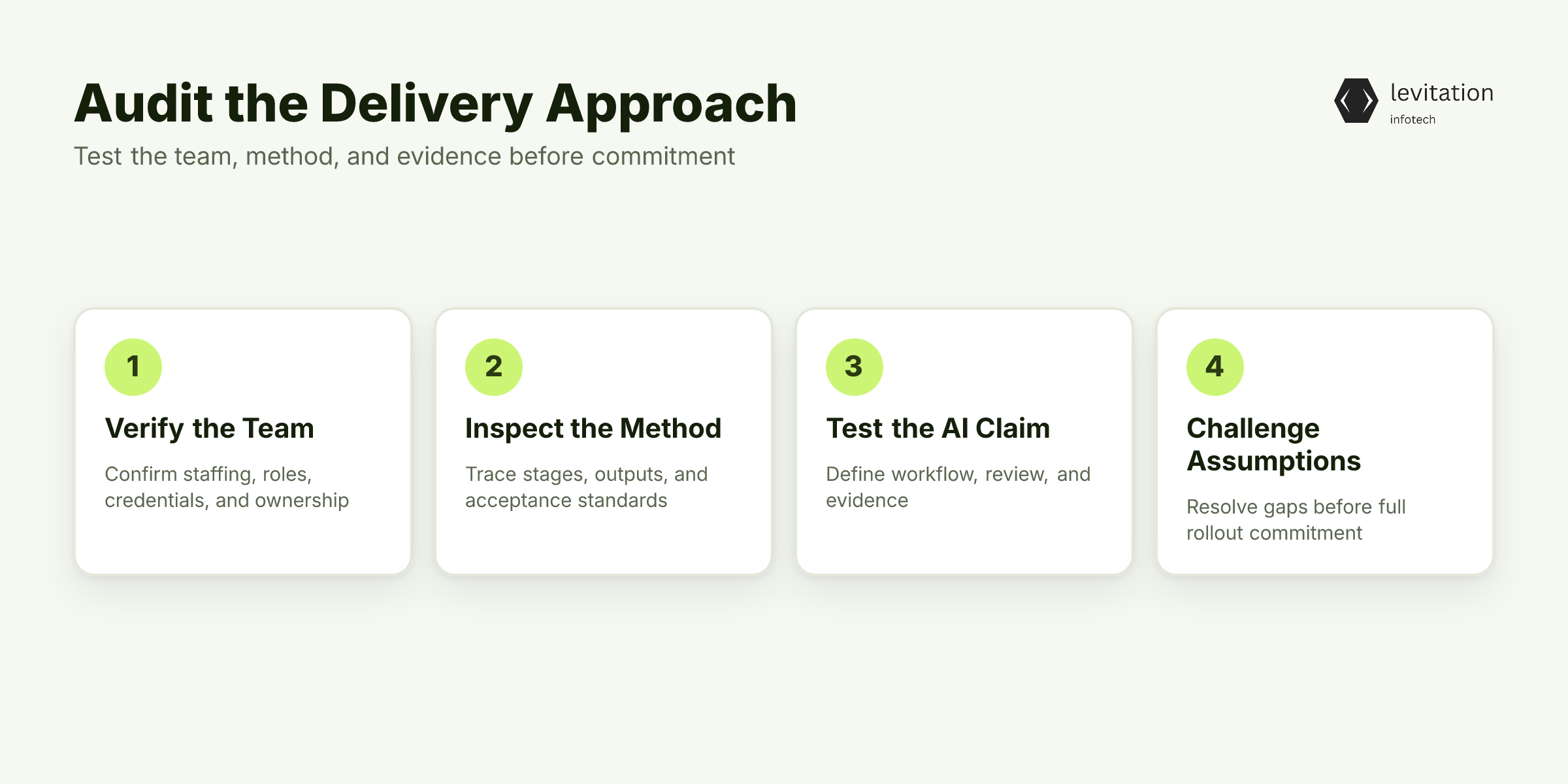
A proposal describes an intended future, while the org chart reveals who must produce it.
Verify the team
Request the named delivery lead, proposed staffing, role coverage, relevant certifications, and escalation ownership.
You should know who owns: - Business discovery and process mapping - Salesforce architecture and administration - Configuration and custom development - Data migration and data quality - Integration design and testing - User enablement and post-launch support
Credentials matter, but role ownership matters more. A senior consultant in the pitch does not prove that a senior architect will guide execution. Who will make decisions during delivery?
Inspect the method
Look for a traceable path through discovery, process mapping, configuration, migration, integration, testing, enablement, and support.
Each stage should have an owner, an output, and an acceptance standard. A vague method often means that coordination work will happen later, without a clear budget. Where does the method leave ownership when work crosses teams?
Test the AI claim
Identify the exact workflow the agent harness accelerates. Ask where human review remains required, how quality is checked, and what evidence supports better delivery.
This matters for Salesforce development and CRM integration, where weak output becomes rework across several teams.
The strongest proposal still contains assumptions, so test them before committing to the full rollout.
Turn the Proposal into a Scored Delivery Test
A polished proposal can hide weak execution. A common test exposes it.
Normalize the bids
Require each proposal to include an itemized schedule covering: - Roles, hours, and rates - Milestones and accountable owners - Deliverables and acceptance criteria - Assumptions and exclusions - Integration and data responsibilities - Training, documentation, and support
A lower-priced bid often states fewer assumptions. That signals more uncertainty, not more savings. Can both bids support the same comparison?
Test one real workflow
Run a time-boxed pilot using sample data and a real business scenario. Define the expected result before the pilot begins.
Written acceptance criteria should cover: - Data accuracy - Workflow behavior - Usability - Handoff readiness
A pilot is not a generic product demonstration. It tests whether the proposed team can deliver your work under real conditions.
Use the results to revise the rollout estimate. Identify missing scope and unresolved assumptions before committing to the remaining work. Will the pilot reveal a weak team before the full contract?
Score evidence, not adjectives
Compare bidders on: - Business fit - Named team and relevant experience - Realistic milestone schedule - Clear lifecycle cost - Configuration versus custom development - AI-assisted delivery with human checkpoints - Post-go-live support model
Agree on scoring weights before reviewing the bids. Otherwise, attractive presentation can outweigh stronger delivery evidence. Which evidence deserves the most weight?
Lock the contract
The contract should cover: - Scope, milestones, and named role ownership - Acceptance criteria and remedy for failed acceptance - Data-migration and integration duties - Change-control pricing - Training, support, documentation, and handover
Your CRM development cost in India comparison only becomes meaningful when every proposal includes the same obligations. A controlled test reduces launch risk; the final payoff comes from what happens after go-live.
Judge the Partner on the Months After Go-Live
Go-live is when the CRM first meets real work. Your buying model must continue from there.
Measure daily use
Track whether sales and service teams use the configured workflows. Also watch data accuracy, manual exceptions, and support requests.
Useful signals include: - Workflow use across actual teams - Data errors and correction requests - Manual workarounds that persist - Support demand by issue type - New configuration requests after launch
Ongoing administration, change capacity, incident support, and future enhancements belong in the total-cost comparison.
The AI value is also visible in daily use. Show whether the agent harness improves implementation quality and reduces support demand, rather than merely speeding up a demo. Do the early support numbers justify the promised savings?
Make the final decision on delivery evidence
Choose the partner that combines: - A realistic schedule - A named execution team - A controlled workflow test - Clear lifecycle cost - Accountable post-go-live support
This approach favors accountable delivery over the lowest invoice. Disciplined implementation can reduce schedule risk and avoid expensive rework. The result should support daily operations, not merely match the winning quote.
The proposal can look perfect on paper. Only live operation reveals whether it holds.
Frequently Asked Questions
How much should a Salesforce implementation partner charge in Delhi-NCR?
The partner-type rate comparison places global SI teams at $125 to $175 per hour and boutique teams at $150 to $250. Project totals also depend on scope, seniority, schedule, integrations, and support. Compare itemized proposals rather than treating the hourly rate as the complete price; see CRM development cost in India.
How long does a standard Salesforce implementation take?
In the partner-type comparison, standard implementations took 6 to 8 weeks with boutique teams. Lower-rate global SI teams needed 10 to 12 weeks.
Scope and staffing can move either estimate. Require a milestone schedule tied to named resources.
Should we configure Salesforce or build a custom CRM?
Configure Salesforce when standard objects and workflows cover the process with manageable customization. Consider a custom CRM when unique workflows, integrations, or ownership requirements justify build and maintenance. Compare the cost to build a CRM with configuration, retraining, support, and change costs over the intended lifecycle.
How do I compare Salesforce implementation partners in Delhi-NCR?
Compare named staffing, relevant specialty, delivery method, schedule, total cost, AI-assisted delivery with human checkpoints, and post-go-live support. Require a real-workflow test with written acceptance criteria rather than selecting on the rate card alone.
What should a Salesforce implementation contract include?
The contract should define scope, deliverables, named roles, milestones, acceptance criteria, migration and integration ownership, change control, training, support, and handover. It should also specify how estimate changes discovered during the pilot will be handled.
Ask each bidder to put these terms in writing before signing.
About the author
Mayank Singh is a software developer at Levitation Infotech, where he builds web and AI-powered applications across the company’s fintech, healthcare, and enterprise projects.