


TL;DR: Most GenAI projects for Indian SMEs take 9 to 12 months to ship, and nearly 30% get scrapped before going live. The teams that ship in 90 days don't move faster. They sequence friction differently, locking model and architecture decisions in week 2. They front-load evaluation harnesses before any code is written.
Key Takeaways: - The 12-month timeline is not a technology problem; it is a sequencing problem hiding behind three stall points most teams refuse to name. - Plug-and-play GenAI platforms hide integration debt that surfaces late in the project, not in the first weeks. - Teams that ship in 90 days share a pattern: model selection with cost ceiling by week 1, RAG architecture decision by week 2, and a hard demo gate by week 4.
The 12-Month GenAI Project (And Why Yours Will Too)
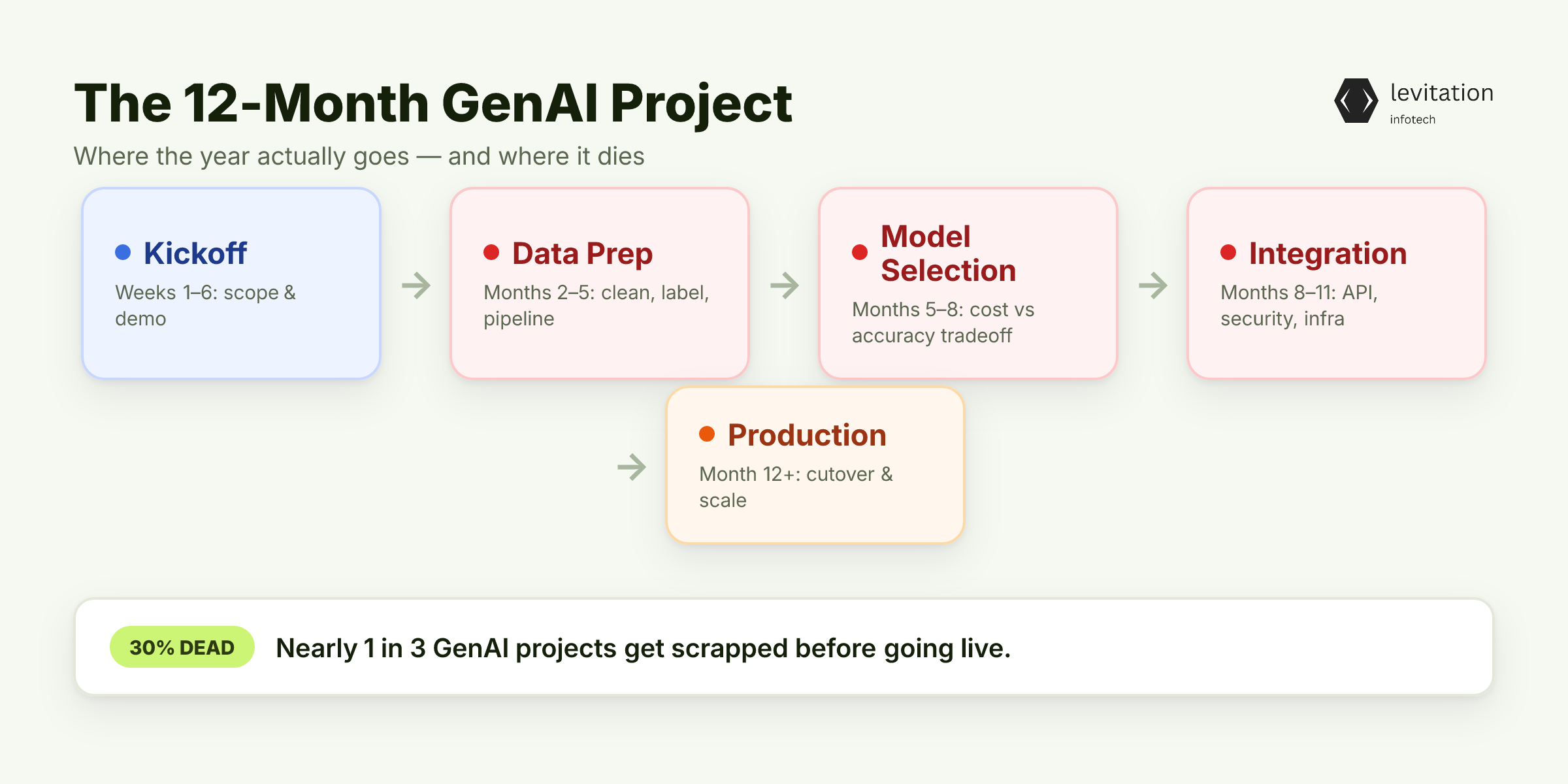
Your last GenAI pilot? The 12-month one? There's a 30% chance it never ships at all. And the teams that do ship in weeks aren't working harder. They're working with a different operating manual entirely.
Most GenAI projects for Indian SMEs stretch across 9 to 12 months from kickoff to production. That is the consistent pattern across generative AI development timelines reported by practitioners serving the mid-market. Within that pattern sits a darker number: nearly one in three projects gets scrapped before going live.
The reflex is to blame data. "We need better data" is the most common first sentence in any GenAI kickoff. It is also incomplete. Data readiness is one stall point, but two more sit alongside it: model selection and integration architecture.
Miss any one of the three, and the project bleeds quarters. Response accuracy concerns have risen five-fold over the past year, mostly because teams picked the wrong LLM for their cost and quality tradeoffs.
They optimized on price and got hallucinations, or optimized on quality and burned budget before the project reached production. The 5x jump in accuracy complaints is not a model problem. It is a selection problem wearing a model costume.
If your project is stalled late, between a vendor demo and a production cutover, you are inside the average. The pattern shows up across top generative AI companies in India and the consultancies serving them. So where does the year actually go, and why do some projects crash before they even reach a user?
Why the Obvious Fixes Make It Worse
The first instinct early in a stalled project is to throw more data at the problem. Clean it, structure it, dump it into a vector store. This is the most expensive reflex an SME can have. Unstructured data inflates retrieval costs without lifting accuracy.
Noise scales faster than signal in any RAG pipeline. You are paying more per query to retrieve worse answers, and the gap widens with every data source you bolt on.
Most SMEs do not lack data. They lack structured visibility across three layers: their actual data, their model's behavior, and where the system connects to other systems. Without that visibility, every fix is a guess.
Plug-and-play enterprise AI solutions that promise "deploy in 30 days" usually hide integration debt that surfaces late in the project. The demo is real. The cost of wiring the demo into your SSO, your audit logs, your data residency requirements, and your customer's actual workflow is not.
By the time you find out, the budget is spent and the team is tired. Teams that try to eliminate friction early, skipping evaluation harnesses, skipping stakeholder demos, skipping the RAG-versus-fine-tuning decision, are the ones that restart late in the timeline.
They removed the work that was supposed to save them. The teams that break the 12-month cycle do not avoid the hard parts. They sequence them on purpose.
That is the gap between enterprise AI implementation that ships and enterprise AI implementation that stalls in demo purgatory. So what does the 3 in 10 that ship in 90 days actually do differently?
The Friction Principle: What 3 in 10 Teams Get Right
The 30% that ship fast do not have better engineers or better data. They have a different operating sequence. Friction-first teams front-load the decisions that usually kill projects late in the timeline: model selection, architecture, and demo discipline.
The work is heavier early and lighter later. AI-assisted coding tools like Cursor, Copilot, and Claude Code cut boilerplate GenAI development time dramatically, but only when paired with a strong evaluation harness. Without the harness, the tools amplify bugs at speed.
The evaluation gap between test prompts and production traffic is exactly where friction-first teams refuse to fly blind. They build the harness in week 2, before the first prompt is written.
Authorization-as-a-service, whether Auth0, Clerk, or a custom OIDC layer, eliminates the auth wiring that derails most SME pilots. The work is unglamorous. The compounding effect is enormous.
Once auth is solved, every downstream feature moves twice as fast. These teams embrace three deliberate friction points, and they do it on a clock: - Model selection with a hard cost-per-query ceiling by the end of week 1 - RAG architecture decision, not "we will add it later," by week 2 - A working demo in front of a real stakeholder by week 4, ugly or not
The pattern is consistent across AI development services delivered by teams who treat early friction as a feature, not a delay.
The data backs it up: AI-assisted coding paired with authorization-as-a-service and a friction-first genai company sequence compresses delivery by 40 to 60%. Here is what that sequence looks like in practice, written out as a concrete 90-day architecture you can follow.
The 90-Day Architecture That Beats the 12-Month Death March
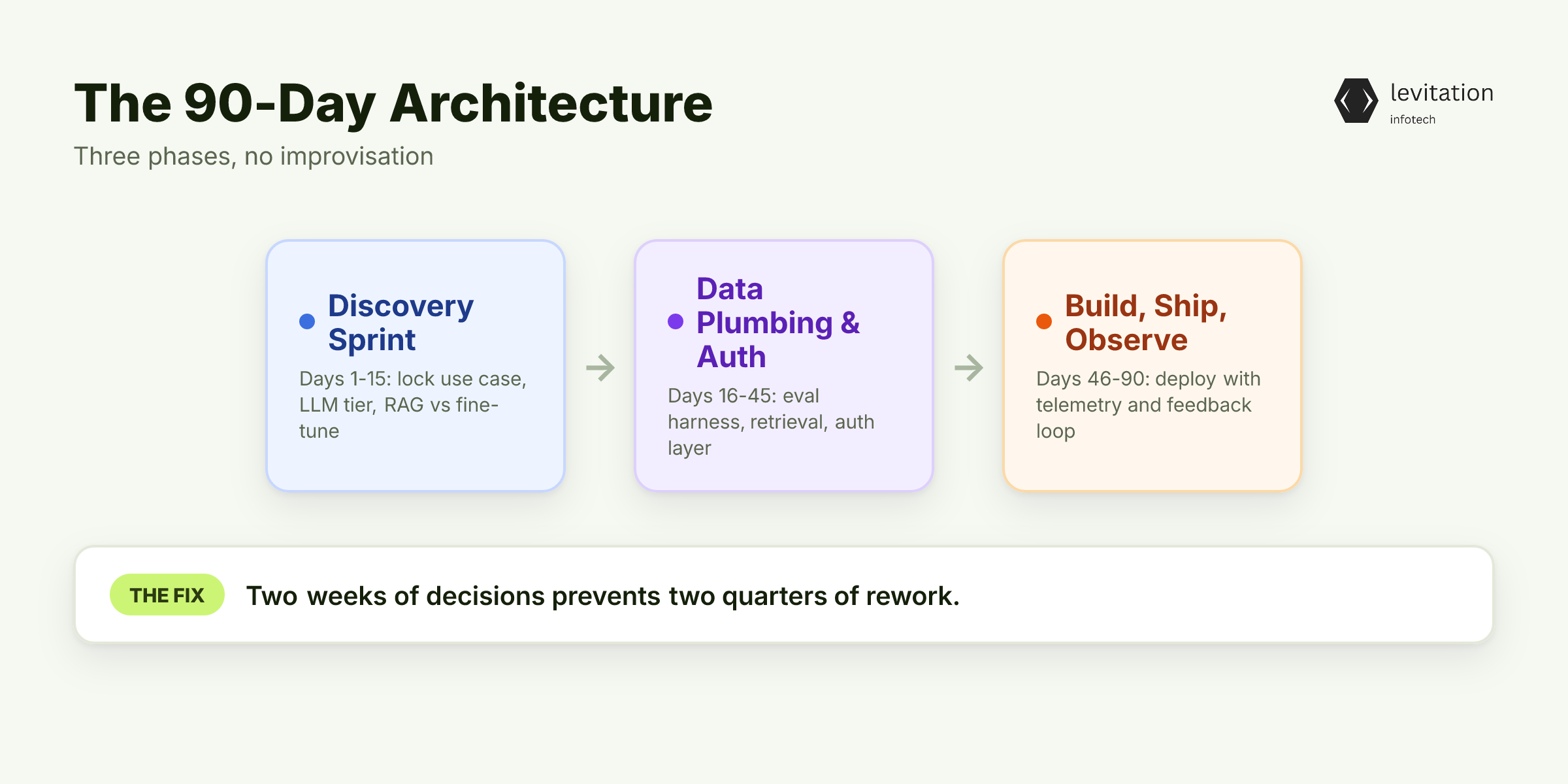
The architecture has three phases. No code in phase one. No architectural improvisation in phase three unless you skipped phase two.
Phase 1 (Days 1 to 15): Discovery Sprint. Pin one use case with measurable ROI. Lock the LLM tier, not just the model name, but the cost-per-query ceiling. Decide RAG versus fine-tuning.
This is the moment where the wrong architectural call made early becomes the rewrite that kills the project late. Spending two weeks on decisions that prevent two quarters of rework is the best ROI a GenAI project can produce.
Phase 2 (Days 16 to 45): Data Plumbing and Auth. Wire authorization-as-a-service, build the evaluation harness, and stand up the retrieval pipeline. Custom AI development pays off here because the architecture is already fixed. You are not exploring, you are executing.
AI-assisted coding shines in this phase, not the first one. Without the harness, your LLM gateway logs everything and inference logs nothing. That gap is exactly what the production phase exposes.
Phase 3 (Days 46 to 90): Build, Ship, Observe. Production deploy with usage telemetry and a feedback loop. Hallucination rate, latency, and cost-per-query are tracked from day one, not bolted on after launch.
This is what separates a production AI system from a demo that impresses a room and dies in the wild. The same approach applies to AI app development for any use case where the system has to survive past the launch press release.
What does the business actually look like once you ship in a quarter instead of a year?
What Changes When You Ship in Weeks Instead of Quarters
Cost drops in the same 40 to 60% range as the delivery speedup, and not because engineering is cheaper. Rework, scope creep, and abandoned pilots are the line items that inflate AI quotes for Indian SMEs when sequencing is missing. Remove them, and the same use case ships for a fraction of the budget.
ROI is measured in months, not fiscal years. The second use case ships faster than the first, because the foundation is reusable. The evaluation harness, the cost-per-query dashboard, and the feedback loop do not get rebuilt; they get applied.
Without the observability layer in place from day one, fintech AI cost forecasts break early in production. That is the bill teams pay when they ignore the pattern.
Competitive positioning shifts. You stop being the SME running a 12-month GenAI experiment, and start being the one already in production. Customers notice. Boards notice. Procurement teams notice.
The operating model changes too. Evaluation harness, cost-per-query dashboard, and feedback loop become standard, not afterthoughts. That is what separates a one-off enterprise AI solutions project from a platform the business can keep building on.
For teams looking to extend this pattern across multiple use cases, AI solution development is the next natural step. This is what production-grade AI work looks like when sequencing replaces heroics. The difference is not the team. It is the manual they hand to the team.
Frequently Asked Questions
How much does generative AI development cost for Indian SMEs?
For a focused, single-use-case deployment following the 90-day architecture, most Indian SMEs see costs driven by data complexity, LLM tier, and integration depth. Projects that skip structured visibility see costs balloon. So do projects that try to tackle multiple use cases at once, often due to rework in the final third.
What are the most common genai use cases for Indian SMEs?
The dominant patterns are customer support automation using RAG over knowledge bases, internal copilots for sales or support teams, and document processing for compliance-heavy workflows. Most successful deployments start with operational efficiency or customer-facing applications, then expand into innovation-driven use cases once the foundation is in place.
How long does a typical GenAI project take from kickoff to production?
Industry benchmarks for generative AI development services put timelines at around 12 months for SMEs that face data readiness and infrastructure constraints. Teams that adopt AI-assisted coding, authorization-as-a-service, and a friction-first sequence can compress this to 90 days without sacrificing production quality.
Why do 30% of GenAI projects get scrapped before going live?
Most scrapped projects fail because teams avoid necessary friction early. They skip model selection tradeoffs, defer evaluation harnesses, and pick architectures they cannot maintain. Projects that embrace deliberate friction points early ship. Projects that try to shortcut the hard decisions restart.
How do I pick the right LLM for a SME GenAI project?
Pick on three axes together: cost-per-query ceiling, accuracy on your specific domain (not generic benchmarks), and latency requirements. Response accuracy concerns have risen five-fold largely because teams optimized on one axis, usually cost, and ignored the other two. A short evaluation harness in week 2 prevents a costly mistake.
Your next GenAI project does not have to take a year.
Sources
Research and references cited in this article:
- India's Small Business Revolution is Rewriting Social Impact GenAI
- Top 10 Generative AI Use Cases for Enterprises
- Real-world gen AI use cases from the world's leading ...
- Generative AI for business sustainability: Examining usability, usefulness, and triple bottom line impacts in small and medium enterprises
- Artificial Intelligence Adoption in SMEs: Survey Based on ...
- Generative AI Development Cost in India: 2026 Guide
- How Generative AI is Reshaping Enterprise IT Services in 2026 | nasscom | The Official Community of Indian IT Industry
- AI Development Cost in India: Complete Pricing Guide for 2026
- Real Cost of Generative AI: What SMEs Actually Pay
- How Much Does Generative AI Development Cost in 2026?
- AI Development Costs 2026: Cut Budgets 3x With AI Tools
- Why Most GenAI Projects Fail: Only 1 in 3 Make It to Production - The New Stack
About the author
Mayank Singh is a software developer at Levitation Infotech, where he builds web and AI-powered applications across the company’s fintech, healthcare, and enterprise projects.