


TL;DR: Paying ₹1.8 lakh per year per MERN developer does not buy you shipping speed. It buys the bottom of the talent band. The real cost of MERN development is not salary. It is cycle time. Most Indian founders buy salary, then pay for cycle time in runway they never budgeted for.
Key Takeaways: - The cheapest MERN quote in India almost always buys the bottom of the talent band, not the bottom of the risk curve. - A team of three juniors with no tech lead is a coordination problem disguised as a coding team. - The right metric is features shipped per week, not headcount per month. The contract enforces both.
The Bottom-of-Band Trap: What Bottom-Rate MERN Hiring Actually Produces
Scholarhat data for Ahmedabad shows MERN salaries ranging from ₹1.8 lakh to ₹7.6 lakh per year. That is the spread. The "cheap" MERN developer is almost always a 0-2 year engineer.
A team of three juniors is a coordination problem disguised as a coding team. When three developers at the bottom of the band are paid ₹1.8 lakh each per year, the invoice looks lean. The runway tells a different story.
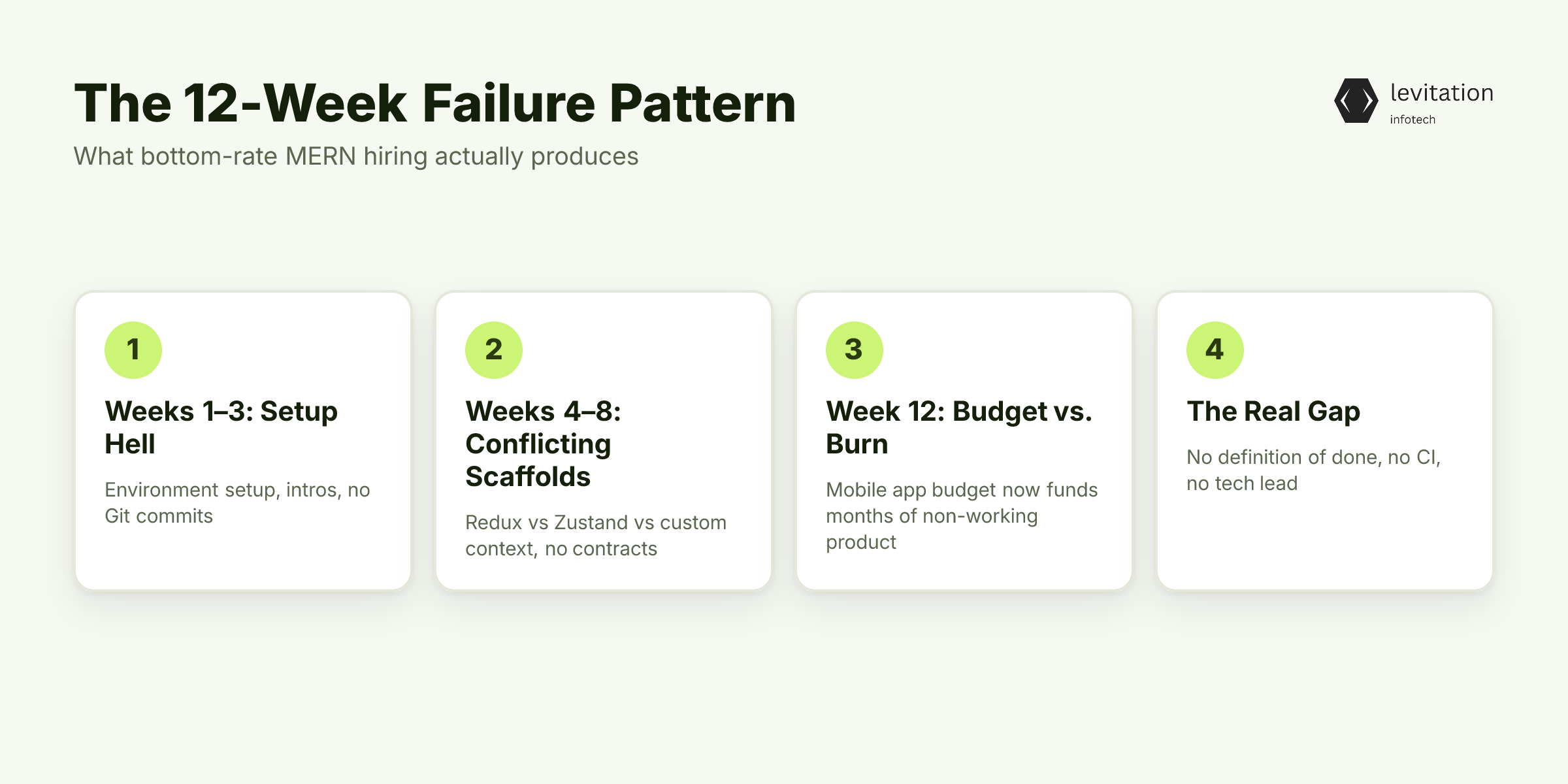
The first three weeks are typically consumed by environment setup, Slack introductions, and "architecture discussions" that produce no Git commits. Velocity was assumed to be a function of headcount. So the team grew, the burn grew, and the product did not.
Weeks four through eight produce partial scaffolds that conflict with each other. Nobody owns the contract between frontend and backend. One developer structures state with Redux. Another picks Zustand. The third builds a custom context. The result is three apps in one repo, none of which talk to each other cleanly.
By week twelve, the founder sees a new problem. The budget reserved for mobile app development cost in India now competes with extra months of burn on a non-working product. The team has skills on paper. What they lack is: - A written definition of "done" tied to deployed code - A working CI pipeline that catches broken contracts early - A single tech lead to kill the bike-shedding and pick the stack
A team that can whiteboard a microservices diagram yet cannot merge a feature end-to-end is a pattern, not an exception. It is the default when developer salary is treated as the entire cost of shipping software. The price tag on the invoice is the smallest line item in your real cost.
So can more money, tighter deadlines, or better tools actually fix this?
Why the Obvious Fix Fails: More Money, Tighter Deadlines, Better Tools
Founders reflexively respond to a stalled team in three ways. Add people. Raise pay. Bring in a project manager with a Gantt chart. All three moves usually make delivery worse.
The instinct to throw resources at a stuck team is one of the most expensive habits in early-stage hiring. It shows up in the same pattern as founders who pay ₹35 lakh for a ₹12 lakh app without understanding what they actually bought.
A 2.5-year MERN developer on the Indian market today commands roughly 7 LPA. A 5-year veteran can cross 18 LPA. The ₹1.8 lakh per year figure already sits at the entry-level end of the Ahmedabad band. That means the founder is not buying a bargain. They are buying the market floor for a 0-2 year engineer.
Adding a fourth developer to a stuck team increases merge conflicts, not velocity. The bottleneck is never typing speed at this scale. It is: - No weekly demo gate to expose drift early - No automated test to catch a broken contract before a human had to - No API specification the three developers agreed on before they wrote a line of code
A 2.5-YOE developer posting on Reddit asking whether 12 LPA is "too much" while earning 7 LPA is a signal. Experienced MERN talent is being correctly priced.
Founders who anchor on the bottom of the band are buying the bottom of the market. Then they wonder why the bottom of the market ships at the bottom of the curve. If salary and team size are not the lever, then what is?
The answer is uncomfortable. The cost of shipping has less to do with who you hire. It has more to do with what they ship against.
The Hidden Cost No One Quotes: It Is Not Salary, It Is Cycle Time
Compare MERN developer cost in India to the cost of cycle time, and the math inverts. A developer at the bottom of the salary band with a 12-week cycle is far more expensive than a senior developer shipping in 4 weeks. The invoice looks like savings. The runway tells a different story. The founder feels that gap first.
MERN as a stack is permissive. That is a strength for prototyping. It is a weakness for accountability. Every developer can structure the project their own way without a type system forcing a contract. Three developers, three conventions, three weeks of merge hell.
This is the failure mode that shows up in cross-platform projects that look 40% cheaper in Noida. They bleed in year two for the same reason.
Code that does not ship has a real cost: - The runway it burns while customers wait - The customers who churn while waiting - The morale tax on a founder who has to keep explaining the delay - The missed window in a market that does not care about your excuses
The mobile app development cost in India you quote to your board is a number on a slide. The cycle time is the number your runway actually feels. Treat the website or product as a business asset, not a one-time expense. The metric that matters is shipped features per week, not headcount per month.
Founders who treat delivery as a measurement problem, not a hiring problem, start asking different questions. They stop asking "who is the cheapest MERN developer." They start asking "which hiring model compresses my cycle from 12 weeks to four." That framing changes the entire conversation.
It is the same shift that separates a realistic software quote from a runaway one. So what does the right hiring model look like in practice?
The Three Hiring Models That Actually Ship in 90 Days
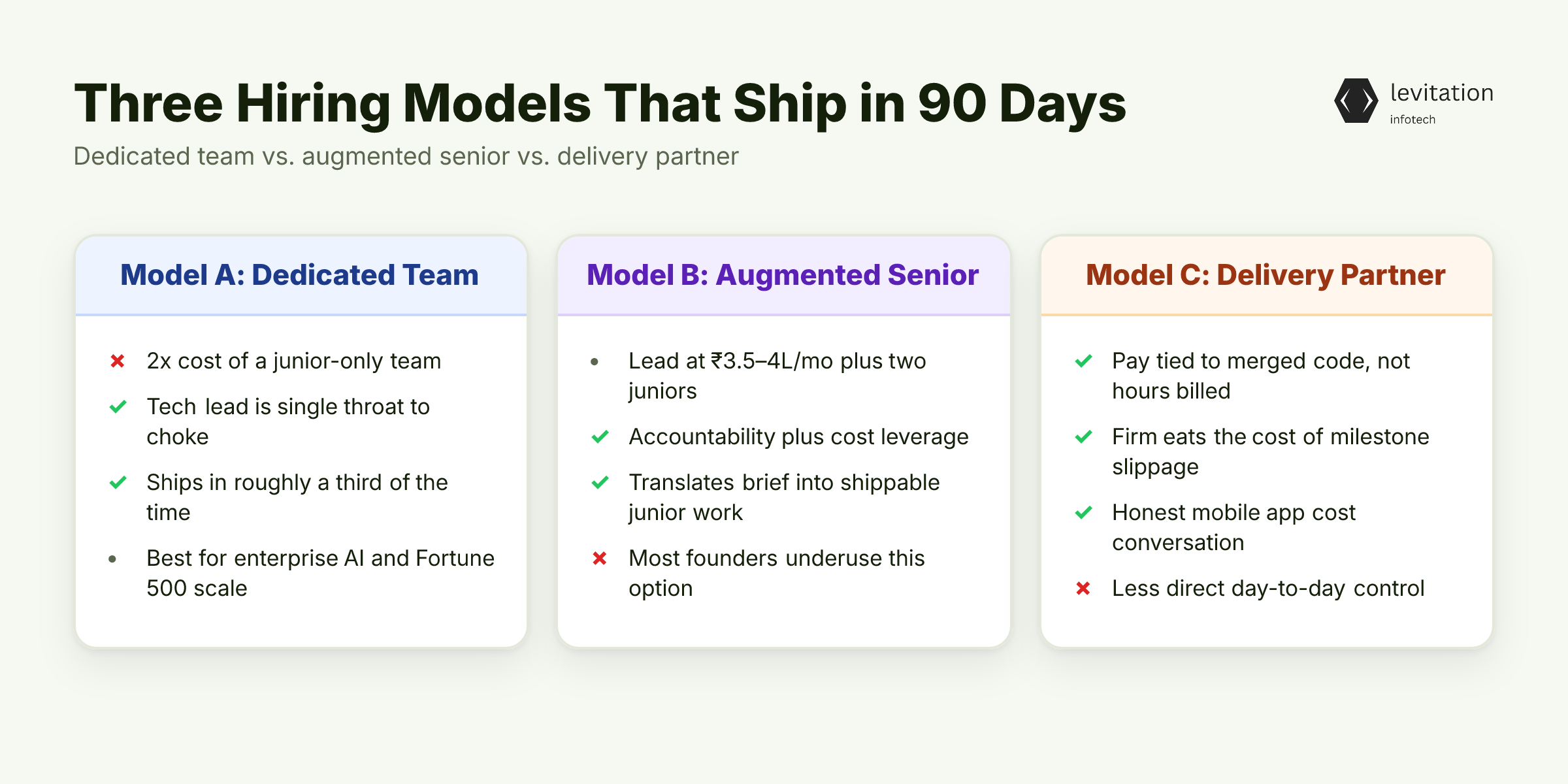
Model A: The Dedicated MERN Team with a Tech Lead. One senior full-stack engineer with 6+ years of experience, plus two mid-level developers. The cost is roughly 2x the budget for a junior-only team. The team ships in a third of the time.
The lead is the single throat to choke on architecture, contracts, and the kill list for bike-shedding. Fortune 500 brands rely on this model for enterprise AI systems in India because accountability scales with seniority.
Model B: The Augmented Senior Model. Hire one battle-scarred MERN lead at ₹3.5 to ₹4 lakh per month. Let them hire and manage two juniors. You get accountability plus cost leverage. Most founders underuse this option because they want to be the manager themselves.
The lead's job is to translate your brief into work the juniors can ship, and to catch broken contracts before they hit main.
Model C: The Delivery-Partner Model. Engage a firm where the contract has milestone-based payment tied to working code merged to main, not hours billed. This is where the mobile app development cost in India conversation finally becomes honest, because pricing is tied to outcomes.
If the milestone is "auth flow deployed to staging with passing tests," the firm eats the cost of slippage, not the founder.
Each model must include three non-negotiables: - A weekly demo on a deployed environment, not a local laptop - A CI pipeline that runs tests on every pull request - A single source of truth for API contracts (OpenAPI or tRPC) so three developers cannot drift in three directions
Interview differently. Stop asking for CRUD trivia. Give candidates a 48-hour take-home with a real bug in an existing repo. Observe how they read code rather than write it from scratch.
The reading skill predicts team outcomes more than the writing skill. The same discipline is what separates a compliant healthcare system from a breach.
Picking the model is half the battle. The other half is what happens in the first 14 days. That window decides whether the team finds its rhythm or drifts toward the empty-repo outcome.
The First 14 Days: A Founder's Playbook to Prevent the Empty-Repo Outcome
Day 1 to 3. Hand the team a written one-pager with three user stories, the data model, and the deployment target. Refuse to start work until the team writes acceptance criteria in their own words. A user story without acceptance criteria is a wish, not a spec.
The same discipline shows up in why most plant managers log line stops in WhatsApp instead of an ERP. No one defined the contract for the ERP either.
Day 4 to 7. Stand up the monorepo, CI pipeline, and a deployed staging environment on day five. The first pull request must be a passing "hello world" through the full stack. A working pipeline is a forcing function for everything that follows. If the team cannot get a build green by day seven, you have a process problem, not a code problem.
Day 8 to 10. Ship the first vertical slice end-to-end, even if it is ugly. The goal is to prove the team can move a feature from idea to deployed URL in one week. That is the only honest predictor of the next 80 days. A team that cannot ship one slice in week two will not ship three slices in week twelve.
Day 11 to 14. Run the first retrospective and ask one question. What would the next pull request look like if it had to ship today? Kill any work that cannot answer that question in 24 hours. The kill list is the most underrated artifact in early-stage delivery, and most founders never write one.
Founders who follow this playbook consistently report that the conversation with their developers changes. It shifts from "are we almost done" to "here is what I want to demo on Friday." That shift is the entire point.
Once the operating rhythm is set, the numbers start to look very different. But what changes once the rhythm is locked in?
What Changes When You Get the MERN Hiring Model Right
The same quarterly spend that produced zero code in a junior-only scenario can produce a working MVP with payments, auth, and an admin panel. This works when routed through a dedicated MERN team in India with milestone-based accountability. The line items on the invoice do not change. The line items on the runway do.
Runway stops being a countdown and starts being an investment. Every two-week sprint produces a demo a founder can put in front of a customer or an investor. The app development cost in India you quote to your board becomes defensible because it is backed by shipped increments, not best-case promises.
Founders recover the thing they hired developers to buy back: time. Time is the only resource that cannot be re-allocated once a quarter is gone. A team that ships weekly also rewires the founder's relationship with engineering, from suspicion to collaboration. That is the real ROI on getting MERN hiring right.
The pattern holds whether you are running a 3-person startup team or coordinating delivery across enterprise AI systems in India. Pay for outcomes, not hours. Pay for cycle time, not headcount. Pay for shipped features, not warm bodies.
If your dedicated India team is serving three clients instead of one, the unit economics are broken before the first sprint starts. The fix is the contract, not the country.
Frequently Asked Questions
How much does it actually cost to hire MERN developers in India?
MERN developer cost in India ranges from ₹1.8 lakh per year for a 0-2 year engineer in a tier-2 city. It goes up to ₹18+ lakh per year for a senior full-stack engineer in Bengaluru. Most production-grade teams need a mix. A realistic monthly budget for a three-person MERN squad sits between ₹4.5 lakh and ₹7 lakh, not the bottom-of-band figure that appears in low-ball estimates.
Why do some MERN teams ship nothing for three months even when paid on time?
A junior-heavy team with no tech lead to enforce contracts. No working definition of "done" tied to deployed code. A missing CI pipeline that hides integration problems until the end. The salary clears the bank. Without a forcing function, the work drifts into architecture debates and environment setup.
Is a dedicated MERN team in India cheaper than hiring in-house?
A dedicated MERN team in India is typically cheaper than a comparable US or EU in-house team. The cost advantage narrows when you add accountability and milestone guarantees to freelance setups. The savings disappear if the team is not delivery-tied. Contract structure matters as much as geography.
What is the average React developer salary in India in 2026?
The React developer salary in India for a 3-5 year engineer sits between ₹8 lakh and ₹14 lakh per year. For a 6+ year senior, it crosses ₹18 lakh. Ahmedabad and Pune track 10-15% below Bengaluru rates. Remote roles are pulling the median up because the talent pool is now nationally priced.
How long does it realistically take to build a MERN MVP in India?
A focused MERN MVP with auth, one core workflow, payments, and a basic admin panel takes 8-12 weeks with a senior-led team of three. A junior-heavy team needs 16-24 weeks. Anything beyond 24 weeks on a defined scope is a process problem, not a complexity problem. The right response is a delivery review, not a budget increase.
A 14-day paid pilot with one milestone tells you more about a team than any salary quote ever will.
Sources
Research and references cited in this article:
- MERN Developer Hiring Cost in India (2025-2026 Rates)
- MERN Stack Developer Salary In India: 2026 Insights
- Cost to Hire MERN Stack Developers: The Latest Guide
- MERN Stack Developer Salary in India 2026
- Is MERN Stack Worth It in 2026? Demand & Pay | SourceKode
- MERN Developers in Trouble? Future Jobs Explained for ...
- MERN Stack Development Services in India | Nitai Technologies
- AI made developers faster. So why are product teams still slow? | YourStory
- Is it true that large corporations do not have much work and ...
- Why Your Development Team Keeps Missing Deadlines & ...
- Cost to Hire MERN Stack Developers in India vs. the USA
- 10 Indian MERN Stack Development you should know about
About the author
Mayank Singh is a software developer at Levitation Infotech, where he builds web and AI-powered applications across the company’s fintech, healthcare, and enterprise projects.