


TL;DR: AI cuts regulatory reporting costs by automating extraction, validation, and narrative generation. These are the tasks that consume most compliance bandwidth. The real return is the team time that gets reallocated from documentation to forward-looking risk analysis.
Key Takeaways: - The bottleneck in modern compliance is not risk analysis. It is the reporting pipeline between analysis and submission. - Four AI mechanisms, including extraction, validation, mapping, and generation, compress reporting cycles. They remove manual matching that does not scale with headcount. - Production deployments using pre-built connectors ship faster than in-house builds. They remove the integration sprawl that kills most projects.
Compliance Teams Are Drowning in Reporting, Not Risk
Governance teams are taking on more AI risk management work than they did two years ago. A growing share of organizations are speeding up governance updates as a result.
Yet most compliance leaders will tell you their teams are still buried under reporting cycles. Not risk analysis.
The irony is sharp. The more regulators demand, the less time compliance has to think about compliance.
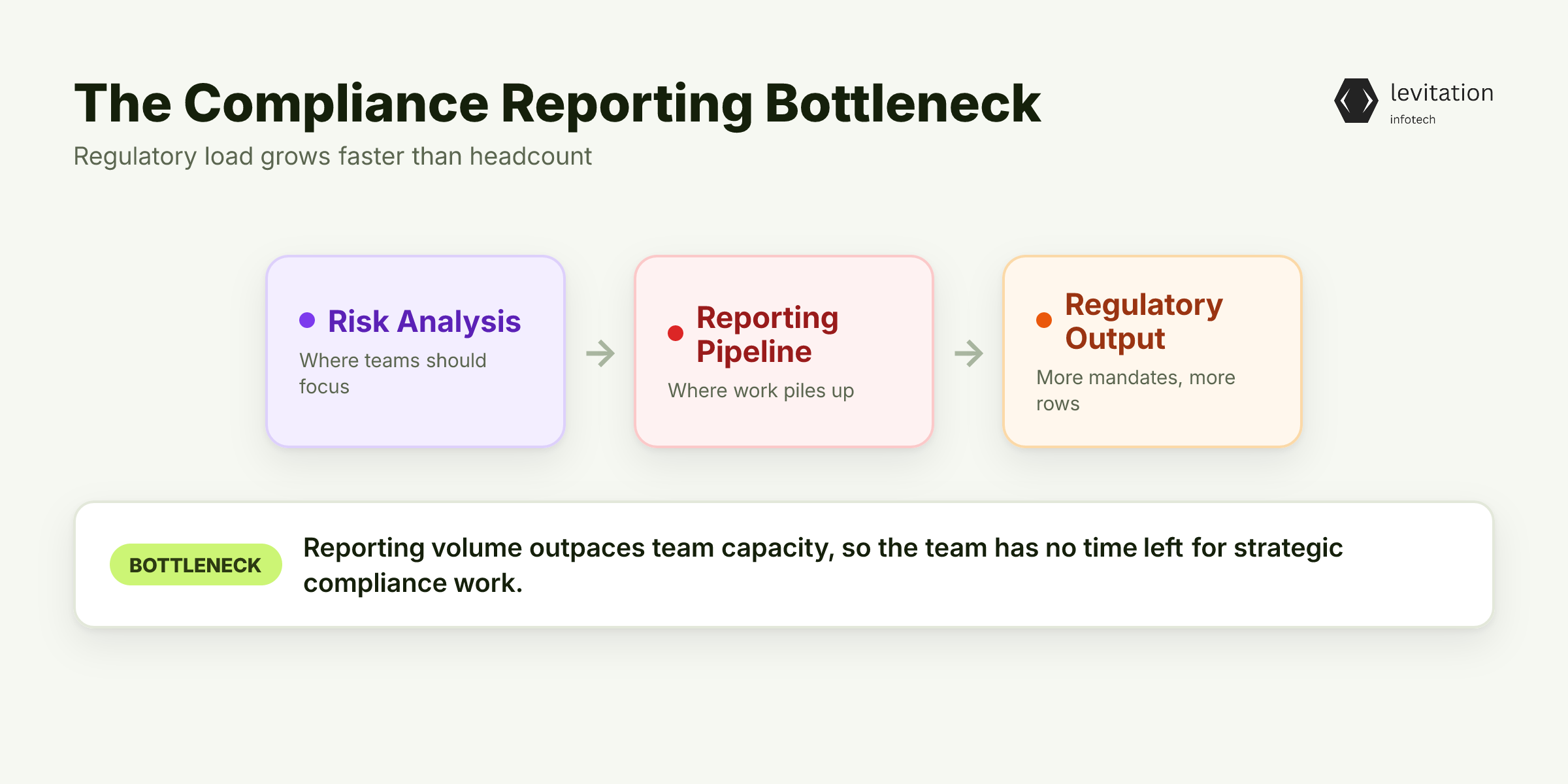
This is the structural paradox at the heart of modern AI compliance. Organizations have purchased more GRC tools. They have generated more reports. They have hired more analysts. The volume of reporting work still outpaces the team's capacity. As a result, the team cannot do anything strategic with it. - More dashboards added each year. - More line items in every regulatory return. - More matching steps between systems that do not share a schema.
The driver is simple. Regulatory frequency grows faster than compliance headcount across financial services.
New circulars, amended standards, and reporting rules from many regions land on overlapping cycles. Each new mandate adds reporting rows, not reporting hours.
Headcount grows in a straight line. Regulatory load grows fast. The math stops working.
The bottleneck is not analyzing risk or designing controls. It is the reporting pipeline between the two. That is where the cost curve has gone vertical.
Why Traditional Compliance Reporting Architectures Break at Scale
The typical reporting architecture looks like this. Core banking systems push data to a data lake. A reporting team extracts it. Then it normalizes the data manually in spreadsheets. After that, it matches the data against CRM and trade systems.
Then the team assembles a narrative. Every quarter, the process repeats. Every quarter, it gets harder.
The problem is not the people. It is the architecture.
When SEBI, RBI, and IFRS updates land on overlapping cycles, manual mapping fails by definition. A single new requirement can trigger control rewrites that cascade across the documentation library. Each rewrite requires a sign-off chain. Each sign-off chain adds days. The result is a reporting operation that works fine for one cycle. Then it collapses by the third.
There is a hidden cost most leaders miss. Audit preparation absorbs compliance bandwidth in the weeks before submission. That time is borrowed from risk analysis, control design, and forward planning. The compliance function runs hot on reactive work and cold on strategic work.
Rules engines and RPA are not new. What changed is what AI can do. AI now works with free-form regulatory text, transaction narratives, and evolving control libraries. No rule book needs a manual rewrite every quarter.
For institutions navigating rules from many regions, the cost of split reporting shows up in another place. It shows up in the Basel IV endgame data requirements too. Every new ratio creates a new matching task, and every matching task is a new error class.
What AI Actually Changes in the Reporting Pipeline
The shift is not a single technology. It is four mechanisms working together. Each addresses a stage of the pipeline that traditional automation could not touch. - Extraction. NLP reads source systems, transaction narratives, and regulatory text. It pulls the right data points without manual matching. This is the layer that replaces the spreadsheet-of-spreadsheets. - Validation. Unusual pattern detection compares extracted data against historical baselines. It flags deviations before they reach a report. Errors get caught at loading, not at audit. - Mapping. Embedding models match new regulatory text to existing internal controls. When a circular changes, the system finds affected controls in hours, not weeks. - Generation. LLM-assisted narrative generation produces the human-readable sections of the report. It comes with fixed guardrails and human review on important submissions.
The expected impact: lower compliance costs. Also, faster data collection, fewer documentation errors at audit, and quicker response to regulatory changes.
The deeper shift is structural. Point-in-time audits become continuous compliance monitoring. Regulators, auditors, and compliance teams work from the same live data. They do not work from a snapshot frozen at quarter-end. The audit dynamic changes entirely.
Most importantly, the time reallocation matters. Compliance teams move from documentation to strategic risk analysis. That is the ROI the board actually cares about. A team's value is no longer measured by how many reports it ships. It is measured by how much forward-looking risk it sees.
Regulatory compliance at scale stops being a function of headcount. It starts being a function of architecture.
Knowing the mechanism is one thing. Deploying it inside a regulated bank is another. Model risk management review and audit-trail requirements are where most projects die.
The Deployment Window and the In-House Build Gap
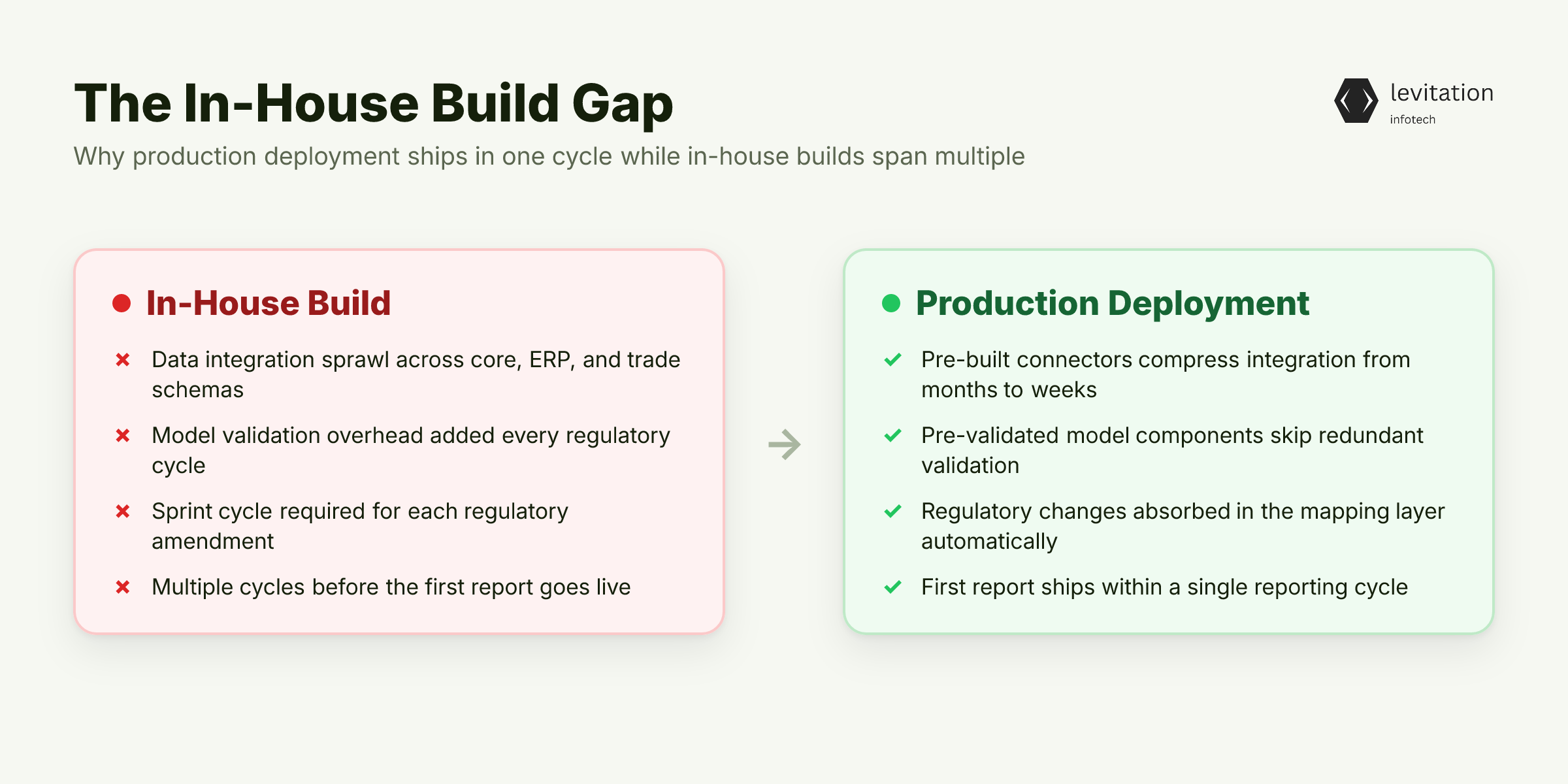
The gap between production AI reporting systems and in-house builds is not talent. It is time-to-first-report.
A production deployment using pre-built connectors and validated model components ships in a single reporting cycle. An in-house build from scratch spans multiple regulatory cycles before the first report goes live. The difference comes from three failure modes that consume the in-house timeline. - Data integration sprawl. Every core banking, ERP, and trade system has its own schema. Pre-built connectors compress the integration phase from months to weeks. In-house teams write the connectors, validate them, and then validate them again under audit review. - Model validation overhead in regulated environments. Model risk management requires clear logic, bias testing, and repeatable results documentation. Without pre-validated components, each cycle adds weeks of validation work. - The maintenance tax when regulations change. Every regulatory amendment triggers a control update. In-house systems require a sprint cycle. Production systems absorb the change in the mapping layer automatically.
When RBI circular frequency speeds up, the system must act fast. It must take in, interpret, and update control mappings without an extended sprint cycle. That requirement alone eliminates most in-house architectures. The compliance automation layer must be continuous, not batch.
Deployment economics favor speed. Breakeven arrives faster when the project ships in one quarter instead of three. The cost of delay is not just engineering hours. It is the continued burn of the manual reporting operation the system is meant to replace.
The numbers tell one story. The architecture, including the data layer, intelligence layer, and reporting layer, tells another. That architecture is what decides whether the system survives its fifth regulatory cycle.
Reference Architecture: A Production-Ready AI Reporting Stack
A production AI reporting system has three layers, each with non-negotiable traits for regulated environments.
The data layer
The data layer loads, normalizes, and tracks data lineage across core systems with full audit traceability. Every figure in the report must trace back to a source document, a transformation rule, and a timestamp.
The data layer is where the audit trail begins. Regulators will start their inspection here.
The intelligence layer
NLP for regulatory text parsing, ML for unusual pattern detection, embedding models for control-to-requirement mapping. This is where the four mechanisms discussed earlier live.
The intelligence layer is versioned, explainable, and rollback-capable. Model drift is monitored continuously. Predictions carry confidence scores that downstream layers can inspect.
The reporting layer
LLM-assisted narrative generation with fixed guardrails and human-in-the-loop review for important submissions. The reporting layer does not invent. It composes from validated data and approved templates.
Every generated sentence is linked to a source. A compliance officer reviews and signs before anything leaves the institution.
Why these traits matter: a system must still produce correct reports. It must do this after the underlying regulation has been amended three times. That is the operational test. Systems still running in production long after deployment share one trait. They were built for change, not for the regulation of the day.
Model versioning, clear logic logs, and rollback capability are non-negotiable. Any system a regulator will inspect needs them. This is also where most MLOps pipelines quietly fail model risk reviews. The engineering is sound, but the audit story is incomplete.
The technical payoff is predictable. The organizational payoff is what changes the conversation with the board. Compliance becomes a strategic function rather than a reporting back-office.
From Cost Center to Strategic Function: The Organizational Shift
The team time that returns to strategic work is not abstract. It shows up as forward-looking risk analysis, control design optimization, and regulatory horizon scanning. The compliance team shifts from documenting what happened to anticipating what will happen.
The board-level reframe matters here. AI compliance reporting is not a cost reduction play. It is a risk posture upgrade that happens to also reduce cost. The institution that ships faster on regulatory change carries less risk than the institution that scrambles.
What to measure changes too. Four numbers the board should watch: - Time-to-submission across the reporting calendar. - Error rate at audit, measured per report, not per quarter. - Regulatory change adoption latency, in hours, not weeks. - Percentage of team time on strategic work, tracked monthly.
Headcount per report stops being the metric. For competitive positioning, the math is straightforward. Institutions that ship faster on regulatory change outpace those that treat it as overhead. The cost variation across fintech AI stacks shows that architecture quality separates the leaders from the laggards. It is not just tool selection that makes the difference.
The institutions running these systems in production tend to share one pattern. They prioritize durability over initial cost. The system has to outlast the regulatory cycle that triggered it. Levitation has built its practice around security-critical AI systems. The compliance-first CTO persona it serves is the same one asking these questions today.
When the reporting layer processes transactions across banking, insurance, and capital markets without missing a control, the question changes. It is no longer whether the cost went down. It is what the team can now see.
Frequently Asked Questions
Q: How long does it take to deploy an AI compliance reporting system?
A: Production deployments in regulated environments ship faster than in-house builds. They use pre-built connectors and validated model components to achieve this. In-house builds from scratch span multiple regulatory cycles. The work compounds over time. Data integration, model validation, and audit-trail preparation all add up. They add up before the first report ships.
Q: Can AI handle changing regulatory requirements automatically?
A: AI parses new regulatory text, maps it to existing controls, and flags gaps within hours rather than weeks. The system still requires human review before any control change is accepted. The faster response time comes from compressing two phases. It compresses the interpretation and mapping phases. The compliance officer stays in the loop.
Q: What's the difference between compliance automation and AI compliance reporting?
A: Traditional compliance automation runs predefined rules against structured data. It is useful but brittle when regulations change. AI compliance reporting adds a layer of interpretation. It reads free-form regulatory text, checks narrative context, and generates human-readable submissions. The AI layer handles the reporting work that does not fit into a rule.
Q: What ROI should a CTO expect from automated regulatory reporting?
A: AI-driven reporting reduces overall compliance costs and cuts data collection time. It also reduces documentation errors at audit. The harder-to-measure but more strategic return is the share of team time. That time gets reallocated from documentation to forward-looking risk analysis.
Q: How do regulators view AI-generated compliance reports?
A: Regulators care about accuracy, clear logic, and repeatable results. They do not focus on whether a human or a model drafted the narrative. The critical requirement is traceability. Every figure links to source data. Every mapping decision is logged. Every model output can be rebuilt for review.
The right architecture makes the difference. It separates a system that ships in one cycle from one that spans three.
About the author
Mayank Singh is a software developer at Levitation Infotech, where he builds web and AI-powered applications across the company’s fintech, healthcare, and enterprise projects.