


TL;DR: India outsourcing still delivers a real 60% day-one labor cost advantage. But 6 of 10 companies erase that saving by month 24 through rework, management drag, attrition, and unmanaged scope creep. The 4 in 10 who keep their savings past year two do it by changing the accounting boundary, not the rate. The fix is contract architecture, instrumented KPIs, and a single accountable decision-maker on the client side.
Key Takeaways: - The 60% headline is structurally intact. The failure rate comes from cost envelope creep, not rate changes. - The dedicated team model is necessary, not sufficient. Without a cost-control layer, flexibility becomes a meter running. - The minority who kept their savings past year two did it through contract structure and governance, not better rates.
The 60% Headline Is Real. So Is the 60% Failure Rate.
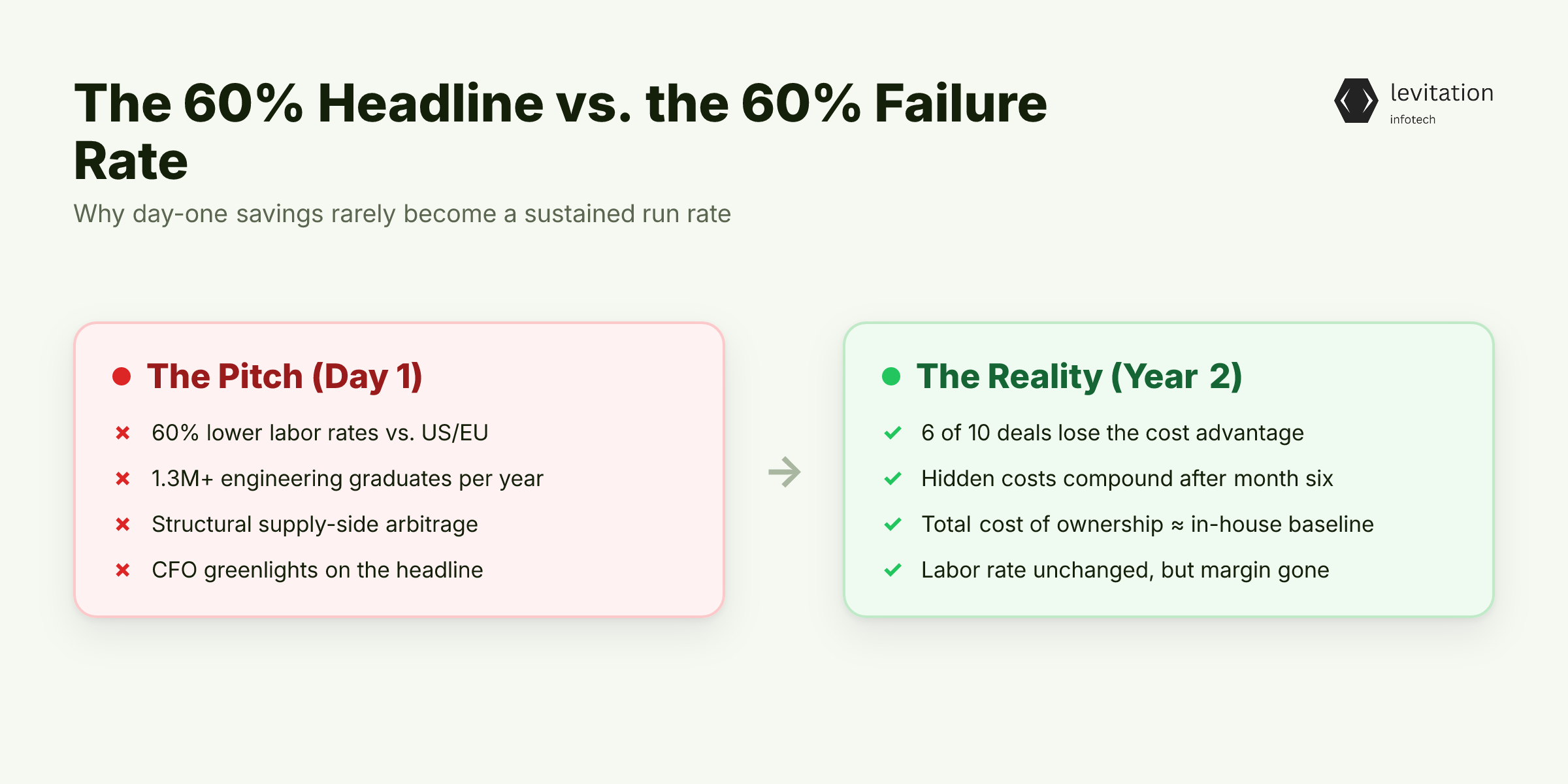
Your CFO greenlit the India outsourcing deal at 60% cost savings. Eighteen months later, finance is asking why total cost of ownership looks almost identical to the in-house baseline. You're not bad at math. You were sold an incomplete equation.
The 60% day-one saving is real. Indian engineering salaries and overhead remain a fraction of US and EU baselines. That gap hasn't closed despite years of wage growth. India still produces over 1.3 million engineering graduates a year.
The supply-side economics that built the arbitrage haven't changed. What has changed is what happens after month six.
Six of every ten companies that struck India outsourcing deals lose the cost advantage by year two. Not because rates went up. Because the cost envelope around those rates grew until the total looked almost identical to keeping the work in-house.
The 60% on the pitch deck is a starting position, not a sustained run rate. Treating day-one rate as a run rate is the most expensive mistake a CEO can make in this space. It turns a real structural advantage into a budget illusion.
The CFO didn't lie to the board. The model just stopped at the wrong boundary. But the labor rate didn't change between month 6 and month 24. So what exactly is eating the margin?
What Actually Erodes the 60% Between Month 6 and Month 24
Four cost streams do the damage. None of them show up on the vendor's rate card.
First, rework and defect repair. On day one, the scope was small and the team had nothing to undo. As scope expands past the initial build, defect rates climb. Rework consumes a growing share of outsourced capacity as programs mature. The defect rate was low at the start because the surface area was low.
Second, management drag. Distributed teams need explicit governance. More sync meetings, clearer specs, tighter acceptance criteria. That overhead usually lands on senior in-house staff. Their fully-loaded cost never enters the vendor invoice. It shows up on your P&L. The 60% saving was measured against the wrong baseline.
Third, vendor-side attrition. Indian IT services firms see ongoing annual turnover. The engineers who leave take product context with them, and rebuilding context costs real hours. The vendor rarely absorbs the bill. It shows up as slower delivery and more questions next quarter.
And here is the trap buyers miss: the "dedicated" team on the contract is not always as dedicated as the label suggests. Vendors split attention across accounts. This pattern shows up in how your "dedicated" India team serves three clients.
Fourth, scope creep. The dedicated team model is sold as flexible, and it is. It flexes upward in hours faster than contracts get renegotiated. A team that "can take on one more thing" becomes a team that took on three more things.
Nobody reset the envelope. Each of these is invisible on a rate card. They appear on the P&L.
Knowing the cost bleed exists is one thing. Understanding why the standard fixes (better RFPs, stricter SLAs) don't close the gap is where the real diagnosis begins.
Why the Dedicated Team Model Is Necessary and Not Sufficient
A dedicated team gives you a captive unit focused on your product. It eliminates the per-ticket overhead of project-based outsourcing. It gives engineers deep context on your codebase.
That structural value is real. It's why the dedicated team model has eaten the rest of the market. It's also where the 6-of-10 failure concentrates.
The model's flexibility, the same quality that makes it useful, is what lets cost drift hide. Teams run, hours log, deliverables ship. But nobody is instrumenting whether each unit of cost is producing a unit of value. Without that instrumentation, flexibility is just a meter running.
Companies that sustain savings past year two (the 4 in 10) don't pick a different vendor model. They add a cost-control layer on top of the same model. That layer is what turns labor arbitrage into engineering equity.
The offshore unit stops being a cost line and starts being a capability line. It ships features your in-house team would have built, at a fraction of fully-loaded cost, with compounding context over time.
Without that layer, the dedicated team is staff augmentation with a different label and a 60% day-one number on the pitch deck. The structure works, but on its own it cannot hold the savings.
So what does the cost-control layer actually look like, and why might the minority who kept their savings have built it while the majority haven't?
custom software development cost in India
The Cost Architecture That Survives 24 Months
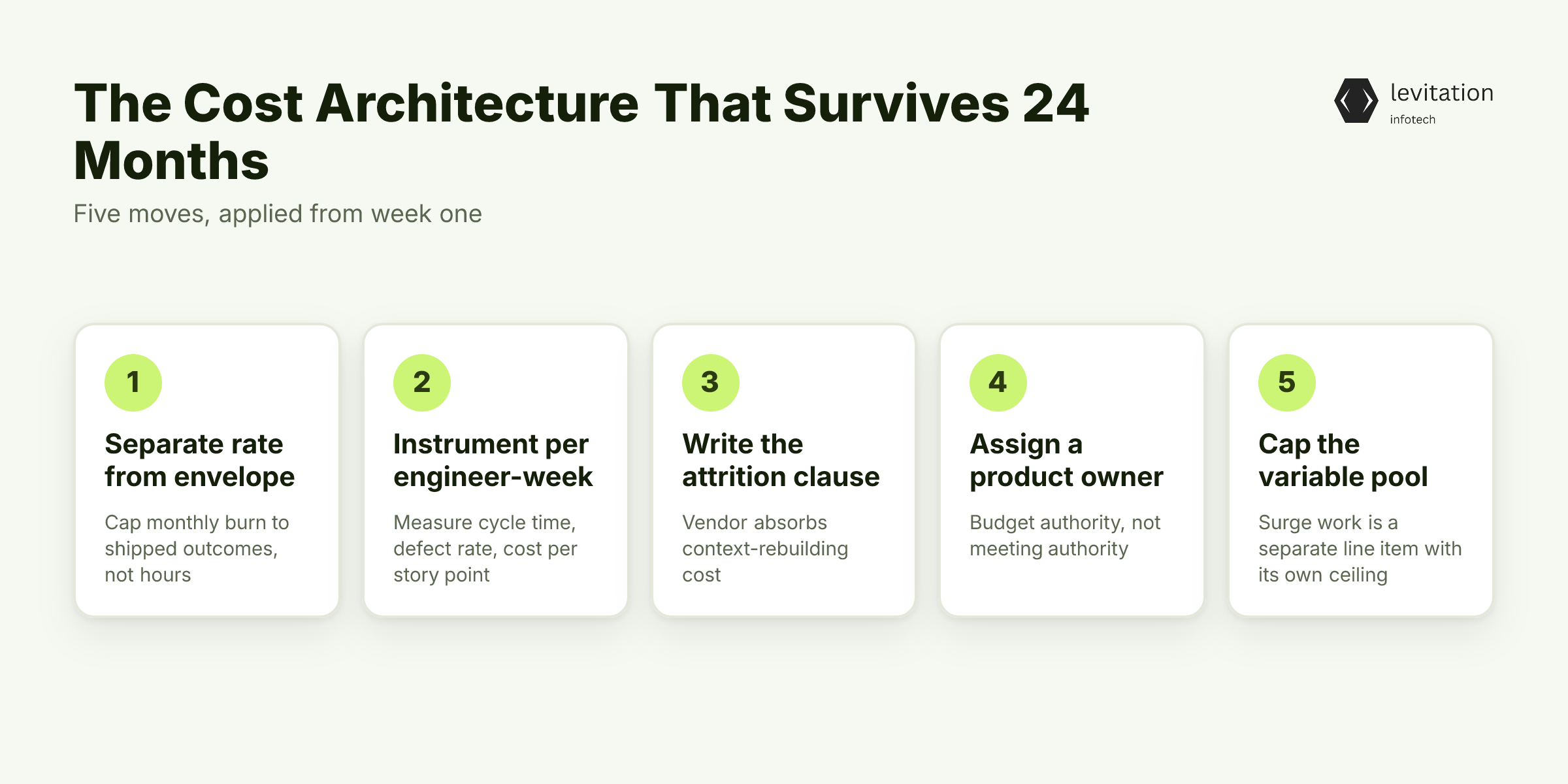
The fix is changing what you measure and what the contract lets you measure. Five moves, applied from week one. - Separate the rate from the envelope. Fix unit economics (hourly or monthly). Cap the envelope with a monthly burn ceiling tied to shipped outcomes, not hours logged. Hours are what the vendor wants to be measured on. Outcomes are what your CFO needs to see. - Instrument productivity per engineer-week against feature delivery, not lines of code or hours billed. The KPIs that catch scope drift before it becomes cost drift: cycle time per feature, defect escape rate, cost per shipped story point. The deeper principle holds here too: the real cost isn't salary, it's cycle time. - Write the attrition clause into the contract. The vendor absorbs the cost of context-rebuilding when a team member rotates. Without that clause, you pay for churn you didn't cause. - Treat the offshore unit as a product capability, not a vendor relationship. Assign a product owner with budget authority, not a project manager with meeting authority. The 4 in 10 who kept their savings built an internal owner who could say no to scope expansion in real time. - Cap the variable pool. Surge work happens. It should be a separate line item with its own ceiling, not an open tab that bleeds into the next month.
The minority who kept their savings past year two didn't get a better rate. They changed the accounting boundary. That boundary change is what made the savings durable.
The programs that hold for five or more years aren't accidents. They are systems built on this architecture from the start.
That's the mechanism. Here's how to actually wire it into the contract, the cadence, and the org chart from week one.
Build the Engagement So It Holds: A 5-Part Operating Model
Architecture without execution is a slide deck. Here is the operating model that takes the cost-control layer from principle to practice.
Contract structure. Dual-tier. A fixed monthly retainer covers the core team. A capped variable pool covers surge work. The cap requires your sign-off to break. Not a Slack thread. Not a "we will true this up later" promise.
A written authorization with budget impact attached. The day you start treating the variable pool as overflow, the envelope is gone.
Cadence. Weekly demo against acceptance criteria, not against hours logged. Monthly burn review against the ceiling. Quarterly scope reset that re-baselines what the next 90 days will deliver.
This rhythm catches the cost bleed at 30 days, not at the 24-month audit when the CFO asks why the savings evaporated.
KPIs that actually predict cost. Four metrics from week one: - Cycle time per feature - Defect escape rate - Attrition rate on your account (not the vendor's overall rate) - Cost per shipped story point
If you aren't tracking all four, you are tracking input volume, not output value.
Governance. One decision-maker on your side with budget authority. Not a committee. Not a steering group that meets monthly and decides nothing. A single accountable product owner who can greenlight scope, sign off on burn exceptions, and stop the bleed in real time.
The first 90 days. This is where the architecture is set. If the contract, KPIs, and governance aren't in place by month three, you've already built the engagement that will fail at month 18. Most companies spend the first 90 days on team formation and defer governance to "once we are stable." That deferral is the single biggest predictor of year-two failure.
Run this architecture for 24 months and the math looks fundamentally different. Here is what that looks like on the other side.
custom software development cost in India
What Changes When the 60% Actually Stays
The headline is that total cost over 36 months reflects a sustained saving rather than collapsing to the in-house baseline. The day-one 60% compresses, but it does not collapse. You got a real saving, and it compounded.
The deeper change is what happens to the team itself. With the cost-control layer in place, the offshore unit becomes a compounding asset. Institutional knowledge, domain familiarity, codebase ownership. These accrue instead of evaporating with each contract renewal. By year two, your offshore engineers know your product better than half your in-house staff.
A side effect most companies don't price in: you stop re-tendering every 18 months. The cost of vendor search, due diligence, transition risk, and onboarding a new partner is real. It sits outside the rate card. Eliminating that churn alone recovers a meaningful slice of program cost.
Engineering velocity improves too, not just cost. The governance model catches defects and drift at cycle time, not at quarterly review. You ship faster because the feedback loop is shorter.
This is the difference between outsourcing as a procurement decision and outsourcing as a capability decision. The 4 in 10 who kept their savings made the second choice. They run engagements that look identical to the failed ones on a rate card and fundamentally different on a P&L.
Frequently Asked Questions
Is outsourcing software development to India still worth it in 2026?
Yes, for companies that treat it as a capability investment rather than a cost-cutting exercise. The 60% day-one rate advantage is structurally intact. Preserving it past year two requires contract architecture, KPI instrumentation, and a single accountable decision-maker on the client side, not a better vendor.
What is the total cost of outsourcing to India over 3 years, not just year one?
For companies that keep their savings, the 3-year total reflects a sustained rate advantage, with the headline gap compressing as envelope costs accumulate. For the 6 in 10 who lose their savings, the 3-year total often matches or exceeds in-house cost once rework, management overhead, and attrition-driven context loss are added back. The year-one rate is a poor predictor of 3-year total cost.
Why do India outsourcing cost savings disappear after the first year?
The labor rate does not change. What changes is the cost envelope around it: rework from expanding scope, management drag from distributed delivery, vendor-side attrition that triggers context rebuilding, and scope creep that the dedicated team model enables but rarely caps. Each is invisible on the rate card and visible on the P&L by month 18.
Does the dedicated team model actually save money?
It saves money relative to project-based outsourcing because it eliminates per-ticket overhead and gives the team deep product context. It does not by itself preserve the 60% labor advantage. That requires a cost-control layer (burn ceiling, productivity KPIs, attrition clause) on top of the dedicated team structure. The model is necessary, not sufficient.
How do you keep India outsourcing costs from ballooning past year one?
Cap the monthly envelope, not just the rate. Track cost per shipped story point and cycle time from week one. Write attrition cost into the vendor contract.
Assign a single product owner with budget authority. Review burn monthly, not quarterly. Companies that do all five are the 4 in 10 who keep their savings.
Want to see how this maps to your specific engagement? Start with a free architecture review.
Sources
Research and references cited in this article:
- Software Development Outsourcing to India
- Software Development Outsourcing Rates 2026: Costs and Trends
- Cost of outsourced software development by country 2026
- Software Development Outsourcing Statistics 2026 | Keyhole Software
- Outsource Software Development to India: Full Guide (2026)
- Outsourcing to India: What Really Works in 2026
- The Complete Guide to Software Outsourcing: Models, Costs, and How Not to Get Burned (2026)
- How to Outsource Software Development Successfully in 2026
- Software Development Outsourcing: Complete Guide for 2026 | Vetted Outsource
- Case Studies: Companies Thriving with Outsourcing
- Top 5 successful outsourcing case studies
- 10 IT Outsourcing Case Studies Every Enterprise Can Learn From
About the author
Mayank Singh is a software developer at Levitation Infotech, where he builds web and AI-powered applications across the company’s fintech, healthcare, and enterprise projects.