


TL;DR: Indian clinics pay anywhere from ₹80,000 to ₹6,00,000 for AI chatbots that do similar work. The gap comes from opaque quotes, hidden integration costs, and bundled "compliance" fees, not from real capability differences. Operations Heads who can decode a vendor's SOW (statement of work) gain negotiating leverage by separating model costs from integration, audit, and support line items. Here's the cost bands, red flags, and exact questions to ask before you sign.
Key Takeaways: - The same chatbot can cost several times more depending on how the vendor scopes integration, audit trails, and bilingual support. - Patient-intake chatbots with Hindi + English cost ₹3-6 lakh to set up, with monthly costs of ₹6,000-18,000 and a 4-6 month payback. - Five quote red flags expose vendors hiding fees: vague SOWs, missing audit logs, no EHR (Electronic Health Record) integration plan, and "custom AI" labels on white-label wrappers. - A properly scoped deployment delivers measurable payback. In-house builds typically stretch much longer for the same outcome due to integration, compliance, and hiring overhead.
The ₹80K-₹6 Lakh Spread: What Your Quote Actually Contains
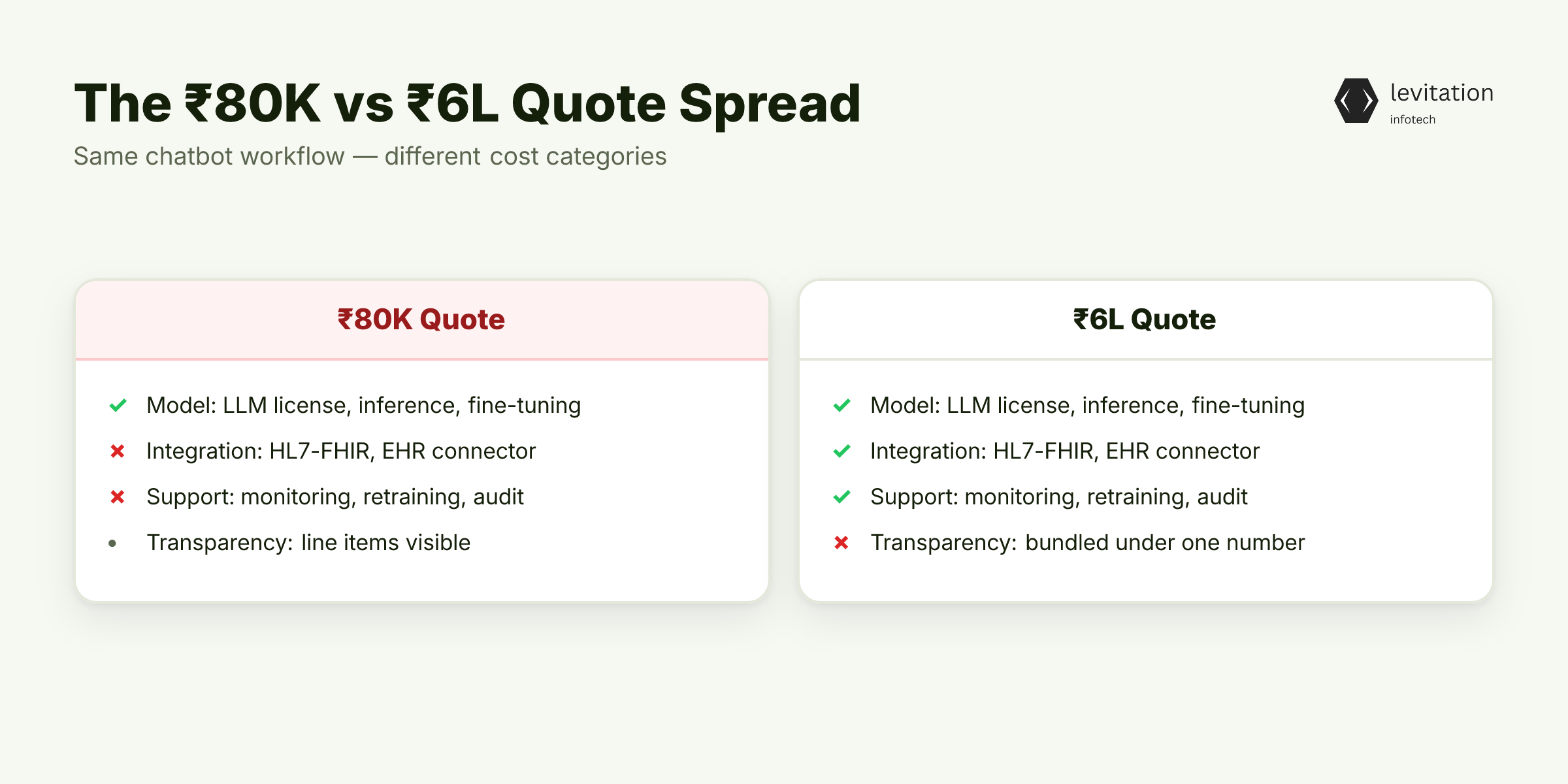
Two clinics receive quotes for the same patient-intake chatbot. One pays ₹3 lakh. The other pays ₹6 lakh.
Neither can explain the difference, because the vendor won't break down the line items.
This isn't a one-off. Indian clinics routinely receive quotes ranging from ₹80,000 to ₹6,00,000 for AI chatbots that look functionally identical on paper. Some clinics pay ₹15,000/month subscriptions. Others pay a one-time fee of ₹6 lakh for the same workflow.
The spread isn't a market anomaly. It's a transparency failure.
Vendors bundle integration, compliance, and training under vague line items. Operations Heads rarely see a cost breakdown that separates model costs from integration costs from support costs.
The quote arrives as a single number with a "scope" paragraph that reads "custom AI development, HL7 integration, and ongoing support." Three cost categories. Zero numbers. - Model costs: the LLM (large language model) license, inference, and fine-tuning. - Integration costs: HL7-FHIR (Health Level 7 - Fast Healthcare Interoperability Resources, the standard protocol for clinical data exchange) adapter build, EHR connector, testing. - Support costs: model monitoring, retraining, audit logging, and incident response.
The ₹80,000 quote usually covers model costs only. The ₹6 lakh quote bundles all three, but doesn't tell you which ₹2.5 lakh goes where.
That opacity is a feature, not a bug. It stops you from shopping line items against another vendor.
In healthcare technology deployments, this bundling is common. The problem is that clinic teams don't have a procurement playbook to challenge it. They see a number, compare it to a competitor's number, and pick the middle option.
That's exactly the trap vendors count on. But here's the part most clinic teams miss: the difference between ₹80K and ₹6L isn't quality. It's what's hidden inside the quote.
Why the Same Chatbot Costs Several Times More From Different Vendors
The opacity isn't accidental. Four structural drivers explain the wide spread, and each one is a lever you can pull during procurement.
EHR vendor lock-in is the silent cost driver. Your HIS (Hospital Information System) vendor charges ₹3-6 lakh for a one-time API (Application Programming Interface) export. The chatbot vendor then passes that cost to you as "integration complexity." Clinics with HL7-FHIR-ready EHRs pay less because the data pipe already exists. Clinics running legacy systems eat the export fee.
Audit trail gaps force hidden work. A proper clinical chatbot must log model version, prompt, output, and reviewer decision on every call. When a clinical quality review asks why the AI proposed a specific code six months later, the log must answer.
Most vendors don't scope this upfront. They add it as a "compliance surcharge" mid-project, which inflates the final bill. The same pattern that sinks many hospital AI buys shows up here: buyers skip the audit-trail question and pay for it later.
Language support is a markup. A Hindi + English bilingual chatbot costs more than an English-only build. Vendors don't flag this until contract review, when you've already invested time in the sales process.
If your patient base is 70% Hindi-speaking, this is non-negotiable. If it's 90% English, you're paying for capacity you won't use.
"Custom AI development" is often a black box. Vendors quote a single line item for the entire build. You can't compare apples to apples because the SOW is intentionally vague.
One vendor's "custom AI" is a fine-tuned model on your clinical data. Another's is a white-label wrapper around an off-the-shelf LLM with a prompt template. Same label, radically different cost and capability.
This maps to our breakdown of AI chatbot development cost in India: the spread comes from scoping gaps, not model selection.
That opacity is by design. So what does a properly scoped chatbot actually cost? The answer depends entirely on the use case.
What 5 Real Indian Clinic Use Cases Actually Cost to Build
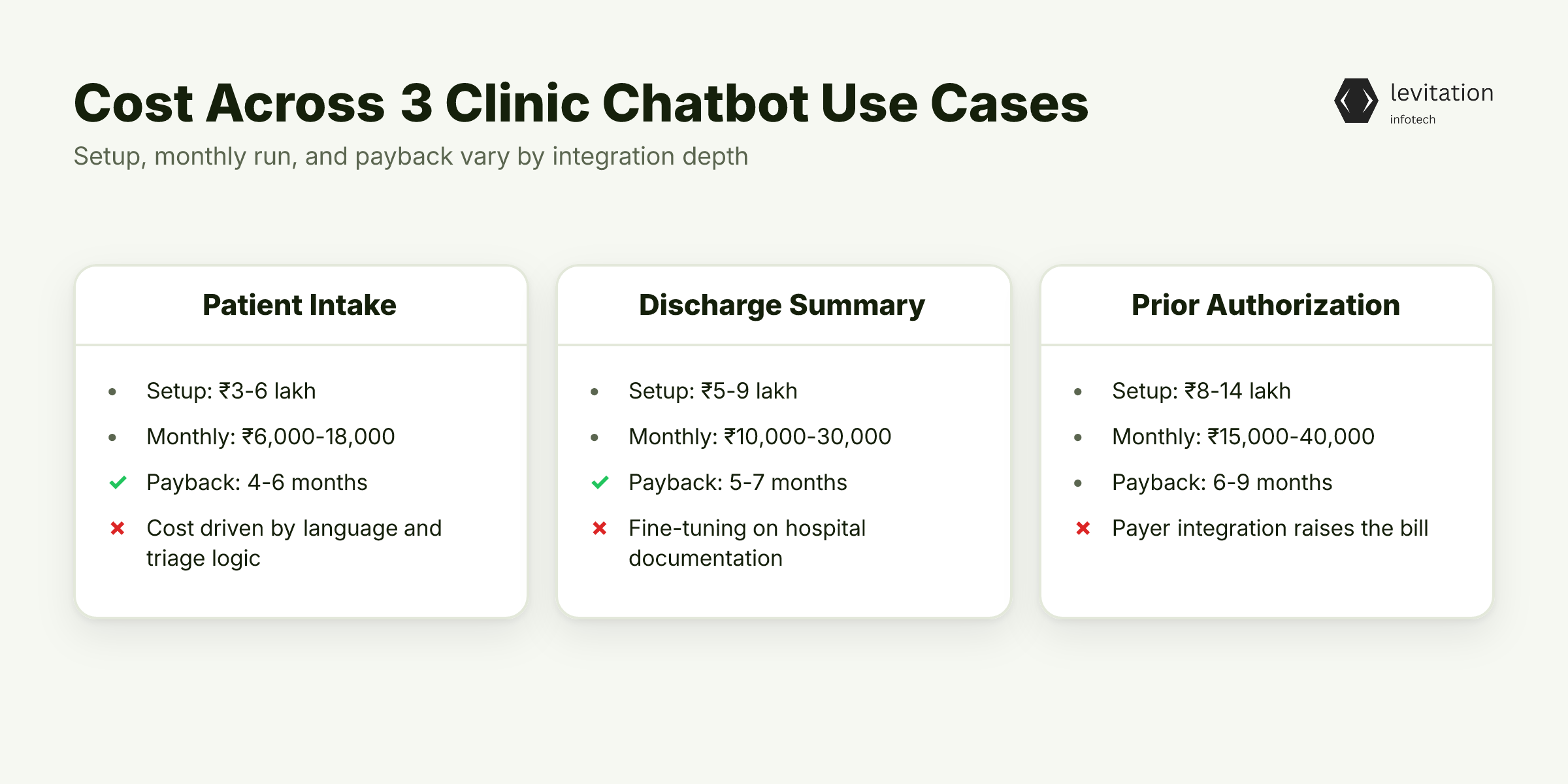
Not all chatbots are equal. The cost band shifts dramatically based on what the bot actually does, and how deeply it integrates with your clinical systems. - Claims and ICD-10 coding assist: ₹4-8 lakh setup, ₹8,000-25,000/month, 3-5 month payback. The bot reads clinical notes and suggests ICD-10 codes (the International Classification of Diseases, 10th Revision, used globally for diagnosis coding). Integration depth drives the spread. Clinics with structured EHRs pay the lower end. - Patient-intake chatbot (Hindi + English): ₹3-6 lakh setup, ₹6,000-18,000/month, 4-6 month payback. This is the most common starting point. The variation within the band is driven by how many languages, how much triage logic, and whether the bot writes back to your HIS. - Discharge summary drafting: ₹5-9 lakh setup, ₹10,000-30,000/month, 5-7 month payback. The bot listens to the ward round (or reads typed notes) and drafts a summary for the doctor to edit. Model fine-tuning on your hospital's documentation style adds cost. - Prior authorization automation: ₹8-14 lakh setup, ₹15,000-40,000/month, 6-9 month payback. The bot generates the clinical justification letter your staff currently writes by hand for insurance pre-approvals. This sits at the high end because payer integration is messy. - Radiology reporting assist: sits at the higher end of the spectrum. Model fine-tuning on imaging reports and structured finding templates adds both setup and monthly cost.
The variation within each band is driven by integration depth, not model capability. Clinics with HL7-FHIR-ready EHRs pay less. Clinics on legacy systems pay more, and that's before the API export fee from your HIS vendor.
The pattern here mirrors what we see across AI development services for other regulated sectors. The model is a fraction of the total cost, while integration, compliance, and support dominate the bill. It's also why the broader pattern of hospital AI pilots failing in year one shows up so consistently. Under-scoped integration kills more projects than model failures.
These numbers only matter if you can verify them against a vendor quote. Most Operations Heads can't, because they don't know what questions to ask.
5 Red Flags That Mean You're Overpaying (and the Questions to Ask)
A quote audit is quick if you know what to look for. These five red flags catch most of the pricing traps.
Red flag 1: Vendor won't separate model costs from integration costs. If the SOW has a single "development" line, push back. Ask for a line-item breakdown covering model license, integration build, audit logging, training, and ongoing support. A vendor who refuses is hiding margin.
The same trap that turns a ₹2 lakh chatbot into an ₹8 lakh bill starts with a single-line SOW.
Red flag 2: No mention of audit logging or model versioning. This is non-negotiable for clinical settings. If the quote doesn't specify how model version, prompt, output, and reviewer decision are logged on every call, it's missing.
Vendors add it later as a compliance surcharge, which means it was scoped in their head, just not your contract.
Red flag 3: Vague timeline with no milestones. A proper deployment follows a structured track with weekly checkpoints. An in-house build stretches much longer for the same outcome.
If the vendor gives a range without naming the milestones, they're padding the timeline. Demand week-by-week deliverables.
Red flag 4: No discussion of EHR integration approach. HL7-FHIR adapters should be budgeted upfront, not mid-project. If the vendor hasn't asked which EHR you run, whether it exposes APIs, or what your data residency requirements are, they haven't scoped the hardest part of the job.
Red flag 5: Vendor claims "custom AI" but proposes a white-label wrapper. True custom AI development requires model selection, prompt engineering, and evaluation frameworks.
If the vendor can't name the model, describe the evaluation harness, or show you a sample of the prompt logic, you're buying a template.
The same gap shows up in our analysis of ₹30K and ₹8 lakh chatbot quotes where both are wrong. The problem isn't price. It's the absence of genuine model work.
Demand HIPAA-grade (Health Insurance Portability and Accountability Act, the US data-protection standard that has become a de facto benchmark for clinical AI globally) compliance even for Indian deployments. Leading hospital chains in India have deployed HIPAA-compliant systems, so the bar exists domestically. A vendor who says HIPAA is "only for US clients" hasn't kept up with the Indian market.
The full quote audit checklist maps directly to the framework in our AI chatbot development cost in India guide and the broader AI development services procurement playbook.
Once the quote survives that audit, the real question becomes: what does a proper deployment actually look like?
What a Proper Deployment Actually Delivers
A properly scoped deployment has a predictable shape. The cost is front-loaded, but the value compounds once the bot hits production. - Phase 1: EHR integration, data audit, and model selection. No patient-facing deployment yet. The team connects the HL7-FHIR adapter, maps your clinical data schema, and runs a model evaluation against your historical notes. This is where the heaviest setup work happens. - Phase 2: Internal pilot. Staff log every AI suggestion and the reviewer's decision. You're measuring acceptance rate, not patient impact yet. If the bot frequently produces suggestions that doctors override, the model needs more fine-tuning. - Phase 3: Patient-facing rollout with a feedback loop. Weekly model evaluation. The bot handles real traffic, and a human reviewer catches edge cases. This is where you see front-desk load drop and staff hours get reclaimed. - Phase 4: Full production with measured payback. Patient-intake chatbots hit 4-6 month payback in most Indian clinic settings. The bot is now paying for itself.
The outcome isn't just cost savings. Clinics reduce front-desk load, cut coding errors, and reclaim staff hours previously spent on prior-auth paperwork.
The compounding effect shows up in year two. The same clinic scales to two bots instead of one, and the marginal integration cost drops because the data pipe already exists.
A typical vendor deployment runs faster than in-house builds, which stretch much longer for the same outcome. HIPAA-compliant systems are already in production at leading Indian hospital chains, and that's the benchmark. If your vendor's timeline is longer, the scoping is wrong. If it's shorter, the scoping is missing something.
The pattern is consistent with what production-grade healthcare technology delivery looks like when model work, integration, and compliance are all scoped in from day one.
Teams like ours at Levitation have shipped these systems end-to-end, from HL7-FHIR adapter to model evaluation harness. The ones that hit payback on schedule are the ones that refused to skip the pilot, which is the gap the five questions below are designed to close.
Frequently Asked Questions
How much does an AI chatbot actually cost for a small Indian clinic?
A patient-intake chatbot with Hindi + English support typically costs ₹3-6 lakh as a one-time setup, plus ₹6,000-18,000/month for hosting and model inference. Cheaper ₹80K quotes usually exclude EHR integration, audit logging, and bilingual support, all of which become mandatory in production.
What's the difference between an ₹80K chatbot and a ₹6 lakh chatbot?
The ₹6 lakh quote typically includes HL7-FHIR integration with your HIS, HIPAA-grade audit trails, bilingual support, and model versioning. The ₹80K quote is often a thin wrapper with no clinical context, no audit logging, and no integration. It's fine for appointment booking but useless for coding assistance or discharge summaries.
How long does it take to deploy a healthcare chatbot in India?
A properly scoped vendor deployment runs faster than an in-house build, which typically stretches much longer due to integration, compliance, and hiring overhead. The compressed timeline assumes your EHR exposes APIs and your team can run a 4-week internal pilot before patient-facing rollout.
Can I use WhatsApp Business API instead of building a custom chatbot?
WhatsApp works for appointment reminders and basic FAQs, but it cannot access patient records, log clinical decisions, or integrate with your HIS. For anything beyond simple notifications (intake, coding assist, discharge summaries) you need custom AI development with proper audit trails.
What compliance requirements apply to healthcare chatbots in India?
The ABDM (Ayushman Bharat Digital Mission) framework governs health data exchange, and the Digital Information Security in Healthcare Act (DISHA) sets data protection standards. For clinics serving international patients or handling US data, HIPAA compliance is increasingly standard. Leading Indian hospital chains have already deployed HIPAA-compliant systems.
Run your current quote through the five red flags above, and you'll know within an hour whether you're paying for real capability or bundled margin.
About the author
Mayank Singh is a software developer at Levitation Infotech, where he builds web and AI-powered applications across the company’s fintech, healthcare, and enterprise projects.