


TL;DR: SOC 2 is voluntary, yet an enterprise buyer's risk review can make the report a commercial gate. Indian SaaS vendors should replace badge-led selling with a current, correctly scoped report that answers control questions and speeds vendor review.
Key Takeaways: - Match Type I or Type II to the buyer's assurance requirement, not prestige. - Define scope and Trust Services Criteria from real service commitments and buyer risks. - Price readiness, evidence, remediation, observation, and issuance as one program.
The Procurement Filter a Badge Cannot Pass
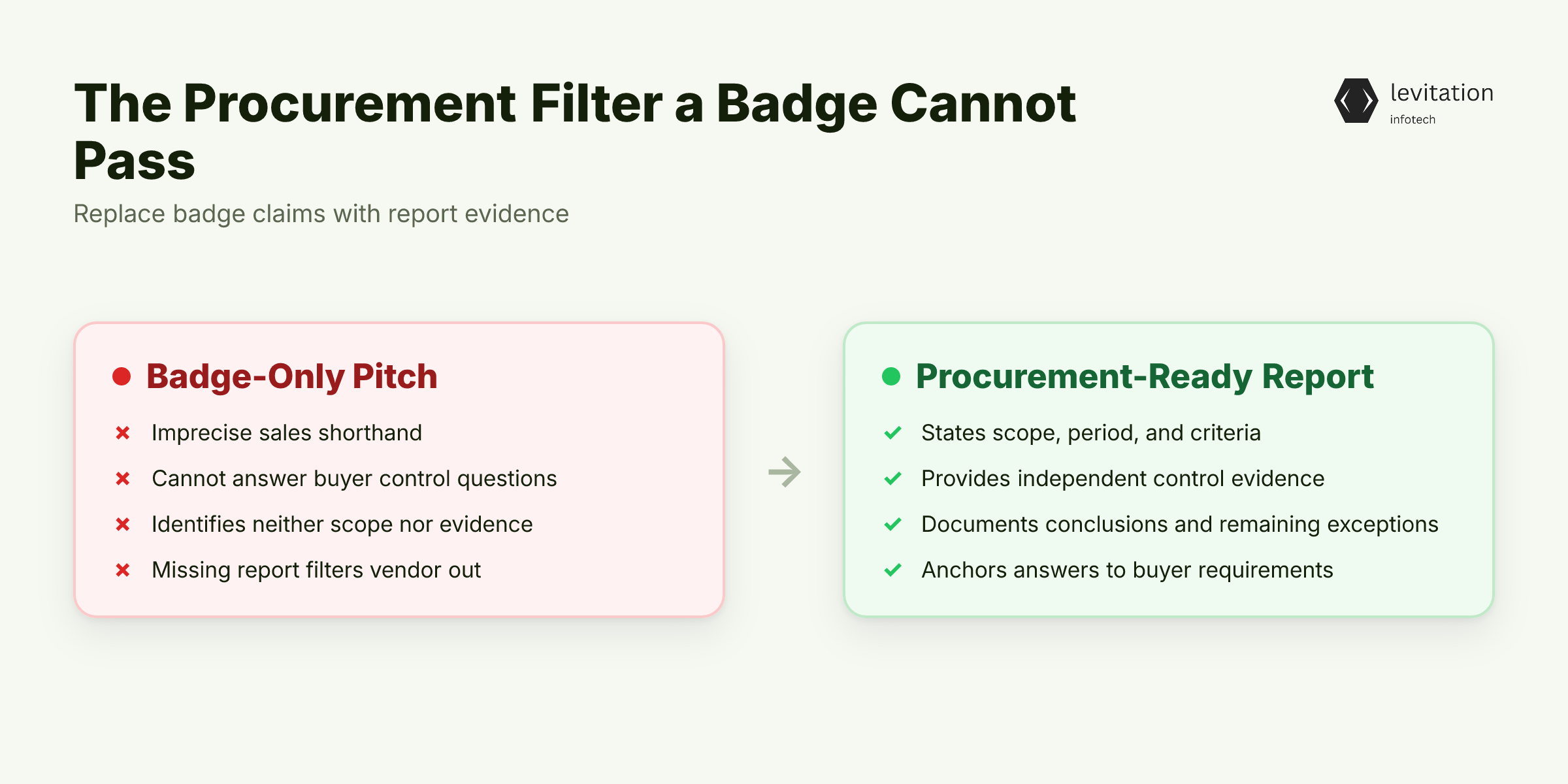
A US enterprise buyer opens a vendor portal and spots a shiny “SOC 2 certified” badge, then asks for the report. If the report is missing, the Indian SaaS vendor is ruled out before the demo. If the badge is all that exists, it cannot answer the risk team's questions.
Voluntary standard, commercial gate
SOC 2 is a voluntary AICPA assurance standard. It becomes commercially mandatory when a US enterprise buyer requires it during vendor risk assessment. Without a current report, the vendor gets filtered out before the product is evaluated.
The SOC 2 report for enterprise procurement provides independently assured control evidence. It does not guarantee a sale, but it keeps the vendor inside the evaluation. The review starts with one question: which artifact does the buyer actually receive?
Separate the artifact from the slogan
“SOC 2 certified” is imprecise sales shorthand. SOC 2 can refer to the report, the third-party audit, or the framework of controls. Procurement needs the actual report because it states the scope, period, criteria, and auditor conclusions.
Suppose a buyer requests a Type II report for a defined period. A website badge saying Type II identifies neither the boundary nor the evidence. Which answers can the report actually provide?
Reframe the CISO's objective
The CISO's goal is not displaying a credential. It is answering buyer control questions quickly, accurately, and with independent evidence. - Which systems and data flows were assessed? - Which Trust Services Criteria were examined? - What period did the auditor review? - Which exceptions remain, and what changed?
Each answer should point to report language, supporting evidence, or a named follow-up owner. Silence forces the buyer to assume the risk. Capture those requirements before choosing a report.
Capture buyer requirements first
Before selecting a report type, ask the buyer's security and legal teams for four decisions. - Which SOC 2 type do they require? - Which Trust Services Criteria matter? - What audit period must the report cover? - When must the report arrive?
For example, a buyer with a fixed review window needs Type I first when the deadline comes before Type II can mature. Confirm whether Type II follows. Do not assume a sequence.
The badge wins attention, but the report earns consideration. What does that report actually prove? The answer depends on its type.
Type I and Type II Answer Different Buyer Questions
A buyer asks, “Were controls designed properly on this date?” Then asks, “Did they operate effectively across the assessed period?” These questions require different reports.
Type I tests design at a point in time
A SOC 2 Type I report addresses whether relevant controls were designed appropriately on a specified date. It gives the buyer a baseline view of the control environment.
Think of it as a snapshot of control design. It does not show how those controls behaved over time. To see operation over time, the buyer needs a different report.
Type II tests operation over time
A SOC 2 Type II report evaluates whether controls operated effectively during an observation period. It answers a stronger question than design alone: did the control work throughout the assessed period?
Think of it as motion over time, not a single frame. That history still needs an independent source.
Independent assurance is the differentiator
What makes the artifact credible is independent assurance. The report comes from a third-party CPA auditor, not an internal checklist or marketing seal.
For a practical benchmark, teams comparing their planning approach can read how Indian SaaS teams plan SOC 2 readiness. The right type depends on the buyer's actual question.
Choose by procurement requirement, not prestige
Match the engagement to the procurement requirement, evaluation stage, and delivery deadline. - Use Type I when the buyer asks for design evidence at a date. - Use Type II when the buyer asks for operating effectiveness over time. - Confirm the observation period and delivery date against the procurement calendar.
Type II does not fit every pursuit. It cannot cure a wrong scope, weak evidence, or unresolved exceptions.
But what happens when the report's scope does not match the buyer's question?
Scope Turns a Report Into Buyer Evidence
Imagine a report covers the production API but excludes the support portal handling the same customer records. Technical soundness does not make the report commercially complete.
Draw the system boundary
Define the system boundary before the audit begins. Compare audited systems, services, locations, data flows, and supporting infrastructure with the product and data the buyer will use.
Ask: - Is every service component in scope? - Which locations and data flows matter? - Which shared services support the product? - Does the buyer expect coverage you have not documented?
Shared infrastructure does not transfer another provider's controls into your report automatically. Document how it supports the in-scope system and which controls remain yours. The boundary also needs a criteria map.
Map the Trust Services Criteria
Use the Trust Services Criteria as a buyer map. Every report includes the Common Criteria within Security. Availability, Processing Integrity, Confidentiality, and Privacy are optional categories.
Select optional categories from actual service commitments and buyer risk. An uptime promise supports Availability. A sensitive-data commitment supports Confidentiality.
Choose for relevance, not prestige. Even well-chosen categories can produce exceptions that need context.
Prepare for exceptions and adjustments
Prepare to explain adjustments, exceptions, and remediation context before a buyer sees the report. Concealing them creates a more difficult review later.
Credible assurance has clear limits: it explains what was tested, what was not, and what changed. Connect those limits to each buyer requirement.
Build a requirement crosswalk
Create a buyer requirement crosswalk so the reviewer does not have to reconstruct the assurance story. Connect each requirement to: - The relevant report section - The associated control area - The internal evidence owner - Supporting evidence - Any open issue and its follow-up answer
Teams that need buyer-facing context can also review buyer-facing gaps in a Type II report.
Once the scope is legible, what evidence must follow?
Operational Proof Is Not Audit Proof
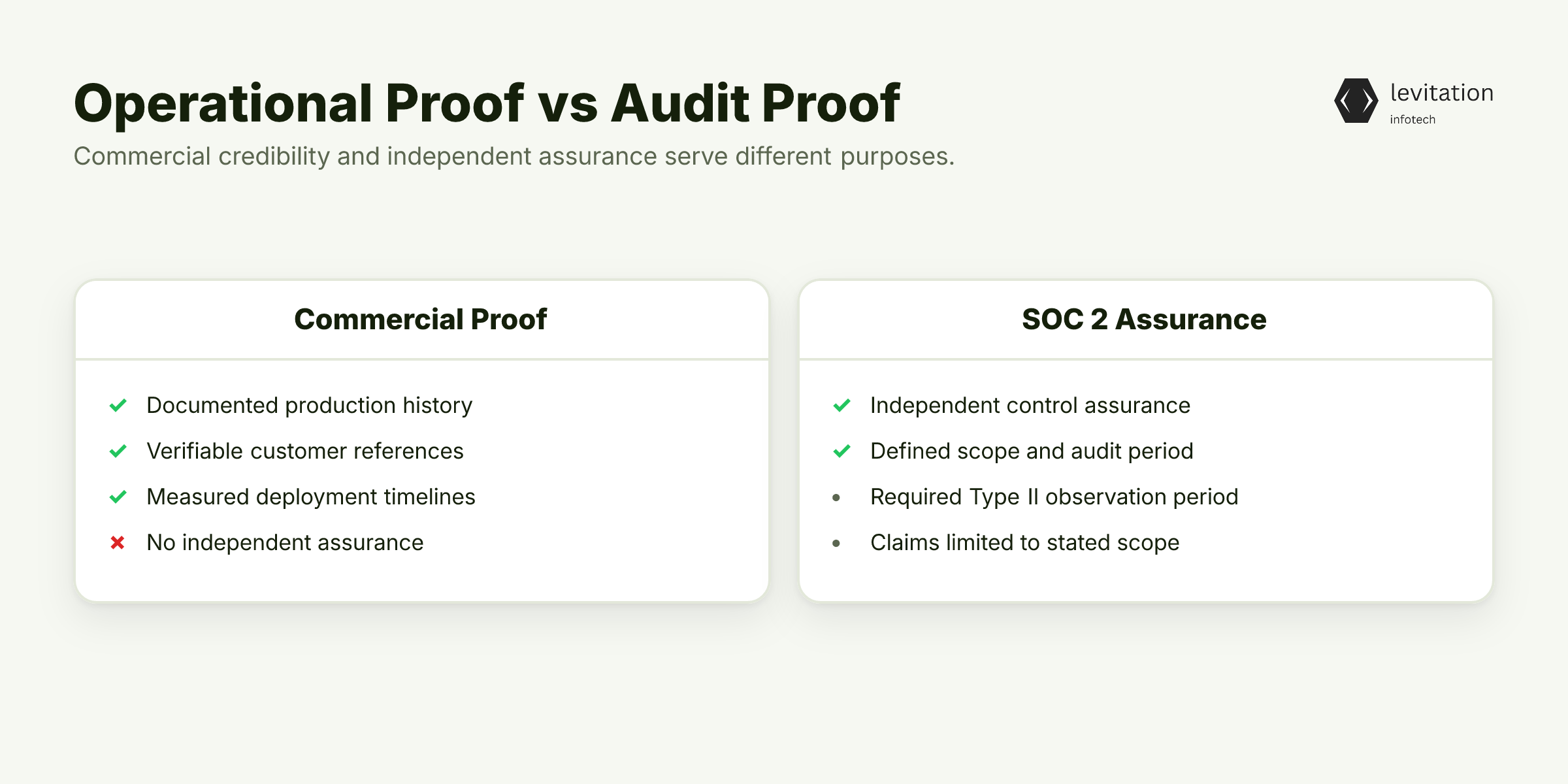
A platform can run for years without a visible failure. That proves operating experience. It does not prove that access reviews, change controls, or incident procedures worked as designed.
Separate credibility from assurance
Use commercial proof to establish credibility without presenting it as independent assurance. Commercial signals include: - Documented time in production supports a delivery-history claim. - Verifiable customer references support commercial credibility. - Measured deployment timelines support an execution claim.
These claims strengthen sales conversations but cannot replace a SOC 2 report, which needs its own operating context.
Do not confuse implementation speed with observation time
Implementation speed demonstrates delivery efficiency; it does not compress the evidence period required for Type II. No deployment timeline can create operating history before that history exists.
That proof belongs in a buyer-ready package.
Make the report the centerpiece
Package the final report as the center of a buyer-ready security evidence pack. Include: - The final report, scope, and audit period - The selected Trust Services Criteria - Remediation context - A control-to-requirement map - A current evidence index - A named security contact
Put these items in a controlled location the buyer can access under its review process. The package needs clear claim boundaries.
Keep every claim within its evidence boundary
Commercial proof can show delivery history, customer trust, and execution speed. None of these claims expands the report's stated scope. Use the report for independently assured control claims and commercial proof for everything outside that scope. Clear limits make continuous evidence easier to manage.
Operate the evidence continuously
Assign control owners and maintain an evidence index. Review the package before every major enterprise pursuit.
SOC 2 control ownership turns evidence collection from a last-minute scramble into routine work. One report closes an audit period, while continuous evidence management prepares the next one.
That evidence package can still become expensive if scope, readiness, and the observation period are decided late.
Control the Variables That Drive SOC 2 Audit Cost
Two audit quotes arrive, and each shows a different program. One lists a headline fee. The other lists preparation, testing, monitoring, and issuance.
The second quote shows the same program more honestly.
Price the complete program
Request a complete program view. Ask for separate line items for: - Auditor fees - Readiness work - Evidence collection - Remediation - Control monitoring during the observation period - Report issuance
A SOC 2 audit cost estimate that hides internal labor cannot guide a sound budget decision. The first variable is the report type.
Variable one: report type and observation period
Type I records control design at a point in time. Type II tests operation across an observation period. The longer evidence window and operating-history needs change both cost and scheduling. Scope is the next variable.
Variable two: scope and criteria
Tie every included system, location, service, data flow, and optional criterion to a buyer requirement or documented business risk. Removing unnecessary scope lowers effort without weakening relevant assurance. Cost then depends on the maturity of the evidence.
Variable three: evidence maturity
Evidence maturity is the hidden variable. Check whether these records exist and can be produced consistently: - Access reviews - Change management - Incident response - Vulnerability management - Backup records - Monitoring evidence
Remediation and manual collection are major cost drivers. An audit readiness assessment exposes them before contract signature. The engagement model also changes the quote.
Variable four: auditor and operating model
Compare the auditor and operating model. Review engagement structure, period length, readiness support, and ongoing monitoring needs. Use identical scope assumptions for every quote and implementation partner. Those choices must fit the buyer's deadline.
Sequence the audit around buyer deadlines
Arrange the audit around buyer deadlines. - Capture buyer requirements - Define the system boundary - Close critical gaps - Conduct Type I if required - Run the Type II observation period - Issue and package the final report
A Type II promise must include readiness, observation, and report issuance. Do not treat implementation speed as audit speed. A final review tests the plan before signature.
Run a commercial readiness review
Before signing, run a commercial readiness review. Confirm that: - The planned scope satisfies the buyer's security and legal teams - The estimate includes remediation and internal work - The planned report date falls within the procurement window
The payoff is not a logo on a website. It is a report that changes what happens in procurement. Does it change the outcome for the better?
What Changes When Procurement Gets the Report
A vendor survives the first filter. The risk team opens the report and starts asking follow-up questions. The difference between a document dump and an evidence package now matters.
Move past the first filter
A usable, correctly scoped report lets the vendor remain in evaluation. It does not win business, but it lets the product receive substantive consideration. Review speed now depends on how quickly reviewers validate the evidence.
Make security reviews faster
Give reviewers the report, scope summary, evidence index, and remediation narrative first. Answering routine questions up front reduces repeated requests for spreadsheets, screenshots, or explanations.
The SOC 2 buyer packet should answer routine questions before the meeting. Reusable evidence also improves the next audit.
Turn one audit into reusable evidence
Reuse control narratives, ownership records, and tested procedures across future reports and enterprise pursuits. Update them for the current audit period and scope. The next discipline is stating what that evidence proves.
Support claims without overstating them
Operational and commercial evidence strengthen the commercial story. The SOC 2 report carries the independently assured control claim.
At Levitation, the useful discipline is to treat the report as an evidence product, not a marketing asset. Publish and maintain the packet as the next step.
Set the next action
Assign a CISO or compliance owner to publish the current buyer packet. Align report scope with the nearest enterprise opportunities. Schedule evidence reviews before each audit cycle.
An enterprise readiness review exposes gaps before a live buyer finds them. Which terminology, timing, and cost questions should CISOs answer before acting?
SOC 2 Report FAQ for Indian SaaS CISOs
Buying teams need direct answers. What artifact is it? Which assurance? When can it arrive inside the procurement window?
Clarify the artifact
A SOC 2 engagement produces an independent assurance report from a third-party CPA auditor. “SOC 2 certified” is common sales shorthand, not the artifact buyers review. In enterprise vendor risk assessments, that report is the document under scrutiny. The next decision is how much assurance the buyer needs.
Compare assurance types - Type I evaluates whether controls were designed appropriately at a specified point in time. It provides point-in-time design evidence. - Type II evaluates whether controls operated effectively over an observation period. It provides operating-effectiveness evidence across that period.
Cost and timing follow from that assurance choice.
Make cost and timeline actionable
There is no universal price. Cost depends on Type I versus Type II, report scope, selected criteria, observation period, evidence maturity, and remediation work.
Request an itemized quote that separates auditor fees from readiness, evidence collection, and ongoing control operations. Deployment speed is not a substitute for observation time. The timeline depends on the evidence period.
Separate legal and commercial requirements
SOC 2 is voluntary, not a universal legal requirement. Enterprise procurement creates the requirement in these deals.
Buyers comparing assurance frameworks can review SOC 2 versus ISO 27001 for Indian SaaS. An SOC 2 audit readiness consultation translates buyer language into scope and timing decisions. These choices set the commercial path.
Frequently asked questions
Is SOC 2 a certification or a report?
The deliverable is an independent assurance report issued by a third-party CPA auditor, not a certificate. “Certification” is sales shorthand rather than the document a buyer reviews.
What is the difference between SOC 2 Type I and Type II?
Type I addresses whether controls were suitably designed on a specified date. Type II addresses whether those controls operated effectively across an observation period.
How much does a SOC 2 audit cost?
Budgets vary with assurance type, scope, selected criteria, observation window, evidence maturity, and remediation demands. Ask for an itemized quote that separates auditor fees from readiness, evidence collection, and ongoing control operations.
How long does a SOC 2 Type II engagement take?
The timeline combines readiness, any necessary remediation, an observation period, and report issuance. Duration depends on the condition of the controls, the selected observation period, and the reporting schedule. Faster implementation does not replace the need to accumulate operating evidence.
Review the current buyer packet before the next enterprise opportunity. The next procurement conversation may depend on whether that packet is ready.
About the author
Mayank Singh is a software developer at Levitation Infotech, where he builds web and AI-powered applications across the company’s fintech, healthcare, and enterprise projects.