

TL;DR: Indian SaaS CTOs spend heavily on a SOC 2 Type 2 audit and treat the report as the finish line. Enterprise buyers read it as a due-diligence document, not a certificate. Four specific sections determine whether the deal moves forward. Writing those sections with operating detail compresses procurement cycles. It turns the report into a sales tool rather than a check-the-box deliverable.
Key Takeaways: - A clean auditor opinion is not enough. Buyers read the management-written sections, not the auditor's, to decide if your security program is mature. - The Management Assertion, System Description, Tests and Results, and CUEC/CSOC sections carry the deal. Most first-time Indian SaaS reports treat them as boilerplate. - The gap between a fast pre-aligned build path and an in-house path built from scratch shapes revenue outcomes. A pre-aligned build wins enterprise deals in the current quarter. An in-house path built from scratch loses them to a competitor whose report is already in the buyer's hands.
The Audit Report That Doesn't Close the Deal
You spent serious budget on a SOC 2 Type 2 audit, sent the report to the prospect's procurement team, and waited. Two weeks later, the deal stalled. Not because your security was weak. The four sections enterprise buyers actually read were thin, templated, or missing the operating details they needed to sign.
This is the most common failure mode in Indian SaaS enterprise sales. SOC 2 Type 2 audit fees in India from a Big Four or mid-tier firm consume real budget. Founders treat the report as the finish line. It is not.
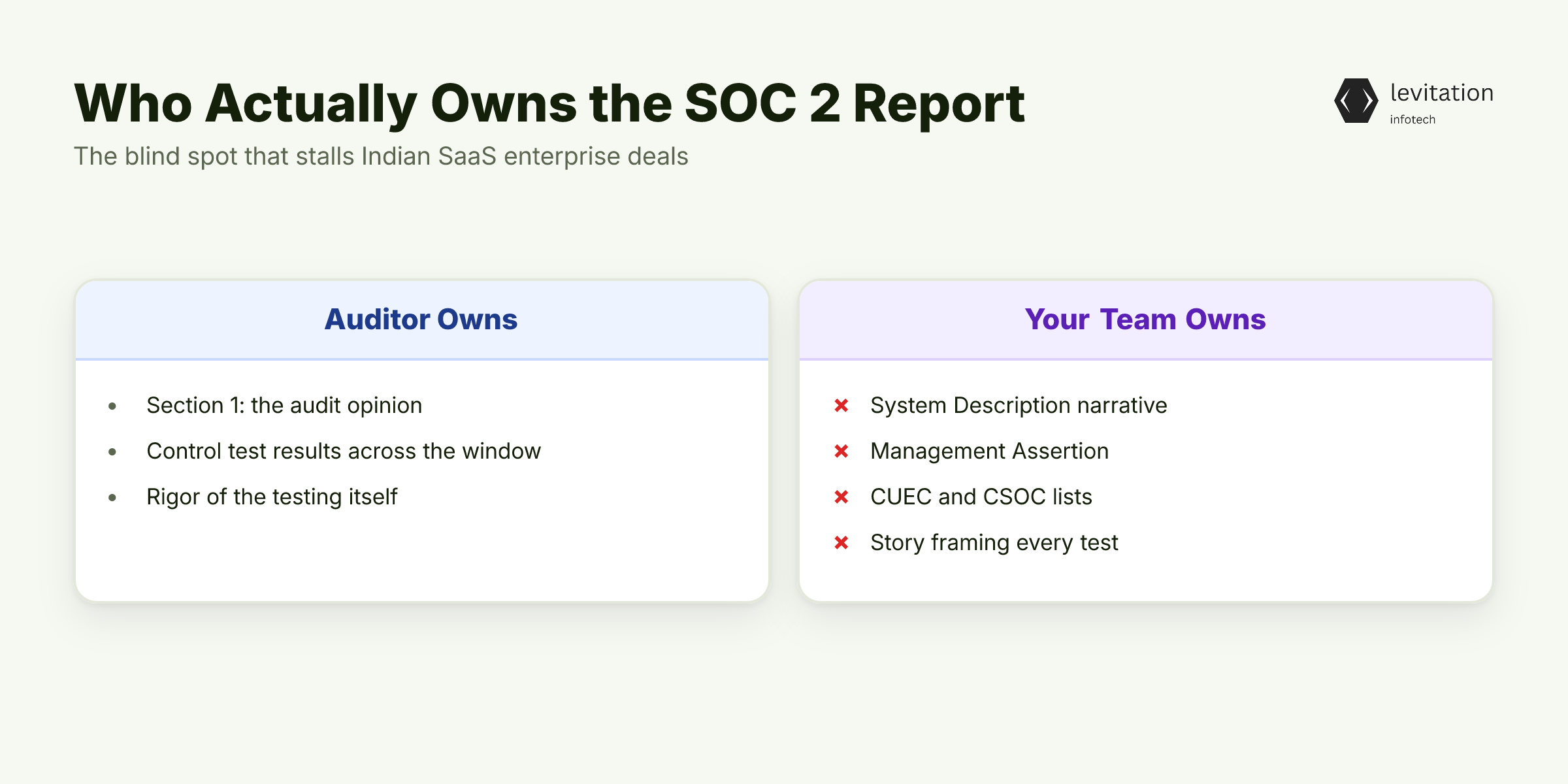
The auditor's role is to test controls and issue an opinion. Everything around the opinion is written by your team. That is what procurement teams, security reviewers, and CISOs actually read.
Here is the blind spot. Most Indian SaaS companies approaching enterprise compliance assume the auditor owns the report. The auditor owns Section 1 (the opinion) and the test results.
Your team owns the System Description, the Management Assertion, the CUEC and CSOC lists, and the narrative that frames every test. When those are written from a generic template, the report reads as immature. The buyer's review team notices within minutes.
The audit itself is rigorous. The problem is that the report surrounding the audit is treated as boilerplate. That boilerplate is exactly what buyers dissect first.
Why a Clean Audit Opinion Still Gets You Rejected
An unqualified auditor opinion confirms a narrow fact: controls were designed and operated effectively over the audit period. It does not describe your environment, your risk model, or your boundaries. Most buyers skip to the next page.
What they actually want lives in the management-written sections. The System Description tells them what you do, who does it, and what is out of scope. The Tests and Results tell them which controls drifted, how often, and whether you caught it.
The CUEC and CSOC lists tell them what responsibility they carry and which sub-processors you depend on. A thin write-up in any of these reflects on your team, not your auditor.
Evidence collection for SOC 2 Type 2 is the part most companies underestimate. SOC 2 compliance extends past security personnel. The report covers HR onboarding flows, vendor risk reviews, and policy ownership. The audit extends past them too.
Set aside time for HR, policy owners, and anyone responsible for security program governance. They will be interviewed. They will be asked to produce evidence. And they must own their part of the report. Otherwise, the final document will read as a security-team project that nobody else understood.
The result is a report that satisfies the auditor but fails the buyer. The buyer's enterprise security questionnaire preparation team reads the same sections your team wrote. The same thinness triggers a long follow-up questionnaire.
Once you see the report through a buyer's eyes, four specific sections become the deal-makers. Most Indian SaaS reports treat them as filler.
The 4 Sections Enterprise Buyers Actually Read
The full SOC 2 Type 2 report structure explained has many moving parts, but buyers concentrate on four.
Section 1 - Management Assertion. A signed statement from leadership asserting the System Description is accurate and that controls operated effectively across the audit period. A weak assertion, signed by a security lead with no CTO or CEO co-sign, reads as leadership not standing behind the program. Buyers see this immediately on the first page.
Section 2 - System Description. The narrative of your product, infrastructure, people, processes, and data flows. This is the section buyers use to map your controls against their own risk model. Gaps here trigger a long round of follow-up. The reviewer cannot tell what you actually built, where customer data lives, or how segregation works.
Section 3 - Description of Tests and Results. Where the auditor documents each control test, the sample size, and any exceptions. Buyers count exceptions and look for patterns of drift over the audit period (typically 6-12 months). They read this section to judge whether your controls are stable or whether you pass one quarter and fail the next. The report also covers operating effectiveness of controls over a period. This includes Information and Communication and Monitoring Activities. Buyers evaluate your ongoing evaluation of controls here, not just the point-in-time evidence.
Section 4 - Complementary User Entity Controls (CUECs) and Complementary Service Organization Controls (CSOCs). The list of controls the buyer must run on their side and the controls you rely on from sub-processors. Buyers use this to assess shared-responsibility risk before signing. A missing sub-processor or an unclear CUEC is the fastest way to get escalated to a third-party assessment.
Knowing which sections matter is half the answer. The other half is writing them so a buyer's CISO can sign off in one pass, without firing back a long questionnaire.
What Each Section Must Contain to Pass Buyer Review
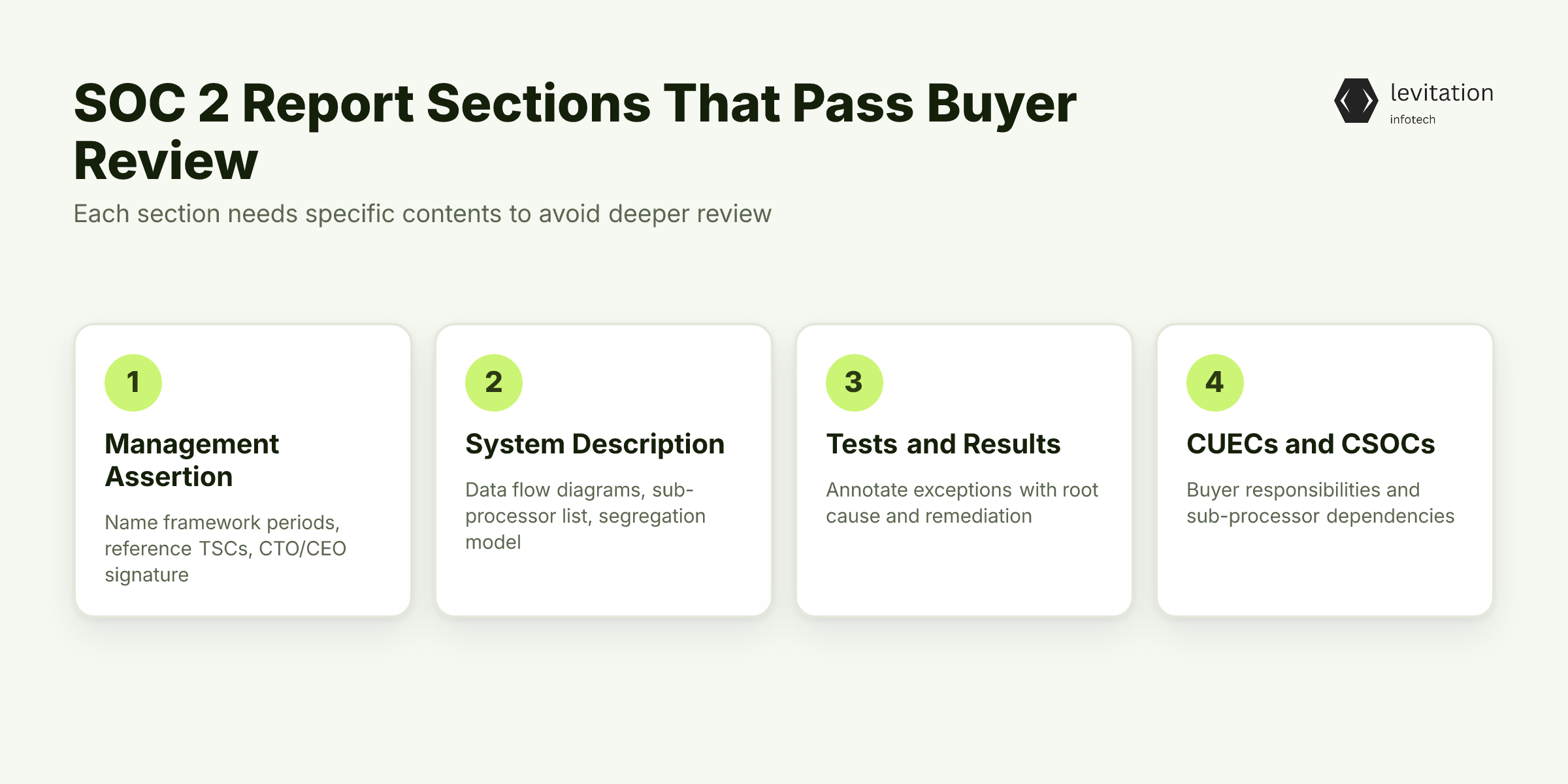
The Management Assertion should name the specific framework periods. It should reference the TSCs in scope. Security, Availability, and Confidentiality are the minimum enterprise buyers expect.
The assertion should be signed by the CTO or CEO, not a security lead. Buyers infer program maturity from who is willing to put their name on the assertion.
The System Description must include your actual data flow diagrams. It needs a sub-processor list with data residency, a customer data segregation model, and your change-management cadence. The more concrete, the fewer follow-up questions.
Generic descriptions that match five other vendors get flagged as templated and trigger deeper review.
Tests and Results should pre-emptively annotate any exceptions with root cause and remediation date. A buyer reading exceptions with clear remediation reads maturity.
A buyer reading exceptions with no annotation reads negligence. The difference between a pass and an escalation lives in how you describe what went wrong.
CUECs and CSOCs must explicitly list what you expect the buyer to do. For example, enabling MFA on their admin accounts. They must list which sub-processors you depend on. For example, AWS Mumbai, Snowflake.
This is where HIPAA-aligned healthcare buyers look first when evaluating a vendor handling patient data. A SOC 2 evidence collection playbook that maps each control to its evidence source makes this section much easier to write and defend.
The enterprise security questionnaire faster angle matters because the same well-written sections answer most of incoming questionnaires. Skip that work, and every new prospect triggers a fresh questionnaire cycle.
Writing these sections well takes months of structured work. In-house teams routinely let that window stretch far longer. They do not know what "done" looks like.
The report sits in draft while enterprise deals stall.
The Fast Build vs the In-House Trap
The SOC 2 Type 2 timeline for Indian SaaS splits cleanly into two paths. In-house teams typically spend months selecting a compliance platform, further months mapping controls, and additional months collecting evidence. The arc stretches long enough that enterprise deals stall or close with a competitor whose report was already in the buyer's hands.
The fast path compresses this. The control library, evidence templates, and report-section drafts are already aligned to what AICPA auditors and enterprise buyers expect. Your team stops designing the process and starts running it.
The hidden cost of the slow path is not the audit fee. It is the enterprise revenue lost while the report sat in draft.
Indian SaaS companies selling to US healthcare buyers face an extra layer. HIPAA and SOC 2 overlap for health-tech SaaS means the System Description needs HIPAA-aligned controls, a Business Associate Agreement posture, and evidence of PHI handling discipline. Most first-time reports do not address this, and healthcare buyers reject the report before they finish reading it.
The same lesson shows up across why Indian SaaS start at Month 10. The related failure mode appears in 40% of Indian SaaS failing SOC 2 Type 1.
Speed is the visible win. The less visible win is what happens to the customer relationship after the report lands.
What Changes When These Four Sections Are Written Right
Enterprise security questionnaires compress dramatically because the SOC 2 report already answers most of them. Procurement cycles shorten because the CISO review is satisfied on first pass, not escalated to a third-party assessment.
The same report becomes the foundation for ISO 27001, HIPAA, and DPDP Act alignment. The SOC 2 to ISO 27001 path for Indian SaaS transfers the System Description and control map directly.
Many Indian SaaS founders buy SOC 2 when buyers want ISO 27001 without realizing the report can serve both. Long-term retention is the lagging indicator.
Compliance posture that holds up across successive annual audits keeps buyers signing. Each year's report satisfies their review without escalation.
Teams that have built HIPAA-compliant systems for healthcare buyers carry that experience into the System Description and CUEC sections. The familiarity with PHI-shaped data flows shows up in the report language, and healthcare buyers notice.
Frequently Asked Questions
How long does a SOC 2 Type 2 audit take for an Indian SaaS company?
A Type 2 audit covers 3-12 months of operating effectiveness, so the full cycle from kickoff to report delivery is typically 6-12 months. Companies that build controls and evidence in parallel finish well before in-house teams without a pre-built control library.
Do enterprise buyers accept SOC 2 Type 1 or do they require Type 2?
Most US enterprise procurement teams require Type 2 because Type 1 only attests to control design at a point in time. A Type 2 report with even a few annotated exceptions reads as more mature than a clean Type 1. It shows real operating evidence over a period.
Can we share our SOC 2 report with a prospect under NDA?
Yes. A SOC 2 report is a restricted-use report intended for user entities, business partners, and their auditors. Sharing it under a mutual NDA before contract signature is standard practice and is usually required by the buyer's security review process.
What if a buyer asks for a section that isn't in our SOC 2 report?
Common additions are a mapping to ISO 27001 controls, a penetration test summary, or a Business Associate Agreement for HIPAA. The fastest path is a SOC 2 bridge letter covering the gap period, or a separate one-page control mapping document, not a re-audit.
Is SOC 2 enough for selling to US healthcare buyers, or do we need HIPAA too?
SOC 2 alone is rarely enough for US healthcare buyers. They typically also require a signed Business Associate Agreement. They need evidence of HIPAA-aligned controls in the System Description, and often a HITRUST or HIPAA-readiness assessment.
About the author
Mayank Singh is a software developer at Levitation Infotech, where he builds web and AI-powered applications across the company’s fintech, healthcare, and enterprise projects.