


TL;DR: Plan ISO 27001 certification backward from Stage 2, not forward from an auditor's arrival. Stage 1 lasts only one to three days. The real work is broader. It includes ISMS design, risk treatment, control operation, and months of evidence building.
Key Takeaways: - Stage 1 is a short checkpoint inside a much longer readiness program. - The critical path starts with risk. It then runs through treatment, control operation, and dated evidence. - A 12-16-week baseline assumes scope, ownership, and the intended Stage 2 date are fixed early.
Stage 1 Is a Short Event Inside a Months-Long Project
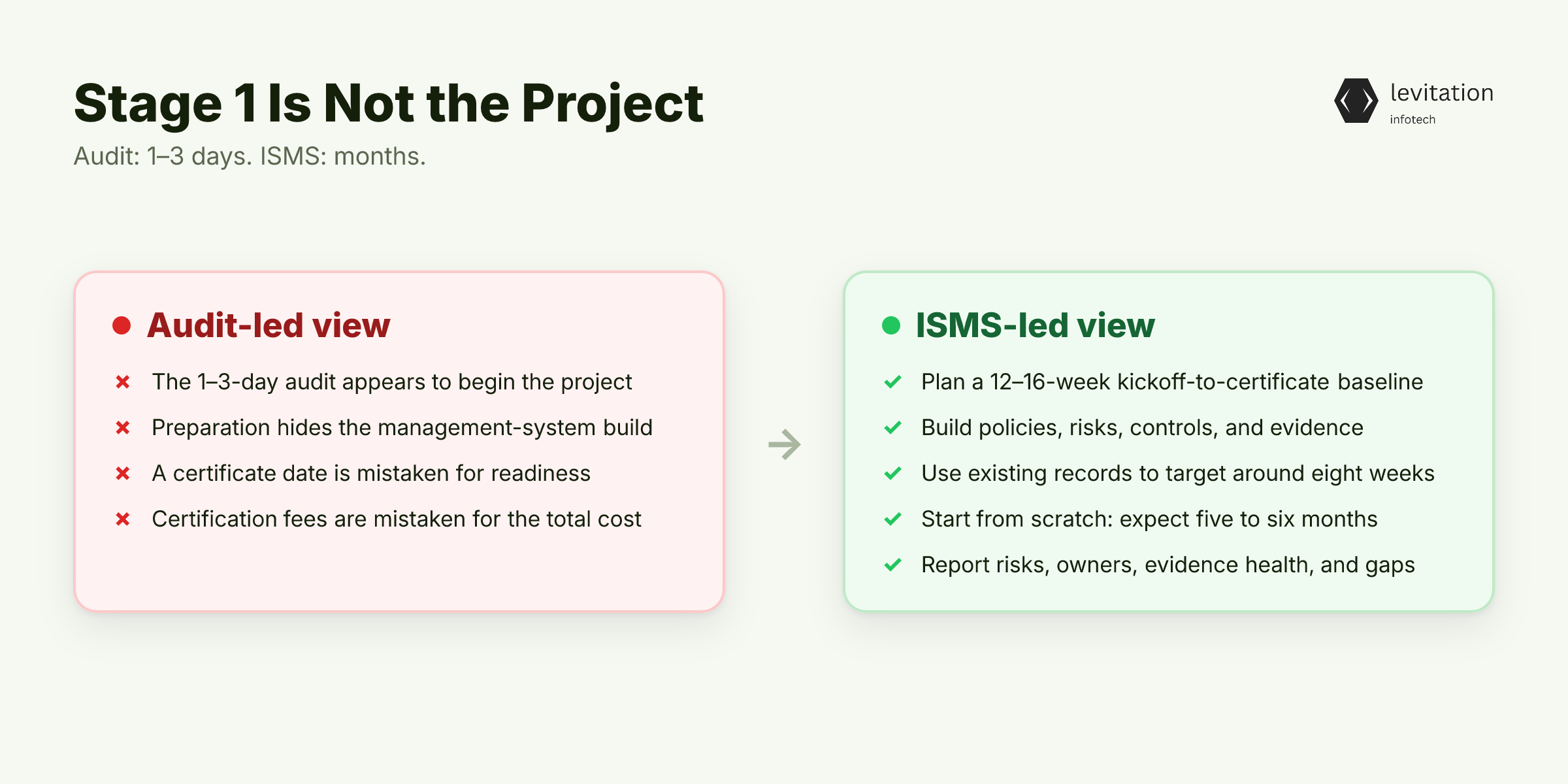
Stage 1 is typically a one-to-three-day document audit. If your ISO 27001 project appears to begin there, your calendar is already hiding the real work.
That work is not audit preparation. It means building the management system that the audit will examine.
Use these planning ranges: - 12-16 weeks: Practical planning baseline from kickoff to certificate. - Around eight weeks: Possible when the current security setup and operating evidence are already strong. - Five to six months: More realistic for a first-time ISMS started from scratch.
Existing records can shorten readiness toward eight weeks. These records include access reviews, incident tickets, supplier assessments, and training records. A company without those records must build the processes and operate them first.
Most time goes into policy development and risk assessment. It also goes into building controls and collecting evidence. The visible audit comes after that longer program.
The ISO 27001 certification process makes this distinction clear. Your commercial plan should do the same. The ISO 27001 certification cost depends heavily on readiness and remediation. It does not depend only on certification body fees.
For a CTO, this isn't administration. Customer due diligence, enterprise sales reviews, and vendor deadlines depend on a working ISMS. They do not depend on a date booked with a certification body.
That distinction also changes board reporting. Show risk decisions, control owners, evidence health, and unresolved gaps. A certificate date can't carry that burden.
If the audit itself is so short, where do the missing weeks actually go?
Why Building a Blank-Slate ISMS Quietly Becomes the Critical Path
Most delay is not caused by one document that is too large. Instead, it comes from a broken chain between risk, control, and evidence.
The critical path starts with management responsibility and a defined scope. It then covers risk criteria, assessment, and treatment. Next, the team selects controls and builds them. The path then covers internal audit, management review, and improvement.
ISO/IEC 27001:2022 lists 93 Annex A controls. These cover organizational, people, technological, and physical themes. That count shows breadth. It does not mean every organization must build every control.
Each control still needs a decision: - It applies because it addresses an assessed risk. - It does not apply because the organization can explain why. - It will apply as scope or operations change.
Common sources of delay include: - Ownership is disputed among security, IT, operations, and business teams. - Scope expands after policies have already been approved. - Policies are drafted before anyone understands the major risks. - Controls are selected without recording the reason. - Evidence collection is put off until audit week.
Control count is the wrong metric. Workload comes from deciding which controls apply. You also have to build the selected controls and prove they work over time.
Consider access management. A policy says reviews happen. The operating evidence must show who reviewed each account. It must also show which exceptions were approved and what access was removed.
The ISO 27001 risk-based implementation process matters. It turns that reasoning into a clear chain. Each selected control should link to a risk, an owner, and a regular record.
Treat ISO 27001 as an operating system for security governance. It should not be a document bundle created for auditors.
Without a working chain, every later deadline becomes uncertain. Which link fails first in your current ISMS?
Build the Evidence Chain Before the Policy Binder
Start with scope, not policy prose. First, name the services, sites, and information covered by the ISMS. Also name the processes and the owner who is accountable for them.
For example, a hosted cloud platform might sit inside the ISMS. Its scope should identify the customer data, production environments, and support processes it covers. It should also name one owner who is accountable. Otherwise, controls may target a service nobody owns.
Policy language comes after that decision. Broad policies can't repair unclear ownership or an unstable scope.
Then turn the risk assessment into an input to daily work. Each major risk should point to: - A recorded treatment decision. - An Annex A control that applies. - An owner who is accountable. - A regular source of evidence.
The evidence chain should read clearly:
Risk identified → treatment approved → control operated → dated record produced → internal audit and management review → corrective action.
Policy approval proves intent. Operating evidence proves activity. They are different things.
Useful examples include: - Access-review records showing who reviewed access and which exceptions remained. - Incident tickets showing detection, response, escalation, and closure. - Supplier-review records showing risk decisions and contractual safeguards. - Training completion records showing who received required instruction. - Physical-entry logs showing how restricted areas were accessed and reviewed.
Stage 2 usually occurs after at least three months of ISMS operation. That clock starts before Stage 1. So evidence collection cannot wait until audit week.
In practice, choose the planned Stage 2 date, then work backward. The ISO 27001 implementation roadmap should link each date to a required output and owner. An ISMS evidence register shows where that chain breaks.
Once the evidence chain is visible, the project schedule becomes easier to defend. Where does yours break today?
A Backward Plan for 12-16 Weeks to Certification
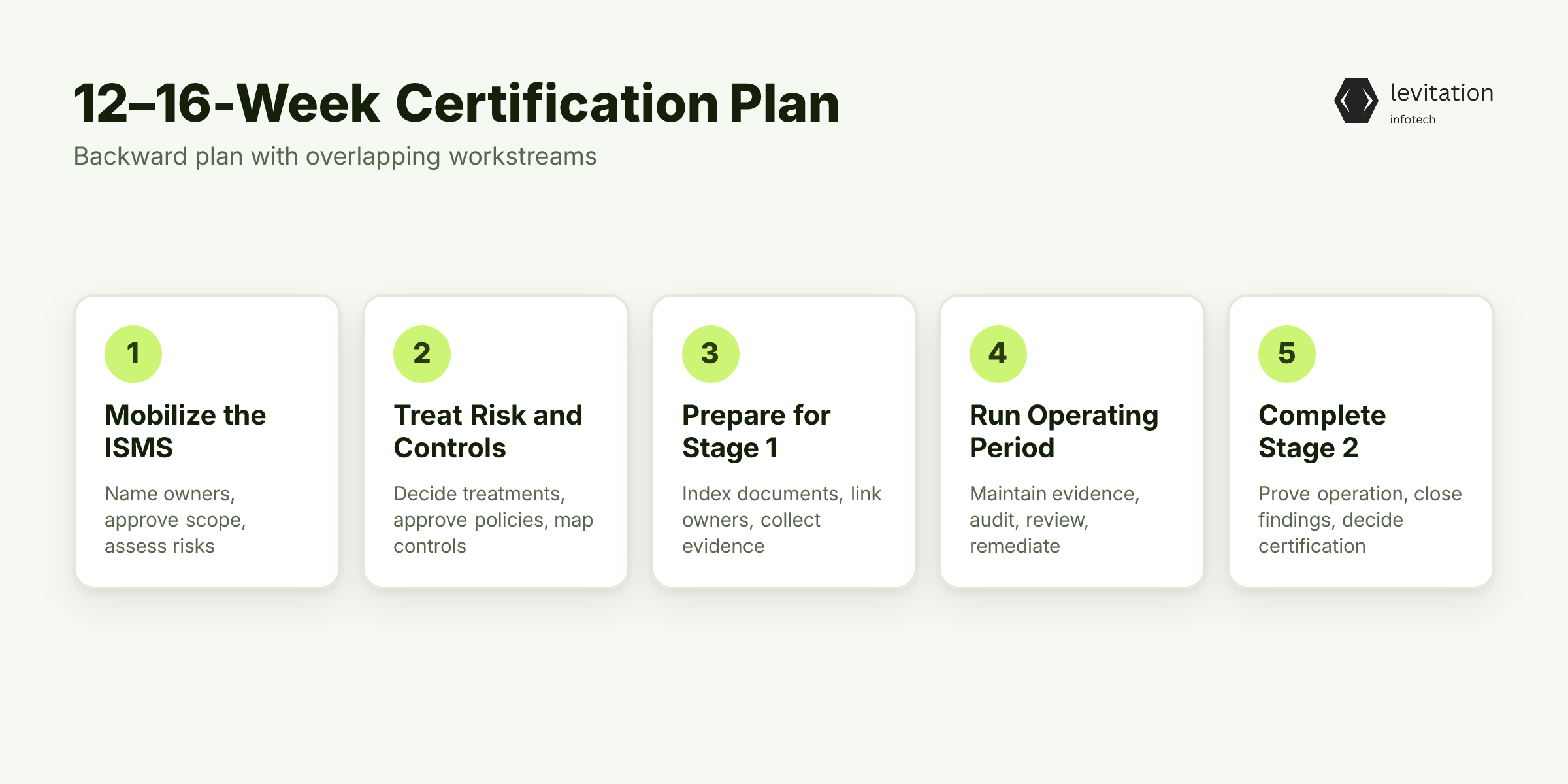
Workstreams overlap. Dependencies don't.
Mobilize the ISMS
Appoint an executive sponsor and an accountable ISMS owner. Approve the scope, risk criteria, and assessment method. Then identify the priority information and processes.
Expect an approved scope and named owners. Also expect a documented risk method and an initial risk assessment. This should happen before later policy work creates rework.
Treat Risk and Implement Controls
This phase overlaps mobilization. Early risk findings often change the scope.
Complete the current risk assessment. Record treatment decisions. Approve the smallest useful policy set. Map applicable controls and close gaps in the control set.
Control mapping without operation is theatre. Before the control can count as ready, three things must exist. It needs a named owner, a working procedure, and a regular record.
Prepare for Stage 1
Index the required management-system documents. Connect every policy and control to an owner. Collect sample operating records.
A brief audit window makes clear links vital. Without clear links, that checkpoint becomes a warning rather than progress.
Run the Operating Period
Maintain the ISMS through the required operating period. This period is usually at least three months. During that period: - Preserve dated evidence as activities occur. - Complete internal audits across the ISMS scope. - Conduct management review with recorded decisions. - Track corrective actions through closure. - Update risks, controls, and evidence as operations change.
Don't recreate records after the fact. An auditor should be able to follow the full sequence from decision to activity to record.
Complete Stage 2 and the Certification Decision
Use the evidence register to show that the ISMS operated and worked well. Close any remaining findings before the certification decision.
The 12-16-week range is a planning baseline, not a guaranteed outcome. Mature organizations can compress readiness toward eight weeks. A first-time ISMS built from scratch can extend toward six months.
Budget around three checkpoints: - Readiness and remediation: Risk work, building controls, internal audit, and management review. - Initial certification: Certification body fees and Stage 2 closure. - Maintenance: Annual surveillance and recertification through the three-year cycle.
For every milestone, record the responsible owner and required output. Also record each dependency, deadline, and escalation path. Use the ISO 27001 timeline template to make those dependencies explicit.
Before signing a certification body agreement, review certification body proposals against the intended scope and audit window. A convenient date shouldn't set your operating schedule.
A backward plan only works if the evidence would survive an auditor's first pass. Would yours?
The ISO 27001 Stage 1 Readiness Checklist
Treat Stage 1 as a dress rehearsal, not a document upload.
Governance and Scope
Verify that sponsorship and responsibilities are documented and approved. Also verify that the ISMS scope, management responsibility, and decision authority are documented and approved.
Ask one hard question. Can the accountable owner explain why each service or location is inside the scope?
Risk and Treatment
Confirm that one consistent chain links risk criteria, the current assessment, treatment decisions, which controls apply, and ownership.
A missing reason matters. An auditor should be able to trace a selected control to the risk that made it necessary.
Policy and Control Set
Check that required management-system policies and Annex A control procedures are current and approved. They should also match the real work setting.
Published policy proves approval. It does not prove that people followed the procedure.
Operating Evidence
Sample records across organizational, people, technological, and physical controls. Each record should have an owner and a date. It should also have a clear link to a risk or control.
For AI-heavy environments, extend the sample beyond conventional IT controls. Our earlier analysis of AI controls an ISO 27001 audit can miss provides a useful extension.
Audit and Improvement
Check that internal audits and the management review are complete. Also check corrective actions and records of ongoing improvement. Don't assume policy publication proves operation.
Use the ISO 27001 Stage 1 readiness checklist as the basis for a mock audit. Index the documents and walk through sample evidence. Record gaps and assign corrective actions before an auditor finds them.
The ISO 27001 internal audit guide helps test whether internal findings receive real follow-through.
Track readiness through practical indicators: - Percentage of controls with current evidence. - Overdue risk treatments. - Open audit findings. - Days since the newest evidence was produced.
Stage 1 mainly tests written proof of readiness. Stage 2 checks whether the ISMS worked well after the required operating period.
Once readiness is real, the only commercial question is what the three-year commitment will cost.
ISO 27001 Certification Cost Is a Three-Year Decision
Certification cost starts before the auditor arrives. It also continues after the certificate is issued.
Your total cost includes: - Readiness work, including risk assessment, treatment, and building controls. - Internal audit and management review. - Certification body fees for Stage 1, Stage 2, and certification. - Maintenance and surveillance after certification. - Fixes required between audit periods.
The certificate stays active through a three-year certification cycle. Annual surveillance audits cost about ₹60,000-₹80,000 each. Recertification follows in year four.
Ask for an initial quote split into readiness, audit, remediation, and maintenance. That keeps remediation visible instead of hiding it in one broad fee. Our article on technical debt hidden in Indian ISO 27001 quotes explains why that distinction matters.
An ISMS can strengthen trust among enterprise buyers when an outside party assesses it. It can also reduce repeat customer security forms and make control evidence easier to reuse. Buyers aren't purchasing a PDF. They're buying confidence that risk decisions connect to controls and records.
Our analysis makes the same point. It appears in why Indian SaaS founders buy SOC 2 when buyers want ISO 27001. The buyer's trust depends on usable evidence, not a preferred framework.
A cost assessment starts with four inputs. These are the planned certification date, proposed scope, current control evidence, and gaps that need fixes. Use the same scope and operating plan to compare certification body proposals.
If the Stage 2 date is fixed, cost becomes answerable. If it isn't, every quote carries hidden schedule risk. Which timeline should anchor your quote: eight weeks, 12-16 weeks, or five to six months?
Frequently Asked Questions
How long does ISO 27001 certification take in India?
Use 12-16 weeks from kickoff to certificate as the practical planning baseline. A mature security setup can compress readiness work toward eight weeks.
A first-time ISMS built from scratch can take five to six months. The final limit is the required evidence from daily use.
How long does the Stage 1 audit take?
Most Stage 1 audits last one to three days. They focus on documents. This short duration does not replace the work before it.
Stage 2 usually takes place after at least three months of ISMS operation. This means policies, risk assessment, controls, and evidence must be ready before Stage 1.
How much does ISO 27001 certification cost in India?
The price is not the same for everyone. Cost depends on scope, existing controls, remediation effort, and the certification body selected.
About the author
Mayank Singh is a software developer at Levitation Infotech, where he builds web and AI-powered applications across the company’s fintech, healthcare, and enterprise projects.