


TL;DR: ISO 27001 certifies that your information security management system (ISMS) manages security risks. It manages them against your own declared criteria. DPDP is a statutory law. It demands evidence of lawful processing, valid consent, retention limits, and data principal rights. A valid ISO 27001 certificate does not exempt you from DPDP. Most first-time DPDP audits on ISO-certified companies surface major nonconformities. These are unrelated to firewalls or encryption.
Key Takeaways: - ISO 27001 answers "is this data protected?" DPDP asks "should this data be collected at all, and did the person agree?" - ISO 27001 is a voluntary management system. DPDP is a law with financial penalties for non-compliance. - Extending your existing ISMS scope to include DPDP is faster and cheaper. It is faster than running two parallel compliance programs.
The Compliance Illusion Hiding Behind Your ISO 27001 Certificate
You spent 18 months and several lakhs earning your ISO 27001 certificate. You walk into a DPDP audit feeling prepared. Three weeks later, the auditor flags 14 nonconformities. None of them touch your firewalls.
The certificate looks official. The auditor's questions feel familiar. This lasts until they ask about consent records for a 2023 onboarding flow. Then the room goes quiet.
How do you determine retention for data you've stopped using? Who responds when a data principal asks to be forgotten on a Sunday night?
Your ISMS has no documented answer. You have 90 days to fix the minor nonconformities. However, the gap is structural, not procedural.
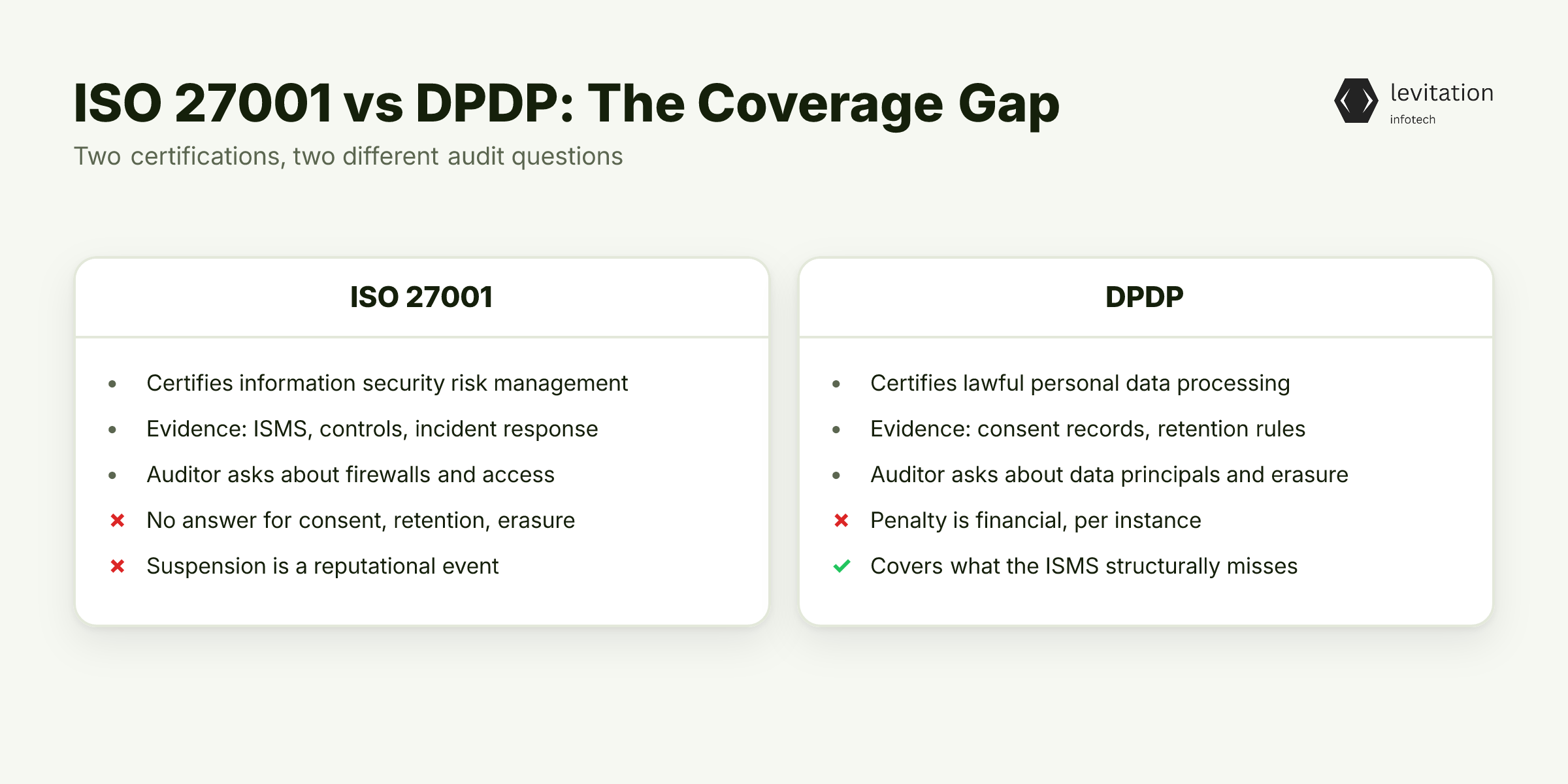
Here is the part most CISOs miss. ISO 27001 certifies that you manage information security risks. DPDP certifies that you process personal data lawfully. These are different questions with different evidence.
An ISO 27001 suspension is a reputational bump. A DPDP penalty is a financial event. It comes with statutory exposure that compounds per instance.
Your ISO 27001 certificate gives you a false sense of coverage. It does not protect you from the one thing regulators now ask about. That one thing is how you collect, use, and erase personal data under Indian law. If you handle employee records, customer onboarding, or vendor data, you are already in scope.
But your auditors told you the ISMS was solid. So where exactly does the protection stop?
What ISO 27001 Actually Audits, and What It Deliberately Doesn't
ISO 27001:2022 covers 93 Annex A controls across four themes. These themes are organizational, people, physical, and technological. Every one of them is evaluated against the classic triad. That triad is confidentiality, integrity, and availability. The auditor checks whether your security controls protect information from unauthorized access, accidental loss, and disruption.
The framework is voluntary and risk-based. You define your scope. You define your assets. You define your acceptable risk levels.
The auditor then checks whether your ISMS matches your own claims. This is a management system standard, not a privacy law.
ISO 27001 does not require any of the following: - Lawful basis for processing personal data - Consent artifacts linked to specific processing activities - Data principal rights workflows (access, correction, erasure, grievance) - Retention schedules tied to processing purpose - Breach notification timelines to regulators or data principals
The standard's privacy control, Annex A.5.34, is a single control in a list of 93. It is not a privacy program. It is a security control that acknowledges PII exists.
The critical distinction: ISO 27001 asks "is this data protected?" DPDP asks "should this data be collected at all, and did the person agree?" These are not adjacent questions. They are unrelated. They ask fundamentally different things.
A perfectly encrypted database of unlawfully collected data is still a DPDP violation.
So if ISO 27001 doesn't answer those questions, what does a DPDP auditor actually demand?
The DPDP Audit: Different Questions, Different Evidence
DPDP is law, not a management system. Auditors evaluate against statutory obligations. They evaluate under the Digital Personal Data Protection Act, 2023. They do not evaluate against a self-defined risk appetite.
There is no "scope" you can carve out. If you process digital personal data of data principals in India, you are in scope.
Core audit domains include: - Lawful processing with consent or legitimate use as defined under the Act - Notice to data principals before or alongside consent capture - Accuracy and retention limits tied to processing purpose - Data principal rights: access, correction, erasure, and grievance redressal - Breach notification to the Data Protection Board and affected principals
Evidence DPDP auditors want looks nothing like an ISMS risk treatment plan. They want consent logs with timestamps. They want versioned privacy notices. They also want a link to the specific processing activity each consent authorizes. They also want Records of Processing Activities (ROPA) per data category.
Other evidence includes Data Protection Impact Assessments for high-risk processing. Auditors also expect provable mechanisms for children's data handling where applicable. Finally, they want a named grievance officer. They want documented response SLAs and a public contact channel.
Where ISO 27001 gives you a "risk treatment plan," DPDP demands a "lawful processing register." Most ISMS implementations never built one.
Your risk register tracks assets. A lawful processing register tracks purposes, legal bases, and retention triggers. The mental model is different.
Our analysis of DPDP compliance gaps shows a clear pattern. Organizations with mature ISMS still miss most statutory evidence requirements on first pass. The reason is structural. The evidence formats required by law differ from the risk treatment plans an ISMS produces. They differ in structure, not just in name.
That's the theory. The practical question for a CISO is which existing ISO 27001 controls can be extended. The other question is which must be built from scratch.
The Gap Map: Where ISO 27001 Stops and DPDP Begins
Not every control in your ISMS is useless. Some translate directly. Others need extension. A few must be built from zero.
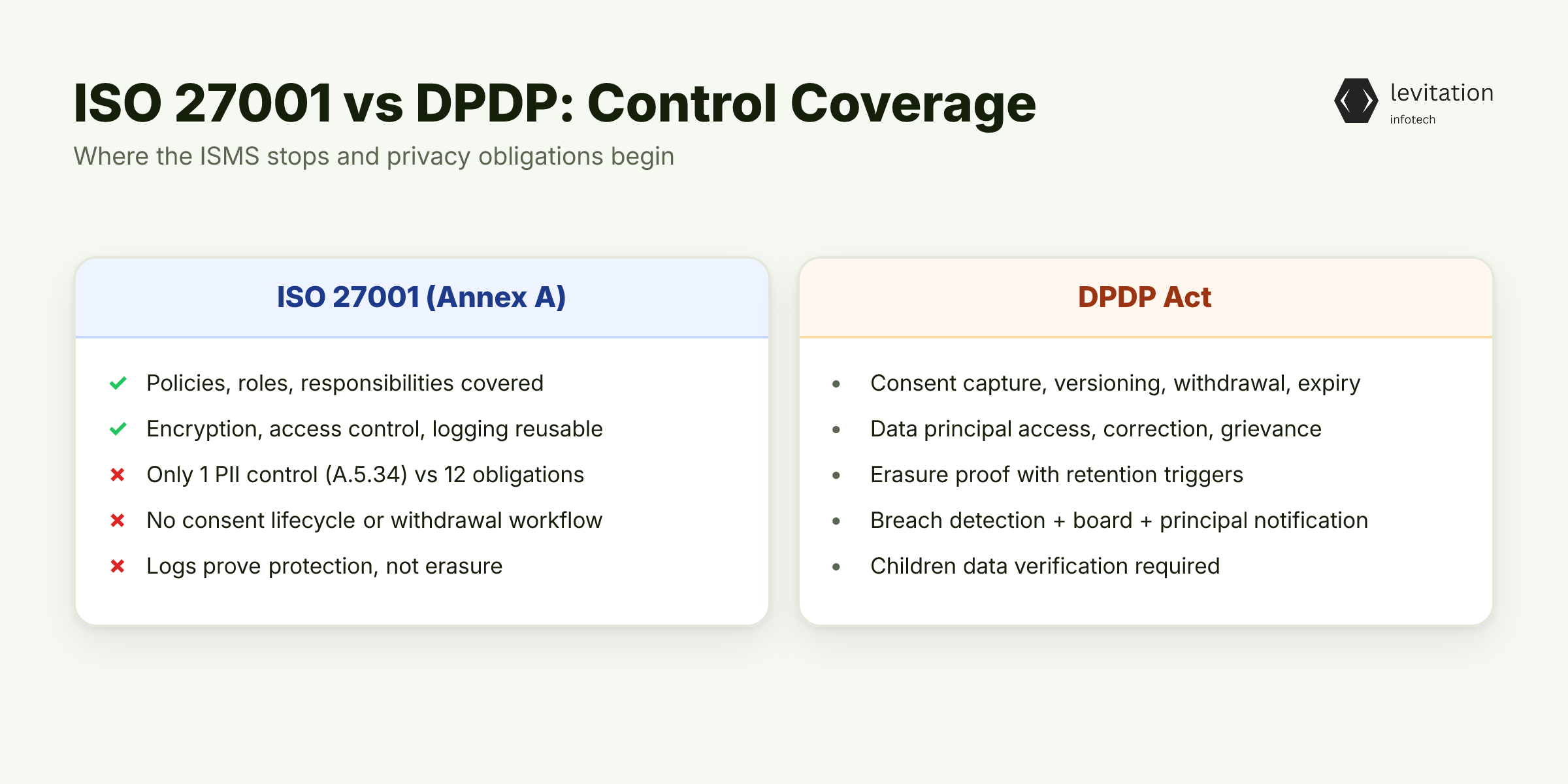
Annex A.5 (Organizational) covers policies, roles, and responsibilities. It does not require consent management or data principal rights workflows. You can extend your existing policy framework. However, the control family for privacy operations is new.
Annex A.8 (Technological) covers encryption, access control, and logging. These are largely reusable. The twist is this. A DPDP auditor will ask whether your access logs prove erasure, not just protection. "Was this data deleted on request?" is a different log query than "Who accessed this record?"
Annex A.5.34 (Privacy and PII) is the closest ISO 27001 gets to a privacy control. It is one control out of 93. DPDP requires evidence across at least 12 distinct obligations. These include consent capture, consent withdrawal, notice versioning, and purpose limitation. They also include retention triggers, erasure mechanisms, and data principal access requests. Additional items cover correction workflows, grievance handling, breach detection, breach notification, and children's data verification.
Three control families DPDP forces you to add to your ISMS scope: - Consent lifecycle management: capture, versioning, withdrawal, and expiry - Data principal rights workflow: intake, identity verification, fulfillment, and audit trail - Breach notification orchestration: detection, assessment, board notification, and principal communication
None of these exist in a typical Statement of Applicability built before 2024.
ISO 27701 is the privacy extension to ISO 27001. It gets you closer. It provides a Privacy Information Management System (PIMS) structure.
But it is still a voluntary management system standard. It is not a substitute for statutory compliance evidence. ISO 27701 references consent and data principal rights. It does not generate the artifacts a DPDP auditor expects.
The gap is real, but it is also narrower than it looks. Here's how CISOs are closing it without rebuilding their ISMS from scratch.
Bridging the Gap Without Doubling Your Audit Budget
The worst response is to treat DPDP as a separate program. That doubles your audit spend. It doubles your evidence repositories. It also creates conflicting narratives during management review. The right approach is to extend your existing ISMS. You absorb DPDP as a regulatory requirement within the same scope.
Step 1: Extend your ISMS scope explicitly. Update your Statement of Applicability to include DPDP as a regulatory requirement your ISMS addresses. This lets one audit cycle cover both frameworks. It also signals to your certification body that privacy is in scope.
Step 2: Build a consent management layer. This single artifact answers a large share of DPDP audit questions. Capture consent with a timestamp. Store the versioned privacy notice shown to the user. Link each consent record to the specific processing activity it authorizes. When consent is withdrawn, the system must propagate that withdrawal to all downstream processing.
Step 3: Stand up a data principal rights workflow. Use your existing ticketing or GRC tool rather than buying a standalone product. Document response SLAs, assign ownership, and ensure every request leaves an audit trail from intake to closure.
Step 4: Add a Records of Processing Activities (ROPA) register. Most organizations already track assets in a configuration management database. The gap is in linking assets to processing purpose, legal basis, and retention trigger. This mapping turns an asset inventory into a lawful processing register.
Step 5: Run a mock DPDP audit 60 days before the real one. Use the same evidence checklist a statutory auditor would apply. Specialist teams outperform in-house builds here. The reason is that the control templates and evidence formats are pre-validated across multiple audit cycles.
A typical specialist deployment completes faster than an in-house build. This is because templates absorb regulatory updates across multiple production cycles.
The engineering bar matters. Platforms running in production across multiple ISO 27001 and DPDP cycles have absorbed regulatory updates. A first-year build will miss these updates.
This is one reason teams like Levitation focus on pre-validated control libraries. They focus on these rather than greenfield privacy stacks. The cost of getting retention logic wrong on day one is far higher. It is far higher than the cost of licensing a proven template.
So what does the organization look like once both certifications are in hand? What does it look like when the unified program is operational?
What Changes When ISO 27001 and DPDP Run on One Program
Audit fatigue drops sharply. One ISMS review covers both. One evidence repository serves both. One management review meeting addresses both.
Teams that previously ran parallel compliance cycles report real gains. They consolidate duplicate evidence collection. They consolidate control testing. They also consolidate internal audits into a single rhythm.
Customer onboarding accelerates. Enterprise procurement teams increasingly ask for both ISO 27001 and DPDP evidence in the same questionnaire.
A unified program means one response, one set of documents, and one audit cycle to reference. Sales cycles shorten because security and privacy reviews finish at the same time.
Regulator confidence grows. When your data protection and information security evidence come from one source of truth, your responses are faster. They are also more defensible. This covers breach notifications and regulatory queries. You can show consent records, access logs, and erasure timestamps from one system. You don't need to stitch evidence across disconnected tools.
Long-term, unified programs are easier to maintain. Every regulatory update touches one control set. Every internal audit tests one set of evidence.
The operational drag that makes stitched-together compliance programs fail in year three does not appear.
The organizations that win on DPDP are not the ones with the most controls. They are the ones whose evidence tells a consistent story across security and privacy. They tell this story on demand, without a fire drill. Programs that treat privacy as a first-class concern, not a bolt-on, compound their advantage. They gain this advantage with every audit cycle.
The deeper test comes when a breach hits at 2 a.m. The unified evidence chain becomes the difference. The difference between a contained incident and a public penalty.
Frequently Asked Questions
Can a company with ISO 27001 certification still fail a DPDP audit?
Yes. ISO 27001 certifies that your ISMS manages information security risks against your own defined criteria. DPDP is a statutory law that evaluates lawful processing, consent, retention, and data principal rights.
A valid ISO 27001 certificate does not exempt you from DPDP obligations. Most first-time DPDP audits on ISO-certified companies surface major findings. These findings are unrelated to encryption or access control.
Does ISO 27001 cover the Digital Personal Data Protection Act requirements?
Only partially. ISO 27001:2022's Annex A.5.34 (privacy and protection of PII) is a single control. DPDP requires evidence across consent management, data principal rights, breach notification, grievance redressal, and children's data handling.
None of these are individually required by ISO 27001. Extending the ISMS scope to explicitly include DPDP is the standard fix path.
How long does DPDP compliance take if we already have ISO 27001?
If your ISMS is mature and your Statement of Applicability is extensible, the DPDP layer can be added quickly. It can be added through a specialist deployment. In-house teams attempting this without privacy-specific templates typically take much longer. The reason is that control mapping, evidence formats, and consent workflows all have to be designed. They have to be designed from scratch. Industry analyses of ISO 27001 implementation costs show how hidden work grows. This happens when scope extension is not planned upfront.
Is ISO 27701 enough for DPDP compliance?
No. ISO 27701 is a privacy management system standard that extends ISO 27001. It brings you closer to DPDP alignment, but it remains a voluntary framework.
DPDP requires statutory evidence. This includes consent records, data principal rights workflows, breach notification timelines, and grievance handling. ISO 27701 references these obligations. It does not generate the artifacts a DPDP auditor expects to see.
What evidence do DPDP auditors prioritize?
Consent logs with timestamp and version linkage to privacy notices. Records of Processing Activities per data category. Data principal rights fulfillment records. Breach notification procedures with tested timelines. A documented grievance officer with public contact details. Organizations already familiar with purpose limitation through their data governance work find the ROPA mapping easier. They find it easier to build.
A focused gap assessment against DPDP shows which ISO 27001 controls translate. It also shows which need new evidence.
About the author
Mayank Singh is a software developer at Levitation Infotech, where he builds web and AI-powered applications across the company’s fintech, healthcare, and enterprise projects.