


TL;DR: About 70% of Indian defence tech bids are rejected at the TRL 6 stage. They are rejected almost always for procedural and documentation failures rather than technology gaps. The fix is not a better prototype. Instead, it is a pre-bid compliance audit. This audit maps your evidence to the evaluation matrix before submission. Founders who run structured pre-bid audits report TRL 6 pass rates well above the unaudited baseline.
Key Takeaways: - TRL 6 is a documentation gate under DAP 2020, not just a technology milestone. Most founders treat it as the latter. - Missing security clearance alone accounts for 35% of TRL 6 rejections, yet founders sequence it as an afterthought. - Pre-bid compliance audits compress readiness timelines. They do this by reusing battle-tested evaluation templates rather than building a method from scratch.
In January 2025, Larsen & Toubro, India's largest engineering conglomerate, lost a Rs 70,000 crore submarine contract. The defence ministry didn't reject the bid because the technology was bad. The bid was deemed non-compliant with the Indian Navy's requirements at the technical evaluation stage. A major defence player, with decades of shipbuilding experience, was screened out at the same gate. That gate filters roughly 70% of all Indian defence tech bids. It is the TRL 6 compliance check. Most founders never see this gate coming.
The TRL 6 Graveyard: Where 7 in 10 Defence Bids Quietly Die
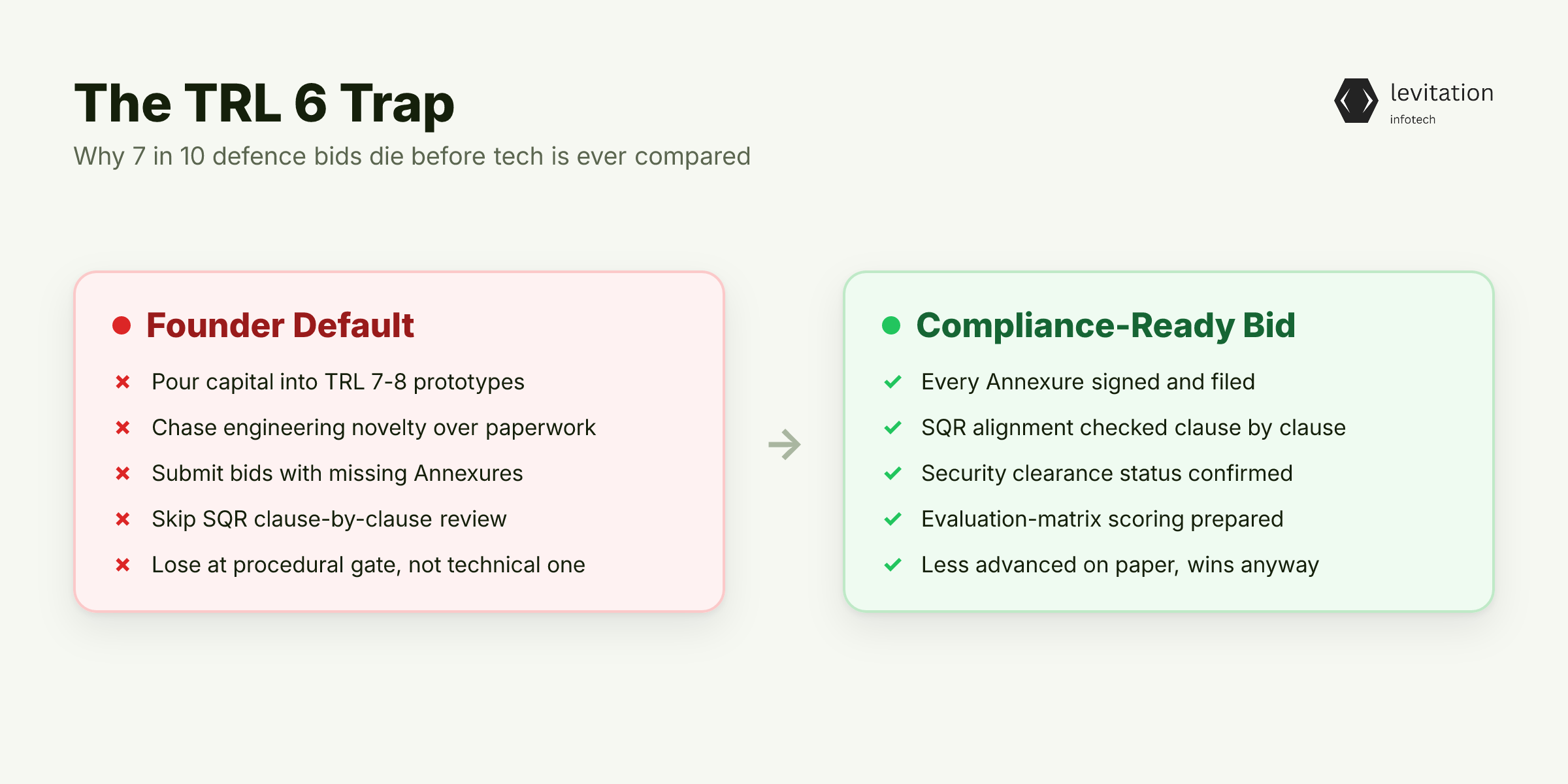
L&T's submarine bid is not an outlier. It's the visible tip of a pattern. That pattern costs India's defence tech ecosystem years of wasted runway. Research on Indian defence procurement shows about 70% of bids get rejected at the TRL 6 stage. This happens long before any head-to-head technical comparison.
Why TRL 6 specifically? It sits at a unique intersection. On one side, it's where "shown in relevant environment" becomes the technical maturity threshold. On the other, it's the gate where DAP 2020's procedural machinery takes over. That machinery covers SQR alignment, security clearance status, Annexure completeness, and evaluation-matrix scoring. The technology stack and the compliance stack collide here. Only those who prepared for both survive.
Deep-tech founders assume the prize is technological maturity. They pour capital into TRL 7 and TRL 8 demonstrations, field-deployable prototypes, and pilot runs. Meanwhile, evaluators at TRL 6 are screening for procedural completeness, not engineering novelty. A bid that looks "less advanced" on paper but has every Annexure signed will outscore a technically superior rival. That rival has a missing undertaking. The win holds as long as every SQR clause is addressed.
This is a founder-specific trap. Deep-tech talent is trained to over-invest in the technical work and under-invest in the paperwork. The result is a graveyard. It sits at exactly the level where compliance, not innovation, decides who advances. Understanding defence procurement readiness is the first move out of this trap.
If the rejection happens at TRL 6, the technology itself isn't the problem. So the obvious fix, "build a better prototype," is exactly the wrong move.
Why 'Better Technology' Doesn't Win These Bids
DAP 2020 is a sequential, compliance-heavy framework by design. Each stage has its own gate, its own paperwork, and its own evaluators. The framework rewards discipline. The bidder who documents every prior TRL level wins the procedural rounds. They also map evidence to SQR clauses. They also file security clearances early. They win regardless of how novel their technology is.
The perverse incentive is structural. Founders invest extended R&D cycles pushing demos to TRL 7 or TRL 8. Evaluators at TRL 6 are screening for completeness at TRL 6. They are not admiring the bidder's roadmap. The evaluators' scorecard asks: did you show your work in a relevant environment? Did you align with the SQR? Is your security clearance active? It does not ask: how impressive will your TRL 8 demo be?
The failures are almost embarrassingly preventable: - Vague scope statements written for the founder's vision, not the tender's exact language. - Late submissions that miss upload windows by minutes. - Annexure mismatches where the bid references a form number that doesn't match the current tender template. - Unsigned undertakings that auto-disqualify a technically excellent bid.
None of these are technology problems. They're documentation discipline problems. They screen out bids that would have been competitive on merit. The DRDO proposal rejection patterns data shows this is the dominant failure mode, not capability gaps.
The obvious playbook, "more R&D, better prototypes, larger demo budgets," deepens the problem. It wastes runway on the wrong battle.
So if technology quality isn't the filter, what is? The research points to three specific, measurable failure modes. These three modes account for the majority of rejections.
The Three Silent Killers Behind TRL 6 Rejection
Most TRL 6 rejections collapse into three categories. Each is preventable with the right pre-bid work.
Killer #1: Missing security clearance. This single factor accounts for 35% of rejections on average. Yet founders routinely treat it as a downstream formality. Security clearance for defence bids is not a checkbox. It is a months-long process involving facility inspections, personnel vetting, and inter-agency coordination. Bidding without an active clearance is like applying for a loan with no credit history. Evaluators don't bend the rules.
Killer #2: Scope ambiguity. Bids written for the founder's vision rather than the tender's exact language get filtered as non-responsive. Indian procurement is literal. If the tender says "shown in Indian tropical coastal conditions," a lab simulation at 20 degrees Celsius doesn't qualify. It doesn't qualify no matter how rigorous the method. Founders who mirror the SQR's phrasing in their scope statements pass. Founders who paraphrase get screened.
Killer #3: Submission mechanics. Late uploads, mismatched Annexures, unsigned undertakings, and incorrect file formats get zero second-look treatment. The evaluation system treats these as automatic disqualifiers, not as fixable issues. An extended engineering effort can die because one PDF was named with the wrong convention.
These three killers are not independent. They're symptoms of a single root cause. That cause is a gap between what the bidder assumes matters and what the evaluation matrix actually scores. The TRL assessment cost in India conversation is really about closing that gap. It should be closed before the bid lands, not after the rejection arrives.
Understanding the three killers is necessary but not enough. The deeper problem is that most founders misread what TRL 6 itself demands in the Indian context.
What TRL 6 Actually Demands (And Why Founders Misread It)
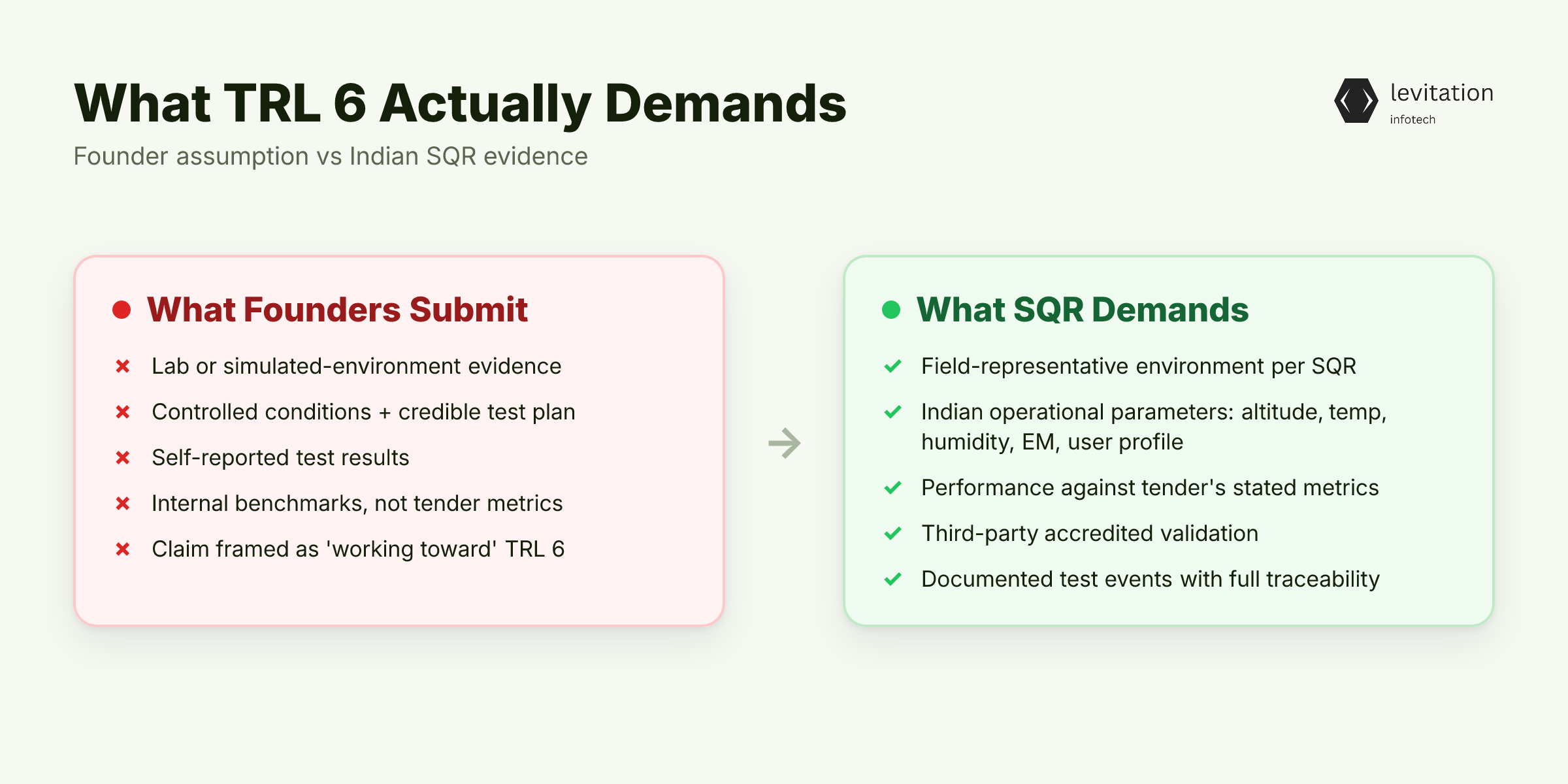
Globally, TRL 6 means "system or subsystem model or prototype shown in a relevant environment." That's the textbook definition. In Indian defence procurement, the definition is tighter. The difference is where bids go to die.
Indian evaluators expect documented alignment with the tender's specific Service Qualitative Requirement. They expect the demo to have happened in field-representative conditions. They expect it to use Indian operational parameters: altitude, temperature range, humidity, electromagnetic environment, and user-operator profile. A prototype that worked flawlessly in a Scandinavian winter test campaign doesn't satisfy the SQR. It won't satisfy the SQR for a system the Indian Army will deploy in the Thar desert.
Most founders submit lab or simulated-environment evidence. They assume that controlled conditions plus a credible test plan equals TRL 6. In the Indian context, that evidence lands as TRL 5 at best. Then it gets bounced.
The audit checklist that separates a passing bid from a failing one looks like this: - Representative environment definition: does the test setting match the SQR's stated operational conditions? - Test plan traceability: can every claimed TRL 6 outcome be traced to a specific test event with documented results? - Performance against SQR: does the evidence show performance against the tender's metrics, not just the bidder's internal benchmarks? - Third-party validation: is there independent verification, or only self-reported claims?
This last point matters more than founders realize. Evaluators treat self-reported test results as marketing. The same finding, validated by an accredited external lab, becomes evidence. Founders who grasp the distinction between explainable claims and auditable evidence build bids that survive scrutiny.
There's also a critical distinction evaluators enforce. It is the line between "achieved TRL 6" and "working toward TRL 6." A technology that has met all prior levels and shown the current one is "at" TRL 6. A technology still completing TRL 5 milestones while claiming TRL 6 readiness is "working toward" it. That technology gets rejected at the gate. The TRL assessment India process is built to surface this distinction before submission, not after.
Once you know what TRL 6 actually scores, the next question arrives. Should you self-audit or bring in external assessors? What does that decision cost in both time and money?
The Pre-Bid TRL Audit: A Founder's Battle Plan
A pre-bid TRL audit is not a research project. It's a focused, structured review of your evidence against the evaluation matrix. It should be completed before you write a single line of the bid document. Here's the sequence that works.
Step 1: Map every TRL 6 requirement in the tender's SQR to your existing evidence. Do this in a gap matrix. List each SQR clause. For each clause, mark "covered," "partial," or "missing." This matrix is the foundation. Every other audit step flows from it. Until you've done this, you don't know what your bid actually has to show.
Step 2: Run an external TRL readiness audit before the bid window opens. An external team benchmarks your submission against DAP 2020 evaluation criteria. They use templates built from prior defence bids. The compressed timeline comes from existing method, not from cutting corners. In-house teams typically take far longer to reach the same confidence level. They take longer because they're building the playbook from zero. The TRL audit cost breakdown conversation always comes back to this speed advantage. Faster readiness means more tenders you can bid on per year. The compliance audit cost math follows the same logic in adjacent regulated industries.
Step 3: Sequence the security clearance application well before bid submission, not at the same time. Treating clearance as a parallel workstream guarantees it will arrive late. Treat it as a critical-path predecessor, and you control the timeline. The security compliance gap in adjacent regulated sectors follows the same pattern. Clearance is always a predecessor, never a parallel track.
Step 4: Build a compliance evidence binder organized by evaluation-matrix row, not by your org chart. Evaluators don't care that your firmware team sits on a different floor from your testing team. They care that row 7 of the matrix has a valid test report attached. Organizing evidence by matrix row makes the bid writer's job mechanical. And mechanical is fast.
Teams that run this structured audit process don't just win single bids. They build a reusable compliance engine. The framework compounds across tenders, not single wins. The cost-benefit math is what most first-time defence bidders underestimate.
What Changes When You Audit Before You Bid
The shift is from "hope the tech speaks for itself" to "control the evaluation matrix." The research on TRL 6 rejection rates makes the gap obvious. Unaudited bids face a 70% rejection rate. That figure is driven by preventable procedural errors, not by technology gaps. A structured pre-bid audit addresses the exact failure modes the research identifies. Teams that make this process standard stop showing up at the TRL 6 graveyard.
The runway math is straightforward. Every avoided rejection saves the founder from re-bidding. It also saves legal review, opportunity cost, and team morale damage. That damage compounds with each failed attempt. Losing a major bid at TRL 6 because of a missing Annexure is not just a financial hit. It's a strategic one.
The deeper gain is institutional. The audit framework becomes a reusable asset across DDP, Make-in-India, and iDEX tenders. It is not a one-time expense. Once your binder is organized by evaluation-matrix row, the second bid costs a fraction of the first. Once your security clearance pathway is documented, the savings grow. Once your SQR-mapping template is battle-tested, the savings grow even more. Founders who take this on board stop treating compliance as a cost center. They start treating it as procurement infrastructure.
The contrarian reframe is the one that matters. In Indian defence procurement, the company that audits its compliance wins. The company that builds a better prototype loses. The technology race is won in the lab. The procurement race is won in the binder. Teams that master both win consistently. Teams that master only one keep showing up at the TRL 6 graveyard, wondering what went wrong.
Frequently Asked Questions
Q: What is TRL 6 in defence procurement?
A: TRL 6 means a system or subsystem model has been shown in a relevant environment. In Indian defence procurement under DAP 2020, this also requires documented alignment with the tender's Service Qualitative Requirement (SQR). It also requires Indian operational parameters, not just lab or simulated conditions.
Q: How much does a TRL assessment cost in India?
A: Costs vary based on system complexity, number of subsystems, and the scope of the audit. What is consistent across cases is the size of the cost relative to the value of the bid. The cost of the assessment is small relative to the value of the bid being pursued. A single rejected major bid can waste years of senior engineering time. The audit is best understood as procurement insurance, not a discretionary expense.
Q: Why are DRDO proposals rejected at the technical stage?
A: Research shows roughly 35% of rejections stem from missing security clearance. The rest come from preventable compliance errors. These errors include non-compliance with tender requirements, vague scope statements, and late submissions. Most rejections are procedural, not technical.
Q: How long does a TRL assessment take before a defence bid?
A: A focused pre-bid TRL audit run by an external assessment team typically compresses timelines a lot. It compresses them compared to building the method in-house from scratch. The external team reuses evaluation-matrix templates and prior defence-bid experience. They do this rather than developing them from zero.
Q: Can a TRL audit improve bid success rates for first-time defence vendors?
A: Yes. First-time vendors who complete a structured TRL 6 readiness audit before submission close the gap. They close the gap between what they assume matters and what the evaluation matrix actually scores. The audit primarily catches the procedural errors that screen out otherwise competitive technology.
Sources
Research and references cited in this article:
- National Technology Readiness Level (TRL) Assessment Framework
- PDF Technology Readiness Assessment Best Practices Guide
- Assessment Guide Technology Readiness
- Technology Readiness Level (TRL) - Overview - AcqNotes
- BIRAC-New
- Why Tenders Get Rejected in India: Top 10 Reasons + Fix Guide 2026 | TenderFlow Pro
- How to Write a Winning Bid Proposal (2026 Guide + Examples)
- Tender Document Mistakes That Cause Rejection
- Why Government Bids Get Rejected - BidEasy - InfraLens
- Government Tender Rejection Reasons India 2026 Fix Guide
- How Procurement Strategy Improve Project Cost Control in 2026
- Top Cost Saving Strategies in Procurement for 2026
About the author
Mayank Singh is a software developer at Levitation Infotech, where he builds web and AI-powered applications across the company’s fintech, healthcare, and enterprise projects.