


TL;DR: A production-ready label is not a capacity receipt. Ten million successful transactions can still hide p99 latency, proxy saturation, and control-plane delay. The test must preserve production traffic shape and produce auditable evidence.
Key Takeaways: - Treat 10 million transactions as a controlled validation campaign with explicit acceptance gates. - Compare no-mesh, server-sidecar, and two-sidedcar paths across rate, concurrency, security, and telemetry. - Make approval traceable from each request to its version, configuration, raw metrics, and decision record.
Istio 1.0's Launch Promise Was Not a Capacity Receipt
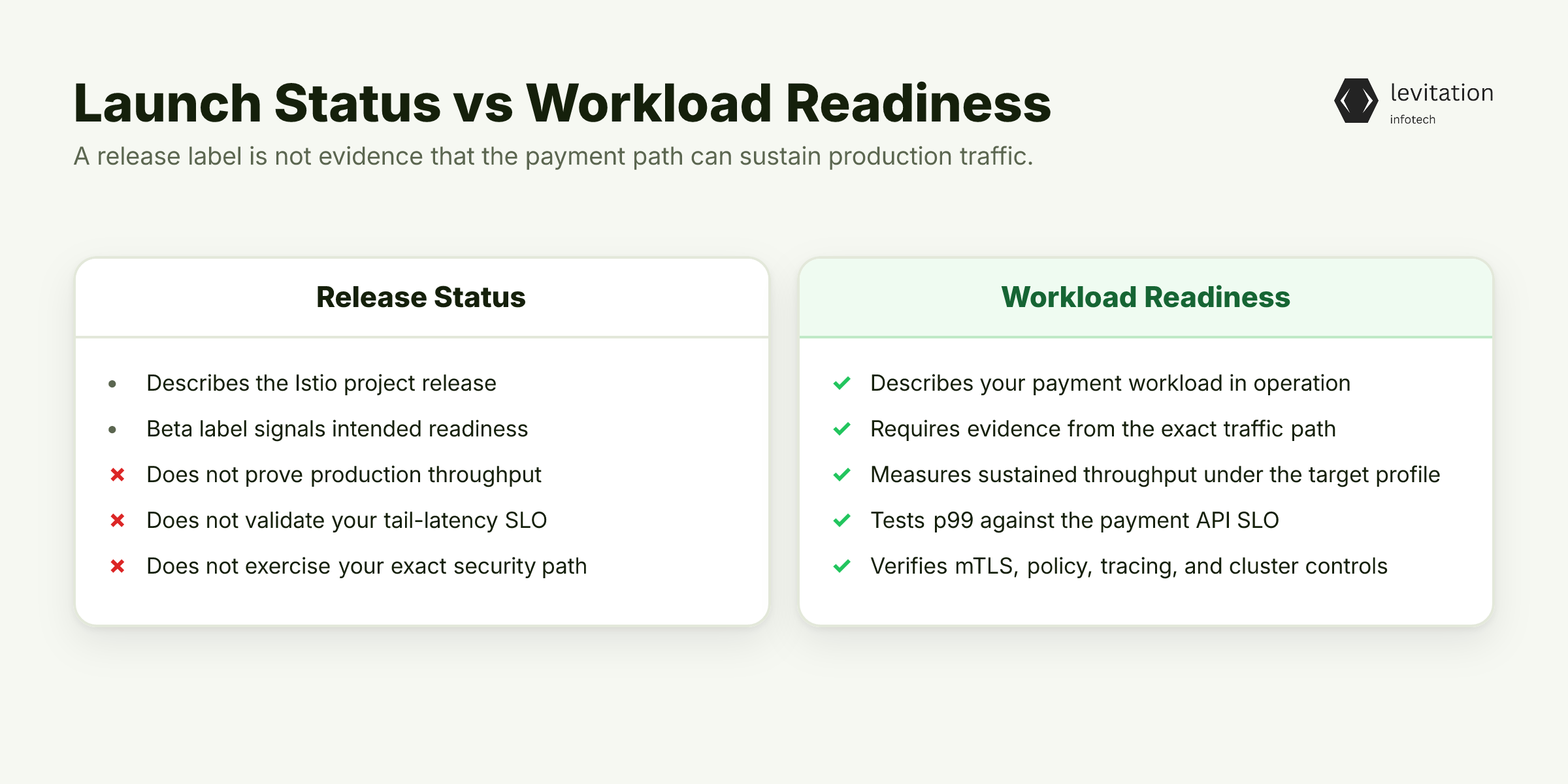
Istio 1.0 sounded production-ready. Your payment API still lacked proof that it could handle production traffic.
Istio 1.0's official announcement marked many existing features as Beta, which it said signaled production readiness. The same announcement treated readiness as an ongoing process of reviews and updates.
That distinction matters. Release status describes the project. Workload readiness describes your system under real traffic, security controls, and operating conditions.
Separate release status from workload readiness
A feature can be declared ready while your payment workload still fails its latency objective. The missing proof isn't another release label. It's evidence from the exact path your traffic will use.
Cloud security is part of this definition, not a later checklist. Cloud security for Kubernetes and mTLS must cover identity, encryption, policy, and cluster controls during the test.
Until that path is tested under real controls, its readiness remains unproven. Can that exact path sustain production traffic without breaching its SLO?
Adoption evidence is not performance evidence
The announcement referenced organizations exploring or using Istio, including eBay, Auto Trader UK, JUSPAY, PubNub, and Trulia.
Those examples show exploration or use. They do not show how your authorization path behaves with your concurrency, payloads, and telemetry.
Two teams can process the same transaction count. One can still miss its p99 objective because requests queue behind proxy workers. Which result would decide your approval?
Frame the challenge honestly
Call this a validation campaign. Don't present it as a pre-existing result or a retroactive verdict on Istio 1.0.
Before traffic starts, translate the CTO's question into measurable gates: - Required sustained throughput under the intended traffic profile. - Tail-latency performance against the payment API's existing SLO. - Intact tracing across every service hop. - Correct mTLS identity and policy behavior. - Acceptable errors, resource headroom, and configuration propagation.
Those gates should derive from the payment API's SLOs, security policy, and production topology. The gap is not whether organizations adopted Istio. It is whether your workload can produce defensible capacity evidence.
That distinction frames the central problem: transaction count alone cannot describe a service mesh benchmark.
Why 10 Million Transactions Proves Almost Nothing Alone
Ten million is an accounting result. A capacity claim needs a workload model.
Convert volume into duration and rate
Ten million requests at 1,000 RPS take 10,000 seconds. At 4,000 RPS, the same count takes 2,500 seconds.
The lower rate creates a longer sustained campaign. The higher rate raises pressure on each second.
A useful run record therefore includes: - Sustained request rate and total duration. - Concurrent client connections. - Burst size, frequency, and recovery gaps. - Request and response sizes. - The proportion of reads, writes, retries, and timeouts.
Without these fields, can two runs with identical totals place very different stress on the mesh?
Hold the workload variables constant
Client connections, target request rate, payload sizes, protocol, proxy workers, CPU allocation, and telemetry filters can all change the result.
Keep them fixed within each comparison. Otherwise, a result can credit the mesh for a lighter payload or penalize it for extra telemetry. Which variables caused the gap?
Define a clear comparison matrix
Run three paths across multiple connection counts and target rates: - No Istio baseline. - Server-sidecar mode. - Client-and-server-sidecar mode.
Run each combination separately because aggregate totals erase where the delay occurred. The result remains meaningful only if the run matches production. Does it?
Reproduce the production environment
A comparison loses meaning when baseline and mesh runs use different settings. Topology, network paths, protocols, payload sizes, worker counts, and encryption settings can all skew the result. Change one dimension at a time when attributing a latency difference.
Use those conditions consistently within the test, and do not treat a generic setup as a production template. Substitute your actual Kubernetes topology, network, security posture, and payment service dependencies.
A service mesh benchmark for custom microservices must preserve the application's request sequence. Otherwise, it measures the wrong system. Does your test preserve that sequence?
Define what “transaction” means
The load generator sees HTTP requests. A business payment transaction may cross several services and produce several requests.
Decide whether the target means 10 million payment operations or 10 million HTTP calls. Do not let ambiguous terminology hide a much larger request load.
A generic endpoint may answer every call identically. A payment API can mix authorization, tokenization, retries, and idempotent writes. Those sequences change connection pressure and backend waiting time.
Average throughput can look healthy while the p99 breaches the payment SLO. Tail contention and two proxy hops remain hidden inside the average. How will your test expose that hidden cost?
Once traffic shape is explicit, test whether the mesh's cost changes as concurrency rises. Do different mesh components also produce different latency profiles?
Concurrency Exposes the Mesh's Real Bottleneck
A fixed latency tax sounds tidy, but a benchmark must test how the mesh responds as loads and settings change.
Quantify data-plane overhead
Use Istio's performance guidance to define hypotheses for client-and-server-sidecar traffic. Measure the added p50 latency relative to the no-mesh baseline. Keep that value separate from total payment latency.
But where does the overhead appear when traffic queues?
Show why the tail matters
Compare p90 and p99 additions at every concurrency and rate.
Tail overhead can grow sharply when proxy workers, CPU, internal contention, or backend queues become strained. A constant shift across all percentiles would miss that behavior.
If configuration and concurrency change the tail, the mesh is not merely shifting every request by a constant amount. Which proxy resource is close to saturation?
Pair latency with saturation
Record Envoy CPU and memory alongside latency and throughput. Rising request pressure can consume proxy CPU before aggregate throughput shows a problem.
These readings aren't a universal sizing law. They show why latency and resource headroom must travel together.
A proxy can meet its throughput target while leaving too little CPU for bursts, TLS work, or telemetry. Can the control plane hide a separate bottleneck?
Separate control-plane and data-plane questions
Istiod configures the data plane. Envoy handles request traffic.
Control-plane demand rises with: - Service and pod counts. - Configuration and deployment changes. - Proxies connecting or reconnecting to Istiod. - The amount of configuration each proxy must store.
Config propagation doesn't add latency to every request. A late policy still creates an operational risk.
Could a newer release's numbers answer those questions for Istio 1.0?
Avoid version leakage
Any figures in the current Istio scalability guidance are useful only as directional reference points. They aren't retroactive proof of Istio 1.0 performance.
Pair proxy telemetry with control-plane timing through Kubernetes observability for service meshes. Also distrust a healthy dashboard; your observability stack can misstate Kubernetes health.
Reference points from newer releases supply a hypothesis, not a verdict for a payment API. What remains unknown is how Istio 1.0 behaves when your production workload supplies the evidence.
Build a Reproducible 10-Million-Transaction Benchmark
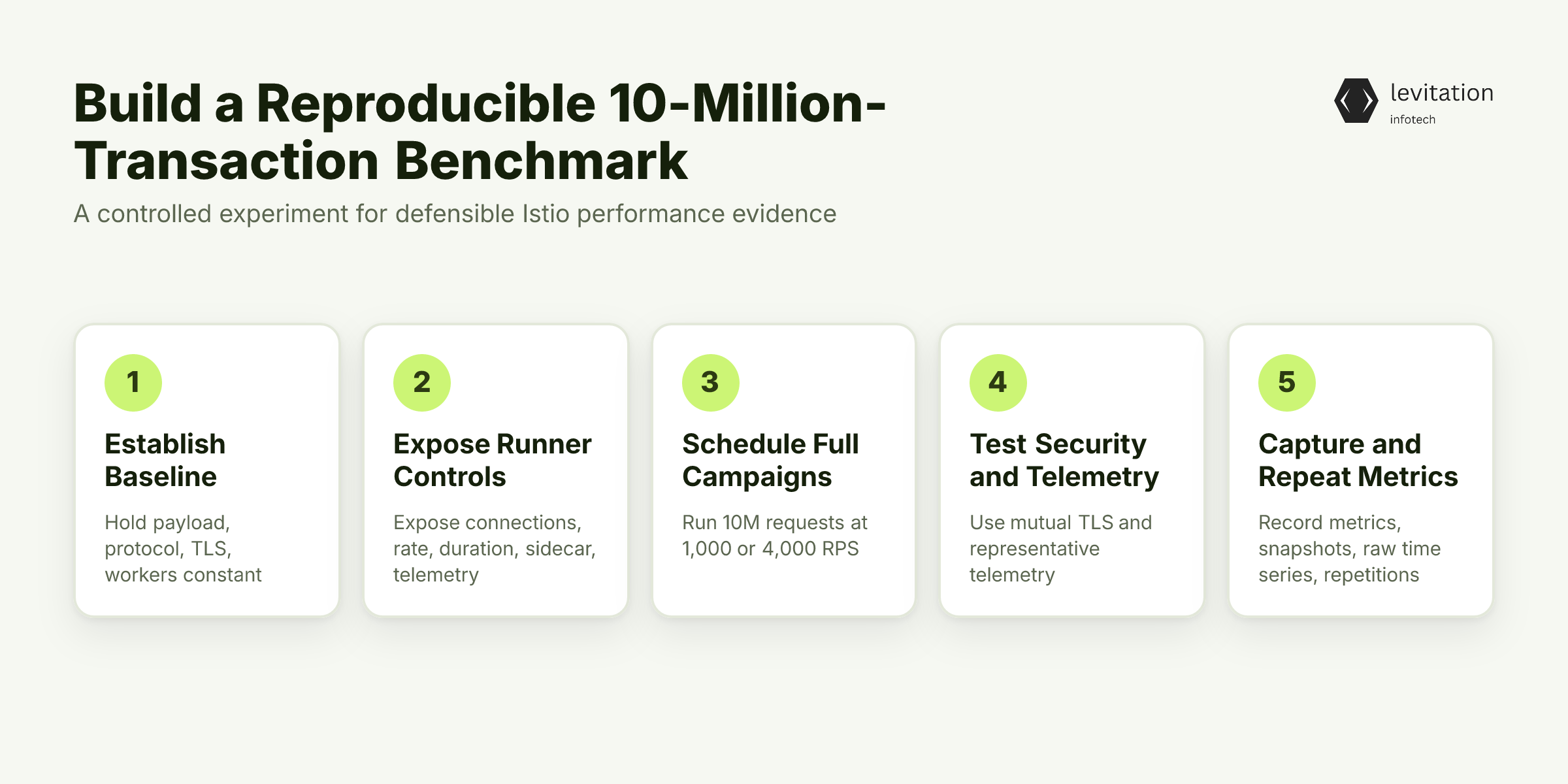
A defensible benchmark is a controlled experiment. Change one dimension at a time, then preserve every observation.
Establish the baseline
Run the same workload without Istio, with a server-side proxy, and with both client and server proxies.
Hold the payload, protocol, TLS setting, proxy workers, and load-generator settings constant. Record each mode separately so one result cannot mask another.
Can the runner expose every variable that affects the result?
Use the upstream runner pattern
Use a benchmark runner that exposes connection, rate, duration, sidecar mode, load-generator, and telemetry settings. Keeping these controls explicit makes each run reproducible.
Short comparison cells can isolate configuration changes. They aren't the 10-million-request campaign. How should the full campaign be scheduled?
Translate 10 million requests into explicit campaigns
Calculate the campaign window from the selected rate: - At 1,000 RPS, allow 10,000 seconds. - At 4,000 RPS, allow 2,500 seconds.
The lower rate sustains load longer; the higher rate compresses the same volume into a shorter window. Preserve your production mix of payment operations, retries, and background calls.
Will the same workload hold at both rates?
Exercise the real security and telemetry posture
Enable mutual TLS and use the production number of proxy workers. The matrix must include telemetry-disabled and representative telemetry-enabled runs.
Across both runs, keep sampling and filters consistent. Tracing overhead must be visible, not silently buried inside the mesh result.
Which decision metrics will capture the result?
Capture decision metrics
Retain more than request totals: - Achieved throughput and error rate. - p50, p90, and p99 latency. - Envoy CPU and memory. - Pod restarts and proxy saturation. - Control-plane configuration-propagation time.
Attach a run identifier and configuration snapshot to every result. That correlation turns scattered charts into usable evidence.
Does one run deserve broad trust?
Repeat rather than extrapolate
Execute the matrix across connection counts and target rates. Retain raw time-series data and document environmental differences.
One successful run proves one run, not a range of operating conditions. Use the Istio performance benchmark setup for APIs and custom backend work to model payment-specific sequences. Keep those sequences identical between baseline and mesh runs.
A completed run still produces numbers rather than audit evidence. For payment APIs, can you trace each number to its request, policy, proxy configuration, and software version?
Convert Payment Tracing Into Audit-Grade Evidence
A screenshot proves someone saw a dashboard. It doesn't prove which configuration produced a payment outcome.
Enable payment API tracing deliberately
Propagate trace context across every service hop. Retain representative traces that connect the request outcome, latency, and mesh configuration active at the time.
Payment API tracing and backend setup should connect business transactions to their underlying service calls. Otherwise, a trace proves little about the complete payment path.
Can that trace also show the cost of watching it?
Measure the observer effect
Measure the difference between the paired telemetry runs while keeping sampling rates and filters consistent.
Tracing that can't explain its overhead can't support a strong audit argument. Measure the difference instead of assuming it is negligible.
What must the evidence bundle preserve?
Preserve an evidence bundle
Archive the following under one run identifier: - Exact Istio version, manifests, proxy settings, and telemetry settings. - Topology, security posture, test parameters, and load-generator settings. - Baseline and mesh results, including raw metrics and time-series data. - mTLS status, identity state, policy state, and configuration-propagation timing. - Representative trace IDs linked to request outcomes and latency.
Use audit-ready mTLS and cloud observability to preserve the control context around each trace. A dashboard can't replace the underlying bundle.
Also retain the policy and identity context. Your Service Mesh mTLS Is a Hidden Backdoor explains why transport encryption alone isn't a complete assurance story.
Can a vendor claim fill any of these evidence gaps?
Separate vendor credibility from benchmark proof
Vendor due diligence and workload proof answer different questions. Published vendor claims can support a general assessment of delivery experience, but they cannot establish Istio 1.0 latency or throughput. The workload run must supply that proof.
With the evidence package defined, production readiness becomes a sequence of explicit go/no-go gates. Which gates should decide whether the release reaches production?
Production Readiness Is a Decision, Not a Release Label
The test has one job: make the deployment decision falsifiable.
Set a correctness gate
Require the payment API's defined error budget to hold. Verify intact trace context, correct mTLS behavior, and successful payment request flows.
A capacity result is worthless if the tested request path behaves incorrectly. Does the tail also pass?
Set a tail-latency gate
Compare end-to-end p99 and added mesh p99 against the payment API's SLO at the intended concurrency.
Don't approve production on throughput or p50. The tail is where proxy saturation and payment retries become visible.
Can operators recover when that tail fails?
Set an operability gate
Require configuration propagation within the approved operating window. Test proxy saturation, pod restarts, policy rollout, and recovery.
Production service-mesh operations should cover failure behavior, not just steady traffic. For distributed deployments, also examine Istio's multi-region failure domain.
Who signs off on the evidence?
Make approval auditable
Attach the benchmark matrix, configuration snapshots, telemetry evidence, and exceptions to the architecture decision record.
Use secure cloud operations to preserve identity, policy, and observability state. Re-run the test when the Istio version, proxy settings, policy, topology, or traffic profile changes.
The 10-million-transaction campaign becomes a decision system, not a publicity exercise. It gives the CTO a defensible answer about capacity, risk, and the limits of the evidence.
Benchmark the exact release and configuration you intend to run. A new release only earns trust after fresh evidence.
Frequently Asked Questions
Is Istio 1.0 ready for production use?
The official 1.0 announcement marked many features as Beta to signal production readiness. It also described readiness as an ongoing process involving reviews and updates.
For a specific payment API, treat the release as a candidate that still needs release-specific capacity, security, and operability evidence.
Does completing 10 million transactions prove an Istio performance benchmark is sufficient?
No. Ten million transactions is a volume, not a capacity profile.
The result depends on request rate, duration, concurrency, payload size, protocol, proxy workers, mTLS, telemetry, and topology. Compare it with a no-Istio baseline and inspect p99 latency, errors, and resource use.
Which metrics matter most in an Istio performance benchmark for a payment API?
Prioritize p50, p90, and p99 added latency, sustained throughput, error rate, Envoy CPU, and memory.
Use those results to decide whether the tested release deserves production trust, then record the decision in an auditable approval record.
About the author
Mayank Singh is a software developer at Levitation Infotech, where he builds web and AI-powered applications across the company’s fintech, healthcare, and enterprise projects.