


TL;DR: Two green regional clusters can still fail a payment request. Istio 1.0 made traffic management production-ready; it did not make regional clusters failure-independent. Treat multi-region failover as tested behavior tied to explicit failure domains, not as a routing-policy promise.
Key Takeaways: - A second cluster helps only when proxies can discover remote endpoints and reach them through an independent path. - Locality routing selects among visible endpoints; it cannot create remote capacity or repair configuration propagation. - Approve resilience only when every failure trigger has a routing decision, observable recovery evidence, and an accountable owner.
Production-Ready Did Not Mean Failure-Independent
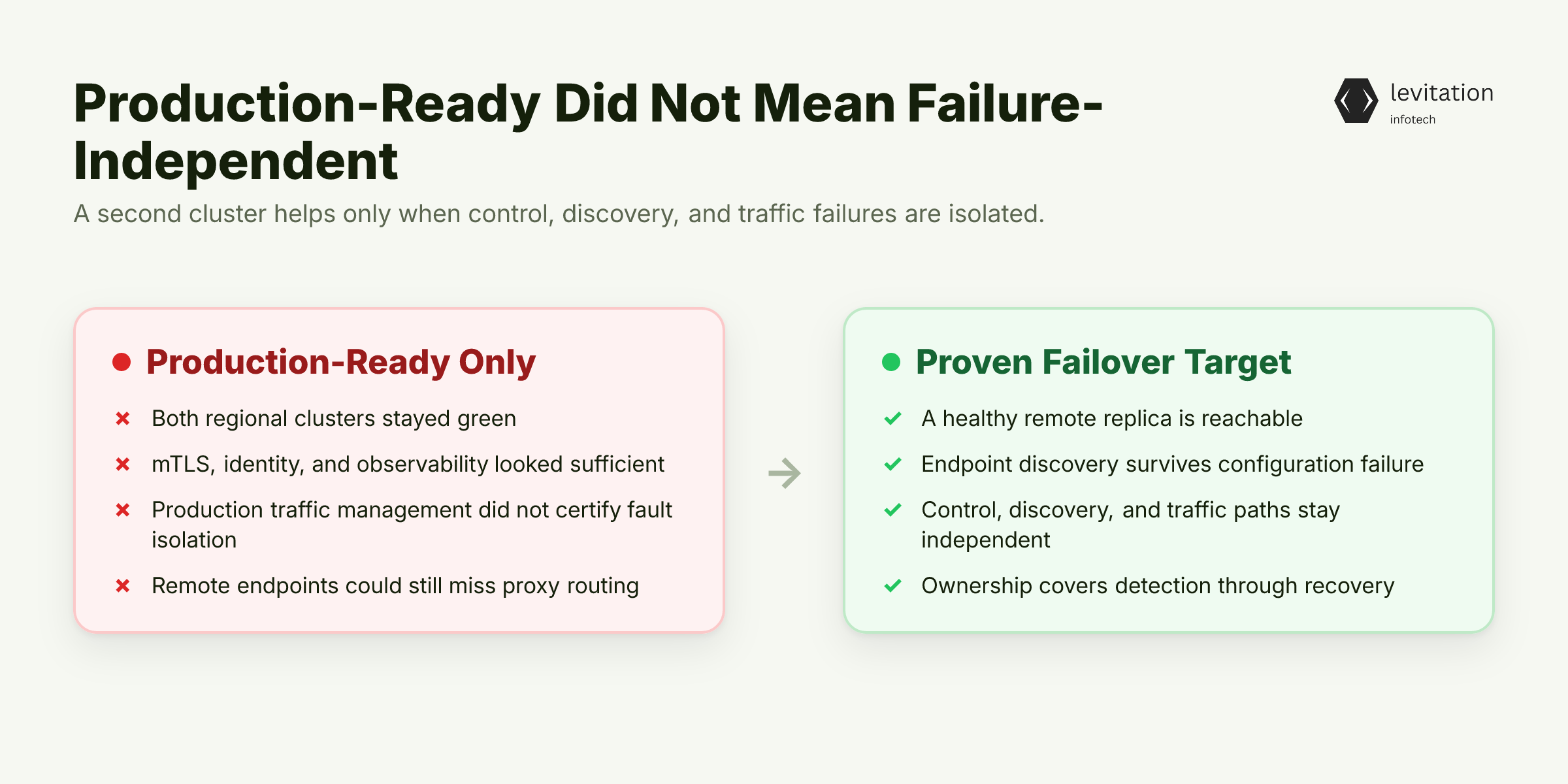
Two Kubernetes clusters sit in separate regions. Both are green. A payment request still fails when the remote endpoint never enters the proxy's routing set after configuration propagation breaks.
That gap separates production-ready traffic management from a proven regional recovery plan.
A Release Milestone Was Not a Fault-Isolation Certificate
On July 31, 2018, Istio announced version 1.0 as ready for production. It named eBay, Auto Trader UK, Descartes Labs, HP FitStation, JUSPAY, Namely, PubNub, and Trulia as production users.
That milestone mattered because it recognized a core feature set teams could rely on. It did not certify automatic fault isolation across regions.
Failure independence is a separate claim. If clusters depend on shared control-plane access, endpoint discovery, and cross-region routing, one broken channel can affect both.
A payment request needs a healthy remote replica, not merely another cluster on an architecture diagram. The acceptance question is therefore not whether DestinationRules can route traffic.
Can the request reach a healthy replica after a region, control path, or configuration channel fails?
Map the Correlated Dependencies
Observability, workload identity, and mTLS are necessary controls, not proof of independence. Use Cloud security solutions to add context around access, encryption, and policy evidence.
Encryption protects the path; it cannot create missing endpoints or restore failed configuration. A green mesh also needs stronger health checks, as Why Your Service Mesh mTLS Is a Hidden Backdoor explains. - Control path: Where policy and service state originate. - Discovery path: How proxies learn remote endpoints. - Traffic path: How requests cross regions. - Ownership: Who detects, routes, verifies, and recovers.
Why can another cluster feel safer without becoming a usable failover target?
Why a Second Region Can Remain Invisible
A second region feels safer because it adds another cluster to the inventory. It becomes a failover target only when its endpoints are visible, reachable, and ready to carry traffic.
Routing Can Only Select Endpoints It Can See
Locality failover can select only endpoints already visible to the proxy. Suppose the payment endpoint in Region A fails while Region B runs healthy replicas.
A failover rule naming Region B cannot help if those endpoints never entered the proxy's endpoint set. The rule creates no remote capacity and repairs no discovery channel.
What must happen before the rule can select a remote replica?
Two Connection Models, One Prerequisite
Two connection models dominate multi-cluster Istio. - Shared control-plane access: Clusters exchange service information through a common control plane. - East-west gateway federation: Clusters exchange service information through a secured gateway path.
Either model still requires cross-cluster endpoint visibility before recovery can work.
Three failure levels often collapse into one green dashboard: - Endpoint failure: One instance fails; another known healthy endpoint can serve traffic. - Regional cluster loss: A whole locality disappears; remote capacity and its path must survive. - Mesh-wide control failure: Configuration propagation fails; every cluster may lose intended policy.
Outlier detection can handle the first level while the third defeats failover entirely. Secure cross-region mTLS, unified telemetry, and a healthy gateway each prove different things.
They show identity, observation, and connectivity, not successful traffic movement under policy failure. Unified dashboards can also hide the cause, as Why Your Observability Stack Is Lying About Kubernetes Health shows.
Who owns the dependencies that decide whether the failover target works?
Ownership Must Cross Team Boundaries
Platform and payments teams should jointly map backend dependencies that remain reachable during regional loss. They should also use cloud security solutions to test cross-region identity and encryption alongside availability.
Use custom software development support where service-level behavior sits outside mesh-owned code. A proxy can route a request that the payment service later rejects.
The solution starts with a map of what can fail independently. What must it show before another cluster becomes a usable failover target?
Draw Four Failure Domains Before Routing Traffic
Resilience starts when teams separate failures that different dashboards tend to merge. Each domain needs its own trigger, decision, evidence, and owner.
1. Endpoint Failure
Outlier detection watches an endpoint's responses and health. When the detector marks that instance unhealthy, Istio ejects it and selects another known endpoint.
Write the payment API expectation plainly: one failed instance should not interrupt service. Availability then depends on another eligible endpoint existing within the timeout budget.
What happens when every eligible endpoint in that locality fails?
2. Regional Cluster Loss
Map the remote payment service, discovery path, gateway or shared control-plane dependency, and capacity needed to absorb traffic.
Can Region B serve the full failure load without relying on the failed region?
3. Control and Configuration Failure
Control and configuration failures need their own scenario. If intended failover policy never reaches regional proxies, healthy clusters cannot apply it.
A retained last-known-good configuration does not prove the desired policy arrived. Test configuration delivery as a separate dependency, not a footnote to cluster loss.
How will teams know the intended policy reached each regional proxy?
4. Cross-Region Path Failure
Cross-region delivery has its own chain: gateway health, service identity, mTLS, and DNS. For a remote-only service, east-west federation can resolve to the remote gateway's load-balancer address.
Verify that behavior instead of assuming direct pod reachability.
Can traffic reach that gateway when the local region fails?
Turn the Boundaries Into a Contract
Encode each failure domain with four fields: - Endpoint loss: Trigger, failed instance; decision, select another known endpoint; evidence, ejection record and upstream trace; owner, service team. - Regional loss: Trigger, local cluster unavailable; decision, select remote capacity; evidence, remote trace and gateway health; owner, platform and payments. - Configuration loss: Trigger, propagation interrupted; decision, retain or reject intended policy; evidence, proxy version and delivery status; owner, mesh platform. - Path loss: Trigger, gateway, DNS, or identity failure; decision, fail safely or use an alternate path; evidence, DNS answer, handshake, and route logs; owner, network and security.
Use workload identity, mTLS, zero-trust access, and audit evidence from cloud security solutions to prove the path is secure. Use custom software development specialists to test independent control-plane and backend behavior.
With boundaries visible, locality routing becomes conditional behavior. How can teams express that condition without pretending the rule creates independence?
Configure Locality Routing as a Conditional, Not a Promise
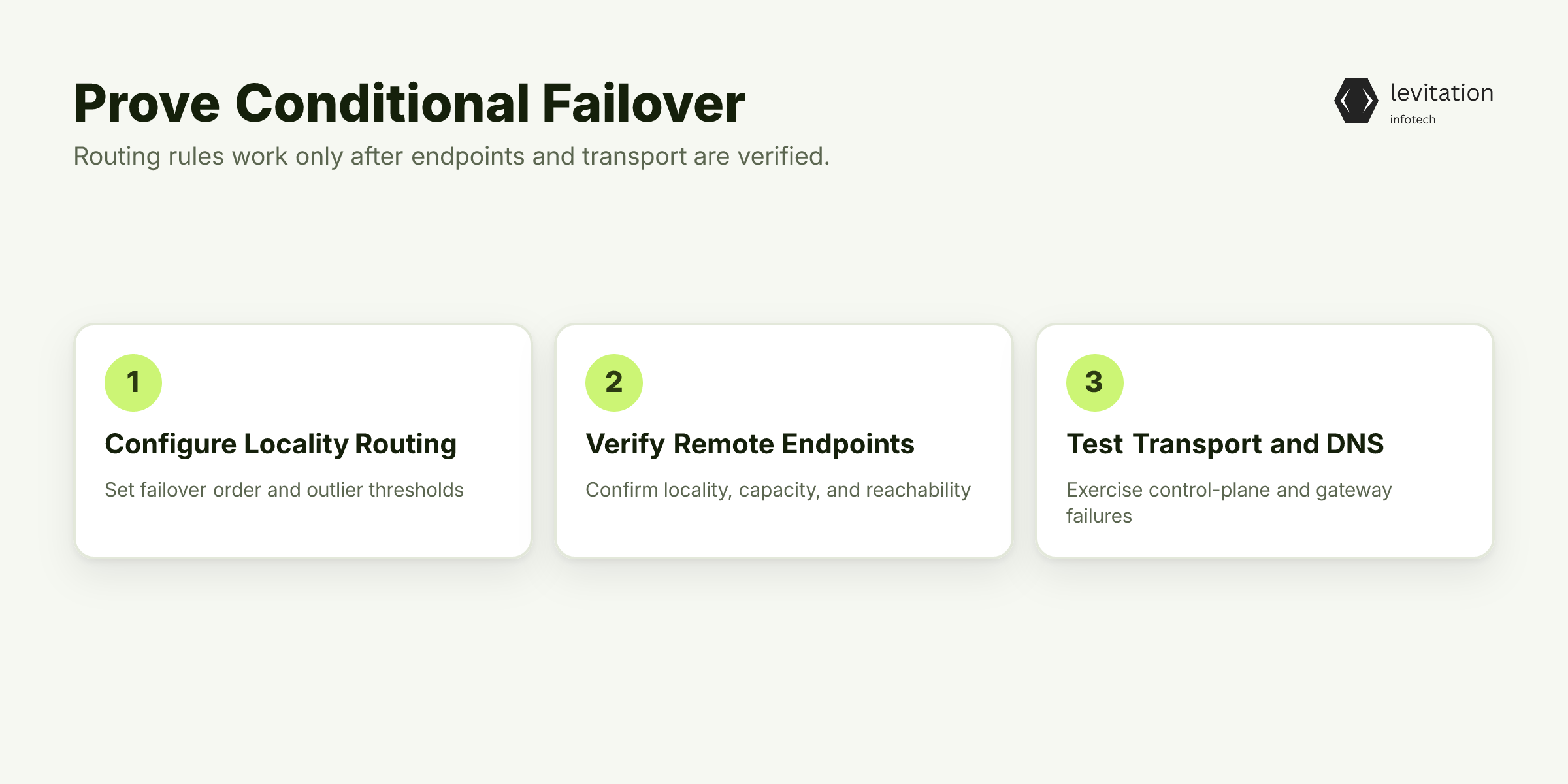
The trap is treating a DestinationRule as the recovery system. It is only the decision layer; discovery and transport still control what the proxy can do.
This is the same drift described in Your Oldest Kubernetes YAML Is Your Next Outage. Valid configuration can preserve a dependency nobody tested.
Start With One Explicit Rule
Start with one explicit `DestinationRule` for the payment service. Its outlier-detection settings define `consecutive5xxErrors`, `interval`, `baseEjectionTime`, and `maxEjectionPercent`.
Then enable `localityLbSetting` and list ordered failover entries using `from` and `to` region entries.
Those settings control detection speed, ejection duration, and how much capacity can be excluded from selection.
Those values are not universal payment defaults. Validate them against timeout budgets, remote capacity, and recovery objectives.
A shorter interval finds trouble sooner but can react to brief blips. A longer ejection period keeps a suspect endpoint out after recovery. Allowing every endpoint in a locality to be ejected permits the full locality to be removed from selection.
The rule cannot create a remote endpoint. How can teams prove one exists?
Prove That Remote Endpoints Exist
Before trusting failover, inspect each proxy's endpoint set. Confirm that the second cluster's payment service appears with correct locality and reachable addresses.
Also confirm that remote capacity remains healthy when local capacity disappears. A syntactically valid DestinationRule cannot route to a service the proxy does not know.
Can the proxy reach those endpoints through a path that survives local loss?
Validate the Transport and DNS
Then test the chosen inter-cluster transport against its own failure. In a shared-control-plane topology, interrupt control access or configuration propagation and observe what each proxy retains.
In east-west gateway federation, verify gateway health, workload identity, mTLS, and remote-only service routing. In that topology, DNS resolves to the east-west gateway's load-balancer address.
That is a path to the service, not direct pod reachability. Use cloud security solutions to validate cross-region identity, encryption, policy consistency, and operational access.
Ensure those controls don't become another hidden shared dependency. A valid configuration is only a hypothesis.
Will traffic move when local capacity disappears without a configuration change?
Remove Local Capacity and Observe Actual Recovery
Start with the test that exposes false confidence. Scale the local payment deployment to zero replicas, then send real payment requests through the mesh.
Confirm the remote deployment serves them without a configuration change. A hello-world test proves proxy mechanics, not payment behavior.
Payment behavior can still fail because of retries, state, identity, or downstream dependencies. The test must use the service whose continuity you are claiming.
Separate the Failure Scenarios
Never combine endpoint, cluster, and configuration failures into one exercise. - Endpoint removal proves instance-level selection. - Complete local-cluster loss proves regional routing and capacity. - Configuration-propagation interruption proves policy delivery.
A successful endpoint test can conceal a shared control-plane dependency. Each scenario needs its own pass condition and reset procedure.
How will teams know customer recovery, rather than dashboard health, proves the result?
Measure Recovery, Not Dashboard Health
Measure customer recovery, not only mesh health. Correlate request completion with endpoint selection, remote logs, traces, gateway health, DNS, and propagation status.
Measure payment API uptime by successful request completion during induced failures. Also record time to detect, eject, route, and recover.
A green control-plane metric does not prove customer traffic moved. For east-west deployments, restore traffic to the local region after the test.
Watch for stale routes, loops, black holes, and repeated retries as traffic returns. A recovery path that breaks during restoration has only moved the outage.
Can the same test reveal failures when traffic returns?
Put the Test Inside the Release Process
Make these checks part of backend releases, not annual tabletop exercises. Synthetic payment checks should run continuously, while full failure drills should follow a defined schedule.
Use custom software development support when test orchestration or service instrumentation must follow payment semantics. A green test dashboard is not a safe deployment, as A Green Canary Dashboard Is Not a Safe Deploy argues.
Traffic recovery is necessary, but the resilience claim becomes credible only when evidence links independent failure domains, test results, and accountable owners.
Can your team connect that evidence to an architecture decision?
Turn Production-Ready into a Tested Recovery Claim
Approve the architecture only when each critical failure domain has four connected records. - Trigger: The exact condition that initiates failure. - Decision: The routing behavior expected after that trigger. - Evidence: Request, endpoint, discovery, gateway, DNS, and configuration records. - Owner: The team accountable for detection and recovery.
Teams shrink the blast radius by exercising capacity and routing independently. The cross-region path must have verified identity and encryption, not merely a green gateway.
Payment API uptime rests on repeatable induced-failure evidence, not an unqualified release label. Teams that need help can use cloud security solutions and custom software development to map dependencies and run recovery exercises.
The only acceptable resilience claim is one your next board update can prove with evidence. Can your team make that claim?
Frequently Asked Questions
Istio's traffic primitives can express regional intent. They cannot grant regional independence. The answers below separate what software can express from what the operating model must prove.
Does Istio 1.0 support multi-region failover?
Yes. Istio's traffic-management primitives can express locality failover, but the 1.0 announcement marked a core feature set as reliable. It did not guarantee regional independence.
Effective recovery also requires cross-cluster connectivity, visible remote endpoints, sufficient capacity, and failure exercises.
What evidence shows that those prerequisites still work during regional loss?
What is the difference between Istio multi-cluster and multi-region failover?
Multi-cluster describes connectivity, such as a shared control plane or east-west gateways. Multi-region failover describes traffic behavior across geographic regions.
A multi-cluster deployment still fails over only when discovery, configuration delivery, remote capacity, and the traffic path remain available.
Which dependencies must survive before regional traffic can move?
How do you test Istio multi-region failover?
Scale the local workload to zero replicas and verify that requests reach the remote cluster without changing routing configuration.
Then test endpoint loss, complete regional loss, and configuration-propagation interruption separately. Observe request success alongside discovery, gateway, DNS, and policy-delivery signals.
Which signals prove the request reached the remote cluster?
Does Istio locality load balancing guarantee payment API uptime?
No. Locality load balancing selects among endpoints already known to the proxy and healthy under its detection rules. It cannot compensate for missing discovery, unavailable capacity, or a broken cross-region path.
Can your team make the next resilience claim with test evidence?
About the author
Mayank Singh is a software developer at Levitation Infotech, where he builds web and AI-powered applications across the company’s fintech, healthcare, and enterprise projects.