


TL;DR: Audit readiness and model risk approval are parallel gates. They are not sequential ones. Your LLM can pass InfoSec, privacy, and compliance review. It can still get killed at the Model Risk Management (MRM) stage. MRM tests something different. It checks whether the model is fit to drive business decisions with customer impact. Teams that get through MRM quickly produce MRM-grade artifacts before they get asked for them.
Key Takeaways: - Audit and model risk are separate sign-offs. They have different owners, different questions, and different ideas of "passing." - MRM checks conceptual soundness, data integrity, output stability, ongoing monitoring, and outcome validation. None of these appear in a SOC 2 or ISO 27001 audit. - Producing five specific artifacts before submission front-loads the work. Then MRM reviewers can validate against complete documentation. They do not send submissions back for missing pieces that reset the review clock.
The Audit Paradox: Why Passing Tests Doesn't Mean Passing Model Risk
Your LLM cleared every security test. It passed penetration review and satisfied the compliance team. Then Model Risk Management walked in. It asked three questions nobody had answers to. Then it killed the deployment. This is a recurring pattern in regulated finance LLM rollouts.
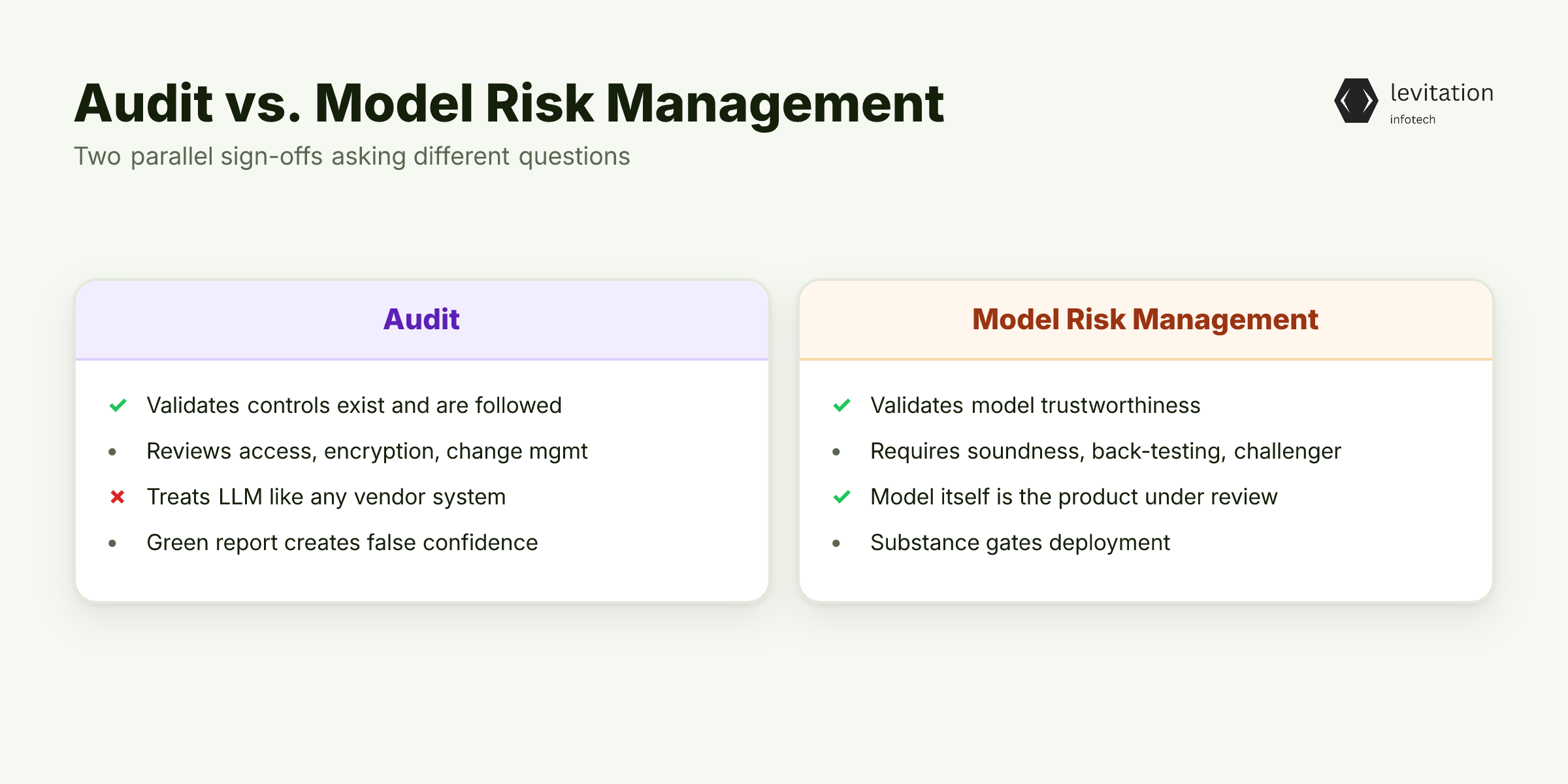
The confusion starts with a structural misunderstanding. Teams assume AI compliance and model risk approval are sequential checkpoints. You finish one, then move to the next. They are not. They are parallel sign-offs owned by different functions. They ask different questions.
Audit validates whether controls exist. It confirms that access management, encryption, change management, and vendor review processes are in place. It also confirms they are followed. These controls are needed. They are not enough.
Model Risk Management validates whether the model itself can be trusted. The model must be fit to drive a business decision with customer impact. The model is the product under review. The controls around it are not the focus.
This is why a green audit report gives a CTO false confidence. The team celebrates. The deployment date holds. Then MRM opens the validation report. The team has no conceptual soundness documentation. It has no outcome back-testing plan. It has no challenger model comparison. As a result, the timeline resets.
We have seen this exact sequence in fintech deployments. The audit was clean. However, the MRM submission looked unrecognizable to the same engineering team.
The first question every CTO asks is: "But our LLM passed every test. What more do they want?" The answer shows a structural misunderstanding. It shows confusion about what model risk really does.
Audit Tests Controls. Model Risk Tests Decisions.
InfoSec audit asks: is the system secure? Privacy review asks: is personal data protected? Compliance asks: are the right policies recorded and followed?
Model Risk asks: is this model fit for the business decision it drives? Can you prove it?
These are not the same question. They do not overlap enough for one to satisfy the other. They live in different reporting lines inside the institution.
InfoSec usually reports to the CISO. Model Risk usually reports to the Chief Risk Officer. It can also report to a model risk committee outside the technology group.
Model Risk is a second-line or third-line governance function. It is not part of engineering or product.
MRM uses a framework designed for credit scoring, market risk, and fraud models. The U.S. Federal Reserve's SR 11-7 guidance defines what reviewers look for. It lists conceptual soundness, ongoing monitoring, and outcomes analysis. Its global equivalents follow the same pattern.
None of these map cleanly to a SOC 2 or ISO 27001 control objective. Audit will never check whether your embedding model version is pinned. It will not check whether your retrieval corpus is monitored for drift. It will not check whether your fine-tuning data has recorded lineage. MRM will.
This matters most at fintech firms and banks. There the platform touches dozens of regulated institutions. The audit checklist is a commodity. Any serious vendor can pass it. What separates a quick approval from a drawn-out one is whether the model can stand up to independent validation. That validation must be done by people with no stake in the launch date. Institutions that have cleared LLMs through MRM treat the model risk posture as a product need. They do not treat it as a post-development tax.
If audit and model risk check such different things, what is MRM looking for? It looks for specific things when it opens the hood on an LLM. The answer breaks down into five specific dimensions.
What Model Risk Actually Checks in an LLM
Model risk reviewers work from a fixed checklist. For an LLM, that checklist adapts the traditional MRM framework. It adapts to non-deterministic, retrieval-augmented systems. Here are the five dimensions they pressure-test: - Conceptual soundness. Architecture choices, training reason, RAG pipeline design, and embedding model selection. MRM wants the "why" behind every technical decision, not just the result. Why this base model. Why this chunking strategy. Why this retrieval ranker. - Input and data integrity. Training data lineage, embedding corpus versioning, prompt template governance, and the controls that stop silent drift. These must cover any of these. Reviewers look for proof that the data feeding the model is reproducible, traceable, and quality-checked. AI/ML training documentation must show this. - Output stability. How the model behaves under small input changes, paraphrasing, and hostile prompting. MRM treats this as a first-class concern, not a red-team exercise. - Ongoing monitoring. Drift detection on input distributions. Output quality sampling schedule. Action limits that trigger escalation. The person or team accountable when monitoring fires. - Outcome validation. How production outcomes will be measured against model predictions. Not "did the LLM respond" but "did the decision the LLM influenced produce the right result." The right result for the customer and the business.
The explainability gap is where most LLM submissions break down. Credit scorecards produce feature attributions. LLMs do not. MRM has adapted by accepting retrieval-grounded reasoning, citation tracing, and prompt-level audit logs as substitutes. Your AI compliance documentation must show how every response can be traced back. It must trace back to the inputs that produced it.
Without that trace, MRM cannot defend the model to a regulator. It will not approve. This is the same gap that sinks external explainability audits. It sinks them when the audit surface is treated as an afterthought.
Bias and fairness testing is non-negotiable. MRM expects recorded testing of equal outcomes across groups. It also expects testing for unfair treatment of protected groups. Testing must run on production-relevant data. It must not run on benchmark sets scraped from the internet.
European data protection authorities have signalled that they are moving toward a similar framework. It merges privacy, fairness, and model risk into a single review surface.
Knowing what gets checked is half the battle. The other half is producing the artifacts that prove it. Build them before MRM asks. That is where the deployment timeline actually moves.
The Five Artifacts That Move an LLM Through Model Risk
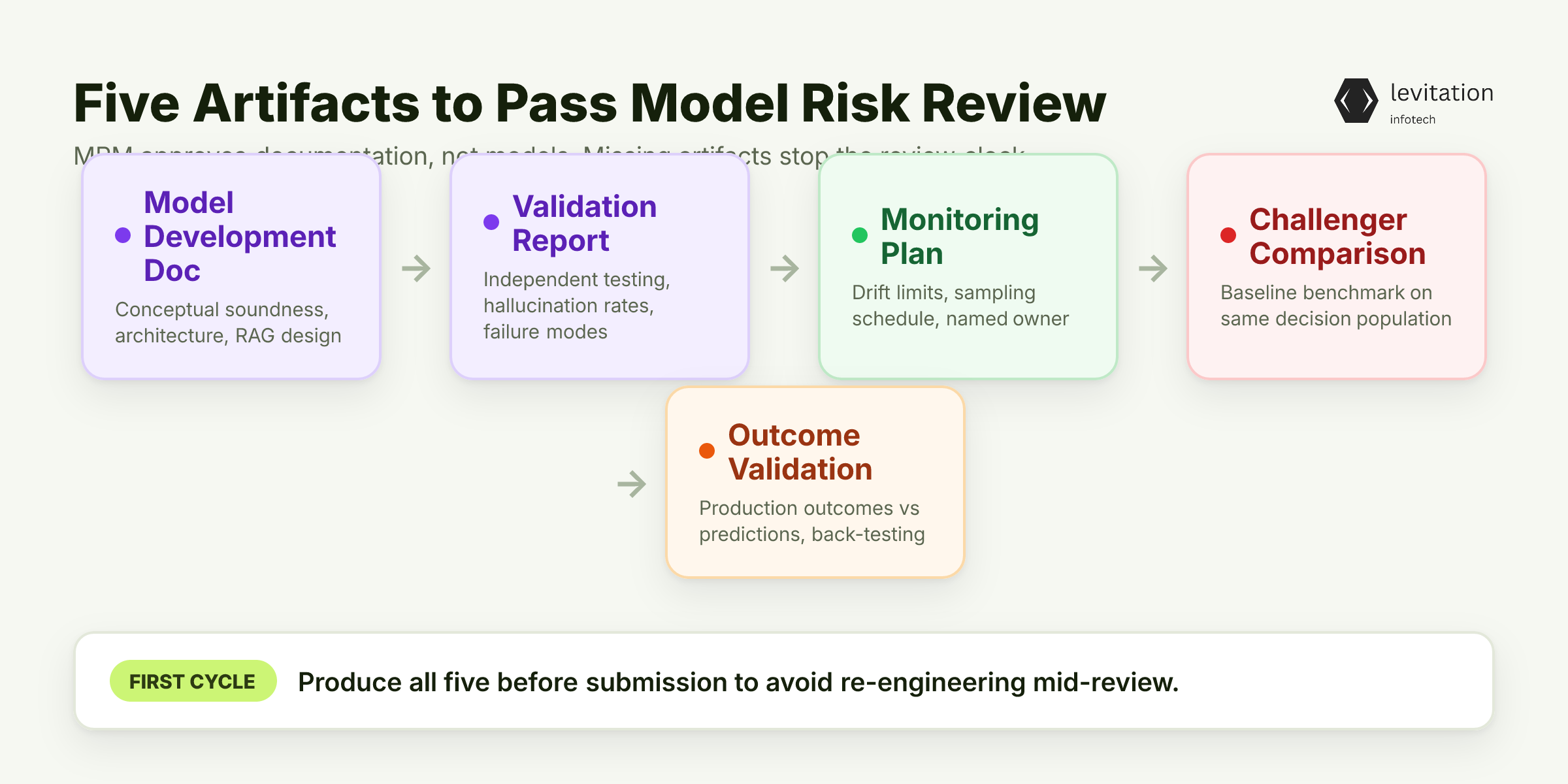
MRM does not approve models. MRM approves documentation. If the documentation is missing, the model does not get reviewed, and the clock does not start.
Here are the five artifacts that change the outcome: - Model Development Document. This is the conceptual soundness artifact. It covers architecture choices, fine-tuning reason, RAG pipeline design, embedding model selection, and version pinning for every component. Without it, MRM has no foundation to validate against. - Validation Report. Independent or semi-independent testing of the model against held-out data, hostile prompts, and a golden evaluation set. The report must show out-of-sample performance, hallucination rates, and failure modes. Internal testing does not count as validation in the MRM sense. Reviewers want to see separation between builder and tester. - Ongoing Monitoring Plan. Drift detection limits on input distributions. Output quality sampling schedule. Action paths when limits are crossed. The named owner of the monitoring function. A plan that exists only in a slide deck will be sent back. - Challenger Model Comparison. The LLM benchmarked against a baseline. The baseline can be a rules engine, a prior model, or a simpler statistical approach. It must run on the same decision population. This is how MRM proves the LLM is worth the added risk. Without a challenger, the LLM is unproven against the alternative. - Outcome Validation Framework. A defined schedule for measuring production outcomes against model predictions. Recorded results feed into the next MRM review cycle. Back-testing intervals should be defined upfront and revisited as production data accumulates.
Teams that produce all five artifacts before submission can move through review on the first cycle. Teams that scramble after the first review cycle must re-engineer mid-review. As a result, timelines stretch out. The difference is not engineering effort. It is the order in which the work happens.
The model registry failures we have seen in regulated finance share a root cause. Documentation is produced too late, in the wrong sequence, by the wrong team.
Even with the right documentation, the technical evaluation trips up teams. It trips up teams who treat LLMs like traditional supervised ML models. The testing playbook is different. Most teams stall there.
Why LLMs Break Traditional Model Risk Testing
Model risk testing was built for deterministic models. Score a loan application, get a probability of default. The output is stable. The input is structured. The testing surface is limited.
LLMs break every one of those assumptions. - Non-determinism. Identical prompts produce different outputs. MRM responds by requiring statistical confidence intervals on quality metrics. It does not require point estimates. Point-estimate accuracy claims are meaningless. They are meaningless if the confidence interval spans a wide enough range. A wide enough range can cross decision thresholds. - Prompt sensitivity. Small input changes shift outputs. A single word change, a reordered clause, or a paraphrased question can flip the answer. MRM testing must include hostile and paraphrase robustness suites. It must not be just holdout accuracy on a fixed test set. - RAG and embedding drift. Swapping the vector store, changing the chunking strategy, or upgrading the embedding model silently changes model behavior. None of these changes touch the base LLM weights. However, MRM treats them as material model changes that need re-validation. Most teams do not even version these components. - Provider-side model updates. When OpenAI ships a new flagship, or Meta releases a new Llama revision, the model your team validated changes. It is no longer the model running in production. Under SR 11-7-style frameworks, this is a material model change. Most teams treat it as a routine upgrade.
The teams that get through model risk fastest do not have better models. They have a different posture toward governance. They treat the LLM stack as a versioned, monitored, independently tested system. They do not treat it as a black box.
What does that posture look like in practice?
What Changes When You Build for Model Risk From Day One
Building for model risk from day one is not a cost center. It is a speed advantage. It grows over time.
First-time-right submissions shorten review cycles. They shorten cycles by removing the rework loop. Systems designed for ongoing MRM monitoring stay easy to defend across cycles. This is because evidence is produced continuously, not reconstructed.
Institutional trust grows. Architectures that pass MRM on the first submission reduce rework, audit findings, and regulator-imposed fixing across the deployment lifecycle. The model risk posture is what makes the vendor-switching cost too high to justify.
For teams who have already failed an MRM review, the path back is the same as the path forward. Produce the five artifacts. Build the monitoring into the platform. Stop treating governance as something that happens after engineering. The board-level conversation about AI risk becomes much shorter when the model risk file is complete.
Frequently Asked Questions
Q: What is LLM model risk management?
A: Model risk management (MRM) is a second-line governance function. It operates at banks and fintech firms. It independently validates whether a model is conceptually sound. It validates whether the model performs as expected. It validates whether the model is monitored for its intended business use.
For LLMs, MRM uses the same framework applied to credit and market models. It is adapted for non-deterministic outputs, RAG pipelines, and prompt-based interfaces.
Q: How is model risk review different from an AI compliance audit?
A: An AI compliance audit checks whether controls and policies exist and are followed. It tests the governance surface.
Model risk review tests the model itself. It checks its logic. It checks its outputs against ground truth. It checks its stability under perturbation. It checks its production performance. Passing AI compliance does not satisfy MRM, and vice versa.
Q: What documentation does MRM require for an LLM?
A: MRM typically requires five documents. These include a Model Development Document, an independent Validation Report, an Ongoing Monitoring Plan, a Challenger Model Comparison, and an Outcome Validation Framework. For LLMs specifically, these must address non-determinism, embedding and retrieval pipeline versioning, and prompt-level audit logging.
Q: Why do LLMs fail model risk review?
A: The most common failure modes include inability to explain outputs and unrecorded training data lineage. Other failures include missing bias and fairness testing on production-relevant populations, no plan for ongoing monitoring of output quality, and treating base model updates from the provider as non-material changes.
Teams that submit without challenger comparisons and outcome validation frameworks are almost always sent back for re-work.
Q: How long does LLM model risk approval take?
A: For teams preparing MRM artifacts from the start, approval timelines are measured in months. Teams that treat MRM as a post-development gate spend far longer in the cycle. The model gets re-engineered mid-review. The difference is almost entirely a function of upfront documentation and testing posture.
Run the five artifacts against your current stack. That is the fastest path through MRM.
About the author
Mayank Singh is a software developer at Levitation Infotech, where he builds web and AI-powered applications across the company’s fintech, healthcare, and enterprise projects.