


TL;DR: Most Indian mid-size manufacturers fund ERP twice within five years. The first system, usually a packaged buy optimised for the sales demo, breaks on the shop floor. Production workflows were never part of the buying criteria. The second purchase is a recovery, not an upgrade. The combined ₹30 lakh is rarely vendor pricing. It is the hidden cost of bad procurement, and it is preventable.
Key Takeaways: - For 100-500 employee Indian manufacturers, verified ERP project costs sit in the ₹15 lakh to ₹60 lakh band; the second purchase is where the upper end lives. - First-time ERPs die on shop-floor execution, not finance, because packaged systems treat production modules as secondary. - Hidden costs (training, customisation, data conversion) are the most common reason ERP budgets blow past estimates. - Build vs buy stops being philosophical once you model 5-year total cost, not just the first invoice. - A phased procurement sequence with a real BOM demo prevents the repeat purchase.
The ₹30 Lakh Repeat Purchase Hiding in Plain Sight
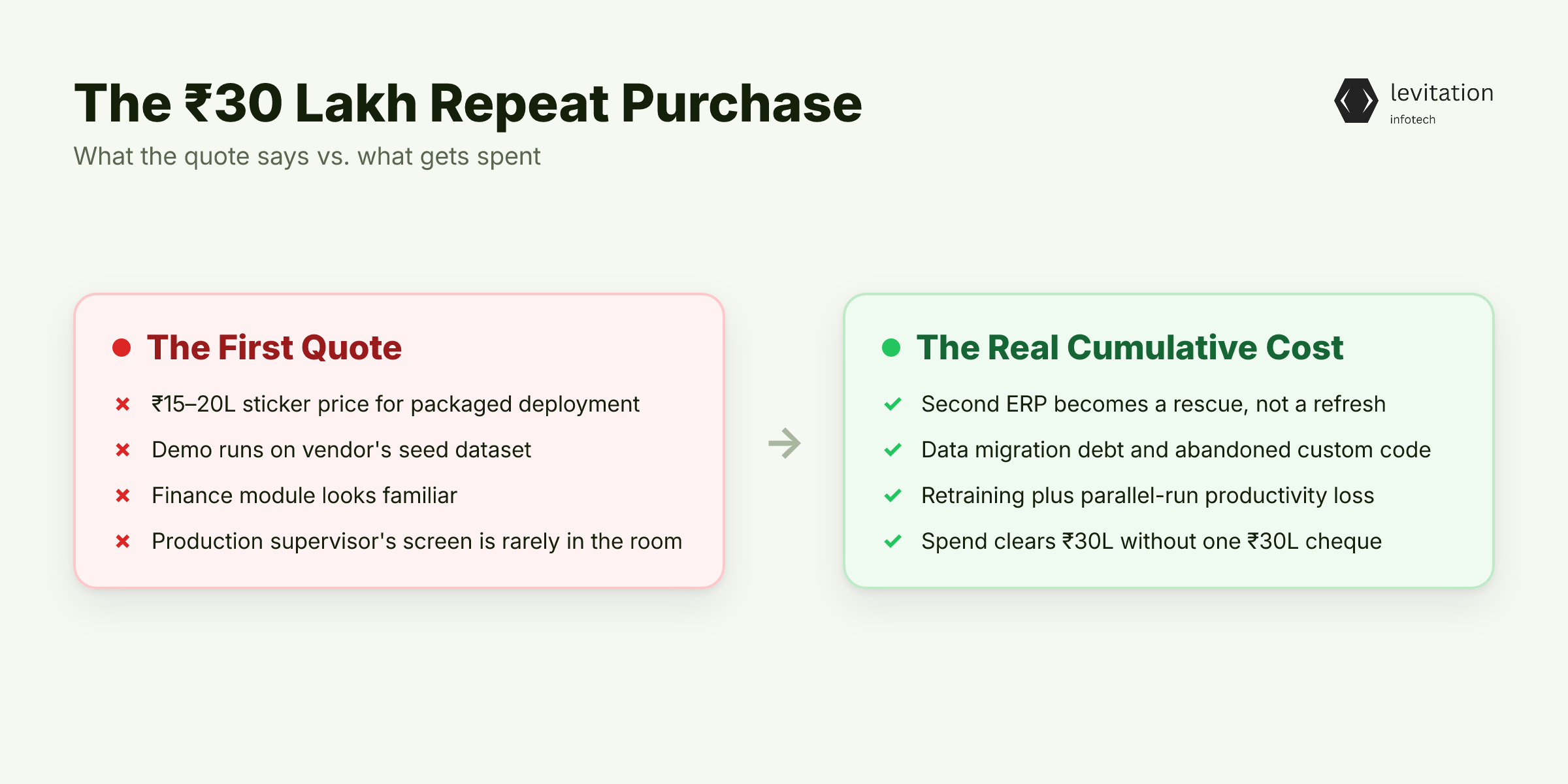
Indian manufacturers spend between ₹15 lakh and ₹60 lakh on ERP. Many pay that bill twice within five years. The second purchase is not a refresh. It is a rescue.
The headline number is misleading. Vendors quote the first ERP at the lower end of the band, often ₹15-20 lakh for a packaged deployment with light customisation.
The second attempt costs far more. The extra comes from data migration debt, abandoned custom code, retraining, and a failed system that leaves no usable foundation behind.
Add the original license, the wasted implementation hours, and the productivity loss during the parallel run. The cumulative spend clears ₹30 lakh without anyone signing a single ₹30 lakh cheque.
This is not a vendor pricing problem. It is a procurement sequencing problem.
The first decision is almost always made on the wrong inputs. Buyers see a slick demo on the vendor's seed dataset, a finance module that looks familiar, and a price that fits the capex window. The production supervisor's daily screen is rarely in the room when the contract is signed.
For context on the verified cost ranges that drive this pattern, the ERP implementation cost in India landscape is wider than most CFOs expect. The gap between entry-tier and mid-tier is where most first purchases land.
If the market is flooded with ERP options from ₹6 lakh to ₹60 lakh, why does the first one so often collapse?
Why Off-the-Shelf ERPs Break in Indian Manufacturing
Manufacturing ERPs are not generic ERPs with a production tab bolted on. They must handle multi-level bills of materials, multi-stage routing, by-products, scrap accounting, shop-floor execution against finite capacity, and the regulatory inventory stack Indian factories carry.
That's a tall order. Packaged systems from global vendors treat these as advanced add-ons. They get locked behind premium tiers or partner-led customisation.
The Indian mid-manufacturing segment is unusually hard to serve. Indian SMEs run revenues between ₹25 lakh and ₹10 crore with sub-1000 employees. Global ERPs overshoot on licensing. Indian-localised ERPs underdeliver on shop-floor depth.
The first purchase usually sits in the awkward middle. Too expensive to be a casual experiment. Too generic to actually run a plant.
The first ERP almost always gets optimised for the sales demo. Not for the production supervisor's daily screen.
The vendor shows finished goods tracking. The buyer nods. The contract closes.
Six months in, the shop floor is fighting the system. Routing changes do not propagate. Batch traceability is a manual spreadsheet. The work order screen is a maze of unused fields.
The data model is the wrong shape for the factory.
The same dynamic shows up in pharma, where a first ERP fails the first recall for the same reason. The system was bought for finance, not for the workflow that breaks under audit.
First-time ERPs in Indian manufacturing tend to die in operational modules. Finance can be papered over with manual journals. A broken production line cannot.
The same logic explains why adoption collapses after go-live. The system goes live. The floor keeps using WhatsApp and Excel because the new tool was not built around their actual workflow.
For manufacturers evaluating their options, the early decision between packaged and custom ERP development usually happens before the shop-floor workflow is even documented. That timing is the first reason the second purchase becomes inevitable.
A failed first ERP does not just cost the license fee. It leaves a trail of costs that nobody budgeted for.
The Hidden Cost Anatomy of a Failed First ERP
The visible invoice is the smallest part of the bill. The real cost stack has six layers, and most are invisible at the time of signing.
Layer one is staff retraining. ERP projects consistently underestimate the time floor staff need to reach competence. A supervisor who spent three years on a legacy system does not become fluent on a new one in a week of training.
Layer two is unanticipated customisation mid-project. The vendor signs a scope, then discovers during UAT that the client's BOM structure has levels the system handles badly. Change orders follow.
Layer three is data conversion from legacy spreadsheets. It is the single biggest source of timeline slippage in Indian ERP rollouts.
Layer four is parallel-run overhead. Old and new systems both have to be maintained while users build trust.
Layer five is the licensing model. Subscription fees feel cheaper in year one, but the five-year horizon usually favours perpetual licensing for manufacturers with stable user counts. The math reverses around year three.
Layer six is the connectivity assumption. Cloud subscription assumes reliable connectivity, and Indian factory floors in industrial estates do not always have it. Some buyers get pushed back to on-premise deployments with dedicated servers, backup infrastructure, and a five-year hardware refresh cycle nobody priced in.
None of this is theoretical. The most common hidden costs of ERP implementation, across global and Indian deployments alike, are staff training, unanticipated customisation, and data conversion. They are the same three items that cause budgets to blow past estimates.
The ERP implementation cost in India discussion usually quotes license fees. The procurement conversation that actually matters is the one about these six layers.
Once you see the real cost stack, the build-vs-buy question stops being philosophical and becomes arithmetic.
The Build vs Buy Math for ₹15-60 Lakh Budgets
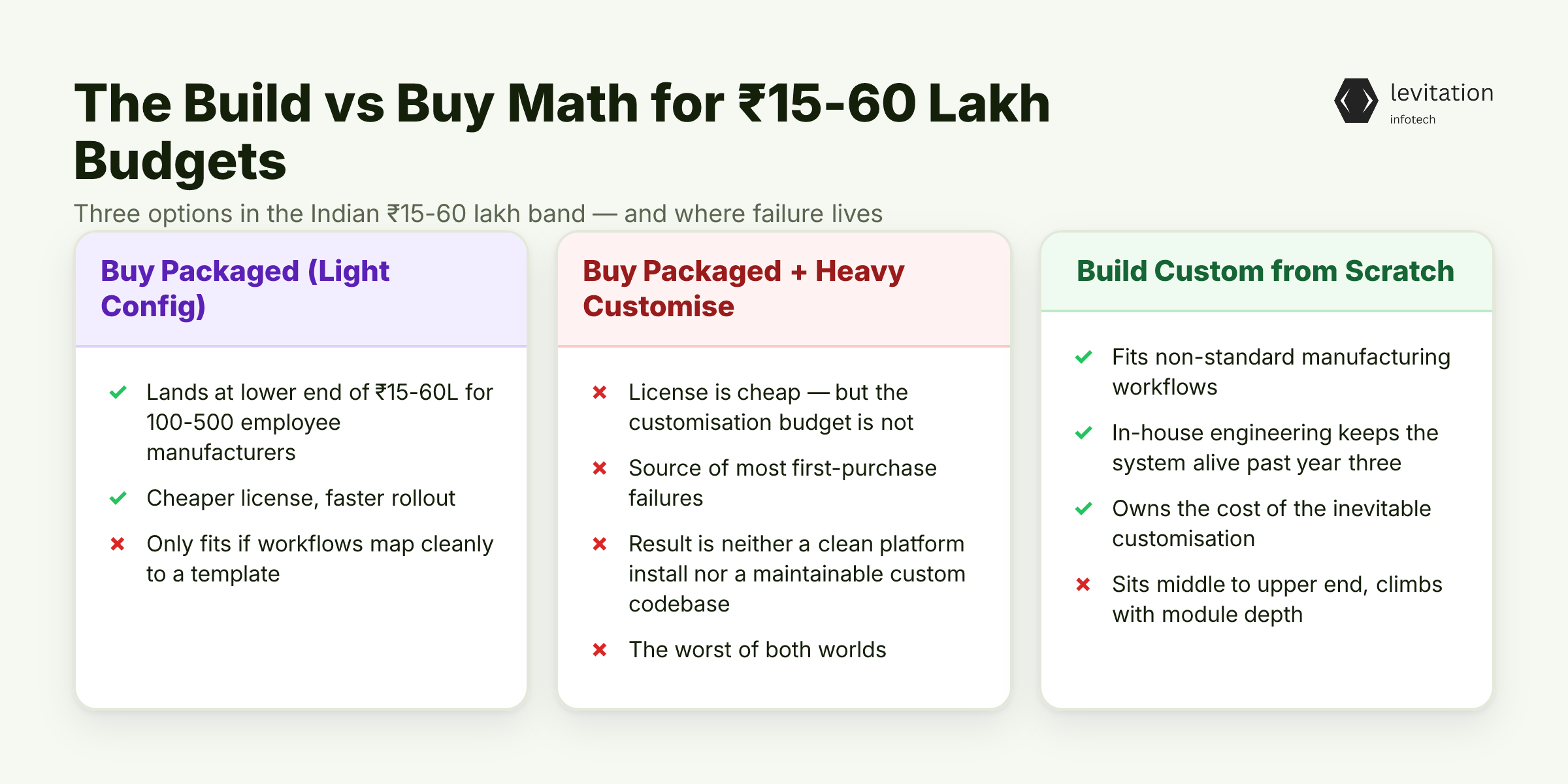
The honest menu has three options. Buy a packaged ERP with light configuration. Buy a packaged ERP and customise it heavily. Or build custom from scratch.
In the Indian ₹15-60 lakh band, the landing is roughly this. Entry-tier packaged platforms from India-localised vendors land at the lower end for a 100-500 employee manufacturer. Mid-tier global platforms with implementation sit toward the middle. A custom build for non-standard manufacturing workflows sits in the middle to upper end, climbing with module depth.
The verified range from ₹15 lakh to ₹60 lakh confirms this spread. The upper end reflects complexity, customisation, and module scope.
The failure pattern lives in the middle of the menu. Buying a packaged ERP and customising it heavily to fit a non-standard factory is where most first-purchase failures originate. The license was cheap. The customisation budget was not. The resulting system is neither a clean platform install nor a maintainable custom codebase.
It is the worst of both, which is why packaged ERP rarely fits a plant floor without heavy surgery.
For manufacturers whose production workflows do not map cleanly to a template, the ERP software development for manufacturing decision is really a decision about who owns the cost of the inevitable customisation. The vendor's professional services team, or an in-house engineering function that can keep the system alive past year three.
Cost without ROI is just an invoice. Here is the number that changes the conversation.
When the Second ERP Costs Less Than Your Inventory Carrying Cost
Here is the math that flips the procurement conversation. Holding ₹30 lakh in inventory carries a carrying cost of roughly ₹6-9 lakh per year, depending on financing rates and obsolescence risk.
A 20% reduction in that inventory, which is a realistic outcome from a properly scoped ERP with real-time stock visibility, saves ₹1.2-1.8 lakh every year.
A correctly scoped ERP often pays for itself in inventory working capital alone. That is before counting throughput gains, quality cost reductions, or the elimination of manual reconciliation between finance and operations.
The cost of a first ERP that fails is not just the license and the rescue project. It is the ₹1.2-1.8 lakh per year of working capital the factory should have been freeing up.
Global per-user cost benchmarks are widely cited but rarely realistic for the Indian SME segment. Per-user figures for global enterprises do not map cleanly to a mid-size Indian factory, where user count, licensing model, and module mix distort any dollar-per-seat comparison.
The right benchmark is the 5-year total cost against the inventory carrying cost floor, and against the savings from a single percentage point of throughput improvement.
The ERP implementation cost in India conversation that matters is the one against this ROI floor, not the vendor's year-one list price. The build-vs-buy decision should be made on the same terms.
Knowing the math is not the same as running the procurement. Here is the sequence that prevents the second purchase.
A 5-Step Procurement Framework to Buy Once
Five steps, in order. Skipping any of them is how the second purchase becomes inevitable.
Map production processes before shortlisting vendors. Shop-floor workflows, not finance, decide fit. If the production supervisor cannot describe the system in one sentence, no vendor demo will fix that.
Demand a working demo on your own BOM and routing data. Not the vendor's seed dataset. A demo on a standard dataset proves nothing about your factory.
Model the 5-year cost: license, integration, training, parallel run, data conversion, hardware refresh. Not just year-one fees.
Insist on a phased rollout starting with one plant or one module. Limit the blast radius. If the first module fails, you want it to fail small.
Contract the customisation scope: hourly rates, change-order process, and ownership of custom code. Without this, the second purchase becomes the only way to escape vendor lock-in.
Phased rollouts on real data consistently beat big-bang deployments on demo data. The failure modes surface early when the blast radius is small, and the same discipline that separates a one-time buy from a five-year anchor is what keeps the deployment from collapsing.
For teams ready to run this sequence, the custom ERP integration and implementation partner matters less than the procurement discipline itself. The right partner enforces the steps. The wrong one lets you skip them.
When the first ERP survives, the numbers look very different from the industry average.
What Changes When Your First ERP Survives
One ERP. One data model. One training cycle. Capital and management attention stay focused on production, not on rescuing IT.
The factories that buy once are not buying better software. They are running a better procurement process. The same engineering discipline that ships enterprise deployments in regulated industries is what keeps a first ERP from becoming a second purchase.
This is the work teams like Levitation do: production-grade ERP, cloud-native platforms, and data infrastructure built for teams that have to live with the system long after the implementation partner leaves.
Frequently Asked Questions
How much does ERP implementation cost in India for a mid-size manufacturer?
For a manufacturer with 100-500 employees, the verified band is roughly ₹15 lakh to ₹60 lakh depending on module scope, customisation depth, and whether the system is cloud or on-premise. The first purchase often comes in at the lower end. The second attempt at the higher end is what drives the ₹30 lakh repeat-purchase pattern.
Is custom ERP cheaper than packaged options in India?
In India, the verified ₹15-60 lakh band translates roughly to entry-tier packaged platforms at the lower end, and custom builds for non-standard workflows at the middle to upper end. Custom is rarely cheaper upfront, but it often wins on 5-year total cost when manufacturing workflows are non-standard.
Why do ERP implementations fail in Indian manufacturing?
The most common failure points are unanticipated customisation, incomplete data conversion from legacy spreadsheets, and underestimating training time. Off-the-shelf systems also tend to treat shop-floor execution as a secondary module, which is exactly where Indian manufacturers with multi-stage BOMs need the system to perform.
How long does an ERP implementation take for a manufacturer with 100-500 employees?
A phased rollout for a manufacturer of this size typically runs longer than vendors pitch. Data migration from legacy spreadsheets and shop-floor training are where timelines slip, so any estimate should be stress-tested against these two workstreams before commitment.
What is the trade-off between SAP and Odoo for Indian manufacturers?
Both fall within the broader ₹15-60 lakh band, but at different points. SAP-style platforms tend to land at the upper end of the band for a similar user count, with stronger out-of-the-box shop-floor modules. Odoo and similar entry-tier platforms sit closer to the lower end, but require more customisation to reach comparable shop-floor depth.
About the author
Mayank Singh is a software developer at Levitation Infotech, where he builds web and AI-powered applications across the company’s fintech, healthcare, and enterprise projects.