


TL;DR: Packaged ERP was built to record transactions at the edges of your plant, not the events happening inside it. The result is a permanent gap between what the system reports and what actually happened on the floor, one that no amount of configuration can close. A plant-floor-native architecture with event capture, fast terminals, and API-first integration is the only durable fix, and it can be delivered as a scoped 90-day pilot.
Key Takeaways: - Packaged ERP tracks transactions, not behavior, so production events like changeovers, micro-stops, and quality holds stay invisible to the system. - Configuration adds technical debt that the vendor will not own across upgrades, and shadow spreadsheets grow around every gap. - A plant-floor-native ERP captures behavioral events as first-class records, runs terminals with response times that keep operators in rhythm, and reconciles finished goods from the event stream itself. - The build-vs-buy decision is rarely binary. Many Noida plants win by keeping packaged finance and building the production layer custom. - A 13-week pilot on one line and one shift is the right unit of risk for proving the model before scaling.
The 3 AM Inventory Number That Wasn't Real
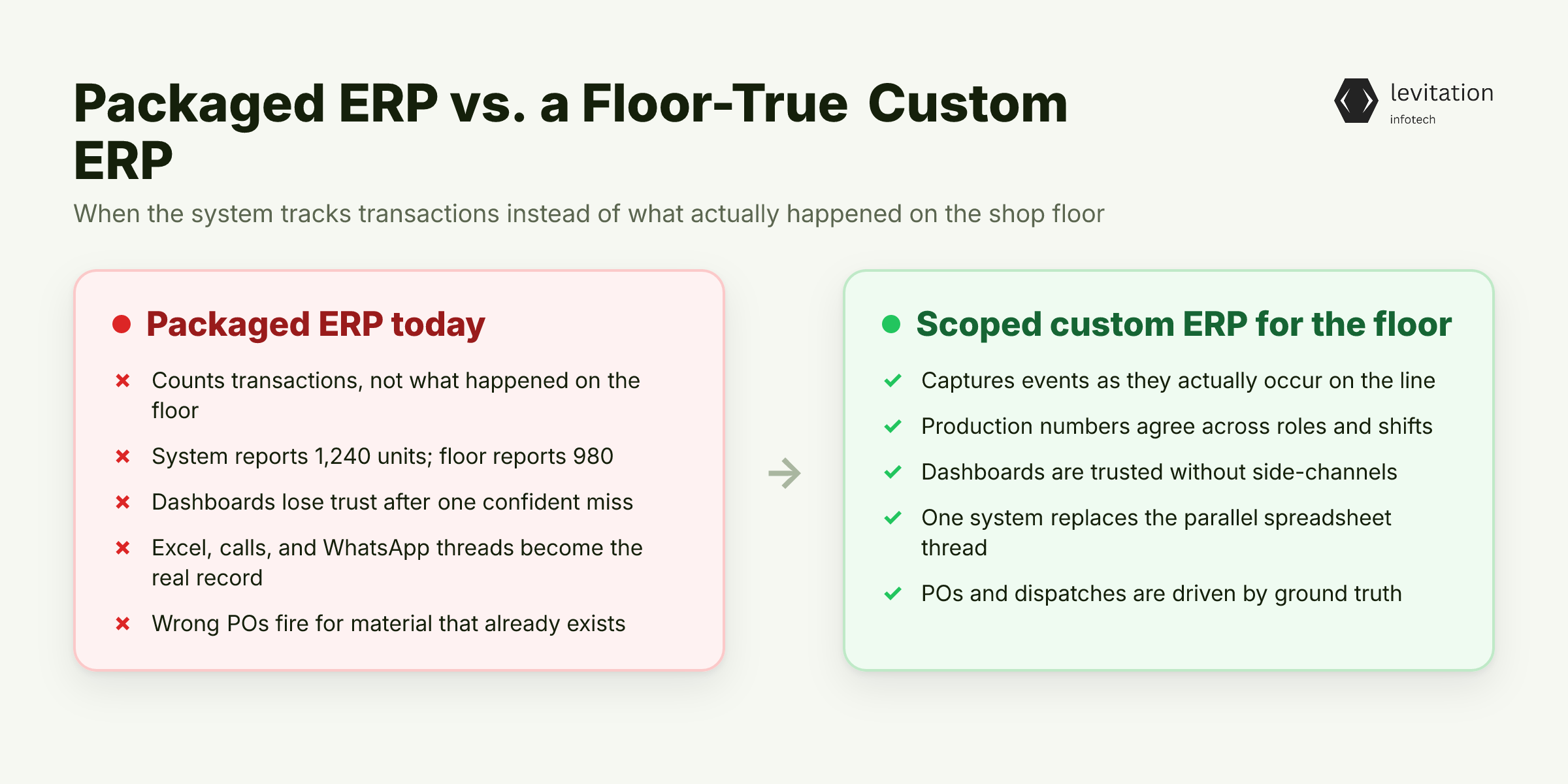
Your ERP says you produced 1,240 units last shift. Your floor supervisor says 980. Both are looking at the same data, and one of them is lying to you. The problem is not your people. It is that packaged ERP was architected to track transactions, not what actually happened on the shop floor.
This is not a small discrepancy. At a Noida plant running two or three shifts, the gap decides whether a dispatch goes out on time. With high SKU variability, the system can fire a purchase order for material that already exists.
Once a manager has been burned twice by a confident-looking number, they stop trusting the dashboard. They open Excel. They call the supervisor. They start a parallel WhatsApp thread to track what is really happening. That is exactly the failure mode we covered in Why Plant Managers Log Line Stops in WhatsApp, Not ERP.
The ERP becomes a screen people look at, not a system people use. The cost of bad data is not a spreadsheet error. It is wrong purchase orders, missed dispatches, and managers who have quietly stopped trusting the system that was supposed to give them answers.
Most teams respond to this by configuring the ERP harder. Add a custom field. Add a new report. Add a workflow. That is the wrong direction, and the cost shows up later, not now. A scoped custom ERP for the floor is the lever that actually moves this number.
Packaged ERP Tracks Transactions, Not Behavior
At its core, any enterprise resource planning system records committed business events: goods received, stock issued, transfers posted, invoices matched. It is a ledger. For most packaged ERPs, tracking only begins once a product is finished or packaged.
The entire production journey before that point is invisible to the system. The changeover. The micro-stops. The operator waiting for a quality hold. None of it gets recorded.
In a Noida plant, this visibility gap is much worse than in a single-SKU Western factory. Indian manufacturers run high product mix, frequent changeovers, and contract-manufacturing variability that no off-the-shelf template was designed for. The packaged system has no model for "this line is in changeover for an extended window." So it has no place to record it.
Then come the terminals. Most packaged ERPs were designed for office desktops, not rugged shop-floor tablets. Operators wait. They lose rhythm. They batch transactions and enter them long after the event.
The timestamp itself becomes unreliable, and the audit trail you thought you had quietly dissolves.
So plant heads ask for more screens, more fields, more clicks. The fix is supposed to be more configuration. It is not.
Why 'Just Configure It More' Quietly Breaks Everything
Every custom field, custom report, and workflow modification in a packaged ERP adds technical debt. The vendor will not carry it forward to the next upgrade. You are forking their product on your own dime.
The signs are easy to spot: - Spreadsheets filling the gaps your ERP will not. - Reports nobody trusts, even when they are technically correct. - Shadow systems maintained by key individuals who quit and take the knowledge with them, the same failure mode documented in Why 60% of Indian ERP Implementations Fail at Adoption. - Unplanned downtime keeps recurring because the ERP scheduling module was never designed for the constraints of your actual lines. It was designed for a generic factory.
Teams that operate at this scale learn fast that a single configuration choice ripples across production, finance, and quality. ERP software development has to start with architecture, not config screens. Complex, multi-process environments demand architecture-first thinking, not config-first thinking.
A long tail of custom fields does not build a system of record. It builds a system of regret.
If configuration is the wrong lever, what is the right one? It starts with a different mental model of what an ERP is for.
What a Plant-Floor-Native ERP Actually Looks Like
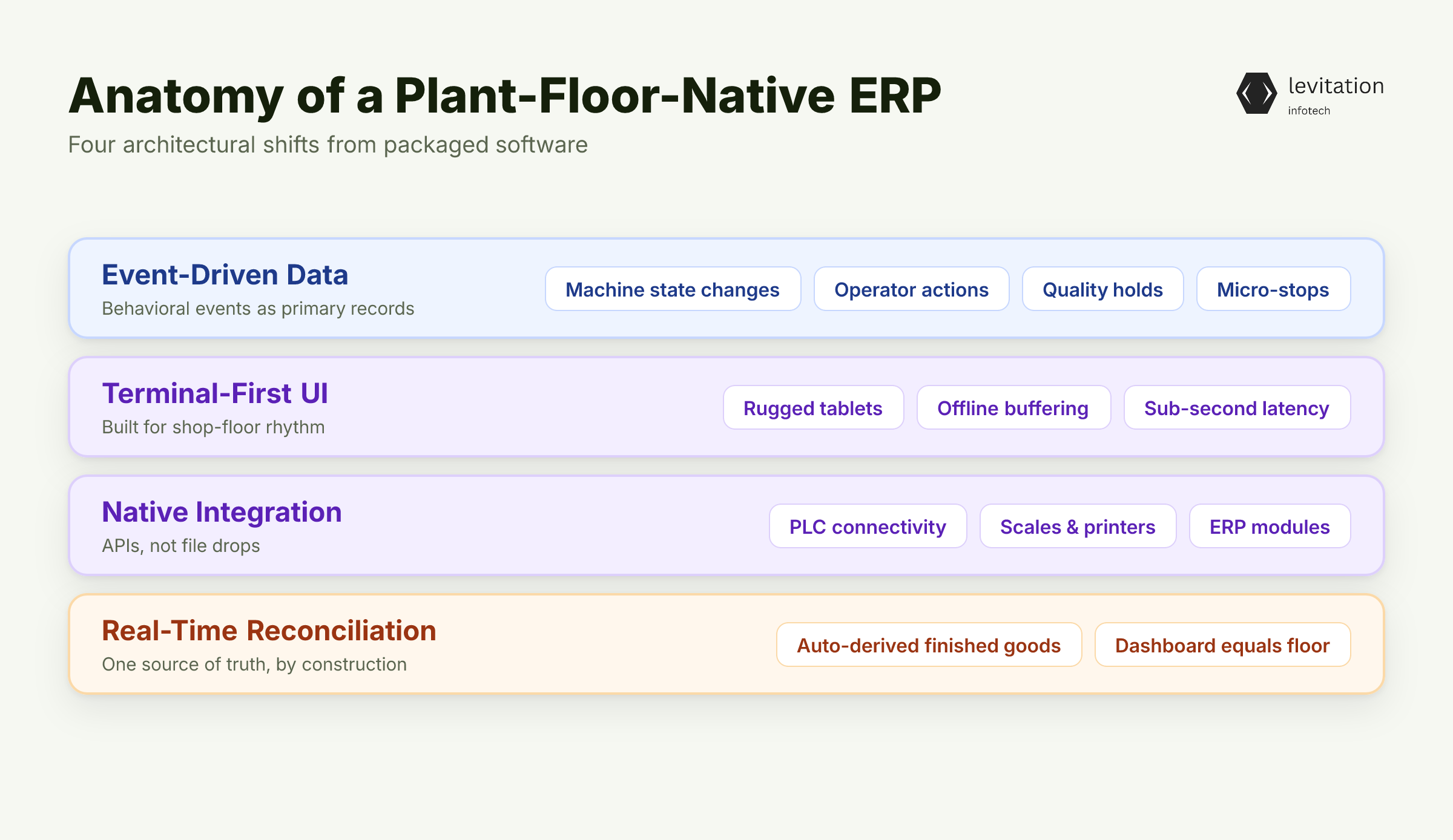
A plant-floor-native ERP is not a packaged product with a mobile skin. It is a different data model.
The first shift: capture behavioral events as first-class records. Machine state changes, operator actions, quality holds, changeover starts, micro-stops. These are not comments in a transaction log. They are the primary data the system is built around.
Finished goods become a derived view of the production event stream, not a separate input a supervisor keys in at end of shift.
The second shift: terminal-first design. Shop-floor screens must respond fast enough to keep operators in rhythm. They need to run on rugged tablets and survive spotty Wi-Fi through offline buffering. A desktop web app resized for mobile will not do. Operators live in these screens for eight hours a day. Latency is not a UX nicety, it is throughput.
The third shift: ERP integration as a feature, not an afterthought. The new layer must talk to PLCs, weighing scales, barcode printers, and your existing ERP system modules through clean APIs. No CSV exports, no nightly reconciliation jobs, no batch file drops that someone forgets to run.
The fourth shift: real-time reconciliation. Because finished goods are auto-derived from the event stream, the number on the dashboard and the number on the floor agree by construction. There is no second source of truth to drift out of sync.
This is the same architectural discipline that ERP implementation projects often skip in the rush to go live. It is the single biggest reason most packaged rollouts under-deliver on the floor.
That is the architecture. Now the harder question: when is a custom build the right call, and when is it not?
The Honest Build vs. Buy ERP Calculus for Noida Plants
Buy makes sense when your processes are standard, your volumes are high and steady, and your competitive edge is cost, not flexibility. An FMCG plant running a narrow SKU range at scale with a stable workforce will get more value from a well-implemented packaged core than from a custom platform.
Build, or heavily customize, makes sense when your plant floor has unique constraints. Proprietary equipment. Regulatory traceability beyond standard. Multi-plant coordination that no vendor has templated. Contract-manufacturing workflows where every customer has a slightly different BOM and routing. In these cases, the packaged product is fighting your business instead of recording it.
The hybrid path many Noida manufacturers miss: keep a packaged core for finance, HR, and statutory reporting. Build the production, quality, and shop-floor execution layers as a custom module that integrates through APIs.
The math is similar to what we covered in ₹14 Lakh Custom ERP Beats ₹1.1 Crore SAP, where the build-vs-buy calculation tilts once you factor in workaround maintenance and reconciliation effort. ERP development for the floor, packaged for the back office, is feasible in most cases. You do not have to bet the company on either extreme.
The real cost of packaged ERP is not the license. It is a dedicated team permanently maintaining workarounds, plus the opportunity cost of decisions made on bad data. Those costs do not show up in the sales quote, but they show up in the P&L.
The next 90 days are where most projects either prove the model or quietly die.
The First 90 Days: Building Custom ERP Without Killing Production
Weeks 1 to 3: process discovery on the floor itself, not in conference rooms. Walk the line. Map every paper slip, every spreadsheet, every WhatsApp message a supervisor sends at changeover. These are the requirements your vendor will never write down.
The process maps you build here become the spec for the build. Without them, you are just rebuilding the packaged ERP badly.
Weeks 4 to 6: scope ruthlessly. Ship the production event capture and shop-floor screens first. Defer finance, HR, and analytics modules to phase two. A working pilot on one line beats a perfect system that never goes live. The temptation to "do it all" is the single most common reason these projects die.
Weeks 7 to 10: integrate with existing systems. Weighbridge, PLCs, barcode printers, and the finance module you are keeping. Use ODOO development or similar frameworks if the core is open-source, or build APIs against a packaged vendor. The principle is the same: every adjacent system gets a clean contract, not a manual export-import ritual.
Weeks 11 to 13: pilot on one shift, one line. Measure three things. Terminal response time, with a hard target that keeps operators in rhythm. Transaction-floor reconciliation accuracy. Operator adoption rate, measured by how often the screen is used vs. how often it should be. If any of these miss, iterate before scaling. The point of a pilot is to learn, not to declare victory.
What Changes When Your ERP Finally Fits the Floor
Data trust returns. Managers stop running parallel spreadsheets because the ERP number is the floor number. Rhythm returns to the line. Fast, well-designed terminals mean operators stay in flow instead of waiting for screens to load. Decisions speed up, because real production events feed planning, not yesterday's summary reports.
The strategic unlock is bigger. Once your ERP reflects your actual operations, you can layer analytics, predictive maintenance, and AI on a foundation that is not lying to you.
Teams that build a custom ERP for manufacturing get audit-ready data capture as a byproduct. The same parallel holds in regulated work where every event has to be reconstructable.
Capture every event at the source. Derive the summary from the event stream. Let the system be a witness instead of an opinion.
That is what a plant-floor-native ERP buys you. Not a new license. A system the floor actually trusts.
Frequently Asked Questions
Can a packaged ERP be customized enough to fit a manufacturing plant floor?
Configuration and bolt-on customizations can close small gaps, but they cannot change the underlying data model. If your packaged ERP treats production as a series of transactions rather than a stream of behavioral events, no amount of field-adding will make it match what is actually happening on your shop floor.
How long does custom ERP development take for a manufacturing plant?
A scoped pilot covering production event capture, shop-floor terminals, and integration with one existing system can be live in a single quarter. A full multi-module rollout timeline depends heavily on the number of plants, lines, and integrations involved.
What is the typical cost of custom ERP vs packaged ERP in India?
Packaged ERP licenses look cheaper upfront than the true cost of ownership. The real cost is the dedicated team permanently maintaining workarounds plus the opportunity cost of decisions made on bad data. A scoped custom build for a single plant shifts spend from perpetual workaround maintenance to a defined engineering investment. Payback depends on how much downtime and reconciliation effort the current setup is generating.
When should a manufacturer choose custom ERP over a packaged solution?
Choose custom or hybrid when you have proprietary equipment, contract-manufacturing variability, multi-plant coordination needs, or regulatory traceability beyond what standard packages offer. Choose packaged when your processes are standard, your volume is steady, and your competitive edge is cost rather than flexibility.
What are the signs that your current ERP no longer fits your plant?
The clearest signs are spreadsheets filling gaps the ERP will not, data nobody trusts for decisions, unplanned downtime that keeps recurring despite the ERP's scheduling module, and a small group of people who hold the system together through undocumented workarounds.
If this matches the gap you are seeing, a 90-day pilot on one line and one shift is the cheapest way to know if the model holds.
About the author
Mayank Singh is a software developer at Levitation Infotech, where he builds web and AI-powered applications across the company’s fintech, healthcare, and enterprise projects.