


TL;DR: Most CRMs sold to NCR brokerages are visit-loggers disguised as revenue systems. They track the activity that doesn't pay the bills. They also ignore the booking, agreement, and commission mechanics that do pay the bills. A closing-oriented real estate CRM in India needs custom build scope. It also needs phased delivery. The price band should reflect the actual work, not the demo-friendly wrapper most vendors sell.
Key Takeaways: - Visit volume is a vanity metric. NCR site visits convert at a low rate. So a dashboard celebrating high visit counts tells you nothing about revenue. - Salesforce, Zoho, and Dynamics 365 need heavy retrofitting to handle long property cycles. They also need work for channel partner hierarchies and RERA-grade agreement data. - A purpose-built CRM with inventory, commission, and RERA modules lands far faster than an in-house team standing up the same scope. - Closing-oriented systems change broker incentives, morning reviews, and revenue forecasting from day one. - Vendor selection discipline matters more than feature checklists. A partner that has shipped compliance-grade systems brings the rigor RERA-grade agreement data demands.
The Dashboard You're Proud of Is the Dashboard Killing Your Closings
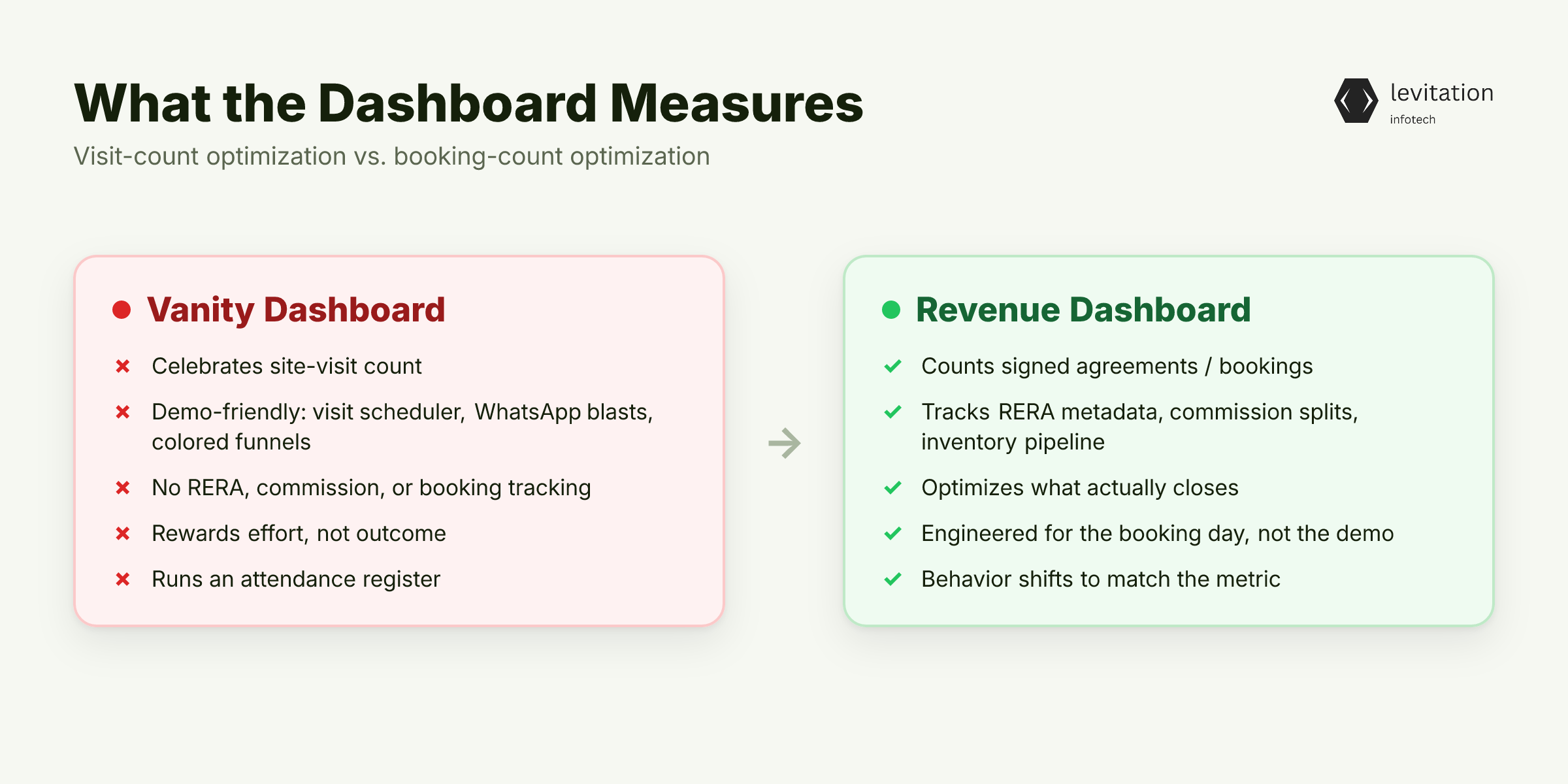
Your sales team logged thousands of site visits last quarter. A small fraction converted. The ₹5 Lakh CRM celebrated the visit count. It was never built to track the bookings.
NCR brokerages often pay mid-five-figure sums for CRMs. These CRMs optimize the wrong variable: visit count instead of booking count. Vendors demo visit pipelines, colored funnel widgets, and WhatsApp blast reports. Sales heads clap. Nobody asks what the system does the day a booking lands.
A site visit in the Noida and Gurugram market is a heavy time commitment. Most of these visits don't close. Visit volume is a vanity metric. When most of those visits don't convert, counting them measures effort, not outcome. Sales heads who celebrate high visit counts in any given month are running an attendance register, not a sales operation.
The disconnect is structural. Most Indian real estate CRM vendors sell features, not revenue outcomes. Demo rooms have a visit scheduler. Engineering backlogs have commission splits, RERA metadata, and inventory pipeline. These items never make the demo because they don't photograph well.
What gets measured gets optimized. If the dashboard rewards visits, brokers will schedule more visits. If it rewards signed agreements, behavior changes.
So if the standard tools are misaligned, the obvious upgrade path (Salesforce, Zoho, Dynamics) should fix it. It doesn't. Here's why.
Why Zoho, Salesforce, and Dynamics Don't Fit an Noida Brokerage
Salesforce and Dynamics 365 are designed for B2B SaaS funnels. Short cycles. Single decision-makers. Monthly recurring revenue. None of that maps to an apartment sale. Such a sale takes months of negotiation across two co-applicants, a channel partner, and a bank loan.
Indian real estate cycles run across multiple towers, phases, and RERA-registered projects. Deals involve bulk bookings, joint applicants, and payment milestones. These milestones shift with construction stage. A CRM that treats every deal as a single record with a "stage" field misrepresents the deal at every step.
Channel partner hierarchies make it worse. A super distributor signs in a franchisee who brings in an associate broker. Commission has to split on net realization, not on visit count. Off-the-shelf platforms force you to model this with custom objects and Apex or Flow workarounds. They also need third-party apps bolted on for inventory and agreement registration. The effective cost and complexity end up higher than a purpose-built CRM. The per-seat license line item balloons once you add the apps, integrations, and consultant hours.
Zoho is cheaper but inherits the same shape problem. It treats leads, deals, and contacts as separate objects. Workflows have to stitch them together. NCR real estate needs the unit, the buyer, the channel partner, and the agreement as one composite record.
Building that in Zoho is possible. By the time you're done, you've effectively built a CRM project on top of a Zoho license. This is the kind of work covered by CRM software development for specialized industries. You would have been faster building native. The same trap we see in Salesforce deployments for NCR brokers repeats itself at every scale.
Since the big CRM vendors miss the mark, the typical Indian "real estate CRM" vendors should be the answer. Most aren't.
What Most Indian Real Estate CRM Vendors Actually Sell You
The dominant product in the affordable mid-market segment is a lead capture + site visit scheduler + WhatsApp blast tool. It's packaged as a "CRM." The demo is short. The dashboard has a visit count widget, a follow-up reminder list, and a chart of "calls made this week." The sales head nods. The contract signs.
Visit logging is the easiest module to build and demo. So it gets sold as the core. Closing analytics need inventory, payment, and RERA integration. Most vendors skip that work. It's harder, longer, and not what the buyer asks for in a demo.
Drowning the sales head in "calls made," "visits done," "follow-ups scheduled" creates an activity culture. Brokers optimize for what the dashboard measures. They will run packed visit schedules to keep their number green. Many of those visits are tire-kickers from a portal that converts poorly.
The CRM is doing exactly what it was built to do. The problem is what it was built to do.
You end up paying custom CRM cost vs. packaged visit trackers for what is functionally a glorified diary app. It has a reporting layer. The visit count goes up. The booking count doesn't. This is the pattern that makes a mid-five-figure CRM lose to an Excel sheet for half the sales floor.
The fix isn't another vendor. It's a different category of system. A closing-oriented CRM for NCR real estate looks like this.
The Anatomy of a CRM That Tracks Closings, Not Site Visits
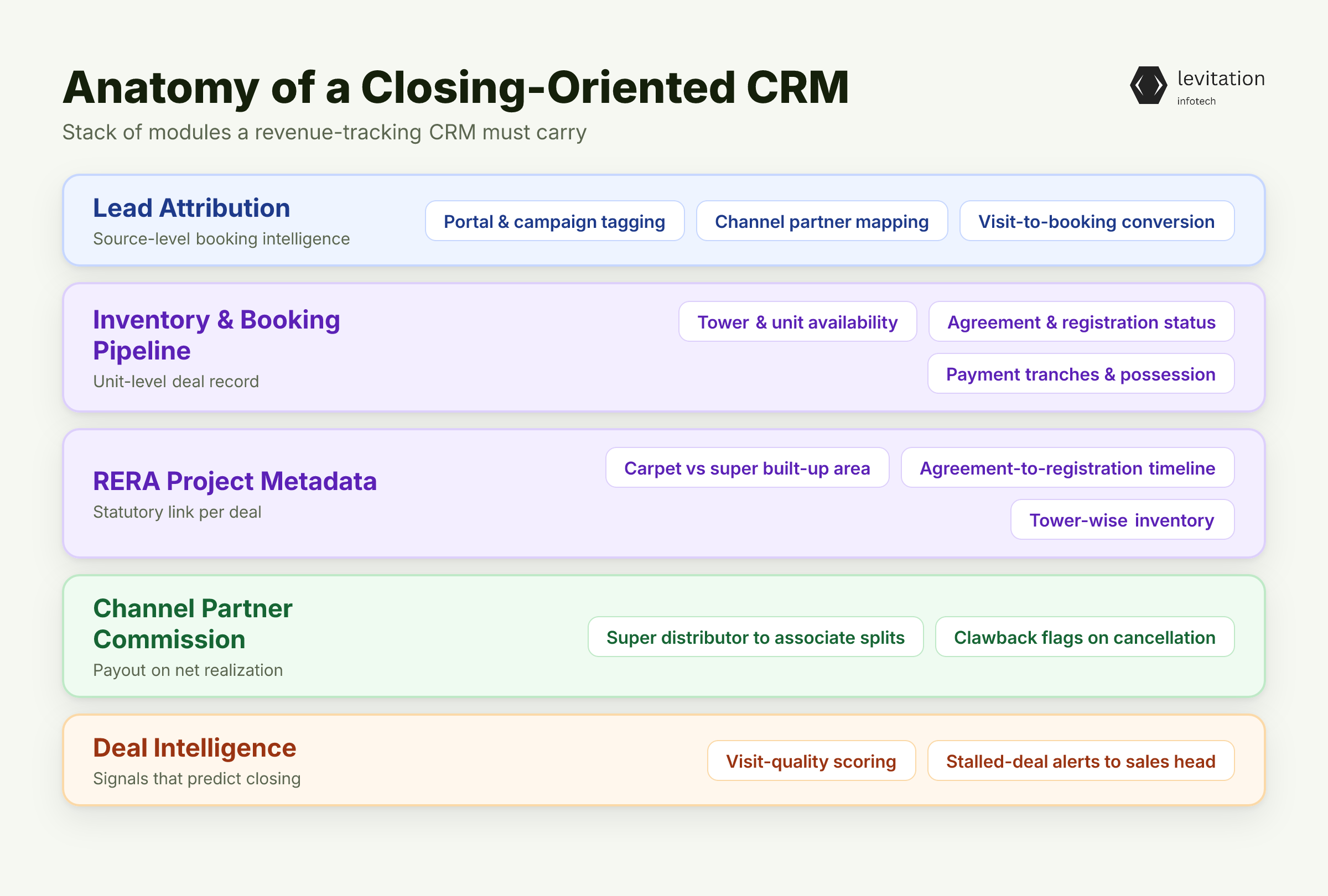
A closing-oriented CRM is built around the booking, not the visit. The lead record carries the portal source, the campaign, and the channel partner who brought it in. The system calculates per-source visit-to-booking conversion. Then it shows the result to the sales head in one view. That single view is the first thing the existing visit-logger cannot produce.
The unit, the tower, the phase, and the agreement status live on the same record as the buyer. Payment tranches, possession timelines, and registration milestones are tracked against the deal. They are not pasted into a spreadsheet by the accounts team at month-end. When the sales head opens a deal, they see the booking. They also see the agreement and the commission impact in one screen.
The custom CRM modules for real estate sales operations stack includes: - Lead source attribution. Portal, campaign, and channel partner broken down to per-source visit-to-booking conversion. The result is visible in one sales-head view. - Inventory and booking pipeline. Tower-wise, unit-level availability, agreement status, registration milestone, payment tranche, all on the same record as the buyer. - Channel partner commission engine. Calculates payout on net realization, not on visit count. Flags clawbacks on cancellations. Handles super distributor to associate broker splits. - Visit-quality scoring. Second visit within a short window, co-applicants attending, buyer asking about possession timeline. These are the signals that predict booking. - RERA project metadata. Linked to every deal. Agreement-to-registration timeline. Statutory disclosures. Carpet area vs super built-up area. Tower-wise inventory. - Stalled-deal alerts. No activity in N days, agreement unsigned past threshold, payment overdue. Pushed to the sales head, not buried in a weekly report.
The CRM development cost for revenue-tracking systems band for this scope is shaped by channel partner complexity. It also depends on RERA integration depth and whether AI lead scoring is in the build. The structural difference from a visit-logger is total. This is a revenue system, not an attendance register.
This is a different kind of build. The scope is what makes the timeline and the bill real.
The Phased Build Path vs. the In-House Trap
A focused CRM development partner with industry-grade delivery engagement for an NCR brokerage lands in a compressed timeline. It spans three usable phases: - Phase 1: Lead and pipeline. Replaces the existing visit tracker. - Phase 2: Inventory and booking. Tower-wise pipeline, unit-level availability, agreement status. - Phase 3: Channel partner and RERA. Commission engine, RERA metadata, stalled-deal alerts.
Each phase is independently usable. The sales head sees value early. This happens before the full booking and commission engine is even scoped. That's the opposite of an in-house build. In an in-house build, the team spends the first stretch setting up infrastructure, CI/CD, and design systems. This happens before any feature ships.
An in-house team takes far longer for the same scope. Hiring alone eats months. Infra setup, architecture decisions, and the long tail of integrations stretch the timeline further.
A specialized development partner starts with the architecture already proven across deployments. This compresses the build.
The CRM development cost in India for real estate scope band for this work depends on channel partner complexity. It also depends on RERA integration depth and AI scoring add-ons. Against that, a ₹5 Lakh visit-logger is a rounding error. The visit-logger is what's leaving the booking count on the table.
Compliance credibility matters here. A partner that has deployed compliance-grade systems for sensitive industries carries the same bar. This bar covers audit-trail rigor, access control, and statutory data retention. RERA-grade agreement and payment data demands the same bar.
The discipline required for regulated data and the discipline required for real estate agreement data are closer than most founders assume. The retention numbers from regulated-industry deployments reflect that.
Once the system is live, the sales head's day changes in specific, measurable ways.
What Changes When Your CRM Tracks Closings Instead of Visits
Broker incentive structures shift. The "visits this month" target becomes "net bookings this quarter with possession milestone cleared." The dashboard now rewards what the bank account cares about: signed agreements, registered units, disbursed payments.
The sales head's morning review moves from "who logged visits yesterday" to: - Which agreements are stalled past an acceptable window - Which channel partner's pipeline dropped week-on-week - Which tower's inventory is moving and which is stuck - Which portal source converts well and which converts poorly
Forecasting becomes real. Tower-wise, source-wise, broker-wise revenue projection based on agreement stage, not on visit extrapolation. The CFO can model next quarter's revenue from the CRM. So the CFO doesn't need to ask the sales head for a number off the top of their head.
A long-term build is why mature clients stay. Strong retention is what a custom CRM built around your sales motion earns. This happens when the CRM stops being a tool. Then it starts being the operating system for the sales floor.
Vendors sell software. Practitioners adopt infrastructure. The difference shows up in renewal rates, and in booking counts that finally move.
Most brokers use only a handful of fields from the dozens their CRM offers. The brokers who use six CRM fields out of dozens pattern shows this. It happens because the system wasn't designed for how they actually sell.
Teams that ship this kind of work (Levitation included) have seen what changes. The dashboard rewards the booking instead of celebrating the visit.
Frequently Asked Questions
How much does custom CRM development cost in India for an NCR real estate brokerage?
A closing-oriented real estate CRM with lead attribution, inventory tracking, channel partner commissions, and RERA integration varies in cost. The variation depends on the depth of channel partner hierarchies. It also depends on payment milestone complexity and whether AI-based lead scoring is included. See the CRM development cost in India breakdown for stage-wise pricing.
Why build a custom CRM instead of using Zoho, Salesforce, or Dynamics for NCR real estate?
Zoho, Salesforce, and Dynamics are designed for B2B SaaS funnels. They need heavy customization (custom objects, Apex/Flow, third-party inventory apps) to handle long property sales cycles. They also need this work for channel partner hierarchies and RERA-grade agreement data. A custom CRM built for Indian real estate captures these natively. It reduces total cost of ownership and user friction.
How long does it take to build a real estate CRM that tracks closings, not just visits?
A focused CRM software development engagement lands in phased delivery. First comes lead and pipeline. Then comes inventory and booking. Then comes channel partner and RERA. An in-house build standing up the same scope from scratch takes far longer.
What features matter most in a CRM for Noida and Gurugram brokers?
Per-source visit-to-booking conversion, tower-wise booking pipeline, channel partner commission engine on net realization, RERA project metadata linked to every deal, and stalled-deal alerts on agreements and payment milestones. Generic visit-count dashboards are the feature set to actively avoid.
Can a custom real estate CRM integrate with RERA project data and channel partner portals?
Yes. Purpose-built CRM systems integrate RERA project metadata, agreement-to-registration status, and channel partner hierarchies into the same lead and deal record. A sales head then sees statutory timeline, commission split, and booking status without switching tools.
About the author
Mayank Singh is a software developer at Levitation Infotech, where he builds web and AI-powered applications across the company’s fintech, healthcare, and enterprise projects.