

TL;DR: AI vendor quotes for enterprise projects routinely cover only a fraction of true delivery cost. Buyers get blindsided when the real bill arrives months later. The cause is a structural blind spot in how projects get scoped. The build phase is quoted in detail. The 70% that comes after the demo (data engineering, integration, evaluation, MLOps) is buried or omitted. CEOs who spot the missing 70% stop getting blindsided.
Key Takeaways: - AI projects in Noida frequently exceed initial cost estimates by 6x, with broader benchmarking showing 3-5× overruns against original budgets - Vendors systematically underbid on the build phase and recover margin on post-launch work that was never itemized - Quote accuracy correlates more with scoping depth (how thoroughly the vendor interrogates your requirements) than with vendor size or pedigree
The Same Brief, Wildly Different Quotes, and the 70% Nobody Quotes For
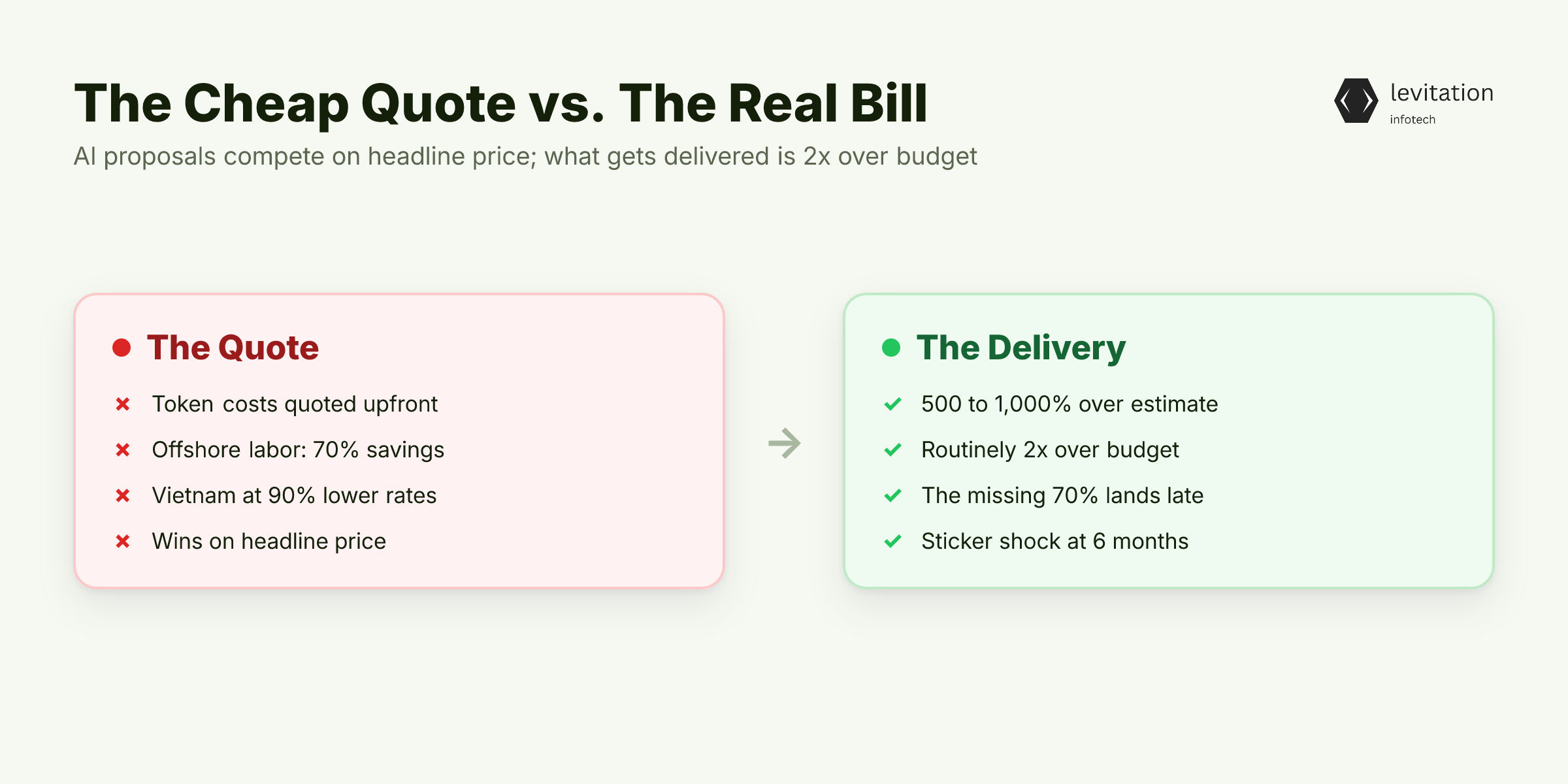
Enterprise AI proposals compete on headline price. That competition is what creates the gap between what gets quoted and what gets delivered.
Here's the pattern that keeps repeating: a company budgets for AI, gets sticker shock six months in, and quietly scales back. The token costs were fine. The surprise was everything else.
Gartner's finding is that CFO AI cost estimates run 500 to 1,000 percent off the mark. The MIT Sloan study mirrors it. AI projects routinely come in more than 2x over budget, even when teams label the work as "non-complex."
These aren't edge cases. They're the norm.
The cheap quote isn't cheap. It's a deposit on a much larger bill.
The offshore cost advantage is real, but misleading. Philippines BPO workers earn $6 to $25 per hour fully loaded. That delivers 70% labor cost savings versus US equivalents.
Vietnam's labor costs run 90% lower than American rates. Yet those savings don't translate into a cheaper AI project once the missing 70% lands.
You saved 40% on the line item that turned out to be 30% of the real cost. The math doesn't help you.
The obvious explanation is that vendors are lowballing to win the deal. That's only half the story, and the less interesting half.
Why the Cheapest Quote Always Wins, and Always Blows Up
The cheapest bid always wins. It also always blows up. This isn't a coincidence. It's a pattern called land-and-expand.
Vendors price the demo, not the deployment. They recover margin on change orders once your team is locked in. The alternative is a 9-month restart.
The hourly rate is the wrong unit. A team with strong scoping discipline that ships efficiently beats a cheaper-rate team that ships slowly with constant scope revisions.
The cheaper rate signals weaker scoping discipline, not better efficiency. We see the same dynamic play out in custom AI development proposals across the board.
Then there's the FTE discount trap. A proposal lists three or four full-time engineers at a fixed monthly fee. It looks predictable.
The vendor is betting you'll never ask what happens when the integrations start breaking. In our experience, the post-integration phase is where the hidden 70% shows up as invoices.
Why do CEOs keep falling for it? - Vendor decks show clean Gantt charts - Polished case slides with headlined references from big-name clients - Nobody shows the data readiness crisis that emerges mid-project, adding hundreds of hours nobody quoted for - Nobody mentions the schema mismatch in your legacy ERP that turns a quick integration into an extended investigation
The pitch is the lie. The proposal is the trap.
If lowballing were the whole problem, the fix would be simple: stop trusting the lowest bid. But the broader pattern across enterprise AI procurement tells us something more uncomfortable.
The 70% Nobody Budgets For: Where the Real Money Goes
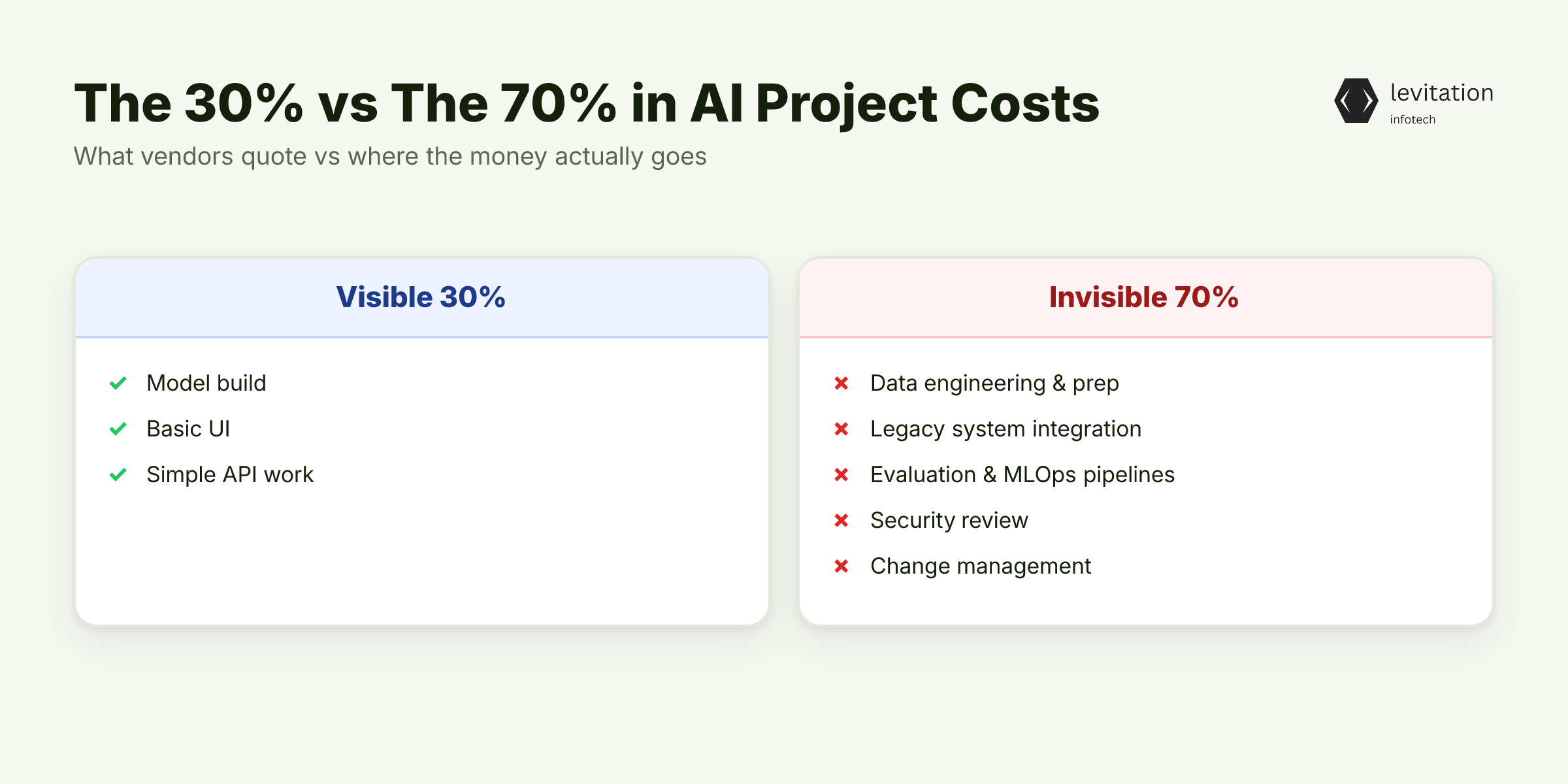
The 70% nobody budgets for isn't a line item. It's an entire category of work that disappears from the proposal.
Here's the breakdown. About 30% of actual project cost gets quoted in proposals: the model build, a basic UI, simple API work. The visible work.
The remaining 70% is data engineering, integration with legacy systems, evaluation pipelines, MLOps, security review, and change management. The invisible work. This gap mirrors the pattern we documented in the three hidden costs that triple AI development cost in India. Most CTOs still haven't internalized it.
A few things stand out.
Token costs are a rounding error. Even at enterprise scale, inference is a small line item. The cost lives in the human effort of getting data clean, schemas aligned, and edge cases enumerated.
In any real AI solution development deployment, 20 to 40% of customer interactions still route to humans. That hybrid layer is rarely priced in the initial quote. It shows up later as a "change order" no one approved.
Data prep alone consumes a major share of total hours across enterprise AI projects. Work that almost no vendor puts on the proposal front page.
Evaluation and monitoring infrastructure is the unsexy work that determines whether your AI works in production. It consistently gets cut first and paid for last. It's the part nobody in sales wants to talk about.
Once you accept that 70% is invisible on day one, the question becomes: what does an honest AI proposal actually look like when you line multiple bids up side by side?
What Noida's AI Market Reveals About Quote Quality
A wide spread between quotes for the same brief is the first clue. Some bids price the demo, others price the deployment. No consistent correlation between price and the vendor's stated experience level.
A few patterns emerge.
Larger vendors with more claimed deployments price lower on average than smaller boutiques. But the larger vendors' quotes tend to be less detailed. They trust their process more than they should.
Process trust is fine until your legacy CRM breaks the integration sprint. The vendor says, "we assumed greenfield." This mirrors what we see in Noida software quotes with 6 hidden costs across the broader market.
Most Noida vendors bury data engineering under "discovery" or "consulting" rather than itemizing it. That's where scope creep hides. It hides in the line items nobody asks about.
On compliance, only a fraction of vendors can articulate a defensible answer to a simple question: "How do you handle PHI in production?" For a healthcare AI deployment, that's a deal-breaker dressed up as a footnote. The gap between vendors who can answer and those who can't is the gap between a real AI system and a liability.
The single most predictive signal across enterprise AI procurement: quote accuracy tracks with the number of questions the vendor asks before sending the proposal. Not with size or pedigree.
Vendors who ask detailed scoping questions produce quotes close to true cost. Vendors who skip discovery produce quotes that land multiples off.
If quote quality tracks with how many questions a vendor asks, the CEO's job isn't to find the cheapest bid. It's to force every bidder into the same depth of conversation. Here's the script that works.
The 8 Questions That Expose a Fake AI Quote
Asking the right questions separates a real AI development company from a sales team with a template.
Question 1: What percentage of this estimate is data engineering? If they can't answer with a number, they haven't looked at your data yet.
Question 2: Show me a line-item breakdown of the 70% post-launch work. Any vendor who quotes only the build phase is front-loading your risk onto the deployment phase.
Question 3: What's your evaluation harness for measuring model quality in production? If the answer is "we'll use accuracy" or worse, "we'll check manually," walk away. Production AI needs drift detection, regression suites, and quality gates. Not vibes.
Question 4: How do you price the integration with our existing ERP or CRM? This is where Noida proposals most often fail. They assume greenfield. Your business is brownfield. The two have nothing in common.
**Question 5: What does the post-integration phase look like?
About the author
Mayank Singh is a software developer at Levitation Infotech, where he builds web and AI-powered applications across the company’s fintech, healthcare, and enterprise projects.