


TL;DR: Around 60% of code in "custom" software projects is often reusable template boilerplate dressed up with superficial changes. This piece gives founders a four-step audit to detect template reuse and a clear framework for deciding when "custom" is the wrong answer.
Key Takeaways: - Templates are a widespread structural pattern across Indian vendors, not isolated bad actors - A four-step code audit (grep, git history, abstraction layers, data model) exposes template fraud in under a week - Genuine custom code outlasts template-based work, which tends to require a full rewrite within a couple of years
The 60% Problem Nobody on the Client Side Wants to Discuss
Your vendor quoted $80K for a "custom" SaaS platform. Six months later, you discover the authentication module, payment flow, and admin panel are byte-for-byte identical to what three other startups received. Welcome to the template economy.
Almost nobody on the buying side knows how to detect it.
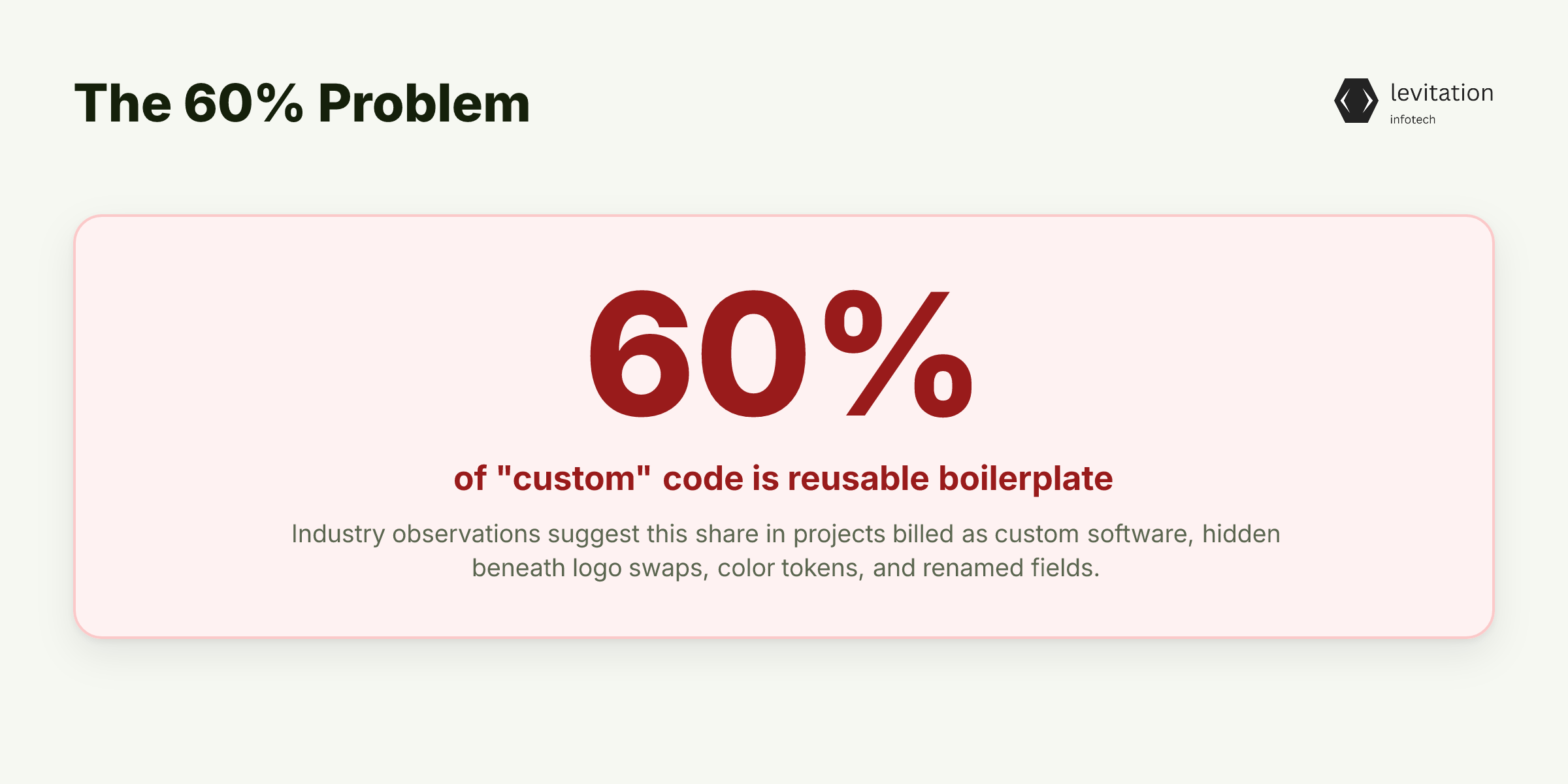
The numbers aren't kind. Industry observations suggest around 60% of code in projects billed as "custom" is reusable boilerplate.
Think authentication scaffolds, admin panels, CRUD generators, API stubs. The surface changes: logos, color tokens, a few field names. The skeleton stays the same.
This is the custom software development industry's most uncomfortable truth. Fixed-price contracts reward speed. Templates deliver speed. So vendors reach for them.
The result: you pay full price for what is, structurally, a configuration job on someone else's codebase. The vendor knows. The client does not.
And the client rarely has the technical access to find out.
But if the problem is this obvious, why doesn't every founder catch it before signing the check?
Why Founders Don't Catch Template Work Until It's Too Late
Because the entire buying process is designed to hide it.
Repositories sit behind vendor IP clauses. You can't audit what you can't see. Most Indian outsourcing contracts grant the vendor source code ownership with a limited license back to the client.
Read the fine print on your own agreement. Many founders discover this clause at the rewrite stage, not the signing stage.
Demos are polished for a reason. A clean admin UI takes two weeks to demo. A smooth payment flow takes the same.
A full dashboard takes months. So the vendor shows you the layer that matters most to a non-technical buyer: the surface. The demo proves nothing about the architecture underneath.
Then comes the build-versus-buy confusion. When the top custom software development companies in India pitch you, you can't tell whether they're building, configuring, or licensing a template.
Some templates are even written by the same vendors bidding on the contract. The RFP process assumes technical literacy most founders don't have.
It gets worse. Most RFPs skip the one line item that would expose everything: full repository access with commit history. We explored a similar trap in our piece on vendor code ownership, where the same structural gap led to a ₹20 Lakh loss.
The pattern is identical: surface looks custom, demo feels custom, code stays invisible.
So what actually separates a template in a trench coat from genuine custom work?
The Architecture Test: One Abstraction Layer Reveals Everything
One structural test cuts through the marketing. Genuine custom software development wraps every third-party dependency in a thin abstraction layer.
Your business logic talks to an interface. The interface talks to the provider. Switch payment gateways, and you edit one file.
Template-based code skips that step. The vendor SDK names appear directly in your business logic. Swap payment providers, and you're editing fifty files, not one.
The cost isn't just technical debt. It's vendor lock-in by design.
This is the real exit-cost test. True custom work is portable. Template work isn't, because the architecture was retrofitted, not built.
Three structural markers separate the two: - Microservices boundaries that map to your actual workflows, not the framework's defaults - Clean API contracts between modules, with versioning that anticipates change - A swappable backend where every external service sits behind a single interface
Bespoke software built for your domain treats these as non-negotiable. Template-rooted work treats them as overhead.
We covered this in our microservices breakdown. The same pattern showed up there: no abstraction layer, hard-coded vendor calls, cascading outages.
Theory is cheap. What does this look like as a concrete audit you can actually run on a vendor's repo?
A 4-Step Audit You Can Run This Week
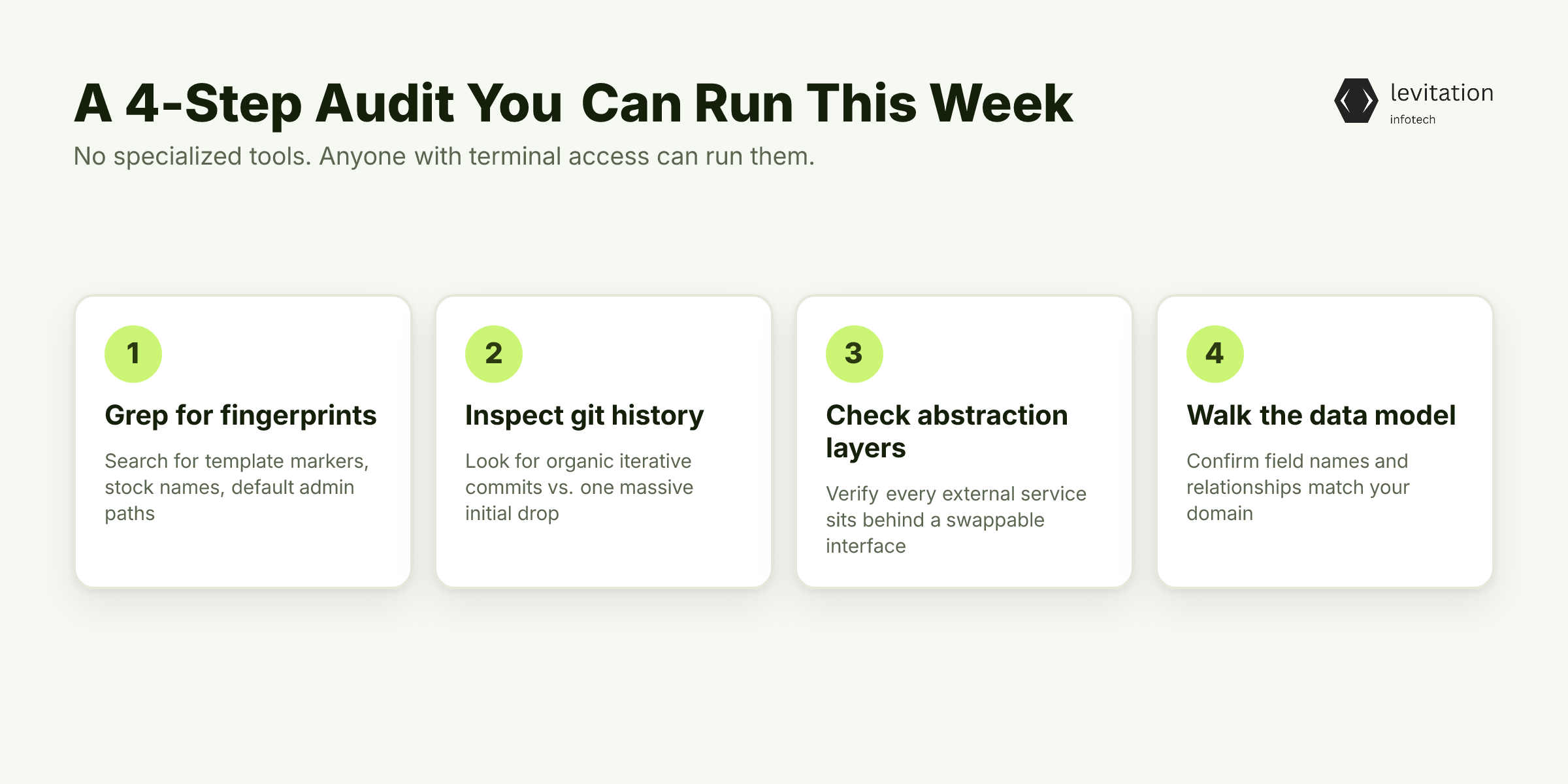
Four steps. No specialized tools. Anyone with terminal access can run them.
Step 1: Grep for template fingerprints. Open the repository and search for generic comment headers, stock author names, and default admin paths like /admin/login or /user/register. Also check for library version mismatches between modules.
A genuine application development project has consistent versions and original comments. A templated one has fingerprints from the original author.
Step 2: Inspect git history. This is the single most revealing step. A genuine project shows hundreds of small iterative commits spread across months. A templated project shows one massive initial commit, then surface-level changes after.
The first commit of a real custom build rarely exceeds a few hundred files. The first commit of a template-in-a-trench-coat often runs into the thousands.
Ask the vendor for the git log. If they resist, treat that resistance as the answer.
Step 3: Demand a thin abstraction layer for every external service. Payment, email, SMS, storage. If vendor SDK names appear in your business logic, the architecture is template-rooted.
If they sit behind a single interface that you can swap, the work was built for you. Request the file structure showing where each external dependency lives.
One file per service is the standard. Anything else is a red flag.
Step 4: Walk the data model. Genuine custom work reflects your domain. Field names match your terminology. Relationships reflect your workflows.
A template's schema has fields for use cases you don't have: subscription tiers, marketplace features, multi-tenant flags. It also misses fields you do.
Read the schema without the vendor's commentary. If it doesn't feel like yours, it isn't.
Sometimes the audit reveals the truth: the project genuinely needed custom code, but you got something else. And sometimes, the harder admission, the project never needed custom code at all.
Build vs Buy: When 'Custom' Is the Wrong Answer Entirely
The "custom" path wins on flexibility, control, and long-term ownership. But only when your workflows are genuinely unique and SaaS configuration would be a worse fit than building.
The "buy" path wins on speed, predictable cost, and reliability for commodity functions. CRM, billing, helpdesk, basic HRMS. These are solved problems.
A template is a legitimate answer here. The deception is in selling it as custom, not in the template itself.
For founders weighing software development companies in India for non-commodity work, a dedicated development team model beats fixed-scope every time.
The reason is structural. Fixed-price projects reward vendors for maximizing template reuse because their margin depends on minimizing custom engineering hours. Dedicated teams get paid for iteration velocity, which aligns with the client's interest in genuine engineering.
We dug into the cost side of this in our ₹12 Lakh Noida CRM analysis and the broader pattern in Noida quote gap breakdowns.
The cheapest quote is often the most templated.
So when custom is the right call, and you've screened for template fraud, what does genuinely good custom software development actually look like years down the road?
What Genuine Custom Software Looks Like Years In
The longevity test is brutal. Systems still running in production years after deployment are the strongest signal that the original engineering was built to last.
Template-rooted systems tend to require a full rewrite well before genuine custom builds. The cracks show up as the vendor who built it stops recognizing the codebase.
Three markers separate the survivors from the rewrite list: - Enterprise-grade trust. Vendors serving enterprise clients at scale treat abstraction, observability, and test coverage as non-negotiable. These aren't template features. They're engineering discipline. - Regulated-industries proof. Deploying in healthcare or finance means the codebase was built around audit trails, access controls, and data residency from day one. You can't bolt compliance onto a template. The schema, the logs, the access model all have to be native. - Pivot survival. A well-built system survives pivots, team turnover, and scale. A templated system survives none of them.
The best partner won't just be the best software development company on a pitch deck. They'll be the one whose custom software development company credentials show up in production systems still serving real users years after launch.
Projects where the microservices architecture was designed for the client's domain, not adapted from a framework's defaults, are the ones that survive.
The founder outcome is simple. Build for your domain, with abstraction layers, and the system compounds in value. Buy a template, call it custom, and you're paying twice: once now, and once at the rewrite.
Run the audit before you sign. The four steps take a week. The rewrite takes two years and a second budget.
Frequently Asked Questions
Q: How can I verify if my outsourced software is truly custom?
A: Demand full repository access with commit history, then run the four-step audit: grep for stock template fingerprints, inspect git history for iterative work versus bulk uploads, verify that third-party SDKs sit behind a thin abstraction layer, and check whether the data model reflects your specific domain or carries irrelevant fields from the template.
Q: What percentage of outsourced code is typically templated?
A: Industry observations suggest around 60% of code in "custom" projects is often reusable template boilerplate: auth, CRUD, admin panels, API stubs, with the remaining 40% being genuine business logic and customization. The exact ratio varies, but the structural pattern is widespread across Indian outsourcing vendors.
Q: When should a startup choose custom software over SaaS?
A: Choose custom when your workflows, data model, or compliance requirements are genuinely unique and would require heavy SaaS configuration anyway. Choose SaaS when the function is commodity (CRM, billing, support) and speed-to-market matters more than differentiation. The worst outcome is paying custom prices for a template that doesn't fit any of these cases.
Q: How do I audit an Indian development vendor's codebase?
A: Insist on repository ownership, full git history, and the right to run third-party code review. Look for abstraction layers over vendor SDKs, a domain-specific data model, incremental commit patterns, and consistent test coverage across modules. If the vendor resists any of these, treat it as a red flag.
Q: Is a dedicated development team better than a fixed-price project for custom work?
A: For most startups, yes. A dedicated development team model gives you ongoing visibility into the codebase, iteration velocity, and the ability to catch template shortcuts early. Fixed-price projects incentivize vendors to maximize template reuse because their margin depends on minimizing custom engineering hours.
Sources
Research and references cited in this article:
- When to Choose Custom Software Development Over Templates - Flexi Boost
- Templates vs custom software solutions, what's best for you?
- Custom vs Template Solutions: When to Invest in ...
- Custom Software Development vs Ready-Made Solutions
- Custom Website vs. Template: Which Is Right for Your Business in 2025?
- Outsource Software Development to India: Full Guide (2026)
- Why Outsourcing Software Development to India Fails: The Evidence (2026)
- Software Development Outsourcing to India
- Software Development Outsourcing Statistics 2026
- Why US & Canada Companies Outsource Software Development to India
- Build vs Buy Software in 2026: Cost, ROI and Decision Guide
- Build vs. Buy: Navigating the Software Decision for Your Business
About the author
Mayank Singh is a software developer at Levitation Infotech, where he builds web and AI-powered applications across the company’s fintech, healthcare, and enterprise projects.