


TL;DR: Odoo's ₹1,250 per user per month is a software subscription, not a deployment cost. A 100-user Indian mid-market company should expect a 3-year total cost of ownership between $110,000 and $212,000. Six hidden line items drive the spread, and most partner proposals bundle them into vague "implementation" blocks. The real CFO question is not whether Odoo is cheap, but how to budget it without getting ambushed in year two.
Key Takeaways: - The headline ₹1,250 seat covers software access only, not configuration, data migration, customisation, training, hosting, or annual maintenance. - Year-one project spend runs 2-4x the annual licence fee. A ₹15 lakh licence year can become a ₹45-60 lakh project year. - Annual maintenance contracts compound over a 3-year horizon, often rivaling year-one project spend. - Above the threshold where customisation dominates, a custom ERP built on open frameworks often beats Odoo's multi-year unit economics.
The ₹1,250 Trap: What Odoo's Headline Price Actually Covers
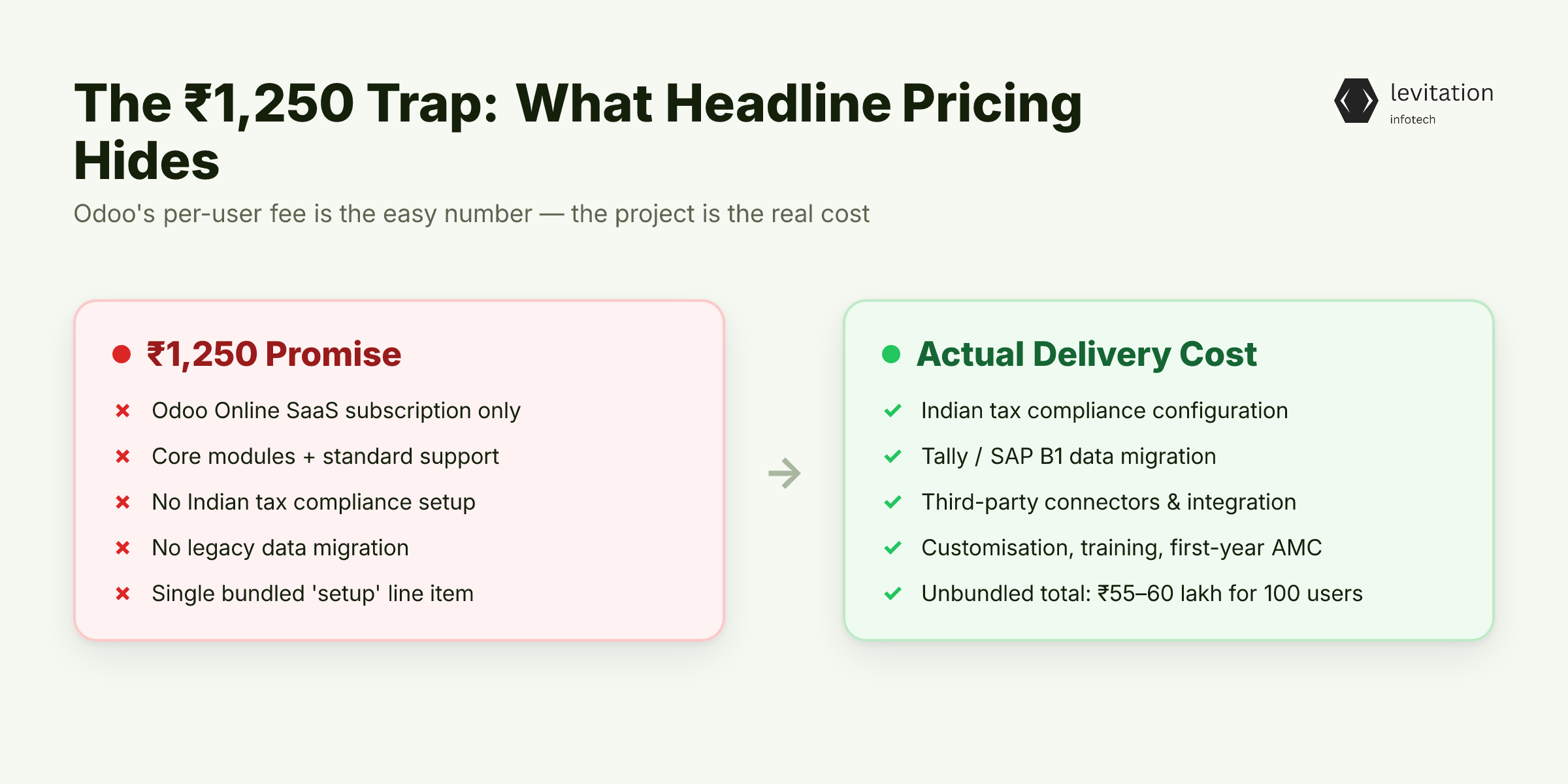
Odoo advertises ₹1,250 per user per month. By go-live, that number has quietly multiplied by 2x to 4x. If you're a CFO evaluating Odoo for an Indian mid-market deployment, the sticker price is the least accurate number in your vendor proposal.
Here is what that ₹1,250 actually buys. It is the Odoo Online SaaS subscription. It covers access to the hosted application, core modules, and Odoo's standard support.
It does not cover configuration for Indian tax compliance. It does not cover migrating data from your legacy Tally or SAP B1 setup. It does not cover the third-party connectors most mid-market companies already depend on.
For a 100-user mid-market company in India, the licence alone is ₹15 lakh per year. That part is the easy number. The hard part is everything that wraps around it.
The first-year project spend combines configuration, migration, customisation, training, and the first AMC payment. It lands at 2-4x the licence cost. Partners know this and quote the licence cleanly to build the case for the project.
Then they bundle the real cost drivers into a one-line "one-time setup" block. Finance teams often sign it without scrutiny. The result is a quote that reads ₹18 lakh for "software and implementation" but actually requires ₹55-60 lakh to deliver.
The CFO's job is to read the quote line by line, demand every cost driver named, and reject lump-sum implementation fees. The Odoo implementation cost in India conversation starts with an unbundled cost model, not a packaged proposal.
The subscription fee is only the first number. The next two categories are where the quote starts to drift from the contract.
Line Items #1-2: Configuration and Data Migration Set the Scope for Everything Else
Configuration is where the project starts to feel real. It covers chart of accounts localisation, which for India means GST mapping, TDS workflows, and e-invoicing integration. It covers approval hierarchies that mirror your org chart.
It also covers multi-company setups, inter-company transactions, and the dozens of small policy decisions that decide whether finance can close the month without manual workarounds.
Partners quote configuration as a fixed-fee block. The block looks tidy. The reality is messier: every Indian compliance edge case, every state-level GST nuance, every change in your approval matrix, becomes a scope conversation. Scope-creep is the norm, not the exception.
Data migration is the line item that breaks timelines. A 100-user company with years of historical data in Tally, SAP B1, or a legacy ERP needs more than a data dump.
You need master cleaning of customer and vendor records, opening balance reconciliation against audited statements, and a parallel-run period where both systems run side by side. None of that is included in a "migration" line on a quote.
Indian compliance adds a layer most Western pricing models ignore. GST return formats, e-way bill integration, TDS deduction workflows, and audit trail requirements are not free under Odoo Enterprise.
They need configuration, testing, and often third-party connectors. For a regulated industry, this layer alone adds weeks of effort.
Configuration and migration together form the first major cost decision, because their scope cascades into every downstream bucket. The Odoo pricing in India conversation should treat these as the first major decision. Everything downstream depends on how cleanly this layer is scoped.
Configuration and migration are visible on a quote. The third line item is the one that turns fixed bids into open-ended retainers.
Line Item #3: Customisation Is Where Quotes Become Fiction
Odoo's open-source codebase is its biggest selling point and its biggest budget risk. Every "small change" feels harmless.
A custom approval matrix for the sales team. A bespoke manufacturing BOM for the plant. A field service workflow for the service team.
Each one is a multi-week dev engagement. Stack five of them and you have a six-month project hidden inside what was sold as a three-month deployment.
Partners typically quote customisation at a per developer-day rate. The rate looks reasonable. The problem is that the scope is rarely pinned.
What counts as "in scope" versus a "change request" is a judgment call. The partner makes that call, often after the contract is signed.
Change requests after go-live are billed separately, and the rates climb. Premium rates kick in because the partner knows you cannot switch mid-implementation.
This is the single most variable cost in any Odoo engagement. It is also the line that decides whether you stay within budget or trigger a change order in month four.
The CFO who controls customisation controls the project. The CFO who lets customisation stay vague controls nothing.
Demand a customisation cap with a unit-rate ceiling and a written change-control process before signing. Every new requirement past the cap must be approved in writing with a stated cost. If the partner refuses this, the partner is planning to bill you for the gap.
The decision to invest in custom ERP development should be evaluated against this customisation ceiling. The moment customisation dominates the project, you are paying for a build with extra steps.
Once customisation is funded, three more cost lines show up in year one. They keep showing up every year after.
Line Items #4-6: Training, Hosting, and the AMC Time Bomb
Training is rarely included beyond a few demo sessions. Structured role-based training for finance, warehouse, and sales teams is a separate line, and rightly so.
A 100-user company needs at least three training tracks: back-office users, power users who handle exceptions, and managers who read dashboards. That work scales with user count and process complexity. Underfunding it causes adoption failures that cost more than the training would have.
Hosting is the choice that reshapes your cost curve. Odoo.sh gives you managed infrastructure and version upgrades. Self-hosted on AWS Mumbai or on-premise saves the subscription portion.
But it adds infra, backup, security patching, and a small ops team. The economics depend on your scale and your internal capability.
Most 100-user mid-market companies are better off on Odoo.sh for year one. They revisit the question after go-live.
The Annual Maintenance Contract is the silent multiplier. Expect a recurring fee tied to the original implementation cost per year, covering support, version upgrades, and bug fixes.
That is the number most finance teams underestimate. They plan the year-one project and forget the recurring layer. Over a 3-year horizon, AMC alone can rival what your year-one project cost.
The Odoo enterprise cost breakdown is incomplete without this layer. This is where "cheap" Odoo becomes "expensive" Odoo. The recurring cost compounds while the licence fee stays flat.
Stacking all six line items produces a number that bears no resemblance to ₹1,250 per seat. Here is what the math actually shows.
The Real 3-Year TCO: $110K to $212K for 100 Users
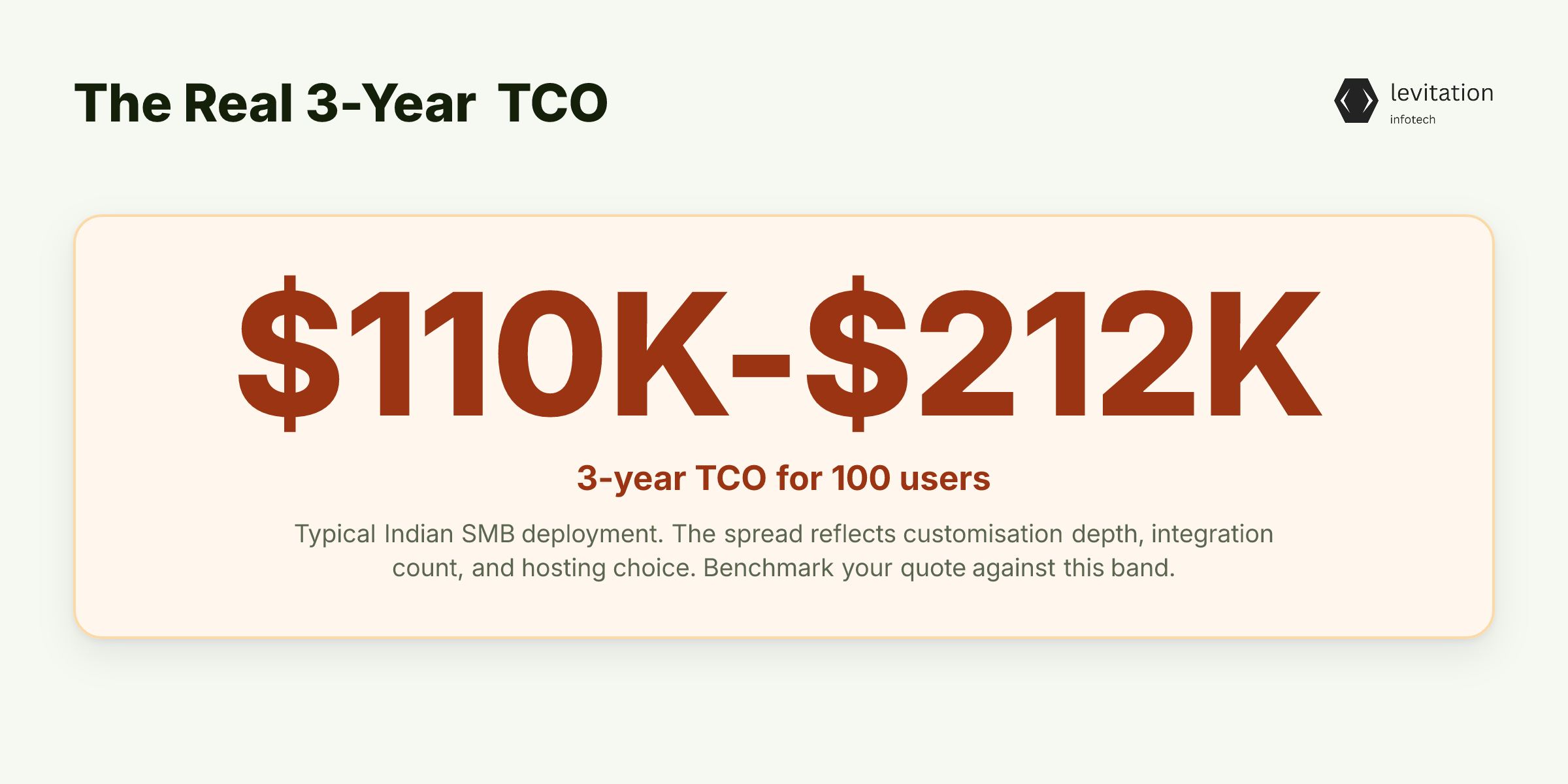
For a typical 100-user Indian SMB deployment, the 3-year total cost of ownership lands between $110,000 and $212,000. The spread is wide, and that is the point.
Your quote lives somewhere inside that band. The band exists because no two Odoo projects have the same customisation profile.
The first-year project investment is 2-4x the annual licence cost. A ₹15 lakh licence year can become a ₹45-60 lakh year-one project.
That is the number to put in front of the board, not the licence fee. The licence is recurring and predictable. The project is front-loaded and full of unknowns.
The pattern resembles what we see in off-the-shelf software deployments that look cheap until year two and the ₹15 lakh quotes that quietly become ₹40-75 lakh projects.
The cost spread between the low and high end of the band comes from three variables: - Customisation depth, which drives the widest variance in project cost across deployments - Integration count with legacy systems, payment gateways, and e-commerce platforms - Hosting choice, which shifts cost from subscription to infrastructure over time
Benchmark your quote against this band. If a partner's total is below $110K for 100 users, ask what is missing. The likely answer is customisation, training, or AMC.
If it is above $212K, ask what is gold-plated. The likely answer is unnecessary module upgrades or scope you did not request.
The firms that structure high-stakes technology budgets for complex rollouts treat this band as a sanity check. They run it before the first negotiation call. Knowing the real TCO is only useful if you can pressure-test the quote, which is exactly where a line-item model earns its keep.
How CFOs Should Structure an Odoo Budget Before Signing
A defensible Odoo budget is not a single number. It is a structured cost model with explicit buckets and a documented control process. Here is the five-step framework that holds partners accountable.
Step 1: Build a line-item cost model. The seven buckets are licence, configuration, data migration, customisation, training, hosting, and AMC. Reject any "lump sum" implementation quote. If a partner cannot break out the costs, the partner is hiding margin or hiding risk. Both are bad.
Step 2: Cap customisation at a fixed number of dev-days with a stated daily rate. Require written approval for any change request beyond the cap. The cap protects you from scope drift. The written approval clause protects you from "I thought that was included" conversations at month six.
Step 3: Negotiate the AMC against a benchmark rate tied to implementation complexity. The partner will push for a premium. Do not let the AMC be a separate commercial line with its own inflation. Tie it to the implementation cost so the percentage holds over time.
Step 4: Run a 3-year TCO scenario with low, base, and high customisation assumptions. Present all three to the board. The low case is your "scope stayed tight" outcome. The high case is your "partner discovered the actual customisation load was far higher" outcome. Do not approve on a single base case. The base case is a lie waiting to be uncovered.
Step 5: Build an exit clause. If the partner is replaced in year two, what does migration cost? Open-source does not mean zero lock-in. Your data is in Odoo's format. Your customisations live in code only the partner maintains. Write the exit cost into the contract now, while you have leverage.
The ERP implementation budgeting framework that survives board review names all seven buckets and the exit cost in the same document.
For regulated industries, compliance overhead inflates every bucket. Hospital and banking deployments run into the upper half of the TCO band faster than expected. The same dynamic plays out in CRM budgets that quietly sabotage delivery, where compliance and integration costs outrun the original line items.
Even with disciplined budgeting, there is a point where Odoo's customisation cost curve makes a custom ERP build the lower-risk option. That crossover is worth mapping.
When Odoo Stops Making Sense: The Build vs. Buy Inflection Point
Odoo's economics work when your processes fit standard modules with light customisation. At low customisation levels, total 3-year TCO is competitive with any build option. The licence, configuration, and AMC structure delivers real value here.
Above the threshold where customisation dominates, the licence savings evaporate. You are paying for partner dev hours anyway.
Those hours compound because every Odoo version upgrade risks breaking your custom code. At that point, a custom ERP built on open-source foundations delivers better 5-year unit economics.
You own the code. You control the roadmap. You skip the partner margin on every change.
The decision is not "Odoo vs. custom" in the abstract. It is "how much of your operating model is genuinely unique."
Map that before the procurement conversation starts. If most of your processes match Odoo's standard modules, Odoo wins. If your operating model needs extensive modification to match how your business runs, a custom build wins.
Founders in places like Noida are already making this switch at scale, as we have seen in deployments where Noida's founders quietly replace Odoo with custom ERP. Teams that get this right treat the ERP choice as a 5-year operating decision, not a software purchase.
They walk into vendor conversations with the TCO band already on paper, and they negotiate from there. The Odoo vs custom ERP India decision is one that benefits from this same framing.
Where data integrity, audit trails, and uptime cannot fail, the calculus shifts further toward custom builds. Think banking integrations, regulated workflows, or compliance-heavy industries. A customisation failure in those environments is measured in audit findings, not just in dev hours.
The ERP choice is a 5-year operating decision. Map your TCO before the first sales call.
Frequently Asked Questions
What is the real cost of Odoo implementation in India for a 100-user company?
The 3-year TCO for a 100-user Odoo Enterprise deployment in India ranges from $110,000 to $212,000. The spread is driven by customisation depth, data migration complexity, and AMC scope. Year one is usually 2-4x the annual licence fee.
What are the hidden charges in Odoo Enterprise pricing in India?
The six hidden line items are configuration, data migration, customisation, training, hosting, and the Annual Maintenance Contract. Customisation is the most variable and is where most budgets get breached.
Is Odoo cheaper than building a custom ERP in India?
Odoo is cheaper only when customisation stays modest and standard modules cover most processes. Above the threshold where customisation dominates the project, partner dev hours make a custom ERP built on open frameworks more cost-effective over a 5-year horizon.
How much does Odoo AMC cost per year in India?
Annual maintenance contracts for Odoo in India recur every year and scale with implementation complexity. Over three years, AMC alone can rival year-one project spend. This is the line that makes "cheap" Odoo expensive.
Does the ₹1,250 per user Odoo price include implementation?
No.
Sources
Research and references cited in this article:
- WHAT Definition & Meaning
- What is the meaning of ''what''?
- what - Wiktionary, the free dictionary
- WHAT definition in American English
- WHAT Definition & Meaning
- Odoo Implementation Cost in India: The Full Breakdown
- Odoo Pricing 2026: True Cost of Odoo Ecommerce & Total Ownership | Swell
- Odoo Community vs Enterprise 2026: Cost, Pricing & Hidden Fees
- Odoo's hidden costs: a cautionary tale | Astraia Technology posted on the topic
- Odoo Pricing | Discover Odoo Plans
- Odoo Enterprise Pricing 2026 - Per-User Cost, TCO & Implementation | ERP Pilot
- The Cost of Implementing Odoo ERP: What Businesses Need to Know | vinova.sg
About the author
Mayank Singh is a software developer at Levitation Infotech, where he builds web and AI-powered applications across the company’s fintech, healthcare, and enterprise projects.