


TL;DR: OpenAI's Jalapeño chip promises roughly 50% lower inference cost per token. But it runs proprietary scheduling, KV-cache, and attention kernels that erase the GPU-level telemetry your compliance audit trail depends on. The fix is to move your audit boundary from the silicon up to the application layer, capturing hashed inputs, full token streams, and version-pinned model identifiers before any request touches custom hardware.
Key Takeaways: - Custom inference chips like Jalapeño ship with proprietary runtimes that no public driver surface exposes, so kernel-level audit fields become unverifiable estimates. - A hardware-agnostic audit trail captures pre-inference input fingerprints, post-inference output fingerprints, and structured schema fields at the application boundary. - Teams that audited at the GPU/CPU boundary will have a 3-6 month hardening window before custom silicon becomes the default inference substrate.
The 50% Cost Win That's Actually an Audit Problem
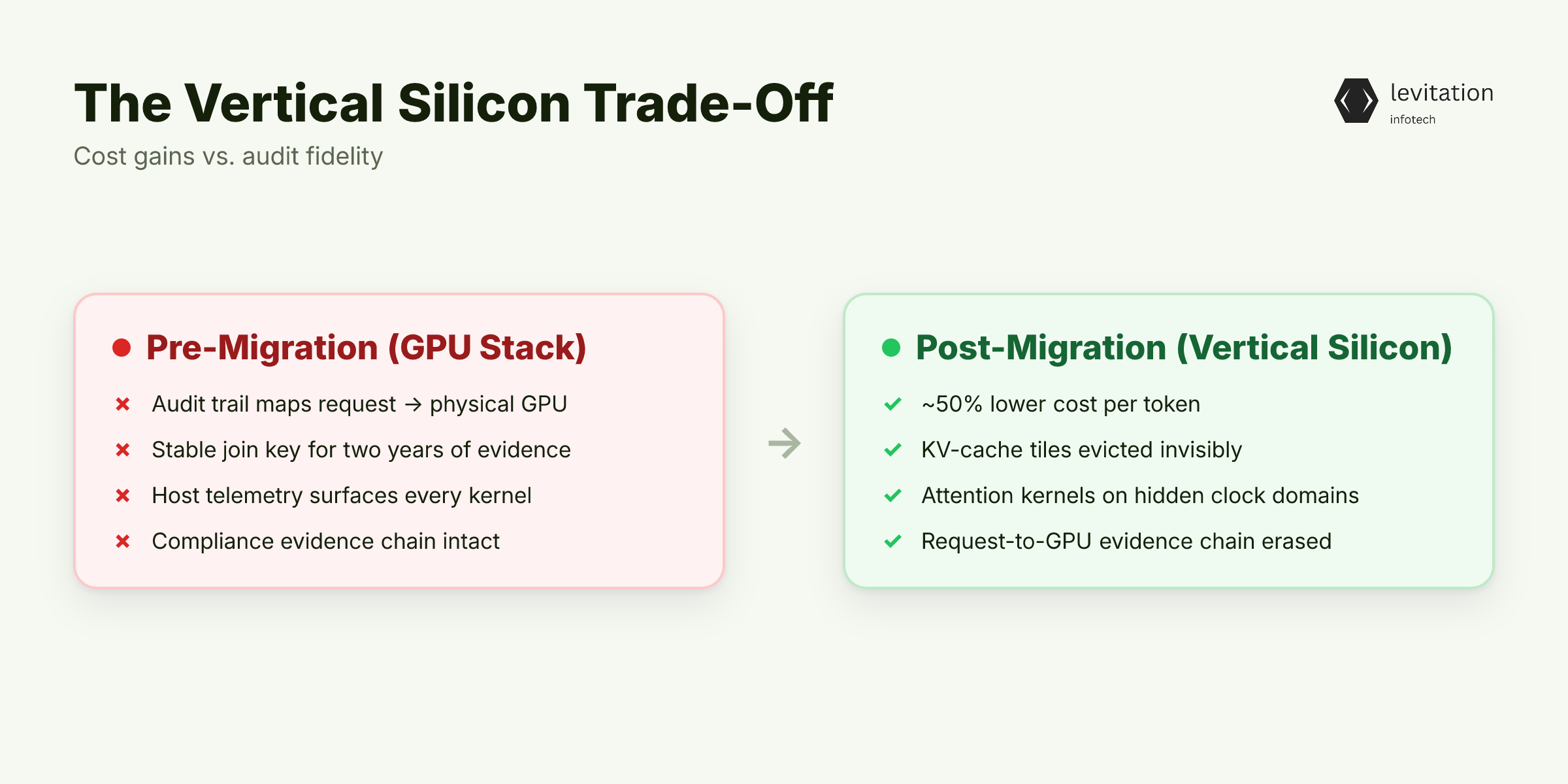
A 50% cost cut on inference sounds like a CTO's dream. Then you realize the same hardware shift breaks the audit trail your compliance team has spent two years building. OpenAI's Jalapeño chip, co-built with Broadcom and made by TSMC, cuts inference cost per token by about 50% versus current Nvidia GPUs in early lab tests. Google built TPUs for its own workloads and cut internal costs by 90%. Amazon built Inferentia for the same reason. Vertical silicon is now table stakes for frontier labs.
CTOs read the price-per-token headlines and plan migrations. The problem runs deeper. Inference workloads were never designed with audit fidelity as a first-class concern. Cost-optimized stacks fuse prompts differently, evict KV-cache tiles invisibly, and run attention kernels on clock domains that don't surface to host telemetry.
If your audit team spent the last two years mapping request-to-physical-GPU as a stable join key, that key is about to disappear. The same choices that make Jalapeño cheap, including proprietary scheduling, on-chip SRAM, and fused kernels, are exactly what erase the evidence chain your auditors rely on. The cost wins are real, but the audit debt gets booked silently.
What does a 50% cost cut actually cost you in compliance?
Why Custom Silicon Breaks Your Existing Audit Architecture
Current audit log schemas assume Nvidia-class GPU telemetry. Teams log kernel-level traces, CUDA event timing, and SM utilization signals. These fields power everything from incident reconstruction to behavioral drift detection. None of them are portable.
Custom inference chips like Jalapeño are built in about 9 months using AI-assisted design tools. They ship with proprietary scheduling, proprietary KV-cache management, and no public driver surface. The host runtime sees a request come in and a response go out. What happens in between is opaque by design. That's where the cost win lives.
When the hardware abstraction changes, every downstream assumption in your AI audit trail breaks. Token-level latency, batch boundaries, and attention kernel timing become estimates instead of measurements. An auditor asks: "Show me the kernel trace for request 7,432 during the March 12 incident." Your GPU exporter returns nothing. There is no nvidia-smi equivalent on custom silicon. The field is null. The row still exists, but the evidence it carried is gone.
If the telemetry surface changes, you don't have an audit gap. You have an audit void. Which layer can you still trust to record the truth?
The Three Inference Layers Jalapeño Quietly Changes
Batching and token routing. Inference accelerators fuse prompts differently than GPU servers. A single physical device may process a slice of a batched request, a speculative decoding draft, and a parallel attention head in the same cycle. The request-to-physical-device mapping no longer exists as a stable audit field. If your schema joins on `gpu_uuid`, every join now returns a partition of orphans.
KV cache management. On custom chips, tiled on-chip SRAM uses aggressive eviction policies invisible to the host runtime. On Nvidia-class hardware, cache-hit ratios and tile residency are partly observable through profiling hooks. On inference ASICs, the cache state lives in chip-local memory that the host cannot read. You can no longer reconstruct a request from cache-hit metadata alone.
Attention kernel timing. Speculative decoding and paged attention on non-Nvidia silicon use different clock domains. Millisecond-precision timestamps that standards like NIST SP 800-53 AU-9 expect for tamper-evident audit records now come from a host-side wall clock, not the inference engine. The host clock and the inference clock drift apart. The audit record says inference started at 14:03:07.421. The chip started at a different time, with the gap varying by request.
Practical impact: - Batching layer: request-to-device mapping is probabilistic, not deterministic. - Cache layer: cache-hit evidence is unobservable from the host. - Timing layer: clock drift breaks millisecond-precision guarantees.
Each of these is a compliance issue dressed as a performance optimization. Teams that treated the audit layer as a first-class deliverable, not a kernel dump, are the ones that survive silicon migrations.
Recognizing the void is the easy part. Fixing it requires a different kind of audit record.
What Your AI Inference Audit Must Capture Differently
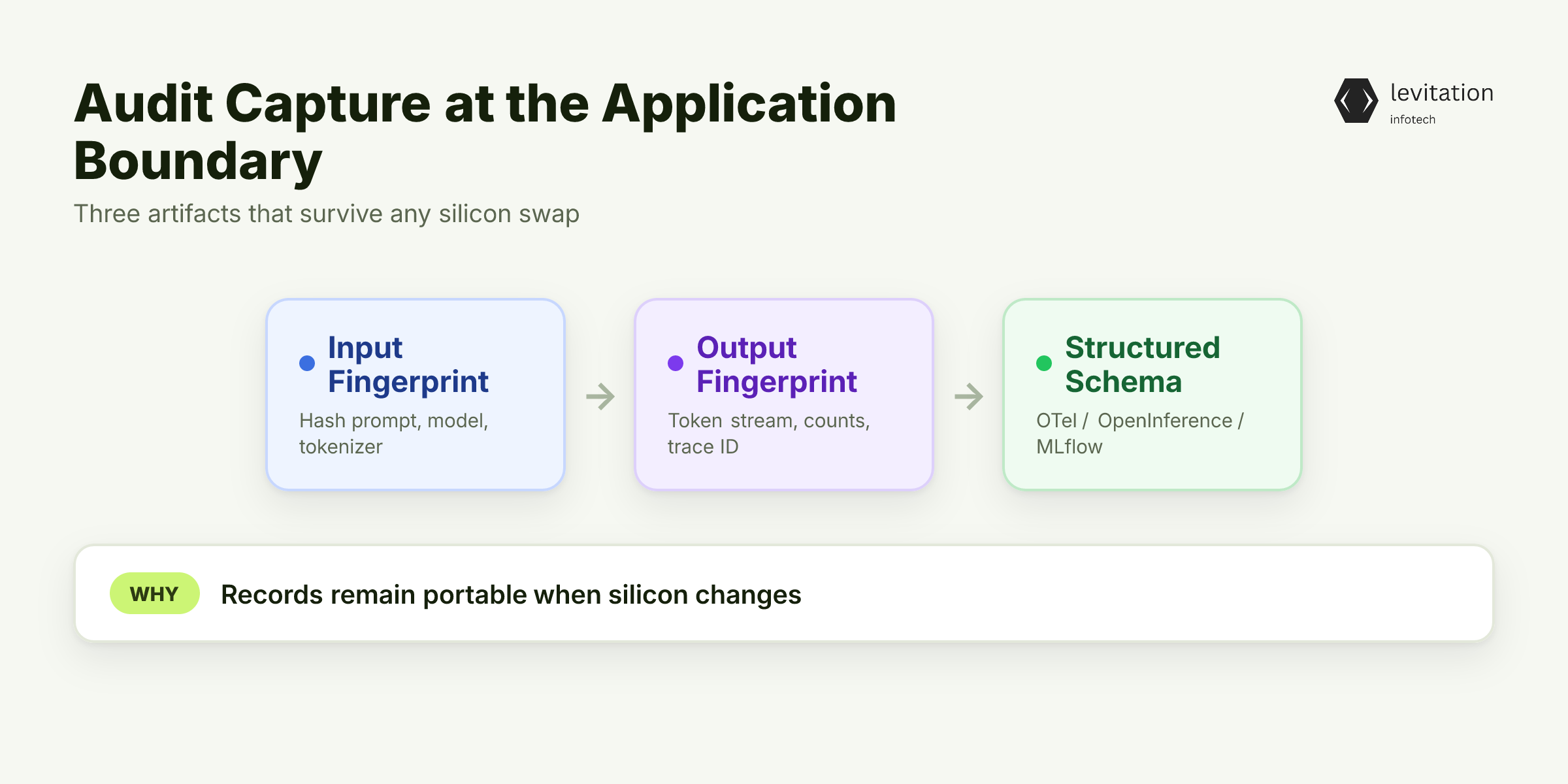
If kernel-level telemetry is no longer portable, capture the audit at the application boundary. Three artifacts survive any silicon swap: the input fingerprint, the output fingerprint, and the version-pinned context that links them.
Capture a pre-inference input fingerprint. This is a hash of the prompt, system prompt, model version, and tokenizer version. If the hash matches a previously logged request, you can reproduce the call even when hardware telemetry is lost. This is reproducibility without dependency on the inference engine.
Log the post-inference output fingerprint. Include the full token stream, prompt/completion/total token counts, and a session-scoped trace ID. These are the minimum schema fields that survive a silicon swap. The full token stream is heavy, but it is the only artifact that lets you replay the exact decision an auditor asks about.
1{2 "schema_version": "openinference/v1.2",3 "trace_id": "tr-9a4f...",4 "session_id": "sess-22b1...",5 "request": {6 "prompt_hash": "sha256:e3b0c44298fc1c1...",7 "model_id": "gpt-5.1-turbo",8 "model_version": "2026-09-12",9 "tokenizer_version": "cl100k-base/v3"10 },11 "response": {12 "output_hash": "sha256:7c211433f02024...",13 "token_stream": [...],14 "prompt_tokens": 412,15 "completion_tokens": 188,16 "total_tokens": 60017 },18 "timestamps": {19 "start_ms": 1737002387421,20 "end_ms": 173700238809821 }22}
Wrap every record in a structured, machine-readable schema, like OpenTelemetry, OpenInference, or MLflow, before the request hits custom silicon. Chip-level logs are unlikely to be portable, but structured records written at the application boundary are.
Systems still running in production 5+ years after deployment are the ones whose audit trail was always written at the application layer, not the kernel layer.
But what happens when the inference endpoint is not even yours to instrument?
How to Audit Inference You Don't Fully Control
When inference is consumed via API from a provider running Jalapeño-class chips, your only durable evidence is the request/response pair and the provider's logged metadata. You have no kernel access. You have no driver surface. You have a contract.
Version every model, every prompt template, and every retrieval index from your side. Store a content hash for each. When the model is updated, the hash changes, and your audit trail records which version produced which output. This is the only reproducibility you control.
Insert a proxy or sidecar that signs the prompt at egress and verifies the response signature at ingress. This gives you tamper-evidence even when the provider's own audit log is opaque or proprietary. The signed envelope is your evidence chain.
Treat fine-tuning, RAG retrieval steps, and embedding lookups as first-class audit events that happen before inference. The model's own hardware can no longer be trusted to surface them. If a RAG retrieval returned any documents, log that fact before the prompt leaves your boundary. The inference provider's chip has no visibility into the retrieval that preceded the call.
A defense-in-depth posture is what separates a surviving audit from a painful one. Teams that harden their application-layer audit trail before a silicon migration avoid the lengthy rebuild that in-house teams face when they try to reconstruct audit from scratch after the fact.
So what does the architecture look like that survives the swap?
The Audit Trail Architecture That Survives Custom Silicon
The fix is architectural. Move the audit boundary from the GPU/CPU boundary up to the application boundary. Hash in, hash out, schema-versioned in between, and your AI inference audit becomes hardware-agnostic.
Pair every model version bump with a logged evaluation run. When a new inference chip ships, you need a baseline that proves what the model did on the old silicon and what it does on the new. Behavioral drift tied to a chip swap is provable, not speculative. This is also the only defense against the "but the chip changed" explanation that vendors offer when an auditor asks why a regression appeared.
The teams that survive silicon transitions write the audit spec before they pick the chip, not after.
The deeper lesson: your RAG citations aren't an audit trail and your LLM gateway logs everything while inference logs nothing. Custom silicon is just the next layer where the kernel-level illusion breaks. Teams that extend their LLM stack without redesigning audit discipline will discover this the hard way.
The audit layer has often been an afterthought of the inference layer in regulated engagements. Retrofitting it under a deadline costs far more than building it right from the start. If Jalapeño-class chips land in your inference stack this year, you have a 3-6 month window to harden the application-layer boundary before the kernel-layer join keys go dark for good.
Audit the boundary you control before the silicon you don't.
Frequently Asked Questions
What is an AI inference audit?
An AI inference audit is a structured review of the inputs, outputs, model versions, and runtime conditions of every inference request your system serves. It exists to reproduce decisions, prove compliance, and reconstruct incidents. All of this depends on logs captured before and after the model runs, not on telemetry scraped from the inference hardware itself.
How does OpenAI's Jalapeño chip change AI compliance?
Jalapeño-style custom inference silicon uses proprietary batching, KV-cache eviction, and attention kernels that are not exposed through standard driver interfaces. Traditional GPU-based audit telemetry, like kernel traces, CUDA events, and SM utilization, no longer exists. That gap forces compliance teams to redesign their audit trail around application-level artifacts instead.
What should be in an AI audit trail for inference?
At minimum: the full prompt and system prompt with version identifiers, the model identifier and version, the complete output, start and end timestamps at millisecond precision, prompt/completion/total token counts, and trace and session IDs for multi-turn correlation. Records should use a structured schema (OpenTelemetry, OpenInference, or MLflow) and be immutable per NIST SP 800-53 AU-9.
Can you audit inference running on custom silicon you don't own?
Yes, but only if you shift the audit boundary up to your own application layer. Hash the prompt at egress, verify the response at ingress, and version every model, prompt template, and retrieval index on your side. Reproducibility should not depend on the inference provider exposing chip-level telemetry.
How quickly should an enterprise redesign its audit trail before custom chips become standard?
Treat this as a 3-6 month hardening project rather than a future-state problem. Jalapeño prototypes are already expected by end of year, and once hyperscalers adopt the pattern, inference-priced APIs will move to custom silicon in a single billing cycle. Teams who audited at the kernel layer will be left with no portable evidence chain.
About the author
Mayank Singh is a software developer at Levitation Infotech, where he builds web and AI-powered applications across the company’s fintech, healthcare, and enterprise projects.