


TL;DR: Quantization cuts inference costs. It also silently breaks the model-to-deployment audit chain that compliance frameworks require. CTOs who treat quantization as a deployment optimization, not a model release event, expose their organizations to reproducibility gaps. They also expose them to undocumented transformations and regulatory findings. The fix is an inference optimization audit protocol. This protocol makes every model transformation traceable, evaluable, and defensible.
Key Takeaways: - A quantized model serving inference is a mathematical transformation of the model that was evaluated and approved. It is not the same artifact. - Approximation errors from quantization break output reproducibility. Reproducibility is a prerequisite for most compliance audits. - Treating quantization as a formal model release event preserves both cost gains and regulatory standing. The event must include versioning, re-evaluation, and per-request logging.
The Inference Bill You Cut Is the Audit Trail You Lost
You cut inference costs with quantization. Your CFO called it a win. The problem is your auditor will call it something else.
It is a black box. You cannot explain it. You cannot reproduce it. You cannot prove it is doing what you claim it does.
Quantization converts FP16 or FP32 weights into INT8, INT4, or lower-precision representations. The memory savings are real. The compute savings are real. So is the hidden cost.
Every forward pass now runs through an approximated model. The model serving production traffic is no longer the model your AI/ML training team validated. It was approved during evaluation.
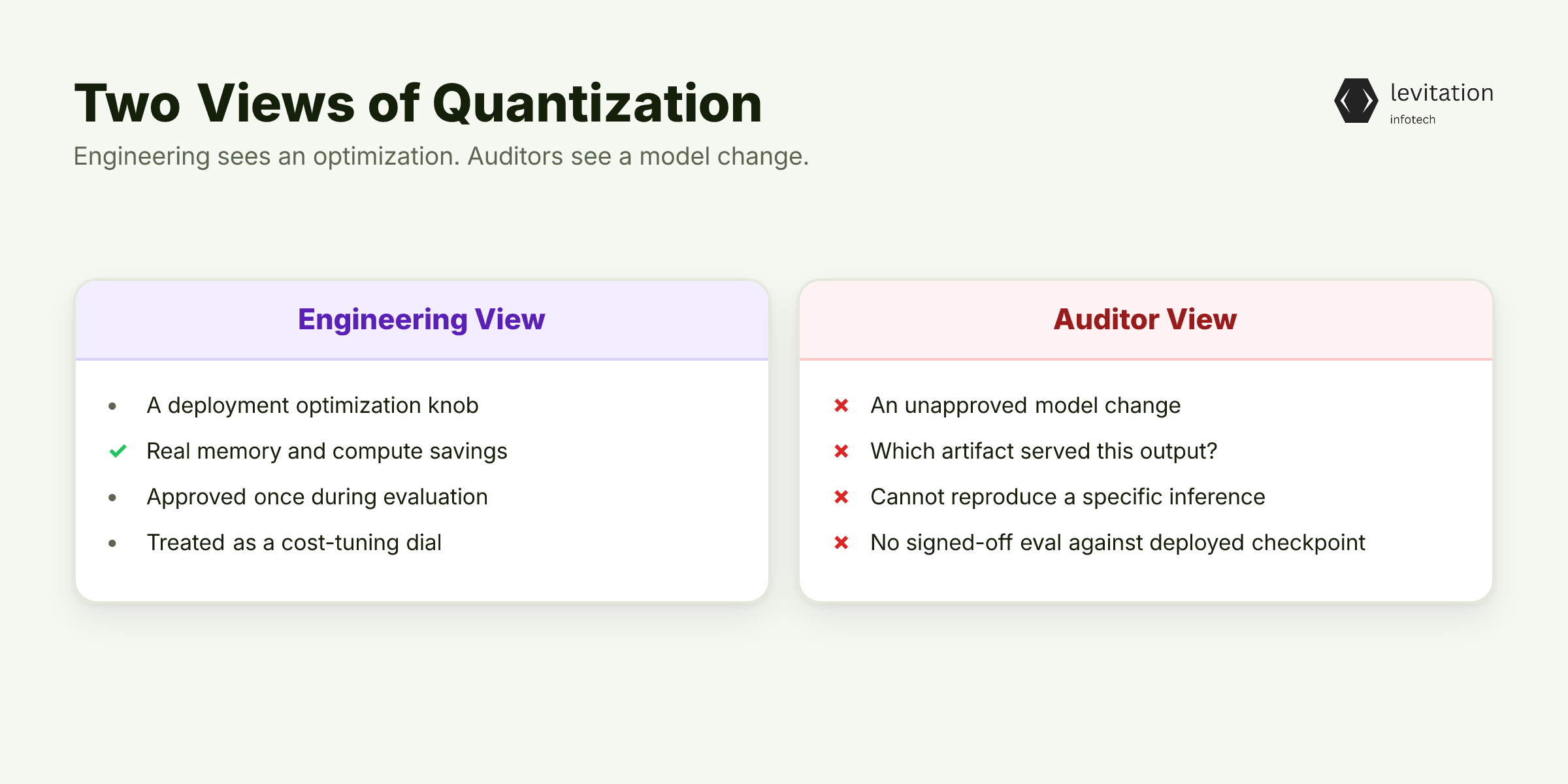
Here is where it gets dangerous. Engineering teams treat quantization as a deployment optimization. They see it as a knob to tune for cost. However, regulators and auditors see it as a model change.
When an auditor asks, "Show me the artifact serving this output, and prove it behaves like the artifact you approved," most teams cannot answer. They cannot reproduce a specific output. Also, they cannot point to a signed-off evaluation against the deployed checkpoint.
They cannot show that the deployed model meets the same safety, bias, and accuracy thresholds as the one in their model card. The savings are documented. The compliance exposure is not documented. It also compounds with every inference request that cannot be reproduced.
This gap between optimization and accountability is where regulatory findings live. The real problem is what happens next. When an auditor asks to see your model's decision path, you cannot reconstruct one.
Why Approximation Errors Make Quantized Models Unauditable
Quantization is not a lossless transformation. It introduces three distinct error types.
Rounding error comes from reducing numeric precision. Clipping error happens when out-of-range values get truncated to fit a smaller representable range. Calibration drift occurs when the scaling factors chosen during quantization do not generalize to runtime data distributions.
None of these errors produce deterministic output deviations. Two identical prompts sent to a quantized model can produce measurably different outputs. The difference comes from numerical noise accumulating differently across attention layers.
That breaks the reproducibility that audit frameworks require. If a regulator asks, "Why did this model produce this specific output for this specific user?", and you cannot reproduce the output, then you cannot answer the question.
The problem compounds with method choice. Post-training quantization methods like GPTQ, AWQ, and SmoothQuant each apply different scaling strategies. The "same" base model becomes a fundamentally different artifact depending on which method you pick.
An INT4 GPTQ model and an INT4 AWQ model are not interchangeable. They have different numerical behaviors. They have different failure modes. They also have different output distributions. Yet most teams treat them as equivalent.
Worst of all, most teams never re-run their safety, bias, and hallucination benchmarks on the quantized checkpoint. They assume accuracy parity and move on. This assumption is wrong in practice.
Approximation errors interact with the model's learned representations in unpredictable ways. A model that scored well on toxicity benchmarks in FP16 can leak more harmful outputs in INT4.
A model that suppressed training data fragments in FP16 can surface them in INT4. This happens because the suppression mechanism relied on precision-sensitive internal thresholds.
Approximation errors create opacity. Opacity breaks explainability. Explainability is exactly what compliance regimes are now demanding. Most teams do not realize which framework they are already inside. Nor do they realize how directly quantization conflicts with it.
The Compliance Framework You Don't Know You're Violating
LLM compliance is the discipline of ensuring that large language models operate within defined legal, security, and organizational boundaries. It covers how data enters, moves through, and leaves LLM workflows.
It also covers whether those interactions meet regulatory expectations for privacy, transparency, access control, and auditability.
Quantization directly conflicts with transparency requirements. The deployed model is a mathematical transformation of the approved model. It is not the approved model itself.
When you quantize without documenting the transformation, you insert an undocumented step. You also skip re-evaluating the output. You also skip versioning the artifact separately. That step sits in the chain from training data to production output.
The EU AI Act, SOC 2, and ISO 27001 audits all require a documented chain from training data through deployed artifact. Quantization breaks that chain. It introduces a post-training modification that auditors cannot verify against the original approval.
For high-risk AI systems under the EU AI Act, this is not a documentation oversight. It is a conformity gap. Such a gap can block deployment or trigger post-market scrutiny.
There is a second risk most teams miss: sensitive information disclosure. Approximation errors can cause models to surface training data fragments that full-precision models would have suppressed.
Quantization changes internal activation distributions. Those changes can weaken the learned boundaries that prevent memorization leakage. For organizations handling PII, financial data, or health information, this is a data exposure risk. It also compounds the auditability problem.
If you serve regulated industries, the question becomes simple. You do serve them if your clients expect SOC 2 reports, ISO certifications, or AI Act compliance. So what does an audit-ready inference pipeline actually look like?
What 'Explainable Inference' Actually Requires
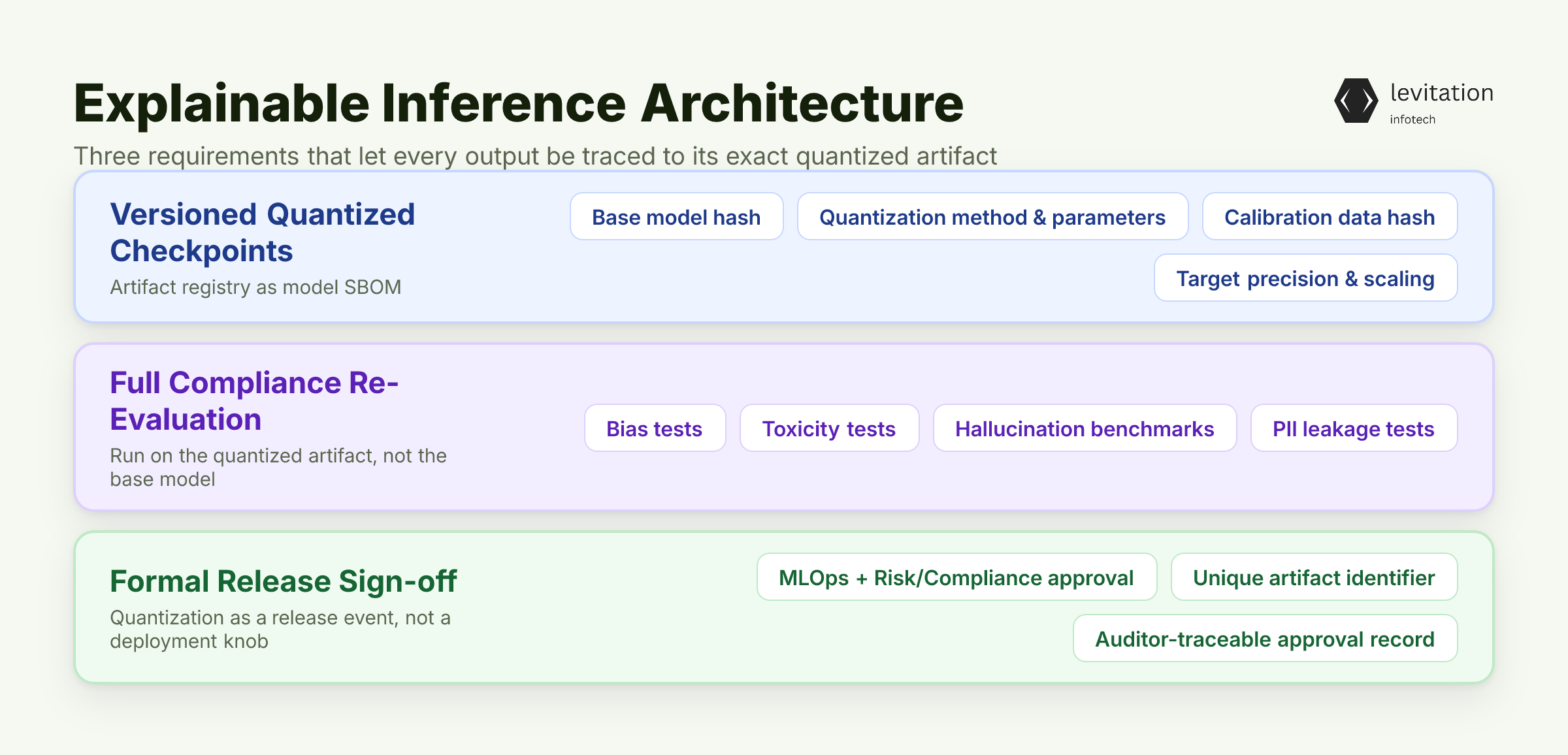
Explainable inference means every output can be traced back through the exact model artifact. It also covers the quantization configuration and serving environment that produced it. Not the "about the same" model. The exact one.
This requires three things working together: - Versioned quantized checkpoints, separate from the base model. They need documented calibration datasets, scaling factors, and quantization method parameters. - A re-run of your full safety and compliance evaluation suite. This includes bias tests, toxicity tests, hallucination benchmarks, and PII leakage tests. All of them run on the quantized artifact, not the base model. - AI/ML training teams and MLOps teams treating quantization as a formal model release event. This event requires sign-off, not a deployment optimization knob.
The first point is the model artifact registry. Think of it as a software bill of materials for your model. It should record the base model hash, quantization method, calibration data hash, scaling parameters, target precision, and evaluation results.
Every quantized variant gets a unique identifier and its own approval record. When an auditor asks which model served a specific request, you can answer with a specific artifact ID. Not "the quantized version of model X."
The second point is where most teams fail. They evaluate the base model extensively. Then they assume the quantized model behaves the same. This is a documentation gap that becomes a compliance gap.
The evaluation deltas, even small ones, are what auditors will scrutinize. Accuracy drops on a hallucination benchmark are not noise. They are evidence that the transformation changed the model's behavior in a measurable way.
The third point is organizational. If your MLOps team can deploy a quantized model without sign-off from your model risk or compliance team, you do not have a controlled release process. What you have is a deployment pipeline that creates compliance debt. The question is how to turn that pipeline into a controlled release process. It must satisfy both auditors and engineers.
That is the architecture. The operational playbook that works inside a regulated production environment has five steps.
The Inference Optimization Audit: A CTO's Playbook
An inference optimization audit is a documented review of every transformation applied between model training and production serving. It also covers quantization, pruning, KV-cache strategies, and batching.
It verifies that the deployed artifact matches what was evaluated and approved. It also verifies that output reproducibility is maintained. Here is a five-step protocol that works in practice: - Step 1: Build a model artifact registry. Record base model hash, quantization method, calibration data, scaling parameters, and target precision. Treat it like a software bill of materials. Every quantized variant gets a unique ID and its own metadata record. This registry becomes the source of truth for "what model served this request." - Step 2: Re-run your full evaluation suite on the quantized model. Document the delta against the base model across bias, toxicity, hallucination, and PII leakage benchmarks. Even small shifts are documented. The delta is what auditors will examine. Having it pre-calculated turns a compliance question into a compliance answer. - Step 3: Build output logging that captures quantization configuration per request. When a flagged output needs investigation, you must be able to reproduce it. You need to reproduce it against the exact artifact that generated it. This means logging model version, quantization method, precision, and any runtime parameters alongside each inference response. - Step 4: Establish a re-quantization trigger policy. Any base model update, calibration data change, or precision adjustment requires a full re-audit cycle. Make this automatic in your deployment pipeline. A quantized model that was not re-evaluated after a base model update is an unquantized compliance risk. - Step 5: Document the audit trail as a living artifact. Tie it to your compliance reporting cadence, not a one-time deliverable. Compliance frameworks expect continuous traceability, not a snapshot from launch day.
For related guidance on building evaluation pipelines that catch what audits miss, see Why Your LLM Evals Approve Models That Fail. And for the cost side of inference optimization, Stop Bleeding Money on LLM Inference covers the engineering decisions that drive spend.
Done right, you get the cost benefits of quantization without the compliance liability. Done wrong, you are rebuilding your inference stack from scratch after a regulatory finding. What separates teams that hit the first outcome from teams that get the second?
From Cost Optimization to Compliant Optimization
The CTOs who treat quantization as a compliance checkpoint, not a cost lever, ship to regulated industries faster. They also ship with fewer post-deployment incidents.
They understand that the transformation is the product. The model is approved. The quantized artifact is what actually runs. Auditors do not care about your cost savings. They care about what served the request and whether you can defend it.
An inference optimization audit is not overhead. It is the mechanism that lets you defend every output your model produces. You can defend it to any auditor, regulator, or board member. It is the difference between "we quantized for cost" and a complete documentation chain. The chain covers every model variant in production. It also includes evaluation results, calibration parameters, and reproducibility tests.
Long-term production stability comes from treating model transformations as formal release events with full documentation chains. It does not come from cutting corners at serving time.
The cost optimization is still there. The compliance standing is still there. What changes is the relationship between the two. They stop competing and start reinforcing each other.
A well-documented inference pipeline is easier to optimize because you know exactly what is running and why. For engineering leaders who want to move from ad-hoc quantization to a controlled, audit-ready inference pipeline, Your MLOps Pipeline Is Undermining Model Safety is a good resource. It covers the MLOps practices that make this transition sustainable.
And if the broader question is how AI automation intersects with compliance in your organization, AI Automation Is Undermining Compliance maps the risk surface that audit-ready inference is one part of solving.
Frequently Asked Questions
Does LLM quantization violate EU AI Act compliance requirements?
Quantization itself is not prohibited, but it creates a documentation gap. The EU AI Act requires traceability from training to deployment. If you quantize without re-evaluating and documenting the quantized artifact, you break that chain. You cannot show conformity for high-risk systems.
Can a quantized LLM be made audit-ready without abandoning quantization?
Yes. The key is treating quantization as a model release event. Version the quantized checkpoint. Re-run safety and bias evaluations. Log quantization parameters per inference request. Maintain a reproducible artifact registry. The cost savings remain. The compliance exposure is eliminated.
What is an inference optimization audit?
An inference optimization audit is a documented review of every transformation applied between model training and production serving. It covers quantization, pruning, KV-cache strategies, and batching. It verifies that the deployed artifact matches what was evaluated and approved. It also verifies that output reproducibility is maintained.
Which quantization methods carry the highest compliance risk?
Aggressive low-bit methods (INT2, INT4 with aggressive calibration) carry the highest risk. They introduce the largest approximation errors. But compliance risk is not just about accuracy loss. It is about whether you documented and re-evaluated the transformation. Even INT8 quantization is a compliance risk if undocumented.
How often should quantized models be re-evaluated for compliance?
Every time the base model changes, you need to re-evaluate. Same for when the quantization method changes, the calibration data changes, or the serving precision changes. Most enterprise teams should tie re-evaluation to a quarterly compliance cycle at minimum. Event-driven re-audits should fire whenever any of the above changes occur.
Sources
Research and references cited in this article:
- LLM Compliance: Risks, Challenges & Enterprise Best Practices
- AI & GDPR in 2026: Compliance Changes for LLM Providers
- “I Always Felt that Something Was Wrong.”: Understanding Compliance Risks and Mitigation Strategies when Highly-Skilled Compliance Knowledge Workers Use Large Language Models _(academic)_
- Compliance in the Age of Large Language Models
- What are the pros and cons of using LLMs in compliance?
- LLM Inference Optimization: Cut Cost & Latency at Every Layer (2026)
- LLM Inference Optimization Techniques: A Comprehensive ...
- What is LLM Inference Optimization: Techniques and Implementation Guide | Adaline
- LLM Inference Optimization Techniques - Redwerk
- Inference Optimization Strategies for Large Language Models: Current Trends and Future Outlook
- 10 Ways LLMs Can Fail Your Organization | by Gary George | Towards AI
- The Real-World Harms of LLMs, Part 2: When LLMs Do Work as Expected
About the author
Mayank Singh is a software developer at Levitation Infotech, where he builds web and AI-powered applications across the company’s fintech, healthcare, and enterprise projects.