


TL;DR: RBI’s new AI underwriting guidelines promise instant loans. However, a mandatory borrower-consent step and legacy batch systems create hidden bottlenecks. Re-architect consent capture. Then expose core-bank data through event-driven APIs. Also automate explainability to meet the rules while keeping approvals fast.
Why RBI's AI Lending Rules Might Actually Delay Your Approvals
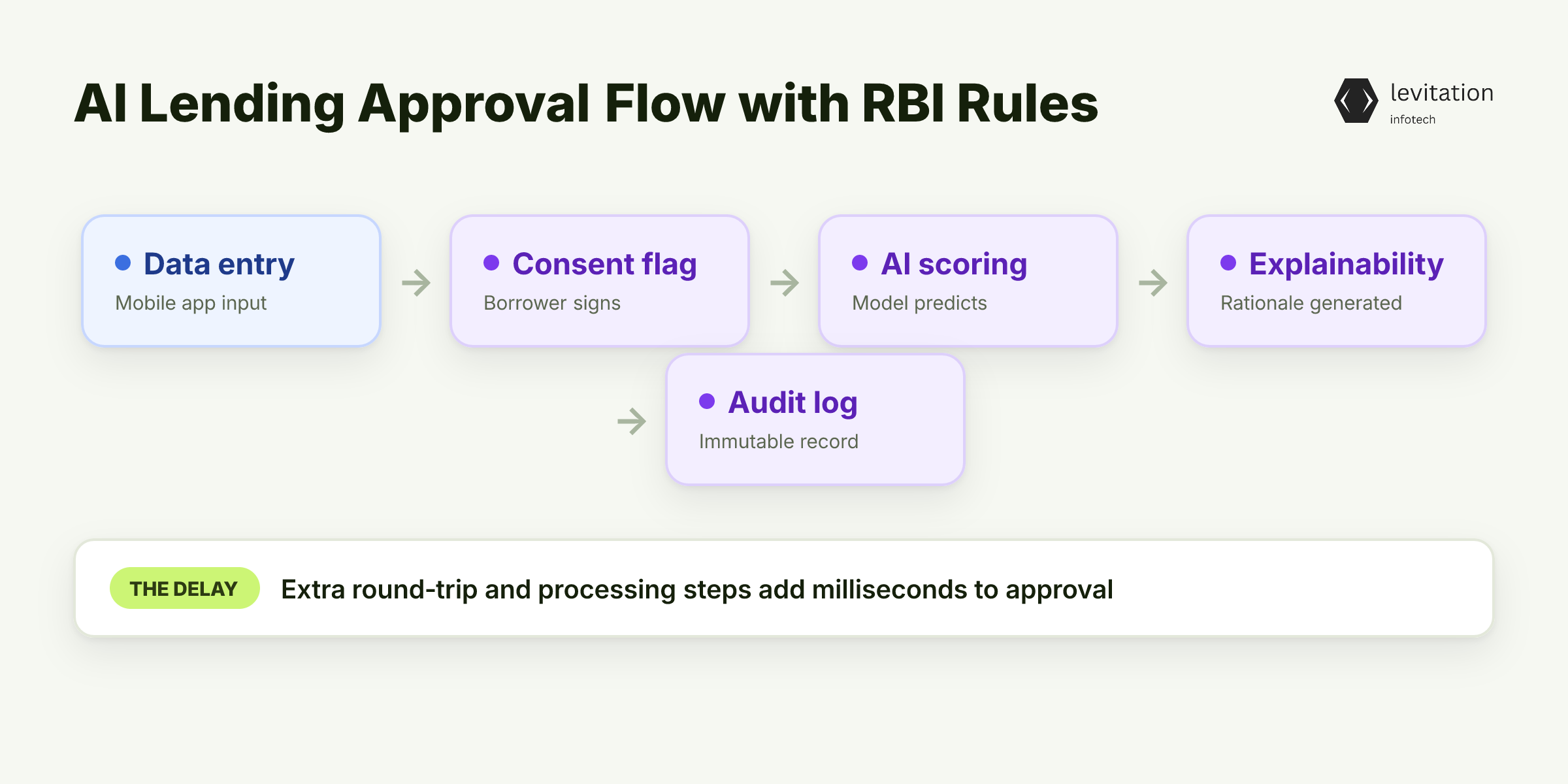
Fintech CTOs expect AI to turbo-charge loan approvals. A recent study shows 40 % of respondents strongly agree that AI can make the process faster. Then they say it is faster than traditional methods. Yet the RBI’s guidelines insert a borrower-consent checkpoint. That checkpoint forces lenders to pause before any data reaches a model.
Imagine a borrower opening a mobile app and entering personal details. Then they see a consent screen that must be signed and stored. The app cannot hand the data to the scoring engine until that flag is persisted. In a world where milliseconds matter, that extra round-trip adds a tangible delay.
The rules also demand model explainability and a full audit trail for every decision. Those requirements translate into extra processing steps: generating per-decision rationale, logging it, and attaching version metadata. Each step consumes compute cycles and network hops.
Key friction points - Consent flag must be captured before any AI inference. - Explainability output must be persisted alongside the decision. - Audit logs must be immutable and searchable for regulators.
What if we could keep consent, data, and explainability on the same fast lane?
The Hidden Friction: Consent, Legacy Systems, and Regulatory Overhead
When consent is forced into a separate UI flow, the data pipeline shatters. Instead of a single stream from front-end to model, you now have two streams. One carries the consent flag, another carries the loan application. The two must rendezvous in a datastore before scoring can begin. That rendezvous point becomes a synchronization choke point.
Most core-banking platforms still run on batch-oriented architectures. They ingest transactions nightly, reconcile balances, and expose results via legacy SOAP or REST endpoints. An AI model that expects a continuous feed of events hits a wall. This happens when the underlying system only releases data once a day. The result is a "data-at-rest" scenario where the model waits for the next batch. This negates any real-time advantage.
RBI’s explainability clause means every inference must be accompanied by a rationale. Often this is generated by SHAP or LIME libraries. Those libraries need to access the model’s feature set. Then they compute contribution scores and write the output to a log. If the log resides on a traditional relational store, write latency can climb into seconds, especially under load.
Why these choke points matter - Separate consent stream forces a join operation that costs time. - Batch-first cores delay data availability, turning "instant" scoring into "overnight" scoring. - Audit-log writes to non-streaming stores add latency that scales with volume.
How can we redesign the pipeline to avoid these bottlenecks?
Balancing Speed and Compliance: The Real Path to Faster Approvals
Move consent capture to the front-end UI and push it instantly into the data lake. Treat consent as another event. Tag the loan record with a flag the moment the borrower clicks "I agree." Kafka or a similar event bus can fan-out that flag to every downstream consumer. This includes the scoring engine, and it works without waiting for a batch job.
Wrap the legacy core with an event-driven API façade. Instead of pulling data on demand, expose a push-based interface that emits loan-application events as they happen. The façade translates core-bank schemas into a flat, AI-ready payload and delivers it over gRPC or lightweight REST. This decouples the AI layer from the core’s batch schedule. Then it lets the model score as soon as the event lands.
Automate model-explainability. Deploy an inference service that runs a SHAP explainer in-process on each prediction. Then it writes the resulting rationale to an immutable ledger. For example, a blockchain-based append-only store can be used. The write happens within milliseconds. Because the ledger is append-only, regulators can verify the chain without manual intervention. Also, the service can serve the explanation back to the UI instantly.
Concrete steps to speed up - Front-end consent micro-service: capture, encrypt, and emit consent events. - Event-driven façade: translate core-bank updates into streaming records. - In-process explainability: generate SHAP values on the fly and log to an immutable store. - Immutable audit ledger: store decision, consent flag, model version, and explanation together.
Now that we have the architecture, can we turn it into actionable steps?
Implementation Blueprint: Build a compliant AI underwriting pipeline that doesn't stall
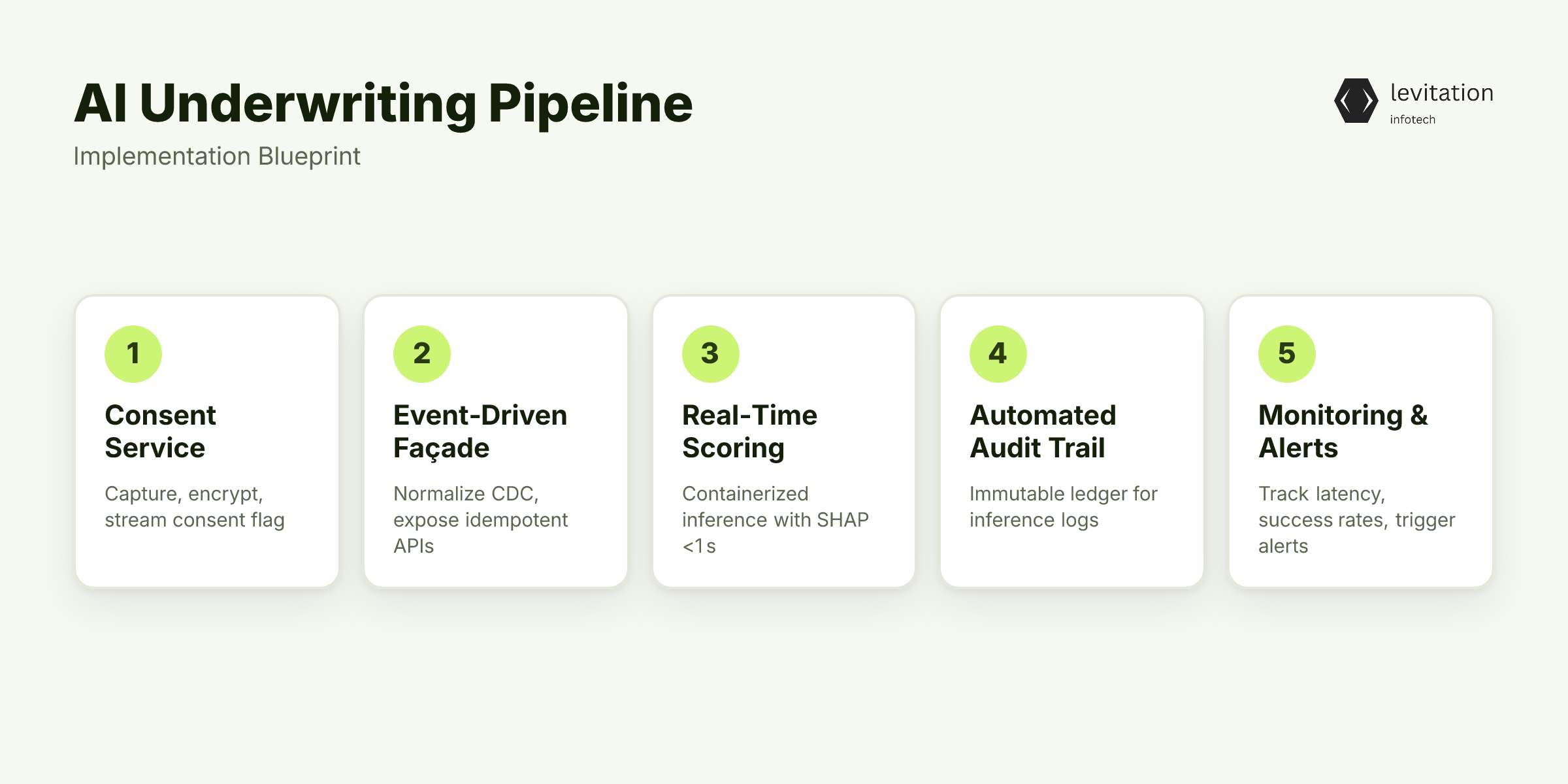
Step 1 - Consent micro-service
A lightweight service sits behind the mobile UI. It records the borrower’s explicit consent, encrypts the flag, and streams it to Kafka. The flag becomes part of the loan’s event stream, ensuring downstream components see it immediately.
Step 2 - Event-driven façade
An adapter layer sits on top of the core-banking system. It subscribes to core-bank change data capture (CDC) topics. Then it normalizes the payload and republishes it as idempotent REST or gRPC endpoints. Because the façade pushes data, the AI engine no longer waits for nightly batches.
Step 3 - Real-time scoring engine
Models run inside a containerized inference service. Each request includes the loan data and the consent flag. The service calls an embedded SHAP explainer, producing a per-decision rationale in under a second.
Step 4 - Automated audit trail
Every inference, consent flag, and SHAP explanation is written to an immutable ledger. The ledger’s append-only nature satisfies RBI’s audit-trail requirement without human bottlenecks.
Step 5 - Monitoring & alerting
A dashboard tracks end-to-end latency, consent-capture success rate, and explainability latency. Alerts trigger if any component exceeds its threshold, keeping the pipeline lean.
Why this works - Consent, data, and explanation travel together on a single streaming backbone. - Legacy batch systems become passive data sources, no longer the gatekeepers of speed. - Immutable logs give regulators what they need while staying invisible to the borrower’s experience.
What does speed look like on the bottom line?
Success Outcomes: Faster Loans, Lower Risk, and Sustainable Trust
Fast approvals translate directly into higher conversion rates. Borrowers who receive an instant decision are far more likely to complete the application. This reduces drop-off and boosts loan volume. Because the decision is backed by real-time explainability, risk teams can trust the model’s output. This leads to tighter loss ratios.
Regulatory-ready logs cut audit preparation time dramatically. Instead of assembling spreadsheets after the fact, the immutable ledger provides a ready-to-export view for RBI auditors. This slashes audit effort. The net effect is a virtuous cycle. Faster loans drive revenue, lower risk protects the balance sheet, and compliance automation preserves margins.
What questions remain about implementing this approach?
Frequently Asked Questions
Q: Do RBI's AI guidelines require separate borrower consent for each loan?
A: Yes. The RBI mandates explicit, documented consent before any AI-driven data processing. This means the consent flag must be captured and stored with the loan file.
Q: Can I use an existing core-bank system with RBI's AI rules?
A: You can, but you need an event-driven integration layer that streams data in real time and attaches consent metadata. Otherwise the legacy batch flow will cause delays.
Q: How do I prove model explainability to RBI auditors?
A: Deploy explainability tools (e.g., SHAP, LIME) that generate per-decision rationale automatically. Then log those explanations to an immutable audit trail.
Q: What's the minimum latency target to stay competitive under RBI rules?
A: Aim for end-to-end decision times as low as possible while satisfying all compliance steps.
Q: Is there a proven stack for secure, long-running AI underwriting pipelines?
A: Platforms built for regulated environments have shown multi-year production stability, showing they can meet evolving RBI guidelines.
Sources
Research and references cited in this article:
- Reserve Bank of India
- Digital Loans & RBI Rules India 2026: Mobile Lending App Guide
- RBI Eases DLG Rules in 2026: Impact on Digital Lending
- RBI's Digital Lending Guidelines: A Legal Deep-Dive for India's ...
- digitallending #dlg #fintechregulations #nbfc #compliance ... - LinkedIn
- RBI Digital Lending Guidelines 2026: What Borrowers Must Know
- Digital Lending Guidelines RBI: Complete 2026 Guide
- AI-Powered Financial Inclusion in India - PIB
- PDF “The impact of AI on loan approval processes: A study of automation ...
- AI in NBFC Lending: Use Cases, Benefits & Guide 2026
- Digital Lending 2 0 AI Driven Credit Innovation for the Digital Economy
- PDF The role of FinTech in building Viksit Bharat | EY
About the author
Mayank Singh is a software developer at Levitation Infotech, where he builds web and AI-powered applications across the company’s fintech, healthcare, and enterprise projects.