


TL;DR: Multi-cloud AI creates fragmented audit trails across hyperscalers. RBI inspections catch the gap every time. A three-layer architecture helps fix the issue. The architecture uses normalized ingestion, model lineage, and immutable retention. It collapses the chaos into one defensible story that survives inspection.
Key Takeaways: - Multi-cloud distributes compute but fragments the audit story across three different log ecosystems. - Adding more logging without normalization makes the problem worse, not better. - RBI inspectors want evidence of executed DR drills, not architecture diagrams of resilience. - Continuous model discovery closes the inventory drift that triggers most compliance gaps.
Your Multi-Cloud AI Stack Has Three Different Stories to Tell
You deployed fraud detection across two clouds for resilience. RBI's audit team just found inference containers, training pipelines, and shadow models. Nobody in your org can explain any of them.
The promise of multi-cloud AI isn't broken. However, the audit trail certainly is.
Most banks treat multi-cloud as a resilience strategy. They spread inference across AWS and GCP. They back up training pipelines to Azure. Then they convince themselves the architecture buys them safety.
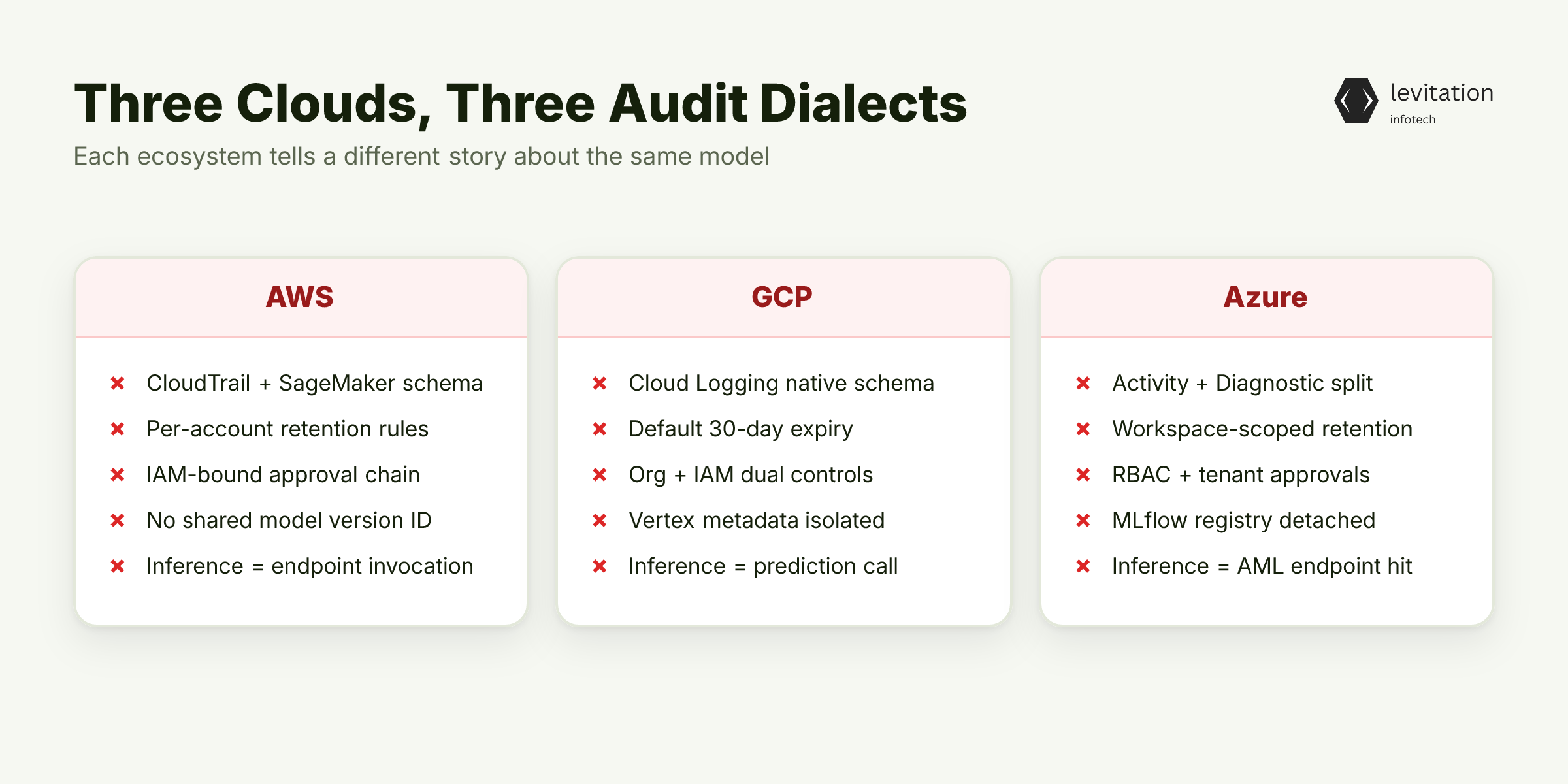
What they actually bought is three separate audit log ecosystems. Each one has its own schema. Each one has its own retention policy. Each one has its own access controls. As a result, the data lives in silos.
Consider what happens during a routine inspection. An auditor asks for a complete inventory. They want every model that touched customer transaction data in the last 90 days. Your AWS console shows one set of models. Your GCP project shows another. Azure has a third.
None of them agree on timestamps, model versions, or even what counts as "inference." - Each cloud speaks a different log dialect. - Each retention rule expires evidence on a different clock. - Each access control needs a different approval chain.
The problem isn't cloud concentration anymore. It's audit trail concentration disguised as distribution. Banks think they've reduced risk by spreading workloads. In practice, they've multiplied the evidence problem instead.
When your AI/ML training pipelines leave breadcrumbs across three clouds, the trail itself becomes a compliance liability. Cloud concentration risk fails RBI audits for similar reasons. Multi-cloud doesn't fix the underlying documentation problem.
So why hasn't the obvious fix, more logging, solved this?
Why More Logging Makes the Fragmentation Worse
The instinct is to log more. Capture everything. Store it all. If a regulator asks, you'll have the answer. But the instinct is wrong. Here's why.
Each hyperscaler sends out logs in proprietary formats. AWS CloudTrail uses one timestamp granularity. GCP Cloud Logging uses another. Azure Monitor sits somewhere in between.
When you try to reconstruct a cross-cloud incident, you hit clock-skew problems. What should be a simple timeline query turns into a forensic investigation. It spans three engineering teams.
The storage boundaries make correlation worse. Inference logs sit in one bucket. Model versioning data lives in another. Training lineage ends up in a third, if it's captured at all.
AI/ML training governance needs stitching these together. However, the buckets were never designed to talk to each other.
Here's the compliance paradox. AI models make decisions at millisecond speed. So the audit window shrinks. But the log volume explodes. Every inference produces events. Every feature lookup produces events. Every model version check produces events.
More data, less time, fragmented systems. The math doesn't work in the auditor's favor, or yours.
Banks that have been through RBI inspections know this. The auditors don't ask "do you log?" They ask "can you reconstruct?"
When the answer depends on three vendor portals with three different query languages, reconstruction becomes a manual exercise. It takes weeks to complete.
But the real damage happens in a place most CTOs don't look: the inference layer.
The Inference Audit Gap: Where Multi-Cloud AI Actually Breaks Compliance
RBI's concerns echo global regulators. The goal is to grow AI's innovation potential. At the same time, regulators want to control amplified system risks from AI speed.
Faster decisions mean faster mistakes. Faster mistakes mean audit gaps that close before evidence is captured.
The inference layer is where this breaks. Shadow models accumulate. Unapproved notebooks spin up. Off-books inference containers appear. They show up because a data scientist needed to test something quickly.
Nobody registers them. Registration needs a process, and processes are slow.
By the time RBI inspects, the AI estate has changed. Inventory drifts. The documentation regulators see doesn't match what's actually running.
Multi-model AI doubles your audit surface. Every additional model adds a tracking obligation. Most governance programs don't catch it.
Multi-cloud AI training pipelines create a second problem. They carry data residency obligations. These obligations mirror the source systems feeding them. A fraud model trained on UPI transaction data inherits the same localization rules as the core banking system.
But governance rarely keeps up with the training pipeline's reach across clouds.
The model moves between clouds for cost reasons. The data obligations don't move with it. Fintech AI stacks routinely pass internal QA only to face RBI rejection for exactly this reason.
The model works. The audit trail doesn't.
Which raises the question: what is RBI actually inspecting for?
What RBI Inspectors Actually Look for in Multi-Cloud AI Audits
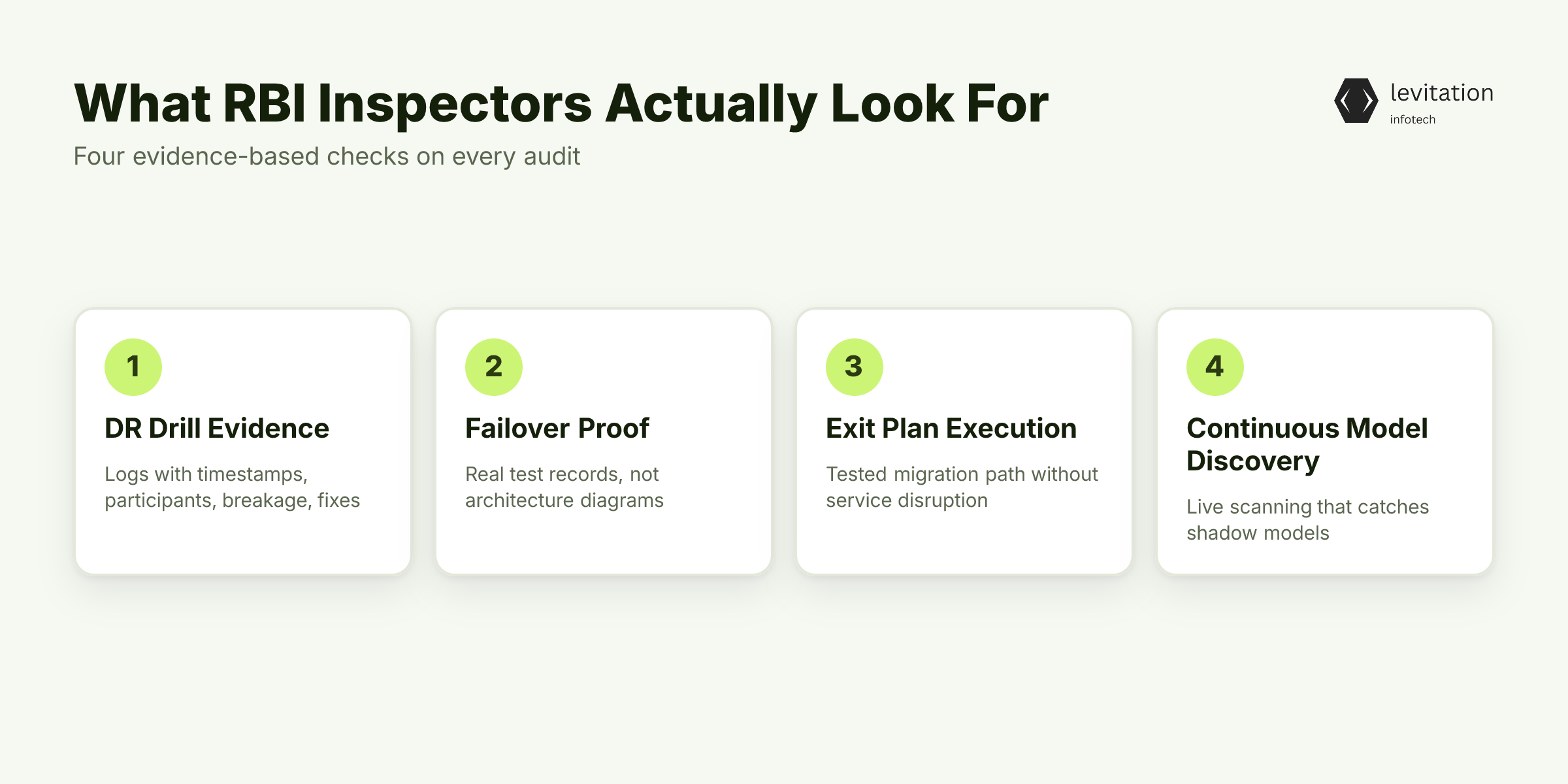
RBI inspectors don't read architecture diagrams. They read evidence. Four things show up on every checklist. Most banks fail at least one of them.
First, DR drill evidence. Inspectors want documented outputs from drills. The drills must be conducted at regular intervals. Not "we have a DR plan." They want actual drill records. Timestamps. Participants. What broke. What got fixed.
RBI looks for evidence that continuity plans function in practice. Not just that they have been written down.
Second, failover proof. Banks must not have excessive dependency on any single cloud provider. That requirement is validated by actual failover test records. Architecture diagrams don't count.
A diagram showing two clouds means nothing. A drill log showing successful traffic shift from AWS to GCP means everything.
Third, exit plan execution. Banks must have a viable plan to exit cloud services. The exit must happen without service disruption. The auditor wants evidence of execution.
Can you actually leave your primary provider? Have you tested the migration path? Paper plans don't count.
Fourth, continuous model discovery. The inventory regulators see must match reality between audits. It must not drift toward fiction. Not a quarterly review.
The discovery must be continuous scanning that catches shadow models before the inspector does.
The fix isn't another logging tool. It's a three-layer architecture. This architecture treats the audit trail as a first-class system.
The Three-Layer Audit Architecture That Survives RBI Inspection
Three layers. Each one addresses a specific failure mode that multi-cloud AI creates.
Layer 1: Normalized Event Ingestion
A pipeline pulls logs from every cloud into a common schema. Timestamps get synchronized using NTP or cloud-native time services. This way, cross-cloud correlation doesn't depend on whichever provider's clock drifts most.
The output is a single event stream. An auditor can query it without learning three vendor-specific languages.
Layer 2: Model and Pipeline Lineage
Every model version is tracked across clouds. Every training dataset is tracked across clouds. Every inference endpoint is tracked across clouds. Cryptographic hashes link outputs back to inputs. An auditor can trace a decision. They can go from a customer-facing API call all the way back to the training data.
This is critical for AI/ML training governance. It's the layer most banks skip. They skip it because lineage tracking feels academic. That is, until an inspection demands it.
Layer 3: Immutable Retention and Replay
Normalized audit data is stored in a write-once-read-many tier. The tier uses cross-cloud replication. Reconstruction during an inspection doesn't depend on any single provider's availability.
If AWS has an outage, the evidence still lives in GCP and Azure. If GCP goes down, AWS has it. The audit trail survives because it's not tied to the infrastructure it audits.
Knowing the architecture isn't enough. Here's what the first 90 days of implementation actually look like.
Implementation: From Shadow Models to Continuous Discovery in 90 Days
Weeks 1-3: Discovery
Deploy automated scanning. It should find every model across cloud and on-prem. It should find every dataset. It should find every compute instance. It should find every pipeline. Surface the shadow assets. Look for an EC2-hosted model. Look for an unapproved notebook. Look for an inference container off the books.
India's AI governance framework reinforces this discovery step. Most banks discover more AI assets than they registered.
Weeks 4-8: Normalization and Lineage
Stand up the ingestion layer. Backfill historical logs into the unified store. Map every active model to its data lineage. Map every active model to its training pipeline.
This is where the architecture earns its keep. Lineage without normalization is just more chaos in a different format.
Weeks 9-12: Immutable Retention and Mock Inspection
Deploy the WORM tier. Run a mock RBI inspection using the new system. Document DR drill outputs as required evidence, not just plans. The mock inspection usually surfaces gaps. Nobody anticipated these gaps, which is the point.
Better to find them now than during the real thing. During a real inspection, the cost of a gap is a regulatory finding. During a mock, it's just a learning exercise.
What Changes When Your Audit Trail Tells One Story
RBI inspections shift from adversarial evidence-gathering to straightforward review. The inventory matches reality. The timestamps line up. The lineage connects.
The auditor's questions land on a system that can answer them. They no longer hit three portals that contradict each other.
Incident reconstruction across clouds becomes a timeline query. You type a transaction ID. The system shows you everything. Every model that touched it. Every cloud that processed it. Every log that captured it. What used to take weeks now takes minutes.
Multi-cloud resilience finally delivers on its marketing promise. The exit plan is testable because the audit data is portable. The DR drills have evidence because the retention layer captures the drill outputs.
The shadow models get caught because discovery runs continuously. AI/ML training governance stops being a quarterly scramble. It becomes a live signal instead.
The promise of multi-cloud AI was never the problem. The audit trail was. Fix the trail, and the promise holds.
Frequently Asked Questions
What does RBI require for multi-cloud AI audit trails specifically?
RBI needs evidence that DR drills are conducted regularly. They must have documented outputs. RBI also needs proof of no excessive single-cloud dependency. This proof must be validated by actual failover records. A viable exit plan with execution evidence is also needed. Continuous model discovery must match reality between audits. The framework treats AI systems with the same data residency obligations as the core banking systems feeding them.
How does multi-cloud AI create audit log fragmentation?
Each hyperscaler uses proprietary log formats. They have different timestamp granularities. This causes clock-skew during cross-cloud incident reconstruction. Inference logs end up in separate buckets. Model versioning ends up in separate buckets. Training lineage ends up in separate buckets. Each bucket has different retention rules. Correlation during an audit becomes nearly impossible. It needs a normalized ingestion layer to work.
What is the biggest multi-cloud compliance risk for AI in banking?
The biggest risk is inventory drift. Shadow models accumulate. Unapproved notebooks accumulate. Off-books inference containers accumulate. They grow when discovery isn't continuous. By the time RBI inspects, the documented model inventory no longer matches what's running. Compliance gaps form. Amplified AI speed makes them worse.
How long does it take to build unified AI audit trails across clouds?
The three-layer architecture addresses three issues. It handles cross-cloud log fragmentation. It handles model drift. It handles evidence portability. Build scope depends on existing infrastructure complexity. It also depends on the number of cloud environments to integrate. It depends on the depth of historical logs needing backfill. A phased approach helps. Teams use discovery first. Then they use normalization. Then they use immutable retention. This lets them surface shadow assets early. It also builds toward mock inspection readiness.
About the author
Mayank Singh is a software developer at Levitation Infotech, where he builds web and AI-powered applications across the company’s fintech, healthcare, and enterprise projects.