


TL;DR: Multi-model routing reduces GPU spend. It works by routing workloads to the cheapest fit. Each model you add creates a new compliance artifact: logging format, retention rules, data residency, lineage, and provider terms. The audit surface scales as N models × M jurisdictions × K prompt types. That product grows faster than your cost savings. The fix is an orchestration layer that produces a single, uniform audit trail, not rolling back to one vendor.
Key Takeaways: - Multi-model saves GPU cost by mixing frontier APIs with self-hosted open models, but every model swap is a new compliance artifact. - Single-model isn't safer; it concentrates risk into one provider's outage, policy, and jurisdiction. - The gateway is the only viable audit substrate because it sees every request before it leaves your boundary. - Audit-first multi-model stacks are built in a defined sequence: instrument the gateway, wire workload-level telemetry, apply structured model cards, add runtime protection, sign capacity changes, and map deployer obligations. - When done right, FinOps and compliance pull from the same telemetry substrate and stop competing for engineering time.
The 40% GPU Savings Your CISO Will Hate
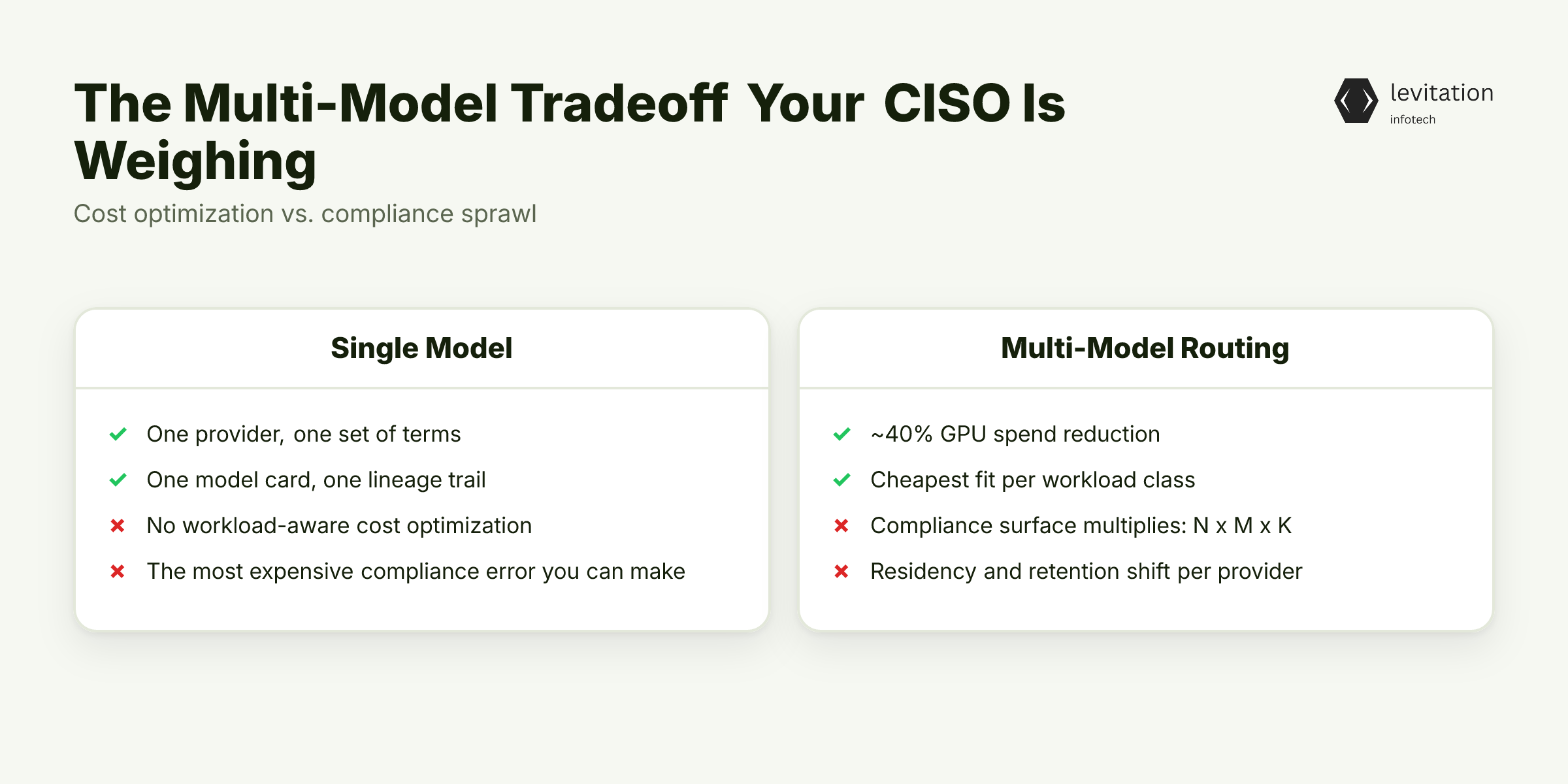
Your infrastructure team just announced a 40% GPU spend cut by routing workloads across multiple models. Your CISO is about to ask how you'll audit that.
Sedai's general availability launch showed the pattern. Their GPU optimization does not read nvidia-smi and call it a day. nvidia-smi only reports whether a GPU is active. It does not report productive inference.
Sedai pulls utilization from multiple telemetry signals at the workload level. Then it deallocates idle Kubernetes GPU resources. The before-and-after cost shows directly in the UI. That is how the 40% number holds up. Not a marketing line.
Idle allocation is the silent drain most teams never see. That is why GPU idle costs more than most FinOps tools admit.
The mechanic: multi-model routing drives those savings by mixing hosted frontier APIs with self-hosted open models. It picks the cheapest fit per workload.
A cheap open model handles bulk summarization. A frontier API handles a hard reasoning task. Idle GPUs get reclaimed. Your bill drops.
Every model swap creates a new compliance artifact you now have to govern: - Version history per provider, with its own cadence and deprecation schedule - Prompt and response logs in a provider-specific format and schema - Data residency footprint that shifts with the model you choose - Model card lineage, buried in a different PDF per vendor - Provider-specific terms of service, each with its own retention rules
The math your CISO will run: N models × M jurisdictions × K prompt types. That product grows faster than any cost line ever shrinks. For context on what the audit substrate has to absorb, the AI compliance surface area is not additive across providers. It is multiplicative. The same sprawl is why your AI strategy says three models, your engineers use eleven in the first place.
So the natural instinct is to roll back to one model. That move looks clean on paper. It is the most expensive compliance error you can make.
Why 'Just Use One Model' Is the Most Expensive Compliance Move You Can Make
Single-vendor AI is a single point of failure wearing a compliance costume. One provider outage, one policy change, one data residency shift, and your regulated workload has nowhere compliant to go. Kai Waehner makes the case that the alternative to multi-model is forcing every market through one provider's compliance envelope. That means accepting the lowest common denominator everywhere, or breaking a rule somewhere.
The obvious fix, adding models, is also the trap. Each new model brings its own logging format, retention rules, data processing agreement, and version drift. The result is not resilience. It is a fragmented audit story your regulator will not accept. Inference and transformer workloads running across mixed providers compound the problem. GPU utilization reported at the cluster level rarely matches what auditors reconstruct from request logs.
Worse, the cost reports that justified the 40% number are built on surface metrics. nvidia-smi only tells you a GPU is active. A controller pod pinning a GPU to do nothing useful still looks "100% allocated" on a cost dashboard.
The same blind spot exists at the AI/ML training infrastructure layer when you mix self-hosted and hosted models. The number your FinOps team celebrated is not the number your auditor will see.
This is the gap that LLM auto-scaling exposes at audit time. The autoscaler and the audit log disagree on what the GPU was actually doing.
The in-house build path for multi-model governance is rarely viable. Building a gateway, model card catalog, and runtime protections from scratch takes long enough. The policy mapping work across multiple regulatory regimes becomes outdated before the first model ships. Regulated workloads do not get to wait while a platform team reinvents what vendors already ship.
The teams that make multi-model AI work for compliance aren't adding more tools. They're consolidating at a layer most architectures skip entirely.
The Orchestration Layer Is Where Your Audit Trail Actually Lives
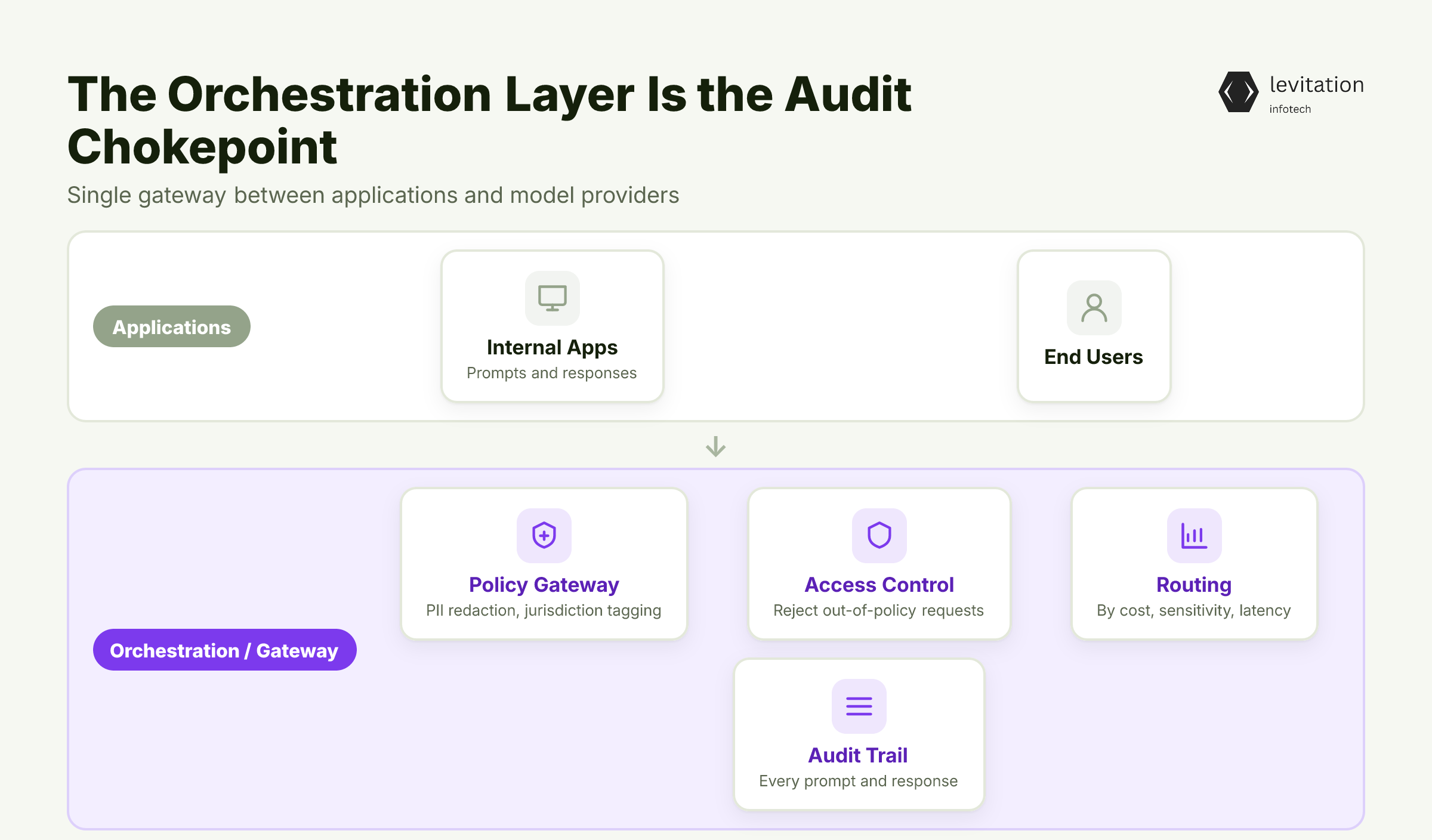
A multi-model strategy only works if an orchestration layer sits between applications and providers. It routes each request by cost, sensitivity, latency, and availability. It produces a single audit trail.
Platform analyses from firms like Liminal describe the same pattern. Governance-enabled platforms create a controlled intermediary layer. Sensitive-data protection and centralized policies run before any request leaves corporate boundaries.
The gateway is the only place where you can enforce data sensitivity rules before a prompt ever leaves your boundary. That is the actual technical control regulatory AI compliance reviewers look for.
Redact PII at the gateway, not at the provider. Tag jurisdiction at the gateway, not in application code. Reject out-of-policy requests at the gateway, not after a delayed post-hoc log review.
If you cannot see every prompt and response at one chokepoint, the rest of your compliance work is guesswork. This is the failure mode covered in governance blind spots.
Sedai's approach to GPU optimization models real utilization at the workload level. It uses multiple telemetry signals, not surface metrics. The same principle applies to audit.
Model the real request path, not the nominal one your application logs say it took. The nominal path is what your developer intended. The real path is what actually reached each model.
A quantized LLM is harder to audit for the same reason. The surface metric (model version) hides the runtime path. Which quantizer, which kernel, and which cache served the response?
Structured model cards slot into this layer. Frameworks like PASTA propose descriptive model card formats. They are designed for cross-policy compliance assessment.
A single artifact can cover EU AI Act, NIST AI RMF, and jurisdiction-specific rules, instead of a different PDF per vendor. Inference and transformer workloads running on a non-uniform card catalog quickly become un-auditable. Each provider speaks a different compliance dialect.
This is also where you split model risk management by role. Frameworks like the Duane Morris multipart model distinguish between model developers and model deployers. Model developers carry training-time obligations.
Model deployers bear the largest share of operational accountability for downstream effects. The gateway is the deployer control plane. That is where most multi-model programs are quietly failing today. The same gap shows up when an AI agent's tool call drops the audit trail entirely, because there is no gateway enforcement on the tool layer.
A minimal PASTA-style model card at the gateway:
1model_id: claude-opus-4.62provider: anthropic3jurisdictions_allowed: [US, EU, IN-non-PII]4data_classes_allowed: [public, internal]5prohibited_content: [PII-raw, PHI, government-ID]6retention_days: 307policy_articles:8 EU-AI-Act:9 article_6_classification: high-risk-no10 transparency_obligation: true11 NIST-AI-RMF:12 govern: mapped13 map: mapped14 measure: partial15 manage: partial
Knowing the orchestrator is the audit substrate is one thing. Building it without rebuilding every downstream system is the harder problem. It is solvable in a defined sequence.
Building the Audit-First Multi-Model Stack
The gateway-plus-model-card design does not force replatforming every regulatory cycle. Cards update, gateway logic updates, and the audit trail stays uniform. That is why the same architecture has held up across multiple regulatory shifts without a rewrite.
The sequence that holds up in production:
Step 1: Instrument the gateway with a structured request envelope. Every request, regardless of provider, produces one uniform audit record. User identity, jurisdiction, data class, model selected, policy decisions applied, response redacted at the gateway before logging. Auditors get a single trail. You stop pooling raw prompts across providers.
1{2 "request_id": "req_8f3a2c",3 "user": "u_441",4 "jurisdiction": "EU",5 "data_class": "internal",6 "model_selected": "claude-opus-4.6",7 "policy_decisions": ["redact-pii", "in-region-only"],8 "response_redacted": true,9 "tokens_in": 412,10 "tokens_out": 8811}
Step 2: Wire GPU utilization telemetry at the workload level, not just nvidia-smi output. Your cost report and your resource audit have to be the same number. If they disagree, an auditor will pick the one that matches the reconstructed request path. It will not be your FinOps dashboard.
This is the same principle behind why time-slicing GPUs to save 60% is an audit trap. The cost view and the audit view diverge. Only the audit view survives a regulator's review.
Step 3: Apply a PASTA-style model card to every model in the router's catalog. Each provider's compliance posture becomes queryable, not buried in a vendor PDF. A new model cannot enter the catalog without a card. The catalog is the policy engine.
Step 4: Add runtime protection in the gateway path. Runtime protection tools like Galileo's platform scan prompts and responses for harmful outputs and policy violations. This is the layer that turns a logging gateway into a control gateway. It is also the layer where AI-written infrastructure code gets audited in flight, not after the deploy.
Step 5: Configure Kubernetes GPU deallocation with cost projections surfaced in the UI. Capacity changes leave a signed record that satisfies both FinOps and audit. A deallocation that nobody can attribute to a policy decision is a deallocation an auditor will question. The Kubernetes cost dynamics under AI workloads make this signature even more important. Autoscalers churn faster than audit logs get reviewed.
Step 6: Map deployer versus developer obligations explicitly in the gateway config. California-style rules and the EU AI Act hold the deployer primarily accountable for downstream effects. Your gateway config is the place that obligation becomes visible, testable, and evidence-producing. For deeper guidance on GPU and KV cache optimization for inference, the gateway is also where cache invalidation is made auditable, not just fast.
The sequence is unglamorous and it works. Teams running it in production are seeing what audit-ready multi-model actually buys you beyond the cost line.
What Changes When Your Multi-Model Architecture Is Audit-Ready
Jurisdiction-specific routing becomes a config change, not a re-platforming project. Sensitive workloads stay in-region. Less constrained workloads route to the best-fit model. The change is one line of policy, not a migration.
Provider failover stops creating compliance gaps. The gateway logs the failover decision with the same structure as a normal request. The audit trail does not break when a provider has a bad day. Auditors see continuity, not a hole.
Regulator inquiries resolve in days. One audit trail covers every model, every region, and every policy regime. No more "let us pull logs from vendor X" cycles that take a quarter. The compliance automation and regulatory AI posture becomes provable on demand.
GPU cost optimization and AI compliance stop competing for engineering time. Both pull from the same telemetry substrate at the gateway. Your FinOps dashboards, your audit log, and your model risk register read from one source of truth. Your team stops being a router between two teams arguing about whose number is right.
The architecture also makes model risk management a living artifact. It refreshes automatically as the model catalog changes, rather than becoming a quarterly documentation fire drill.
This is the payoff that matters. Your CISO stops blocking the 40% cost cut. Your infrastructure team keeps the savings. The audit surface scales with the architecture, not against it.
Frequently Asked Questions
What counts as a 'multi-model' architecture for compliance purposes?
Any system that routes requests across more than one model provider. This includes frontier APIs, self-hosted open models, or a mix. The routing decision affects which data processing agreement and jurisdiction governs a given request. The provider count matters less than whether you have a single audit substrate across them.
How do you audit across multiple model providers without centralizing all prompt and response data?
You log a structured request envelope at the orchestration layer. The envelope includes user identity, jurisdiction, data class, model selected, policy decisions applied, and redacted response content. The gateway produces one uniform audit record per request. Auditors get a single trail. You do not have to pool raw prompts from each provider.
Does multi-model routing violate data residency rules?
Only if your router ignores jurisdiction. With a gateway that tags requests by data class and routes accordingly, multi-model architectures are often the cleanest way to satisfy data residency. Sensitive workloads stay on in-region models. Only non-sensitive workloads cross borders.
What's the difference between model risk management and AI compliance?
Model risk management is the internal discipline of cataloging, testing, and monitoring model behavior. AI compliance is the external discipline of proving that behavior to a regulator across applicable regimes.
About the author
Mayank Singh is a software developer at Levitation Infotech, where he builds web and AI-powered applications across the company’s fintech, healthcare, and enterprise projects.